
Not long ago, a coach's first season at a major college program would kick off amid measured expectations, with the focus on laying the groundwork for the future.
Those days are over. As Curt Cignetti showed at Indiana in 2024, first-year coaches can change everything about a program. The Hoosiers made the CFP in Cignetti's first season, won the national championship in his second and have not looked back.
An active coaching cycle in late 2025 placed a brighter and wider spotlight on the first-year bosses around the sport, taking over at programs such as LSU, Michigan, Penn State, Florida, Auburn, Oklahoma State, Ole Miss, Utah and UCLA. The first half of the season has brought bumps for several high-profile new coaches -- Michigan's Kyle Whittingham and Penn State's Matt Campbell faced each other last week, both searching for their first Big Ten win -- while their replacements (Utah's Morgan Scalley and Iowa State's Jimmy Rogers) have held up nicely.
The biggest first-year splashes have come in somewhat surprising spots like UCLA and Kentucky, which recorded historic wins in the first half and remain in the playoff discussion. Some first-year coaches have ridden the wave of emotion, like LSU's Lane Kiffin and Florida's Jon Sumrall, while the two new coaches in the Bay Area, Cal's Tosh Lupoi and Stanford's Tavita Pritchard, have taken their lumps so far in Year 1.
As teams reach the halfway point, let's evaluate how all the first-year coaches are performing in the Power 4.

Bob Chesney, UCLA Bruins (6-0)

What has gone right: Just about everything. Chesney conquered the offseason, convincing just about anyone that things would be different in Westwood. Then, he delivered on the field. The Bruins have won with offense, scoring a combined 151 points in wins against Cal, Purdue and Maryland. They have leaned on their defense to fluster Oregon, collecting seven takeaways in UCLA's first win at Autzen Stadium since 2004, and holding Wisconsin to seven points and 66 passing yards last week. Running back Wayne Knight and other players who followed Chesney from James Madison to UCLA have hit, as have other Bruins transfers such as linebacker Sammy Omosigho (Oklahoma) and safety Ta'Shawn James (Iowa State).
What's not working yet: The Bruins have been occasionally vulnerable against the pass, allowing 425 yards and three touchdowns to Purdue before tightening up in recent weeks. UCLA is third nationally in turnover margin (plus-1.67 per game) but has seen an uptick in its giveaways, committing seven in the past two weeks. The team also must overcome the season-ending injury to starting quarterback Nico Iamaleava and continue to build out reliable options in the passing game for backup Ty Dieffenbach.
Midseason review: UCLA has waited decades for a coach like Chesney, a natural in the L.A. media spotlight who has quickly reshaped the culture around the program. The Bruins' belief has shown up repeatedly, as they are winning games in different ways, relying on every part of their roster and continuing to buy into Chesney and his messaging. The Iamaleava injury is a significant blow and the Bruins will need some things to go their way down the stretch to continue the success, but things have certainly shifted for the better in Westwood.
Morgan Scalley, Utah Utes (6-0)

What has gone right: The Utes lost notable players and assistant coaches to Michigan when Kyle Whittingham left but haven't flinched. A top-5 offense in 2025 has a different coordinator and a brand-new starting line but ranks No. 8 nationally in scoring (40.2 PPG), No. 18 in rushing (220.2 YPG) and No. 16 in yards per play (6.8). Devon Dampier and Wayshawn Parker form one of the nation's top offensive backfields, and wide receiver transfer Braden Pegan has been a strong addition. Utah ranks No. 12 nationally both in points allowed (14.8) and rushing yards allowed (88.7 YPG). The Utes also have come out fast, outscoring its opponents 75-3 in the first quarter.
What's not working yet: There's not much to nitpick about the first half of Scalley's first season as head coach, but last week's narrow win against Colorado generated some potential red flags. Utah had three consecutive drives go inside Colorado 10-yard line but none reached the end zone, as the Utes kicked two field goals and Dampier threw one of his two interceptions. The Utes' defensive pressure numbers aren't spectacular, and they're converting only half of their fourth-down attempts. Utah ranks 75th nationally against the pass (214.5 YPG).
Midseason review: Scalley didn't face as many hurdles as other first-year coaches, having spent his entire career at Utah and preparing for years to lead the program. But his choices on the offensive staff are paying off, as coordinator Kevin McGiven is clicking with Dampier and backup Byrd Ficklin, and line coach Jordan Gross has a revamped group performing well. The defense has some room to grow, especially with the competition level getting much tougher, beginning this week with No. 14 Houston and with remaining games against No. 2 BYU and No. 25 Arizona.
Will Stein, Kentucky Wildcats (6-1)

What has gone right: Stein has translated the strong offseason vibes into immediate success, as Kentucky already has three SEC road wins and is tied with Georgia for the league lead at 4-1. His go-for-the-win decisions against both South Carolina and LSU are exactly what first-year coaches are supposed to do, and he hit on both. Kentucky is winning with key portal additions such as quarterback Kenny Minchey (Notre Dame), running back CJ Baxter (Texas) and offensive tackle Lance Heard (Tennessee), holdovers such as running back Jason Patterson and freshmen like wide receiver Kenny Darby. The offensive line is on the upswing again, and UK's defense rose up in last week's 21-13 win at Oklahoma.
What's not working yet: The defense has been takeaway-reliant, tying for third nationally with 16 in seven games. But Kentucky has been vulnerable when not creating turnovers, especially against the pass, where it ranks 116th nationally in yards allowed (249.7 YPG). The Wildcats really struggle to get off the field on third down, ranking 130th in the FBS (47.1%), and their third-down offense also has been bad, ranking 136th (29.1%). Kentucky's winning ways might be tough to sustain if the team doesn't improve on the money downs.
Midseason review: At SEC media day, Stein said that he would be the reason big wins would come to Kentucky, and he has backed up the bluster in the first half. The 37-year-old Stein is young, innovative and genuinely excited about leading the program he grew up rooting for. Kentucky has shown no fear in its SEC games and will pose challenges down the stretch, especially if it can continue making strides defensively. In a taxing league where several teams have flopped on the road, Kentucky has wins against Texas A&M, South Carolina and Oklahoma. Stein's confidence is permeating through the program in Year 1.
Pete Golding, Ole Miss Rebels (5-1)

What has gone right: The Rebels haven't backslid with Golding as their coach, especially on offense, where quarterback Trinidad Chambliss is completing 67.6% of his passes with multiple touchdown strikes in all but one game. Ole Miss handled the circus of former coach Lane Kiffin's return to Oxford and came out on top, averaging 5.8 yards per play against a talented LSU defense. The Rebels also are seeing strides with their own defense, holding Missouri to three points last week and limiting Jamal Roberts to 39 net yards on 20 carries. Ole Miss ranks No. 13 nationally in passing offense (290.7 YPG), and leads the nation in red zone touchdown percentage, crossing the goal line on 21 of 24 trips.
What's not working yet: The offense isn't as explosive, dropping from No. 3 nationally in explosive plays last season (151) to tied for 73rd (50) through the first half this fall. Golding's defense fell apart at Florida, which rushed for 305 yards and six touchdowns, and also looked shaky in the opener against Louisville quarterback Lincoln Kienholz (307 passing yards, 69 rushing yards). Ole Miss has struggled to get off the field, slipping to 117th nationally in third-down defense (44% conversions), and has at times struggled with tackling and generating pressure, recording only 11 sacks.
Midseason review: Golding had the benefit of two CFP wins after taking over for Kiffin last season, and familiarity with the program and key returnees such as Chambliss, running back Kewan Lacy and wide receiver Deuce Alexander. He landed the all-important first punch against Kiffin and, while Ole Miss had a major letdown at Florida, the team has since responded well. Ole Miss had its most complete performance against Missouri, outgaining the Tigers 498 to 378 and achieving nearly perfect balance on offense (257 rushing yards, 241 passing yards). The Rebels visit Texas this week but get most of their tougher games at home, including No. 5 Georgia on Nov. 5.
Jon Sumrall, Florida Gators (5-2)

What has gone right: Sumrall had an excellent first month, starting 4-0 behind an offense that piled up 214 points and averaged 7.6 per play. Then, after two blowout losses, the Gators pulled off a massive road win against Texas with backup quarterback Tramell Jones Jr. Offensive coordinator Buster Faulkner has been a strong addition, generating big plays for running back Jadan Baugh, wide receivers Dallas Wilson and Vernell Brown III, and others. Florida is tied for 19th nationally in plays of 20 yards or longer with 38.
What's not working yet: The Gators defense has struggled at times in SEC play, although it rebounded nicely against Texas and quarterback Arch Manning, allowing only 272 yards. Florida had no answers for Missouri's offensive backfield of Austin Simmons and Jamal Roberts in a 45-17 loss, and then really struggled against South Carolina quarterback LaNorris Sellers, who had four touchdown passes and no interceptions. The Gators also have struggled with discipline at times, tying for 123rd nationally in penalties (55) and ranking 124th in penalty yards per game (74.6).
Midseason review: The gushing over the Gators following the Ole Miss win seemed silly at the time and aged poorly in the weeks that followed. But the Texas win confirmed Florida is on the right track with Sumrall, a proven winner who needs a bit more time to build depth in certain areas of the roster. Florida's offense is on a good offensive, and Sumrall's approach and candor generally have gone over well in Gainesville. The Gators simply have more work ahead, but they already own two signature wins under Sumrall. "We have to figure out how to suck less each week," Sumrall said after the Texas win. "We're not a complete team yet."
Lane Kiffin, LSU Tigers (5-2)

What has gone right: LSU has been dominant at home under Kiffin, beating five opponents at Tiger Stadium by a combined score of 225-44. The defense has been stifling in those contests, holding Clemson to eight first downs and 140 yards, keeping Texas A&M out of the end zone and an undermanned Mississippi State team off the scoreboard entirely. Princewill Umanmielen (eight sacks, 11 tackles for loss) followed Kiffin from Ole Miss to LSU and has sparked the pass rush, along with young players like freshman tackle Deuce Geralds (five sacks). Kiffin's offense has generally clicked, as LSU ranks seventh nationally in both scoring and yards. The run game is revived behind Dilin Jones and others.
What's not working yet: The Tigers haven't won away from home under Kiffin, as the defense struggled at times against both Ole Miss and Kentucky, and quarterback Sam Leavitt and the offense haven't been quite as potent. LSU allowed 609 passing yards in the two defeats, more than it has in the five other games (569). Leavitt has been more accurate than in other seasons but also susceptible to interceptions, throwing at least one in each of the first six games.
Midseason review: The buzz around Kiffin has faded a bit since the summer and the first few weeks of the season. He has clearly generated greater balance with LSU's offense and delivered ideal results at home, but LSU's road losses to Ole Miss and especially Kentucky revealed a team that might not contend for much in Year 1. The Tigers begin a very tough stretch this week at Auburn, which just took down No. 1 Georgia, before facing Alabama (home), Texas (home) and Tennessee (road). They will need to play cleaner on defense away from home and avoid turnovers to start recording more true signature wins.
James Franklin, Virginia Tech Hokies (5-2)

What has gone right: The Hokies already have exceeded their 2025 wins total under Franklin, received strong quarterback play from Penn State transfer Ethan Grunkemeyer (1,984 passing yards, 15 touchdowns, 72.6% completions) and showcased a pressure-heavy defense, featuring Aycen Stevens (eight sacks, 10.5 tackles for loss, three forced fumbles), Cortez Harris (five sacks, eight tackles for loss), Mylachi Williams (3.5 sacks, eight tackles for loss, two forced fumbles) and others. The Hokies rank No. 11 nationally in passing (301.6 YPG) and No. 6 in sacks (23).
What's not working yet: Virginia Tech has led in the second half of every game but won only five of them, despite facing just one FBS opponent that currently has a winning record (Pitt). The Hokies are starting games well but have been outscored 56-47 in the fourth quarter, and 94-89 in the second half. Jeffrey Overton Jr. is running the ball well but the team's overall rushing offense ranks 83rd nationally (148.1 YPG) and the team is just 105th in yards per carry (3.9). Virginia Tech is just 70th in third-down conversion percentage and 95th in red zone touchdown efficiency (58.1%).
Midseason review: The record is solid and Franklin has brought good players to Blacksburg, especially from Penn State with Grunkemeyer, standout tight end Luke Reynolds and others. But the Hokies easily could be undefeated, especially given their schedule, and haven't been totally dominant in wins against Boston College and Georgia Tech. Franklin needs to see better finishes from his teams, especially since the schedule gets tougher with Clemson, No. 23 SMU, No. 1 Miami and Virginia all in the second half.
Kyle Whittingham, Michigan Wolverines (4-2)

What has gone right: The Wolverines defense has been a strength under coordinator Jay Hill, sealing the Oklahoma win in Week 2 and shining at other points in the first half. Michigan ranks in the top-15 nationally in yards allowed, pass defense and rushing defense. Defensive holdovers such as linebacker Troy Bowles have shined, as have transfers from Utah (John Henry Daley) and other programs (Chris Bracy, Memphis). Last week's quarterback switch to Tommy Carr sparked an underperforming run game and could stabilize the offense for the second half should Carr keep the job. Michigan is tied for 114th nationally in turnovers with 11, a number Whittingham emphasized must come down.
What's not working yet: The blend of Utah offensive assistants and some players with Michigan holdovers simply hasn't clicked consistently enough. Michigan had Whittingham prioritize retaining quarterback Bryce Underwood, who mostly struggled in the season's first half. Underwood hasn't fit the offense so far and needed to be benched, which happened last week. But Michigan's passing game continues to languish, ranking 131st nationally since the start of the 2024 season (159.4 YPG).
Midseason review: Michigan needed stability after a tumultuous end to 2025, and while Whittingham has been steady in his leadership, the on-field results have been erratic, beginning with the controversial opening win against Western Michigan. The quarterback switch from Underwood to Carr might spark an offense that at least should be able to run the ball effectively to complement an excellent defense. Whittingham has been here before -- thriving on defense with mixed or poor results on offense -- and will need to see complementary football during a second-half schedule that includes three top 10 opponents (No. 3 Ohio State, No. 6 Indiana and No. 9 UCLA) and Oregon.
Alex Golesh, Auburn Tigers (4-2)

What has gone right: Even before the breakthrough win over then-No. 1 Georgia, Auburn had played well for stretches, especially on defense, which propelled wins over Vanderbilt and Baylor and had held up in every game other than against Florida (44 points, 495 yards allowed). The Tigers have surrendered only six passing touchdowns, tied for 22nd fewest nationally, and have received strong performances from linebackers Elijah Melendez and Xavier Atkins (before his suspension and dismissal). Keshaun Singleton and Chas Nimrod have formed a solid receiver tandem.
What's not working yet: Before Week 7, Auburn had struggled to put together complete performances, often lagging on offense with 21 points or fewer in three of five games. Golesh brought a group of players from South Florida and the adjustment to the SEC seemed steep, including quarterback Byrum Brown, who had seven interceptions in his first four games against Power 4 opponents. The Tigers' offensive line has struggled in protection, allowing 23 sacks, most among Power 4 teams and more than all but three FBS squads. Atkins' dismissal is jarring, as he was the team's top returnee, but also seemingly an isolated situation.
Midseason review: Golesh's review would have been lukewarm, at best, before the Georgia win, but there's no minimizing what the Tigers accomplished in Athens. They showcased both their talent and mettle, rallying from 14-0 down with 24 consecutive points. Auburn is running the ball better, combining for 378 yards against Tennessee and Georgia. The team has been competitive in both losses. Golesh, a gifted recruiter, will have more talented rosters in future seasons, but he is establishing some good culture elements in Year 1.
Eric Morris, Oklahoma State Cowboys (4-2)

What has gone right: After two absolutely miserable seasons in Stillwater, Oklahoma State is fun to watch again under Morris, especially on offense with gifted quarterback Drew Mestemaker, wide receiver transfer tandem Wyatt Young and Justin Bowick, and a solid run game. The Pokes delivered the first major shocker of the season, upsetting then-No. 6 Oregon behind Mestemaker, Young and running back Caleb Hawkins. Oklahoma State ranks No. 5 nationally in yards (517.7 YPG), No. 9 in yards per play (7.2) and No. 4 in passing (329.5 YPG). The defense held West Virginia to a season-low 24 points in a road win.
What's not working yet: Morris' team has been a slow starter, especially in road losses to Tulsa and Houston, where it was outscored 14-3 in the first half of both games. Mestemaker's overall production jumps out with 1,940 passing yards and 16 touchdowns, but he also threw four interceptions in the first two games and has had only one turnover-free performance (UCF). Ball security has been an issue, as Oklahoma State's 11 giveaways are tied for No. 114 nationally. As productive as the offense has been, the Pokes have struggled to finish some drives, tying for No. 110 nationally in red zone touchdown efficiency (52.9%). They also have not forced a fumble and have only seven takeaways.
Midseason review: Oklahoma State's whiplash turnaround from a season-opening loss at Tulsa to taking down Oregon reinforced its belief in Morris, whose exciting offense and eye for talent has shown up so far. Morris brought playmakers with him from North Texas and identified other impact transfers, such as Bowick (Illinois) and linebacker Tate Romney (Arizona State), as well as holdovers like cornerback LaDainian Fields. Oklahoma State's loss to Houston might have taken the CFP off the table, but the trajectory looks good in Stillwater under Morris, who faces only one ranked team (No. 8 Texas Tech) the rest of the season.
Collin Klein, Kansas State Wildcats (4-2)

What has gone right: The coach who recruited Avery Johnson to Kansas State has unlocked solid play from the veteran quarterback, who has 10 passing touchdowns, a team-high 462 rushing yards and three more touchdowns, and is completing 63.1% of his passes, after failing to reach 60% completions in the past three seasons. Kansas State ranks No. 2 nationally in yards per carry (6.2) and No. 6 in rushing (239.8 YPG), achieving almost ideal offensive balance with more than 400 total yards in all but one game. The Wildcats have owned the second and fourth quarters, outscoring opponents by a combined score of 124-51. Kansas State's defense has excelled against the pass, ranking No. 3 nationally in yards allowed (136.3 YPG) and tying for No. 12 in tackles for loss (7.5 per game). The O-line has allowed only three sacks.
What's not working yet: Kansas State's run defense has been leaky during Big 12 play, surrendering 672 yards and five touchdowns in three games. The Wildcats are 96th nationally against the run (160 YPG allowed). They have only one interception for the season. While the offense has been generally productive, it ranks 12th in the Big 12 in efficiency and produced just 42 combined points in the first two league games. Kansas State's special teams, a hallmark under Bill Snyder, have been shaky, especially the kickoff and punt coverage units.
Midseason review: Klein was the obvious hire for Kansas State and has made his mark, especially on offense in the run game and with a talented yet inconsistent dual-threat quarterback in Johnson. The team's road loss at Cincinnati might not age well, and K-State struggled to compete at home against Houston. Klein ultimately will need greater balance from a defense that has thrived against the pass but not the run. Kansas State misses BYU, Utah and Texas Tech on the schedule, so a second-half surge could be coming.
Jimmy Rogers, Iowa State Cyclones (3-3)

What has gone right: Despite 83 newcomers on the roster and zero returning starters on offense or defense, Iowa State has held up so far. The Cyclones have a nice home win against West Virginia, and all three of their losses have come against ranked opponents. Rogers worked overtime in the portal and several defenders who followed him from Washington State have shined (linebacker Sullivan Schlimgen, edge Isaac Terrell and safety Brody Miller), but he also has developed holdovers such as running back Aiden Flora, who leads the Power 4 and ranks second nationally in yards per rush (7.6) and 13th in rushing yards (680).
What's not working yet: Other than the WVU win, Iowa State's offense has generally struggled against Power 4 opponents, while facing three strong defenses in Iowa, BYU and Utah. The Cyclones are tied for 121st nationally in percentage of three-and-outs (25.4%), 127th in third-down conversions (31%) and tied for 102nd in fourth-down conversions (44.4%). Iowa State also has struggled to pressure quarterbacks, tying for 102nd in sacks (1.5 per game) and tying for 115th in defensive pressures (53).
Midseason review: Expectations outside Ames were extremely low for Rogers' first season, as he had to reshape so much of the roster after predecessor Matt Campbell took many top players to Penn State. Iowa State has played well at home and developed standouts like Flora. Rogers, who had never coached in the Power 4 before this season, must navigate another ranked opponent this week in No. 25 Arizona, but the schedule gets a bit easier in the second half. Five or six wins would be considered a success after so many changes.
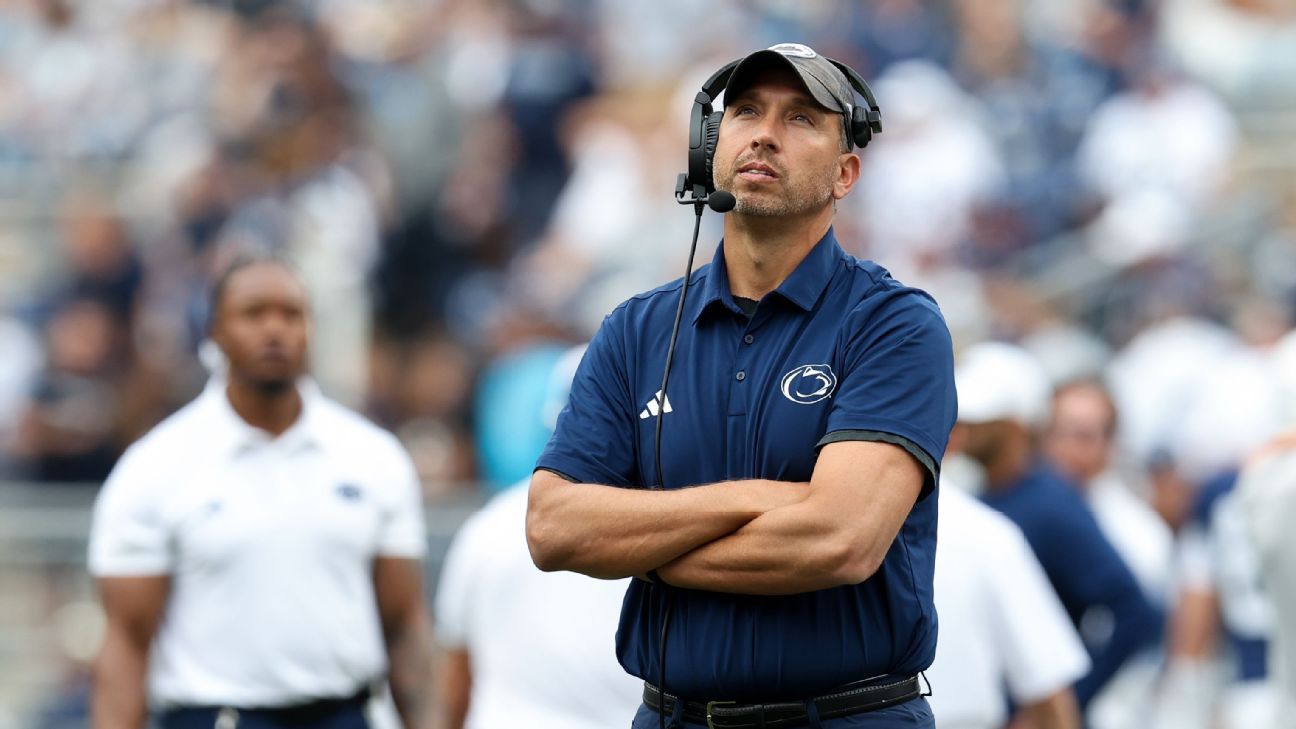
Matt Campbell, Penn State Nittany Lions (3-4)

What has gone right: Very little. Penn State surged to a 3-0 start against non-Power 4 opponents, recording 19 plays of 20 yards or longer, rising into the top-4 nationally in total defense and scoring defense, and outscoring Marshall, Temple and Buffalo by a combined score of 127-22. Wide receiver Chase Sowell has been effective, as was fellow wideout Koby Howard before his injury. Linebacker Tony Rojas has been a bright spot on defense with five sacks, two interceptions and 10.5 tackles for loss, and Penn State still ranks No. 5 nationally in pass defense (141.3 YPG).
What's not working yet: Where do we start? Penn State hasn't won a Big Ten game or established a true identity on either side of the ball. Quarterback Rocco Becht, an accomplished starter under Campbell at Iowa State, has five interceptions and only three touchdown passes. Becht also had a fumble late in the Michigan loss. He completed just 12 of 29 passes against Wisconsin. The Lions haven't helped him in the run game, failing to reach 70 yards in each of their past three games. Penn State's defense has generally limited opposing passing games but surrendered 413 rushing yards to Northwestern and 211 to Michigan.
Midseason review: Campbell brought Becht and many of Iowa State's top players to State College, where Penn State had legitimate CFP hopes with a schedule missing Ohio State, Indiana and Oregon. But the first half has been a mess and Campbell, hired to take the next steps that predecessor James Franklin could not, must find some answers quickly. Campbell often speaks about creating a foundation at Penn State and references abstract principles of building programs, but these are times -- and he's at a place -- that demands results. Penn State still can finish strong as it faces no ranked teams the rest of the season.
Tosh Lupoi, California Golden Bears (3-4)

What has gone right: Several members of Lupoi's celebrated transfer haul have hit, including rangy safety Kingston Lopa, who followed Lupoi from Oregon and has five interceptions and 31 tackles in six games. Wide receivers Chase Hendricks (Ohio) and Ian Strong (Rutgers) have been productive in an erratic offense. Cal grinded out wins against Syracuse (road) and Virginia Tech (home), and ranks No. 15 nationally in passing (288.1 YPG).
What's not working yet: The overall operation has been choppy, especially at home, where Cal already has three double-digit losses, including last week's 41-7 no-show against No. 17 Wake Forest. Lupoi has made an offensive playcaller change, moving from Jordan Somerville to Pat McCann. The decision to announce Jackson Brousseau as the starting quarterback for the Wake Forest game over an available Jaron-Keawe Sagapolutele seemed curious, at best, and the loss extinguished any good feelings from beating Virginia Tech. Cal has some decent offensive numbers but also some terrible ones, including on fourth downs, when it has converted just 5 of 18 opportunities, ranking 129th nationally.
Midseason review: Lupoi returned to his alma mater with an unassailable reputation for talent acquisition but also questions about his ability to oversee a program. The first half hasn't changed the view on either area, as a talented Cal team has underperformed on both sides of the ball. Lupoi helped bring back Sagapolutele but didn't set him up with an experienced playcaller, and then didn't play him against Wake Forest until the Bears were down 41-0. The defense has been similarly inconsistent, rising up in the Syracuse and Virginia Tech wins but breaking down against Wake Forest and late against UCLA.
Ryan Silverfield, Arkansas Razorbacks (3-4)

What has gone right: After being outscored 88-27 in its first two games against FBS opponents, Arkansas has performed much better lately for Silverfield. The Razorbacks were tied with then-No. 15 Tennessee midway through the fourth quarter before falling by a touchdown, and then pulled away down the stretch last week to beat Vanderbilt on the road. Arkansas has played its opponents about even in the second half. Chris Marshall has been one of the SEC's top wide receivers, and the defense is receiving solid performances from transfers such as linebacker Ja'Quavion Smith (Howard) and Khmori House (North Carolina), and holdover lineman Quincy Rhodes Jr.
What needs work: Silverfield's first Razorbacks roster had some clear limitations, which have shown up in areas like the run game, where Arkansas ranks No. 123 nationally in yards per game (111.6 YPG) and No. 128 in yards per carry (3.3). The Hogs haven't had a run longer than 30 yards all season. Arkansas wasn't competitive in losses to Utah and Georgia, and has struggled along the offensive line, ranking tied for 99th nationally in sacks allowed (2.29 per game) and tied for 100th in tackles for loss allowed (5.71 per game). The Razorbacks are 96th nationally in raw QBR.
Midseason review: Silverfield has some baked-in challenges with his first team, revealing last month that he had a locked-in budget for 2026 and did most of his offseason fundraising for the 2027 roster. Arkansas hasn't been set up to win for a while, which has sent the school's board of trustees into action. The Utah and Georgia games were hard to watch and Arkansas' offense lacks explosiveness outside of Marshall (14.7 yards per reception), but the recent uptick in performance suggests the players are still competing hard for Silverfield. Ultimately, he will need more talent to challenge consistently in the SEC.
Tavita Pritchard, Stanford Cardinal (3-4)

What has gone right: Stanford has played well at home under Pritchard, other than the Miami game, averaging 35 points in wins against Hawai'i, Georgia Tech and Elon. Pritchard's passing offense has been respectable, and Stanford has thrown only three interceptions on 245 pass attempts. Young wide receivers JonAnthony Hall and Zion Robinson have shown field-stretching ability, and All-ACC linebacker Matt Rose is performing well with a team-high four tackles for loss. Stanford has been fairly disciplined with the ball, committing only six turnovers (tied for 34th nationally).
What needs work: Road trips have been especially painful for Stanford, which lost at Duke, Wake Forest and Notre Dame by a combined score of 150-17. The Cardinal didn't eclipse 73 rushing yards or 164 passing yards in any game, while struggling mightily on defense. Stanford ranks 133rd nationally and last among Power 4 teams in points allowed (36.6 PPG) and 134th in yards allowed (452 YPG). The Cardinal have really struggled on third downs (33.3% conversions, No. 116 nationally) and fourth downs (42.9%, No. 108 nationally). They rank last in the ACC in scoring offense and scoring defense, and among the league's worst teams in many major categories, including sacks with just four (tied for second fewest nationally).
Midseason review: Stanford brought Pritchard back to The Farm as a long-term move, and while he wasn't the most creative hire, he will need more time and resources to get the roster in better position. The noncompetitive road losses are alarming, although they came against two AP top-20 teams and the defending ACC champion. Stanford has a lot to fix on defense, traditionally a solid unit, and must improve significantly along both lines of scrimmage. The key for the second half is to play better away from campus, as a three-game road swing looms.
Pat Fitzgerald, Michigan State Spartans (2-5)

What has gone right: The undermanned Spartans have generally competed hard, and could be 4-3 if a play or two had gone differently the past two weeks against Illinois and Northwestern. Michigan State's defensive line has received some good play from Ben Roberts, Eli Coenen and others. Quarterback Alessio Milivojevic is completing more than 65% of his passes, and Michigan State has thrived in the kicking game under elite special teams coordinator LeVar Woods, ranking No. 2 nationally in expected points added and 17th in efficiency.
What needs work: Fitzgerald's offenses really fell off during his final eight years at Northwestern, which ranked 131st nationally in both yards per play (4.8) and percentage of plays of 20 yards or longer (4.8%) during the span. The pattern has continued at MSU, which is last in the FBS in percentage of plays 20 yards or longer (3.6%) and 130th in yards per play (4.8). A season-ending injury to top running back Cam Edwards really stung, as the Spartans are just 127th in yards per rush (3.3). MSU's defense has been decent but struggles to get off the field, ranking 103rd in third-down conversions against (42%).
Midseason review: After three years off the college sideline, Fitzgerald couldn't bring a throng of players with him to Michigan State like other first-year coaches did. He inherited a limited roster that has endured several notable injuries in the first half. Although the offense has shown more life lately, Fitzgerald's teams at two stops have struggled to generate enough explosive plays. After guiding Northwestern to two Big Ten title games in three seasons, Fitzgerald is 2-20 in his last 22 conference contests.