
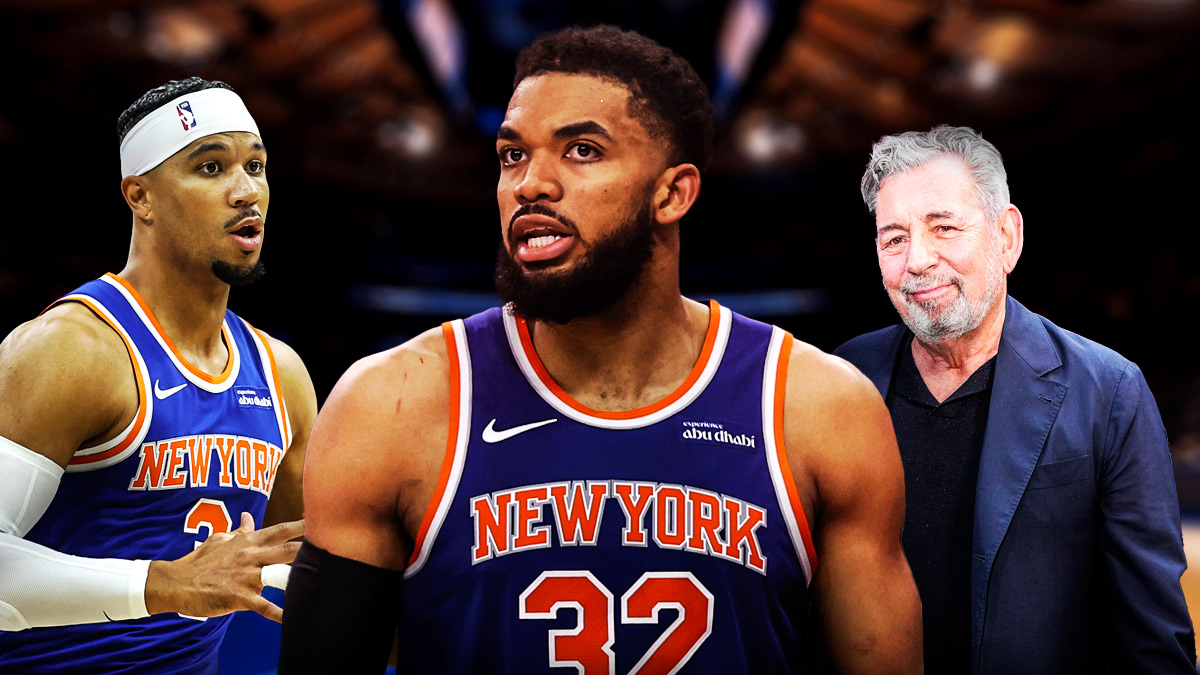
The New York Knicks have kicked off pre-season games, most recently dropping a game 111-109 to the Washington Wizards. Pre-season games are obviously about far more than the end result. But presently, the Knicks have even more to worry about than what they see from reserves and finalizing their rotation. The Knicks have to come to a solution regarding the contract of Karl-Anthony Towns, Josh Hart, and Miles McBride sooner than later—though it now looks like that won't happen before the start of the season. And the implications are big.
What's going on with Karl-Anthony Towns
New York had been negotiating with Towns, among others. Knicks leadership recently made a major announcement pertaining to negotiations:
“As an organization, our entire focus is on preparing for the upcoming season and delivering another year for our fans to be proud of,” a team spokesperson said in a statement to ESPN's Shams Charania on Friday. “As a result, we will not be negotiating contract extensions until later in the season and will remain solely focused on preparing for the start of the season.”
That's an interesting wrinkle to an already contentious back-and-forth. Ultimately, Towns is eligible to sign a four-year/276millionextension.TheKnickswanttolandclosertofour-years/200 million, which Towns feels is too low.
Hart, and to a lesser degree McBride, are stuck in limbo until Towns' situation is figured out. But there are bigger implications at play.
How does Towns' situation involve the Collective Bargaining Agreement?
While Towns' situation can be looked at individually, it is part of a larger trend that's taken hold in the recent past. The Boston Celtics famously blew up their roster after Jayson Tatum's injury against the Knicks in the 2025 NBA Playoffs. They almost immediately moved on from Kristaps Porzingis and Jrue Holiday, and Al Horford signed with the Golden State Warriors. Those moves, at least partially, influenced Jalen Brown's decision to move on, too.
Boston's moves can be interpreted as ownership preferring to avoid paying for a team in a holding pattern while they awaited Tatum's return. But the new(ish) collective bargaining agreement (CBA) and its second apron played a major role.
The second apron was ratified in 2023 and took effect in the 2024 offseason. It implemented punitive measures to deter teams from overspending. In doing so, the middle of pack players have been hurt the most. Guys like the Knicks' Bruce Brown began receiving lower offers and were forced to team hop. Max players received priority given their ability to attract fans and generate interest. Rookies are set, too, due to their being codified in the current CBA. But teams have taken a different, and less willing, approach to mid-level guys.
“The new CBA is good for certain players, right? Max guys, top free agents and maybe rookie extension guys. But other than that, like the middle guys, it kind of sucks for us,” Knicks' guard Brown recently said to reporters.
Boston isn't the only team who's fallen victim to the second apron, by the way. The Oklahoma City Thunder recently traded away a number of role players, including forward Lu Dort. And ironically, the Minnesota Timberwolves were likely motivated by avoiding the second apron when they sent Towns to New York, as well.
Article Continues BelowCan the league, in its current state, survive the second apron?
So, the new trend appears to be to paying max players, rookies, and minimum salary veterans, and to cut back on spending on mid-level guys. Realistically though, owners are using the second apron as an excuse to avoid spending beyond a certain threshold despite all-time high revenue.
On the one hand, a salary cap that does not penalize teams for spending up to $200 million with an average salary of $15 million feels more than fair. But when you consider that owners took in $13.7 billion last season—a more than 10% increase from 2024-25—the situation gets murky. And what does this trend do to player activity? Might it result in expansion, partially to answer the need for more above-average salaries? Does it prevent dynasties altogether, which is something the league was built around? Are there other reactions to the second apron we haven't even considered?
Ultimately, the impact of the second apron has been felt across the league, and it's just getting started. And the next shoe to drop will boil down to the Knicks. Do they pay to keep their championship core intact? Or do they prefer to avoid the penalties that exceeding the second apron brings with it. If it's the latter, why? Is it to remain nimble and retool on the fly? Or is to simply to derive as much profit as possible. We may never fully know the answer—but it's an interesting situation to watch unfold. And its ramifications will directly impact the Knicks and its fans as soon as this season.