



.jpeg)
.jpeg)




BYU basketball’s nightmare 2026 March Madness bracket scenarios

The 2025-2026 college basketball season has been a shaky ride for BYU, with the bumps only getting rougher as March Madness approaches. Despite being led by the nation’s leading scorer, the Cougars remain one of the most unstable teams in the field.
BYU’s season has been a tale of two halves, with the Cougars getting off to a scorching 16-1 start before going just 5-9 in their final 14 games. The tumultuous journey resulted in a 21-10 regular season record entering the Big 12 Tournament.
BYU’s poor end to the regular season exposed holes in its game against elite opponents and removed it from March Madness contention in the eyes of many. Their situation worsened when the team confirmed that sharpshooter Richie Saunders had suffered a season-ending torn ACL against Colorado in mid-February.
Losing Saunders not only took away the Cougars’ second-leading scorer but also ended the season of their emotional leader and captain. As BYU’s best shooter, hitting 37.6 percent of his threes in his senior season, Saunders’ injury also hurt the team in a way it has not recovered from.
BYU was already struggling in Big 12 play with Saunders, but the absence of his shooting further limits its offense. The Cougars averaged 86.5 points per game in their first 25 games with Saunders in the lineup, but are down to 78.1 in their last eight without him.
While Kevin Young took BYU to the Sweet Sixteen in his first season as a college basketball head coach, he finds himself backed into a corner in 2026. Having future lottery pick AJ Dybantsa gives the Cougars the potential to beat anyone in the country, but they will be one of the most flawed top-10-seeded teams in the NCAA Tournament.
Three-point line has been an issue on both ends
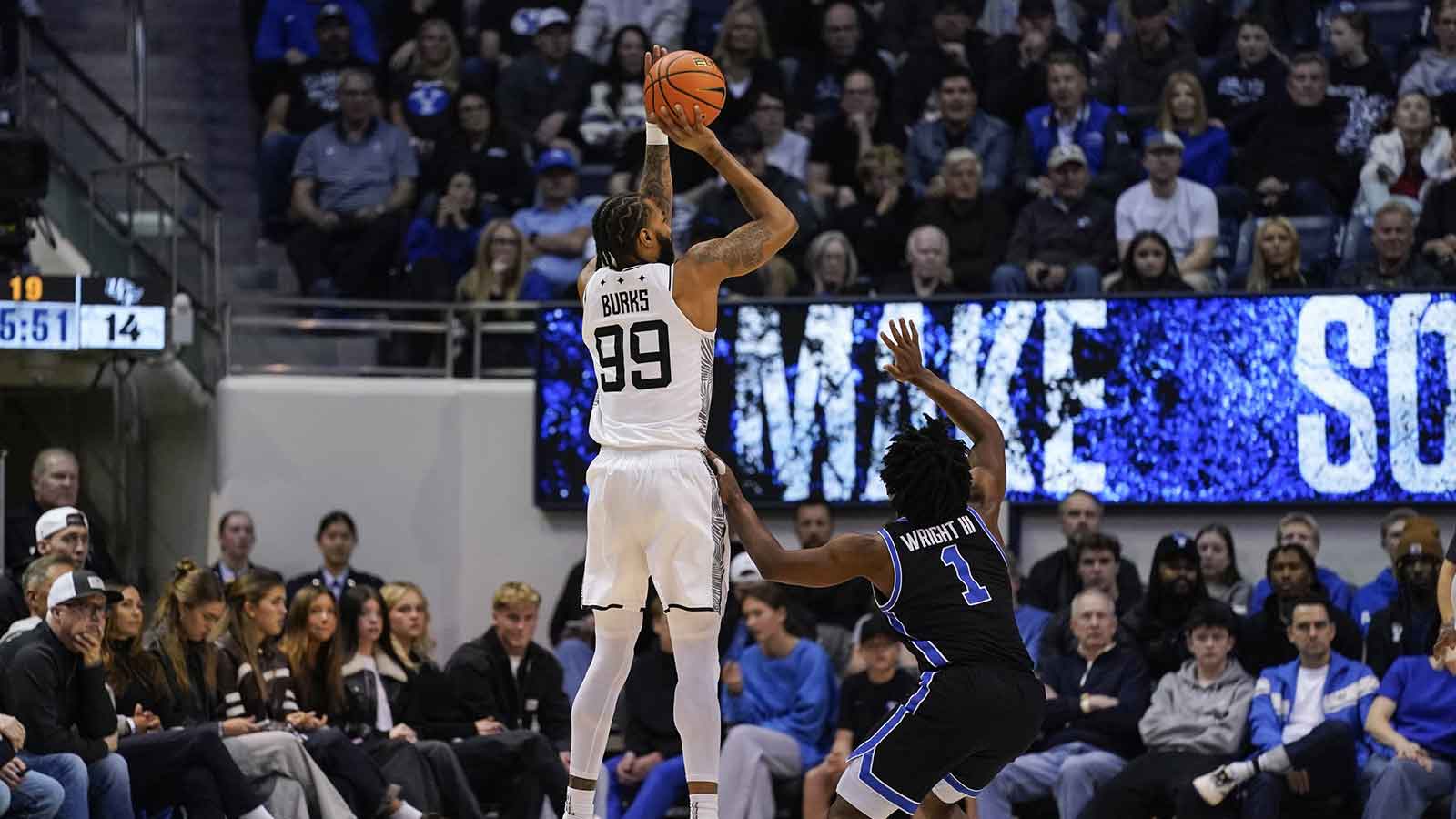
BYU was not a great three-point shooting team to begin with, but losing Saunders only magnified those struggles. The Cougars only average 25.0 three-point attempts and rank 103rd with 8.7 triples per game.
Without Saunders or Dawson Baker, who also suffered a season-ending torn ACL back in November, BYU has just two players who hit more than 35 percent of their shots from deep. Rob Wright III leads the team with a 41.4 percent clip, with backup guard Aleksej Kostic shooting 35.9 percent from downtown.
But with Wright beginning most offensive sets with the ball in his hands, BYU has no shooters to space the floor. That makes life difficult when the majority of the Cougars’ possessions revolve around either Dybantsa or Wright as a pick-and-roll ball-handler, with none of the other three players earning respect as shooters.
Dybantsa and Wright are dynamic enough to lead a high-scoring offense, but the lack of three-point shooting severely limits Young’s offense.
BYU is even worse at defending from beyond the arc, often forcing it to overcome a substantial three-point disadvantage. The Cougars allow 24.2 three-point attempts per game and 8.6 triples made per game, ranking 251st and 289th in the country, respectively.
The three-point defensive woes have shown up in recent results. BYU’s opponents have hit 9.4 three-pointers per game since Jan. 26, during which the Cougars have gone just 6-8.
The gaping holes in the Cougars’ game have been masked by upset wins over Iowa State and Texas Tech, which briefly allowed fans to forget how poorly they fared in Big 12 play. That will change in March Madness, in which BYU lacks the consistency to recognize any meaningful success.
BYU’s nightmare 2026 March Madness scenarios
BYU’s defense has been its downfall all season, but its particular struggles to defend the perimeter will have Young hoping to avoid the country’s premier shooting teams.
BYU could fall anywhere from the six to 10-seed range, likely pitting it against another middling power conference team in the first round. Teams like Santa Clara, Saint Louis, and Florida State each fall in that same range and are ranked in the top 30 from behind the arc, making them matchups the Cougars would dread in the opening round.
Potential second-round matchups against either Alabama or Louisville, which respectively rank first and third in the country in three-pointers made, would be even worse on paper.
BYU also has to pray it will avoid teams adept at defending the interior for as long as possible in March Madness. Facing Clemson or McNeese State early would put additional pressure on them. Even rematches against West Virginia or Iowa State, two teams the Cougars have already beaten, are games Young would like to avoid.
BYU can only hope to avoid landing in the same region as Duke, Houston or Arizona, which defend the paint at elite rates. Houston and Arizona each own wins over the Cougars, which would need a perfect storm to remain competitive in a postseason rematch.
However, the true nightmare scenario would come if BYU has to face a team that defends the paint at a high level as well as it hits threes on the other end. Four Big Ten programs — Michigan, Illinois, Nebraska and Purdue — fit that mold to a tee, making them the teams the Cougars least want to end up in the same bracket with.
BYU has almost too many nightmare scenarios to list out, which is never a good sign entering March Madness. They remain a threat to anyone as long as Dybantsa is on the floor, but are equally likely to return to Provo without a single NCAA Tournament victory.
The post BYU basketball’s nightmare 2026 March Madness bracket scenarios appeared first on ClutchPoints.
What's Your Reaction?
 Like
0
Like
0
 Dislike
0
Dislike
0
 Love
0
Love
0
 Funny
0
Funny
0
 Angry
0
Angry
0
 Sad
0
Sad
0
 Wow
0
Wow
0