
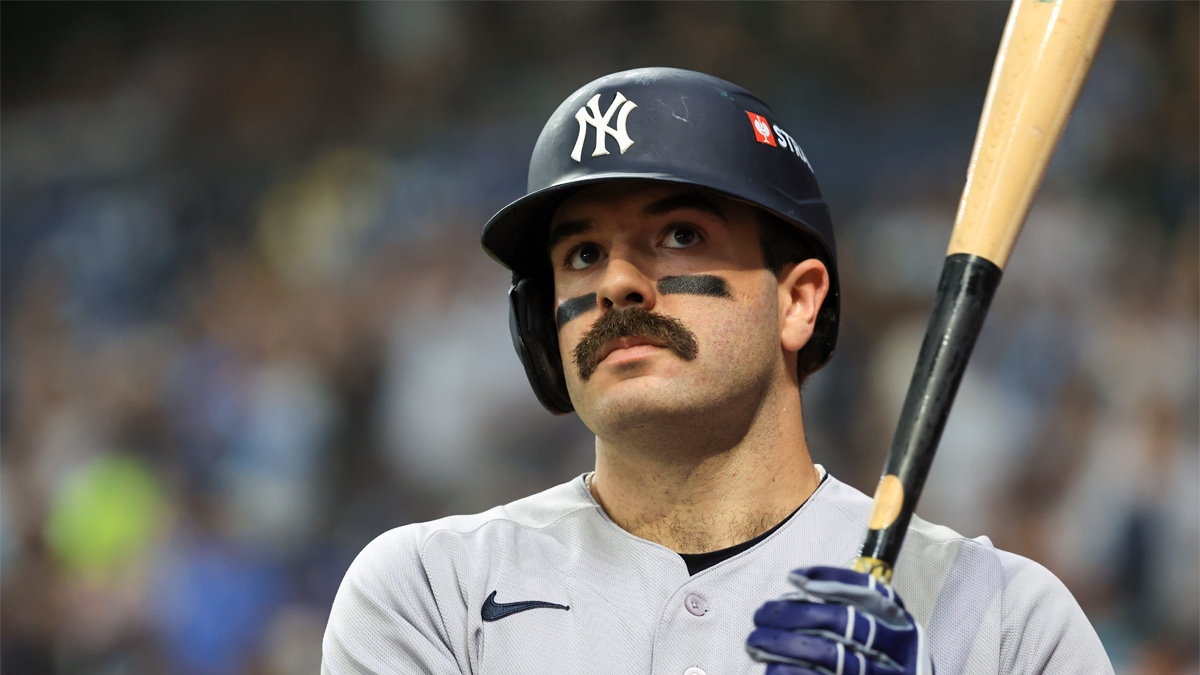
New York Yankees catcher Austin Wells attributed his disappointing offensive performance during the first half of the 2026 MLB season to repeated impacts from foul balls to his mask, Brendan Kuty of The Athletic reported Monday. The 27-year-old experienced headaches and difficulties recognizing pitches after taking two particularly hard hits in April.
The first incident occurred on April 23 at Fenway Park when Wilyer Abreu redirected a 98 mph pitch from Cam Schlittler into Wells' mask. Approximately two weeks later, Milwaukee Brewers catcher William Contreras sent a 99 mph fastball from Schlittler back into Wells' mask at American Family Field.
Although Wells remained in both games and passed concussion testing, he eventually experienced persistent symptoms that led the Yankees to place him on the 10-day injured list on June 6 with cervical headaches.
“I believe that the culmination of multiple blows to the head definitely had something going on,” Wells told Kuty on October 7. “Obviously, the headaches, the pressure that I felt in my head — it is what it is.”
Wells had a difficult opening stretch, hitting .166 with four home runs and 15 RBIs through June 6. Among 230 MLB hitters with at least 150 plate appearances through that date, his 53 weighted runs created plus (wRC+) ranked 222nd.
His monthly numbers laid bare the severity of the slump. After batting .200 with a .688 OPS in March and April, Wells hit .154 with a .436 OPS in May. His June performance deteriorated further, with a .061 average and .152 OPS before his injury-list stint.
Wells returned on June 21 and gradually improved. Although July brought limited progress, his production increased during the following two months. He recorded a .787 OPS and eight home runs after the All-Star break, compared with a .504 OPS and six homers before it.
Wells posted a 122 wRC+ across his final 46 games after August 1, finishing the season with a .186 batting average, 14 home runs, 32 RBIs and a 77 wRC+.
During his time on the injured list, Wells received vestibular training to address symptoms affecting balance, vision and related functions. He also worked with the organization's director of hitting, Jarret DeHart, to improve his swing mechanics and make contact farther in front of the plate.
Article Continues BelowThe Yankees additionally recommended replacing his traditional two-piece catching mask with a bulkier, hockey-style model designed to provide more material for absorbing impacts. Catching coach Tanner Swanson said Wells appeared to experience no further headache-related side effects after making the switch.
Though he faltered at the plate, Wells remained highly effective defensively. Baseball Prospectus credited him with 7.5 Catching Defense Added, the second-best mark in MLB, while his 6.2 framing runs also ranked second. His challenges under the Automated Ball-Strike system were worth 3.1 runs above average, placing him third among catchers.
Looking ahead, Wells is expected to remain New York's primary catcher in 2027. However, his .122 batting average across 99 plate appearances against left-handed pitchers demarcates an area requiring improvement. The Yankees could explore additional catching options to help manage his workload and address that weakness.