
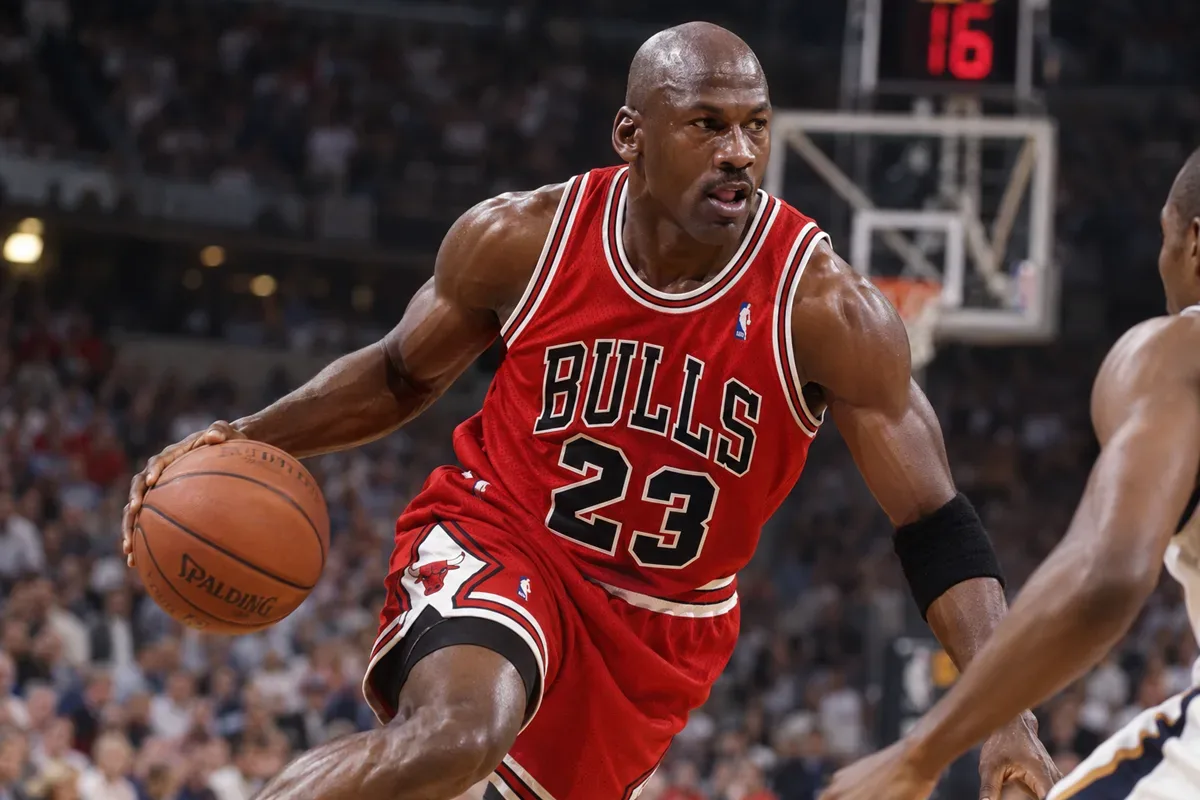
Michael Jordan’s 15-season NBA career included six championships, six Finals MVP awards, five regular-season MVP awards and a record 10 scoring titles. He led the Chicago Bulls to two three-peats, earned major defensive honours and later played for the Washington Wizards.
Jordan’s athletic scoring, two-way excellence and adaptability established his historical significance, while his Olympic appearances and Air Jordan partnership helped expand basketball’s global and cultural reach.
Michael Jordan’s career combined elite scoring, championship success, defensive excellence and a cultural reach that extended far beyond basketball.
Across 15 NBA seasons with the Chicago Bulls and Washington Wizards, Jordan won six championships, six NBA Finals MVP awards and five regular-season MVP awards. He claimed a record 10 scoring titles, earned 14 All-Star selections and became Defensive Player of the Year in 1988.
Those numbers explain part of his standing in basketball history. They do not fully explain his impact.
Jordan became the centrepiece of the Chicago Bulls dynasty that won six championships in eight seasons during the 1990s. His combination of explosive athleticism, mid-range scoring, defence and late-game shot-making gave the Bulls an advantage few opponents could solve.
At the same time, his profile helped turn an already growing NBA into a more recognisable global product. His influence crossed sport, advertising, fashion and popular culture.
For readers exploring the wider history of the league, World in Sport’s NBA coverage follows its defining players, teams and competitions, while the site’s greatest NBA players guide places Jordan’s career in a broader historical context.
Embed from Getty ImagesEarly life and basketball development
Michael Jeffrey Jordan was born on 17 February 1963 in Brooklyn, New York. His family later settled in Wilmington, North Carolina, where he attended Emsley A. Laney High School.
His development there has often been reduced to one familiar story: Jordan did not initially make Laney’s varsity team.
That episode became part of the mythology surrounding his competitiveness, but his progression mattered more than the rejection itself. He grew physically, developed his skills and eventually emerged as one of North Carolina’s leading high-school prospects.
Jordan then joined the University of North Carolina, playing under coach Dean Smith.
His first season immediately placed him on a national stage.
As a freshman in 1982, Jordan scored 16 points against Georgetown in the NCAA championship game. With North Carolina trailing late, he made the go-ahead jump shot in a 63-62 victory. It became the first defining moment of his career on a national stage.
Jordan remained at North Carolina for three seasons. He averaged 17.7 points and 5.0 rebounds during his college career and became consensus National Player of the Year in 1984.
His college career also developed habits that remained visible throughout his professional years. He played within a structured offence, defended seriously and learned to produce without controlling every possession.
Those qualities would become important after he entered the NBA.
Becoming the face of the Chicago Bulls
The Chicago Bulls selected Jordan with the third overall pick in the 1984 NBA Draft, behind Hakeem Olajuwon and Sam Bowie.
His impact was immediate.
Jordan averaged 28.2 points per game in his rookie season and won NBA Rookie of the Year. He played all 82 regular-season games and quickly established himself as one of the league’s most dangerous individual scorers.
His second season brought the first major physical setback of his professional career.
Jordan suffered a broken foot and appeared in only 18 regular-season games. Chicago nevertheless reached the playoffs, giving him the opportunity to produce one of the most famous performances of his early career.
On 20 April 1986, Jordan scored 63 points against the Boston Celtics in Game 2 of their first-round series.
Chicago lost 135-131 after double overtime, but Jordan’s 63 points established the NBA record for most points in a playoff game, a mark that still stands.
It also showed the problem opponents were beginning to face.
Jordan could beat defenders from the perimeter, attack the basket, draw fouls and create shots late in the possession. Preventing one route to the basket rarely removed the next.
Yet individual brilliance did not immediately bring championship success.
The Bulls still had to develop around him.
From scoring champion to complete superstar
Jordan’s scoring reached another level in 1986/87.
He averaged 37.1 points per game, the highest single-season scoring average of his career and won the first of what became a record 10 NBA scoring titles. NBA records list him as the league’s all-time leader in that category.
The following season demonstrated that his influence extended beyond scoring.
Jordan won the 1987/88 NBA MVP award and Defensive Player of the Year in the same campaign. He averaged 35.0 points while becoming one of the league’s most disruptive perimeter defenders.
His defence relied heavily on anticipation and aggression.
Jordan attacked passing lanes, pressured ball-handlers and used his speed to turn defensive possessions into immediate scoring opportunities. At his best, he could influence both ends without reducing his offensive workload.
His teams were improving as well.
Scottie Pippen and Horace Grant developed into important contributors, while coach Phil Jackson introduced an offence built around greater movement and shared responsibility.
That evolution helped move Chicago away from relying almost entirely on Jordan to create every decisive play.
The results soon followed.
The first championship three-peat
Chicago entered the 1990/91 season with Jordan already established as one of basketball’s leading players.
What remained missing was an NBA championship.
The Bulls finally crossed that threshold in 1991.
Jordan averaged 31.5 points during the regular season, won his second NBA MVP award and led Chicago through the playoffs before the Bulls defeated the Los Angeles Lakers in five games in the NBA Finals.
Jordan won Finals MVP.
Chicago then successfully defended the title in both 1992 and 1993.
The Bulls beat the Portland Trail Blazers in the 1992 Finals before overcoming the Phoenix Suns in six games a year later.
Jordan collected Finals MVP after each series, giving him three championships and three Finals MVP awards in three seasons.
He had also become part of another important chapter in basketball’s international development.
Jordan played for the United States at the 1992 Barcelona Olympics as part of the team widely known as the Dream Team.
The United States finished 8-0 and defeated Croatia 117-85 in the gold-medal game. Jordan therefore added a second Olympic gold medal to the one he had won as an amateur in 1984.
The Barcelona team brought together many of the NBA’s most recognisable stars at a time when international interest in the league was expanding rapidly.
Jordan stood at the centre of that visibility.
Embed from Getty ImagesRetirement and baseball
Jordan’s career then took an unexpected turn.
In October 1993, at the age of 30, he announced his retirement from basketball.
He moved into professional baseball and joined the Chicago White Sox organisation. Jordan spent the 1994 season with the Birmingham Barons, Chicago’s Double-A affiliate.
The move interrupted what had been the dominant period of his basketball career.
It also created one of the defining questions surrounding his career: could Jordan return after almost two years away and still operate at the same level?
The answer came in 1995.
Jordan returned to the Bulls late in the 1994/95 season. Chicago reached the Eastern Conference semi-finals but lost to the Orlando Magic.
It was the only playoff series Jordan lost between the Bulls’ 1991 championship breakthrough and his second retirement after the 1998 Finals.
That defeat helped shape Chicago’s next phase.
The second Bulls dynasty
The Bulls returned in 1995/96 with a reshaped squad that included Dennis Rodman alongside Jordan and Pippen.
Chicago then produced one of the outstanding regular seasons in NBA history.
The Bulls finished 72-10, while Jordan averaged 30.4 points and won another scoring title. He also collected his fourth league MVP award.
Chicago defeated Seattle SuperSonics in six games in the Finals.
Jordan won Finals MVP for the fourth time.
The Bulls repeated in 1997, defeating the Utah Jazz.
Game 5 became one of the most remembered performances of his career.
Jordan played despite illness and scored 38 points as Chicago won 90-88 in Utah. The victory gave the Bulls a 3-2 series lead before they secured the championship in Game 6.
The episode is usually called the “Flu Game”, although the precise cause of Jordan’s illness has been debated subsequently. What can be established is that he was visibly unwell and still played 44 minutes in a pivotal Finals victory.
Chicago entered the following season chasing a second three-peat.
Jordan was 35 by the time the 1998 Finals arrived, but he remained the Bulls’ primary scorer and late-game option.
Game 6 against Utah produced perhaps the most recognisable sequence of his career.
With Chicago trailing 86-83 in the final minute, Jordan scored on a drive to reduce the deficit to one point.
He then stole the ball from Karl Malone.
At the other end, Jordan created separation from Bryon Russell and made a 20-foot jump shot with 5.2 seconds remaining.
Chicago won 87-86 and claimed its sixth championship in eight seasons.
Jordan scored 45 points.
He also won a sixth Finals MVP award.
For several years, that shot appeared to be the final field goal of his NBA career.
What made Jordan so difficult to defend?
Jordan’s early career depended heavily on explosive athleticism.
He attacked from the perimeter with speed, changed direction quickly and had exceptional elevation around the basket.
That made his first step particularly dangerous.
Defenders who allowed him space risked conceding a jump shot. Those who moved too close could be beaten off the dribble.
His game then evolved as he aged.
Jordan became increasingly reliant on footwork, balance and mid-range shooting. His turnaround fadeaway became especially important during the second Bulls three-peat.
Rather than challenge defenders only with speed, he learned to create separation from the post and mid-post.
That adaptation allowed him to remain an elite scorer after some of his earlier explosiveness had declined.
Jordan was also a strong rebounder for his position and an effective passer when defences committed multiple players towards him.
His career average of 5.3 assists shows he could create for others, although Chicago’s structure did not always require him to operate as a conventional point guard.
Defensively, Jordan combined lateral quickness with active hands and anticipation.
The Defensive Player of the Year award in 1988 reflected that part of his game, while his nine All-Defensive First Team selections show it was not confined to a single season.
Career statistics and honours
According to Basketball Reference, Jordan played 1,072 NBA regular-season games across 15 seasons. He averaged 30.1 points, 6.2 rebounds and 5.3 assists while shooting 49.7 per cent from the field.
| Career achievement | Total | Context |
|---|---|---|
| NBA championships | 6 | 1991, 1992, 1993, 1996, 1997 and 1998 |
| NBA Finals MVP awards | 6 | Won in every Bulls championship season |
| NBA MVP awards | 5 | 1988, 1991, 1992, 1996 and 1998 |
| NBA scoring titles | 10 | NBA record |
| NBA All-Star selections | 14 | Across his Bulls and Wizards career |
| All-NBA First Team selections | 10 | Part of 11 total All-NBA selections |
| All-Defensive First Team selections | 9 | Also won 1988 Defensive Player of the Year |
| Olympic gold medals | 2 | 1984 and 1992 |
Statistics and honours are complete through the end of Jordan’s playing career in 2003. His Basketball Hall of Fame record confirms six championships, six Finals MVP awards, five league MVP awards and 14 All-Star selections.
Washington Wizards comeback
Jordan retired again after the 1998 championship.
He later became involved with the Washington Wizards’ basketball operations before returning to the court in 2001.
This phase of his career was very different from his years with Chicago.
Jordan was 38 when the 2001/02 season began. The explosive athletic advantage that had defined his younger years was no longer the centre of his game.
He relied more heavily on positioning, footwork and shooting.
Jordan nevertheless averaged more than 20 points per game during each of his two seasons in Washington. He also appeared in the 2002 and 2003 All-Star Games.
The Wizards did not reach the playoffs during his comeback.
That means the Washington period sits apart from Jordan’s championship legacy in Chicago. It did, however, extend his career into a third distinct phase and provided a final demonstration of how far he had adapted from the explosive guard who entered the league in 1984.
Jordan played his final NBA game in April 2003.
He finished his career with 32,292 regular-season points.
Records, achievements and historical context
Jordan’s career statistics remain striking even when separated from the championships.
His 30.1 points per game across 1,072 regular-season appearances remain the highest career scoring average in NBA history.
His 10 scoring titles remain the league record.
His 63-point performance against Boston remains the highest-scoring individual game in NBA playoff history.
He also produced unusual two-way achievement at his peak.
Winning a scoring title and Defensive Player of the Year in 1987/88 demonstrated the range of his influence during that period.
Most importantly for Chicago, individual production repeatedly translated into post-season success.
Six trips to the NBA Finals during the Bulls’ championship era produced six championships and six Finals MVP awards.
Those results remain central to Jordan’s place in debates about basketball’s greatest players, although comparisons across eras inevitably depend on how much weight a reader gives championships, longevity, peak performance and statistical production.
World in Sport examines those different measures in its wider greatest NBA players discussion.
Global influence beyond the court
Jordan’s sporting legacy cannot be separated from his wider cultural influence.
His partnership with Nike helped transform athletic footwear into a major lifestyle market.
The Air Jordan brand became closely associated with basketball culture but eventually extended far beyond the sport.
That visibility coincided with the NBA’s international expansion during the late 1980s and 1990s.
The Naismith Memorial Basketball Hall of Fame notes the combination of his on-court career and wider influence when documenting his 2009 induction.
Basketball itself changed as well.
Later generations of perimeter players studied Jordan’s footwork, post game, fadeaway and approach to isolation scoring.
His influence is visible not because every later guard copied him directly, but because skills once associated primarily with larger players became central to elite wing scoring.
Embed from Getty ImagesMichael Jordan’s legacy
Michael Jordan’s career contains several distinct versions of the same player.
There was the explosive young scorer who entered the NBA and immediately transformed Chicago’s attack.
There was the complete two-way superstar who won MVP and Defensive Player of the Year.
Then came the championship leader whose Bulls won three consecutive titles before his first retirement.
After returning from baseball, Jordan changed again. He relied more on footwork and controlled mid-range scoring while leading Chicago to another three championships.
Finally, his Washington comeback showed an older player operating without the physical advantages that had once defined him.
That evolution matters when assessing his career.
Jordan did not dominate only because he could jump higher or move faster than opponents. His longevity at the top of the sport depended on developing new ways to score, read defenders and control possessions.
His six championships remain the most visible part of the record. But they sit alongside five MVP awards, 10 scoring titles, elite defensive recognition and defining performances spread across more than a decade.
Jordan was inducted into the Naismith Memorial Basketball Hall of Fame in 2009.
More than two decades after his final NBA appearance, his career remains one of the central reference points in discussions about scoring, championship performance, two-way excellence and the worldwide growth of basketball.
That continuing relevance is perhaps the clearest measure of his sporting significance.

World In Sport Forum
Continue the discussion
Join other fans in the World In Sport Forum and debate the biggest talking points from this article.