
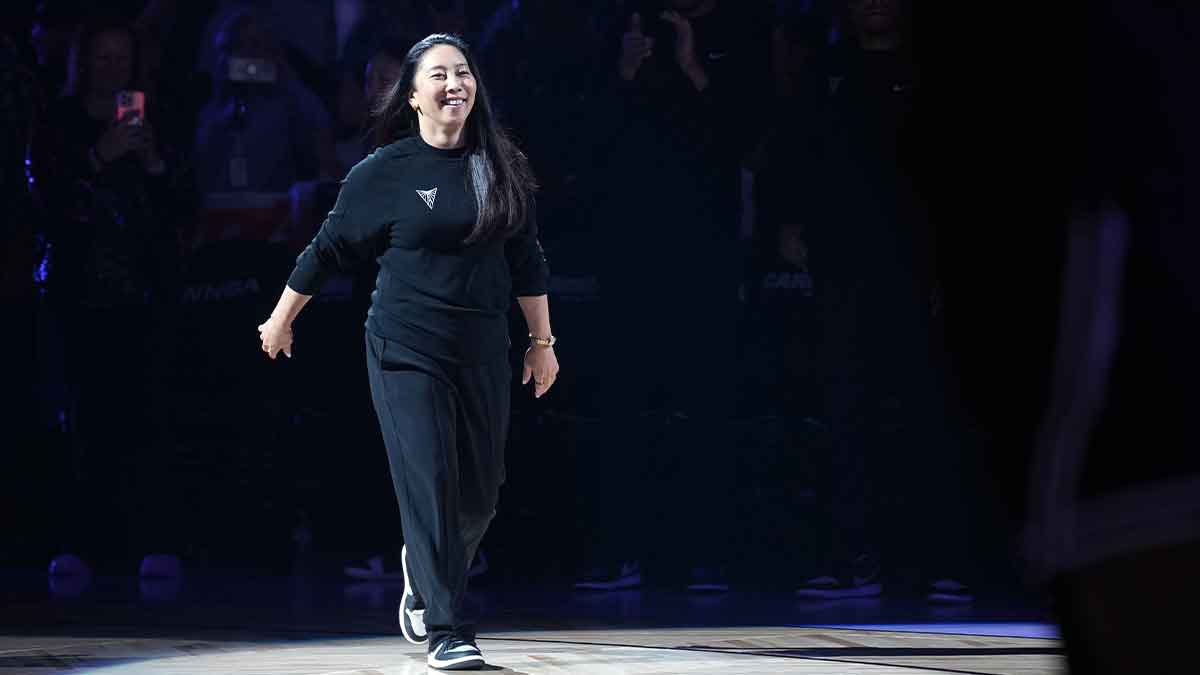
SAN FRANCISCO – When you sit down for a talk with Golden State Valkyries head coach Natalie Nakase, the first thing you notice is her eye contact.
“Where do you want to sit?” I asked the second-year head coach as we hovered around a room with far too many chairs and subsequently far too many options spatially for how we could conduct this interview.
“Here,” Nakase said, pointing at two chairs parked slightly away from the pack. “I want to talk face-to-face.”
Makes sense, I think to myself, based on the two seasons I’ve covered Nakase and the Valkyries. We drag the chairs into the center of the room, arrange them directly across from each other, and sit down. The one-on-one has begun.
The first thing I process, as I match Nakase’s eye contact and explain to her how I’m working on a story about her coaching roots overseas in Japan with the Tokyo Apache, is how equally open and intense this interview feels.
Sitting across from each other, there’s an element of opposition created by talking face-to-face. Especially given how our jobs — head coach and beat reporter — naturally clash at times. But simultaneously, Nakase’s vibe doesn’t feel adversarial. Face-to-face, you can get a better sense of the presence emanating from the person across from you.
With her unflinching eye-contact, the tilt of her head, the nodding, Nakase projects an energy of care and attention, even though she was 48 hours removed from a 13-and-a-half hour flight from Berlin, “running high on adrenaline” when I spoke with her.
This is the approach Nakase takes. It is direct, and it is steadfast. There are no illusions with Nakase, and to use a phrase she’s used in the past: “No BS.”
And this is what it feels like to be the recipient of Nakase’s approach – clarity. Then ever so subtly, Nakase takes hold of the conversation, and I find myself, the interviewer, the one being asked a question.
“How come you’re doing that story?”
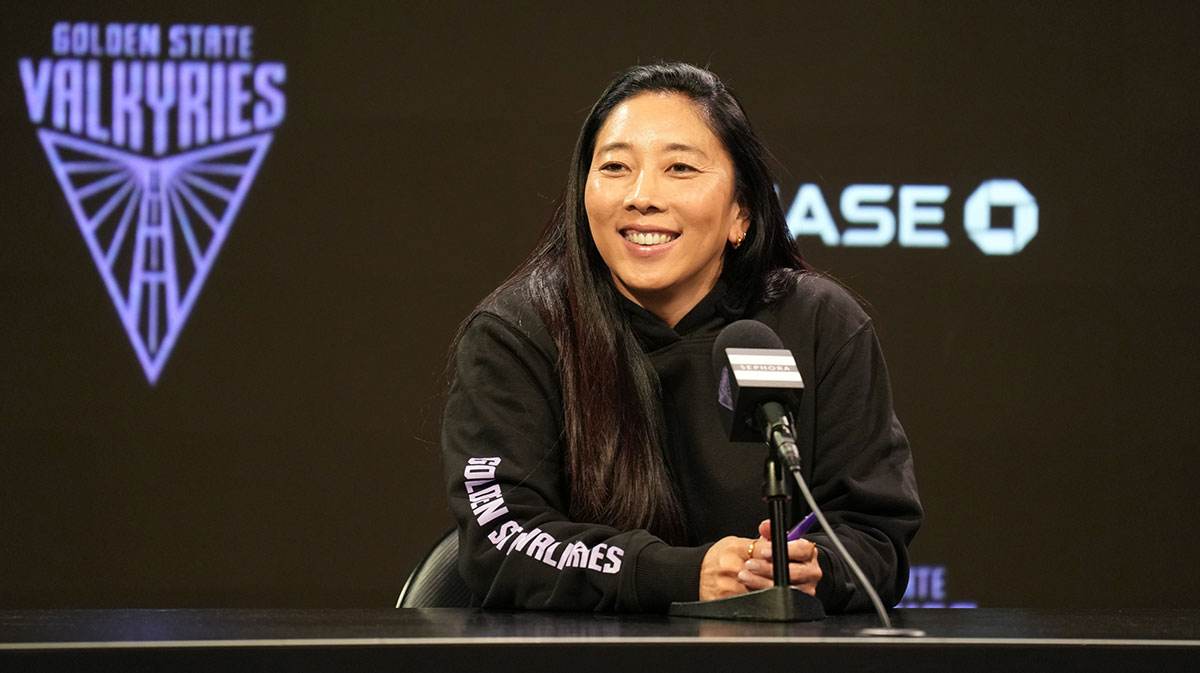
The Tokyo Apache and the roots of Natalie Nakase’s coaching
That story, of Nakase becoming a volunteer assistant coach of the Tokyo Apache under the tutelage of the highly respected coach Bob Hill (well documented in Kate Fagan’s ESPN feature) are her roots.
So, answering Nakase’s question, I wanted to dive back into her time with the Apache because to get a better sense of how she’s been able to accomplish what she’s been able to accomplish with Golden State 16 years later. How her origins turned her into who she is today.
And not just the history she’s achieved guiding the Valkyries to two straight playoff appearances and a 55-35 record, but also the reputation. “A player’s coach,” “a basketball junkie,” “a fiery competitor,” and “relentless work ethic” – Nakase is talked about in basketball circles in the highest regard. And when you dive into her time in Japan, you start to understand why.
Because when Tokyo Apache guard Darin Maki, a close friend of Nakase’s from when they grew up in Orange County together, introduced her to Hill and the team, she came to practice every single day, with the mindset that she was going to keep showing up until they told her not to.
And they never did. The scouting reports she compiled, the extra rebounding in practice she provided, the insight she gave each of the players, all while crashing on Maki’s couch at his apartment in between, Nakase made herself indispensable to the Apache.
But for Casey Hill, son of Bob Hill and an accomplished professional basketball coach in his own right who was on the Apache staff with Nakase and later the Los Angeles Clippers, the memory that’s burned into his head is her competitive fire.
“The thing about Nat is, she played, and she can really shoot a basketball. But she never really talks about it,” Hill told ClutchPoints, recounting that year working together in Tokyo.
“She kind of got pulled into a shooting drill with one of our guys one day down in the depths of Tokyo, and she ended up not just beating him, but kicking his butt in a shooting drill, and I was like, ‘I didn't know.’ I was blown away. Half the gym was, like, blown away. The only guy that really knew was Darin Maki.”
And that wasn’t the only example. Though Maki only half-remembered Nakase dismembering one of his teammates in a shooting drill, he did recall how she regularly beat them at “Horse.”
“When we played horse, she already knew she was gonna beat us and how,” Maki laughed.
Maki and the other Apache players went about trying to beat Nakase like how many would in a game of Horse, by attempting the flashiest, hyper-athletic, high-degree-of-difficulty shots. Shots that they didn’t believe she could make. But Horse isn’t about who can make the wildest trick shots. It’s about who’s the best at making the shots they are the best at making.
So Nakase went a different route, taking shots four-to-six feet from the rim and call “all net.” Simple and far from the trick shots you’d see on SportsCenter, but highly efficient and consistent. Death by a thousand paper cuts.
“She’s just hitting them,” Maki recounted. “Over time, we're all falling off because she — that's what she does, you know. So I feel like the things that she's been through to get to where she's at, like she's always gonna be prepared.”
Understanding her father better
There was another reason why I wanted to dig into Nakase’s origins with Tokyo Apache. It’s not lost on me, a Japanese-American, that Nakase became the first Asian American head coach in WNBA history, and only the second one in basketball history after Erik Spoelstra.
And while it’s the duty of a journalist to be objective and separate one’s personal feelings from their subject, I can’t ignore the poetic element of Nakase going to the country where her family immigrated from to re-realize her dream and get her start in achieving it.
Article Continues BelowIt strikes a familiar chord as a Japanese-American. Because it’s a surreal and existential experience when you visit to the motherland.
Because of the complicated history between Japan and the United States, who were at war with each other less than 90 years ago, there’s a distinct disconnect between the generation that immigrated to America, the Issei, and the ones that were born here, the Nisei, subsequently creating a cultural diffusion thereafter as the next generations assimilated to American culture.
As a result, there are things you recognize and things you don’t. Things you feel detached from but feel like you shouldn’t be detached from. Like language – I can’t speak Japanese. Nakase similarly said she can hardly believe she was able to communicate with her family when she was in Japan because they barely spoke English.
However, you do realize things about your family that you wouldn’t have realized otherwise. Like looking under the table and finding the missing pieces of a puzzle. For Nakase, that was learning about her father and his family.
“Me being a Japanese American, and learning about my culture, I'm like, now I see why my dad's crazy,” Nakase said, who has talked often about her father’s strict parenting helping to instill her work ethic.
“If you ever go to the country, it's super efficient. People (there) work extremely hard. And it actually gave me a sense of ‘Now I understand my dad, because he never let me be mediocre. It was always high standards. It was always work beyond your limits, and have pride in that. I got a nice, comfortable feeling of accepting my dad in a different way.”
But it was more than just experiencing Japanese culture that gave her a deeper understanding of her father. In Japan, Nakase met her second cousin in Wakayama. There, she learned that their grandfather built and ran a plant nursery and realized he passed down his trade to her father, who founded Nakase Brothers Wholesale Nursery in 1965.
“The coolest thing I found out about my grandfather… was that he was the hardest working man that he’d ever known. And so I'm like, well, no shit, my dad is the hardest working man that I've ever known. So it was really cool to see that my dad just didn't come out of nowhere. He worked because of his father, and then obviously my dad poured his work ethic into me.”
“And just to see that we take pride in (working hard). Being a Japanese American, we're prideful of it, and it's just kind of our culture. But instead of people kind of running away from it, I embrace it, and it makes me feel like I'm not weird because I think people might think I'm weird because I'm so obsessive about what I love to do.”
“Being clear is being kind”
It didn’t surprise me that my one-on-one with Nakase became less of an interview and more of a conversation. Other journalists around the Valkyries beat have said that talking to Nakase one-on-one feels like a genuine and earnest back-and-forth. But it was illuminating in how she engages players.
Maki described Nakase as a “very curious” person, which is something that Hill says extends to her off-the-court life.
“She's very inquisitive. She asks questions all the time,” Hill said. “She likes to hear other people's opinions, and think about them, and she takes notes. And if she's not thinking about basketball, she's probably asking someone about an opinion on something, whether it's basketball-related or not.”
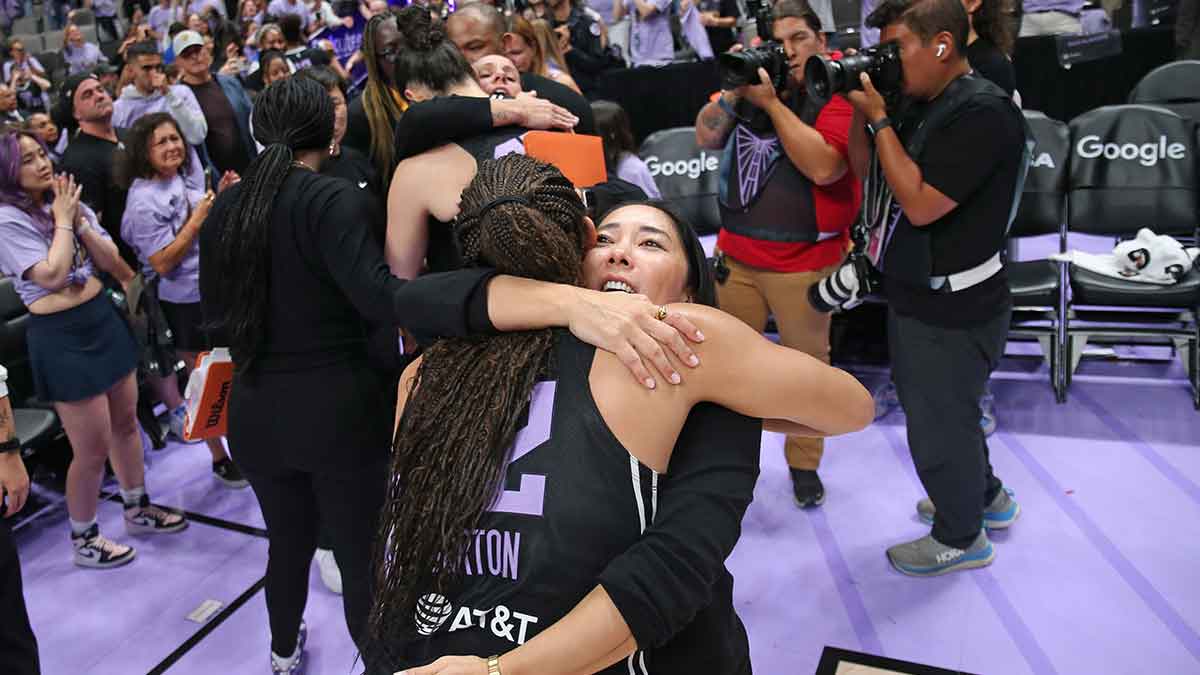
It’s a style and a personality that resonates with players because questions get at the root of how she can engage them, whether that’s from a basketball standpoint or a personal standpoint. It’s a direct, head-on approach. And for Valkyries head video coordinator Daisy Feder, whom Nakase coached and worked out in her college days, being clear is the fastest way into a players’s heart.
“I always say, ‘Being clear is being kind,’” Feder said. ”Everybody wants to know exactly what you expect from them and how you want to perform,” Feder said. “So her ability to do that back then and now, it shows in our players and how hard they compete. They'll run through a wall for her, for each other, and they know what is being asked of them.”
It really is that simple, according to Nakase.
“Just ask them. That’s really the secret,” Nakase said, one she learned from when Bob Hill invited the entire team over for karaoke.
“I remember during Thanksgiving, which wasn't a big holiday in Japan, he had everyone over, and we did karaoke. With Japanese people who are very shy. And so it just showed he cared about them beyond the basketball court. We just had the best time. I've never had as much fun singing karaoke and just bringing people together. And what it showed was you have to give people time. That's where I learned: that giving people your time is the most important thing to people.”
That is the core of Nakase’s coaching philosophy, one founded in her time with the Tokyo Apache and one that is distinctly her own.