
Week 4 is in the books, bringing us another round of fantasy headlines. These are the 10 takeaways you need to know heading into Week 5.
1) Nothing going right in Philly
The Eagles’ problems are twofold. They’re bad on early downs. And they’re bad on late downs. If they just fix both of those issues they can turn the season around. After removing garbage time, the Eagles are the fifth-most run-heavy offense on first and second down, taking the air out of the football on 51.9 percent of their plays. In theory, this makes sense. They are the 14th-best team at running on early downs. In practice, they are still averaging -.07 EPA per play on early down runs, because that’s simply an ineffective way to start drives. Passing more on early downs wouldn’t fix the issue, though. They are averaging a slightly better EPA per play when passing, but that number is still in the negative and ranks 24th among all teams. Because they can’t run or pass on early downs, Philly needs eight yards on average to move the chains on third downs, a bottom-five mark this year.
This puts Jalen Hurts in an obvious passing situation, and he has never excelled in that area. Even during his peak (2022-2024), Hurts had an average first-down conversion rate on third and long. He was below-average in both interception and sack rate on third and long. This year, he has more interceptions plus sacks than first downs on third and long. Philly ranks 29th in EPA per play on these plays. The lack of pass-catching talent is exacerbating this issue, but it was lurking in the background even when the team had A.J. Brown and DeVonta Smith. I’m not sure there is a fix for this catastrophe during the season.
2) Ben Johnson does it again
The Bears were forced to start Case Keenum two weeks ago and dialed up a pass-first offense that put the Eagles in a blender. First snap aside, they went to Tyson Bagent in Week 4 and played an old-school, bully ball game against the Jets. It worked.
The Bears had 34 first downs today. The Jets had 32 plays.
— Benjamin Solak (@BenjaminSolak) October 4, 2026
This is only the second game in the Super Bowl era (since 1966) in which a team had more first downs than its opponent had plays, per ESPN Research.
Kyle Monangai led the way with 30 carries for 146 yards and two scores. D’Andre Swift pitched in for 15 carries and Roschon Johnson even got four rushes. With 54 team rush attempts, it was the most carries in a game by an entire team since 2013. Caleb Williams won’t play in Week 5, meaning Bagent will draw another start. The Bears are preparing to take on a Green Bay defense that ranks bottom-10 in both run and pass defense. They have faced a -3% pass rate over expected this year, the eighth-lowest mark in the league. I’m expecting another heavy dose of the ground game on Sunday.
3) T-Mac explodes versus Detroit
Jalen Coker was out in Week 4 and the Panthers offense ran entirely through Tetairoa McMillan. He saw over 40 percent of the team’s targets and air yards. The rising star turned that into 14 catches for 192 yards and two scores. His 45.2 PPR points are the most for a wide receiver in a single game in 2026. It’s early in the season, but that could hold through the entire year. It would have been the second-highest score of 2025.
McMillan was seeing the ball plenty even before Coker got hurt. He had a 27 percent target share and 39 percent of the air yards over the first two weeks. But the absence of Coker on Sunday night undoubtedly supercharged his production. It might have also reestablished him as the runaway No. 1 receiver, even when Coker returns to the lineup. That could happen as soon as Carolina’s next game, which is versus the Eagles after a Week 5 bye.
4) Texans get Nico Collins back
Collins returned to the lineup in Week 4 after missing multiple games with a hamstring issue. His presence was immediately felt in Houston’s passing attack and Stroud posted a season-high mark in adjusted yards per attempt at 12.5. His previous best was 8.3. Stroud threw for 117 yards and a touchdown on throws 20+ yards downfield. He completed half of his deep shots and averaged 14.6 YPA on them. Headed into Week 4, he had only completed 40 percent of his deep throws at 10.7 YPA with zero touchdowns. Stroud also threw deep at a slightly higher rate versus Dallas. Some of this simply comes down to facing a weak Cowboys defense, but it’s impossible to deny how impactful Collins is on Houston’s passing attack.
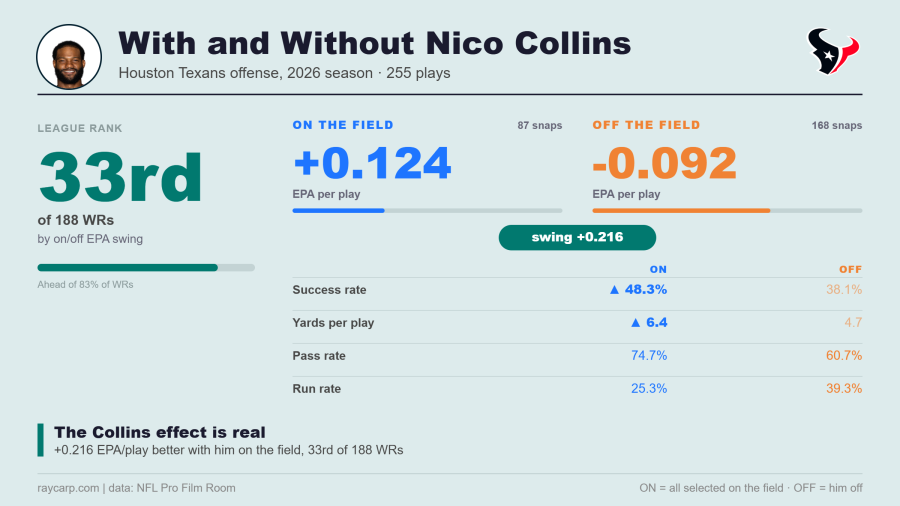
This year, the Texans have been a top-10 offense by EPA per play with Collins on the field and a bottom-five unit when he’s off. Stroud is at least back in the QB2 mix now that he has his WR1 back on the field.
5) What’s going on with Kyler Murray?
This one is relatively simple. Murray is not throwing accurate passes when pushing the ball downfield. PFF has him chartered with a 29.4 percent accurate throw rate on throws 10+ yards downfield. That ranks 37th out of 39 qualified quarterbacks. He is fourth in accurate throw rate on attempts less than 10 yards from the line of scrimmage. On the other hand, the Vikings aren’t built to be a check-down offense. They rank 20th in YAC per catch as a team. None of their receivers are particularly adept at producing yards after the catch:
- Justin Jefferson - 4.2 YAC per catch (44th among wide receivers)
- Jordan Addison - 3.5 YAC (57th)
- Jauan Jennings 1.5 YAC (does not have enough targets to qualify but it would be bad)
- T.J. Hockenson - 3.4 YAC (31st among tight ends)
To defend Murray for a brief moment, Kevin O’Connell doesn’t seem to know what to do with a mobile quarterback. Murray has one designed rush attempt and one RPO throw. He is 20th in play action rate. O’Connell’s offensive and Murray’s play style are a match made in Hell.
6) Patriots offensive revival
Last week I wrote that Drake Maye was making disastrous plays at a league-leading rate and couldn’t buy an explosive play to save his season. He looked like 2025 Maye in Week 4. The Bills pressured him 20 times and he took one sack. He had 10 sacks on 62 dropbacks over his first three games. On the other end of the spectrum, Maye tossed two touchdowns on his seven deep attempts in Week 4. He had zero scores and four interceptions on deep shots through three weeks. Week 5 could be a regression spot for Maye. The Raiders are top-10 in both pressure rate and sack conversion rate. They have also shut down the deep ball this year. Still, his Week 4 showing is what fantasy managers needed to hold the faith a little longer.
7) Other things not going so well in New England
I can’t explain why the Patriots gave TreVeyon Henderson a lead back role in Week 2 and haven’t considered doing so a second time. Whether or not it makes sense doesn’t matter to fantasy managers. Over the past two weeks, Henderson has seen 42 percent of the Pats’ carries and three percent of the targets. He has run a route on just 31 percent of the team’s passing plays and does not have a goal line carry. Henderson isn’t forcing the issue either. He is averaging 2.8 yards after contact compared to 3.0 for Stevenson. His mark of .19 rush yards over expected per carry is slightly better than Stevenson, but his 34.2 percent success rate is well below average. Stevenson ranks 13th in success rate, meaning he offers similar per-carry efficiency but in a far less boom/bust distribution.
Things only get worse when looking at the receiving stats. Henderson has one catch and is posting an abysmal .2 yards per route. With a dozen catches for 90 yards, Stevenson is at a healthy 1.1 YPRR.
The only thing Henderson has going is his health. Stevenson got banged up late in Week 4 and his status for Week 5 is unknown. Henderson would take on the bulk of the backfield work if Stevenson misses time, but he’s otherwise an RB4.
8) Michael Wilson is quietly looking like a star
Fantasy football is a game based on volume. Targets and air yards predict fantasy points quite well because the things they produce are the fantasy points themselves. They’re also relatively stable, because earning volume implicitly requires the player to actually be good at football. As someone who did not draft Michael Wilson much this summer, it pains me to admit he is earning opportunities by the truckload:
- 46 targets (4th among wide receivers)
- 34 first read targets (5th)
- 10 red zone targets (3rd)
- 7 end zone targets (1st)
- 418 air yards (8th)
His market share numbers are all near the top of the league as well. It isn’t a flawless profile. Wilson is still averaging an underwhelming 1.6 YPRR and is largely a catch and fall down receiver, but volume drives fantasy points. This is the profile of a top-15 fantasy wideout.
9) Kyle Pitts missing in action
The Falcons signed Kyle Pitts to a three-year, $54 million contract in the offseason. You wouldn’t know that by watching them play. Pitts had two catches for 20 yards through three weeks, but that could largely be written off as a byproduct of Cooper Rush making a pair of starts. His numbers ticked up in Week 4 with three catches for 47 yards, but the role was more concerning than ever. Pitts ran a route on just 43 percent of Michael Penix’s dropbacks. He earned an acceptable 17 percent target share, but did so with an average target depth of 2.7. His aDOT has fallen in every game this year and he has run fewer than half of the routes twice. Before 2026, Pitts had only logged a route rate below 50 percent once in his career. It has already happened twice this year. He can’t be viewed as a TE1 until the role improves drastically.
10) Expected fantasy points
Expected fantasy points are simply the fantasy you would expect a player to score based on the situation (down, distance, etc.) in which they earned a target or carry. Do that for every opportunity they see, sum it all up, and you have expected fantasy points. You can also compare their actual fantasy totals to the EP to see how a player is doing with the opportunities. Per RotoViz, this is the top of the list in expected points with the points scored above or below that expectation in parentheses:
- Jahmyr Gibbs - 99.8 (+17.3)
- Kenneth Walker III - 89 (+21.1)
- Trey McBride - 85.2 (-16)
- Ashton Jeanty - 83.2 (-9.3)
- Bijan Robinson - 80.2 (+25.2)
Most of the names here aren’t surprising. Of note, Gibbs is on pace to break the expected points record dating back to 2000 with ease. McBride is second in the NFL in targets (46) and first in targets inside the 10-yard line (seven). Brock Bowers may ultimately surge ahead of him as the TE1 overall, but this still looks like a season where there are two elite tight ends and a chasm between them and anyone else. I would be looking to buy low(ish) on McBride.
The buy low question is harder to answer with Ashton Jeanty. He’s seeing loads of work but isn’t living up to the hype for the Raiders or fantasy managers. Jeanty ranks 26th in YAC per carry, 35th in explosive run rate, 48th in missed tackles forced per attempt, and 29th in RYOE per attempt. There is not a single thing in his rushing profile this year that suggests he is an above average back. On the other hand, his college profile is that of an elite NFL workhorse. Buying Jeanty right now is probably an unnecessary risk for teams on the positive side of .500. If you need a spark to reignite your fantasy season, I like taking on the risk and attempting to scoop a potential league-winner in Jeanty.


