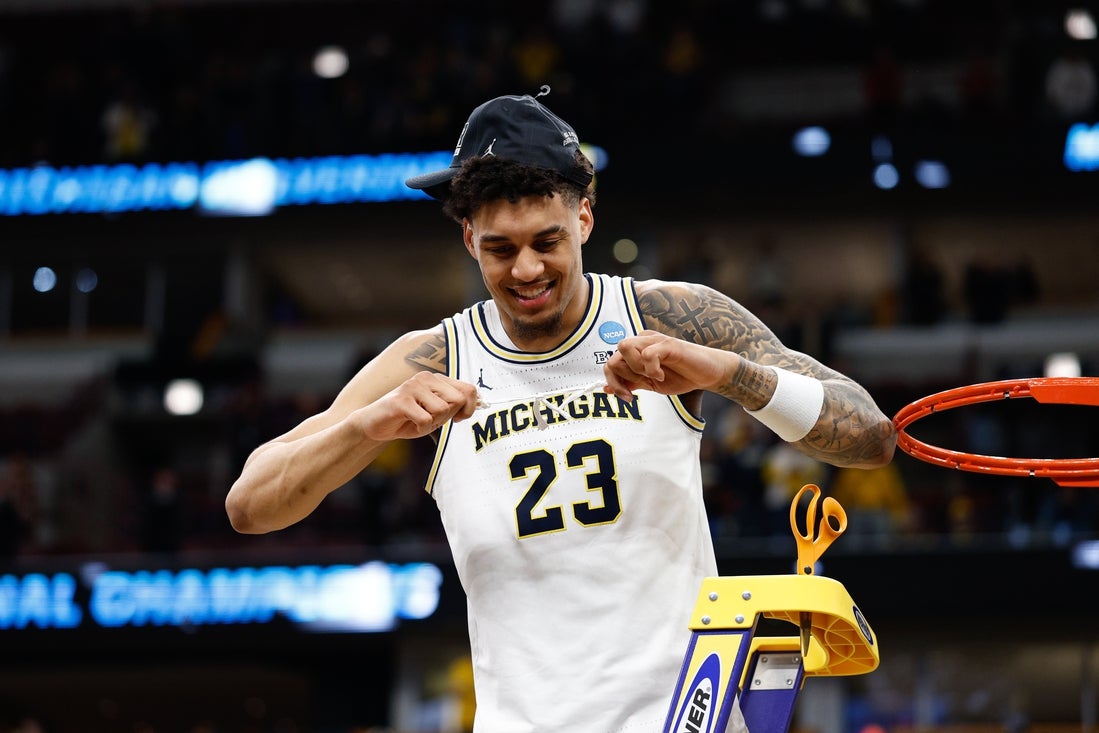






Caleb Wilson is chasing greatness in the NBA Draft, and he’s ready to save your franchise


Mario Mays worried he might be alienating his seniors, but he also couldn’t deny what his eyes were telling him. The head coach at Holy Innocents’ High School had his new team together for the first time during an early summer live period event in Georgia, and he quickly called a timeout to demand his varsity squad get the ball to the kid who just finished eighth grade a couple weeks ago.
Mays told his team in no uncertain terms that every time down the court, Caleb Wilson had to touch the basketball.
This was Wilson’s first unofficial high school game, but he didn’t look anything like a typical incoming freshman. Mays remembers Wilson having to duck to get through the front door, and already dunking the ball with ease. While the physical gifts were easy to see, it was the mental side of the game that was more impressive to his new coach. When one of Holy Innocents’ senior guards ignored the coach’s orders on an ensuing possession, Mays immediately pulled him from the game.
“What they didn’t understand was Caleb’s instincts and feel for the game was way ahead of schedule,” Mays told SB Nation.
Wilson got the ball at the free throw line the next time down the court, hit his defender with a reverse pivot, and whipped a pinpoint pass to the corner, where his teammate drained an open three. “See!” Mays yelled at his bench. “That’s why he has to touch the ball!”
Precociousness has been a through line during Wilson’s young career. He proved to be the best player on North Carolina the first time he put on his college uniform, too, igniting an electric freshman year that combined elite offensive production with flashes of game-breaking defensive playmaking. He dunked 67 times in 24 games, a stunning number that nearly matched Zach Edey’s rate during his senior season as a 7’4 National Player of the Year award winner. If you go by BPM, an all-in-one stat that measures a player’s net contribution to their team, Wilson was a top-five player in the country as a true freshman before his season ended prematurely in early Feb. because of a broken thumb.
Through it all, Wilson never ducked the smoke that comes with being a young superstar. He told reporters he changed his phone background to the McDonald’s All-American Game ahead of an early season showdown with Kansas, because Jayhawks super freshman Darryn Peterson didn’t pass him the ball at the event. He kept a personal “kill list” of opponents he wanted to dominate, and he consistently checked names off the list all year.
As he enters the 2026 NBA Draft, Wilson is embracing the pressure that comes with being a likely top-4 pick.
“I’m going to change their franchise,” Wilson said of the team who drafts him at the combine. “I’m going to change the culture of their franchise and I’m going to change the city, honestly. I’m a culture changer. I did the same thing at North Carolina.”
It’s hard to argue with Wilson’s bravado after putting together an ironclad two-way statistical profile and the single best highlight reel in this draft class. The eye test could occasionally tell a different story, however. Wilson is not an outside shooter, he’s not a lead ball handler, and he’s not a primary rim protector. He’s majorly underweight for an NBA forward at only 211 pounds, and he doesn’t have great length either after measuring with just below a 7’1 wingspan at the combine.
“He’s not a finished product,” North Carolina assistant coach Sean May told SB Nation. “But the product that you’re getting is far better at a starting point than almost anyone else. Where he’s starting, other guys won’t be able to catch up.”
No one disputes that Wilson has flaws in his game. Believing his high-octane style will translate to the NBA requires betting on his character and work ethic as much as his talent.

Wilson never tried to specialize in basketball growing up in Atlanta. He played baseball, football, soccer, and ran cross country. The baseball diamond was his first love, but when he shot up to 6’7 by eighth grade, his strike zone became too wide, and he knew he had to focus on hoops. He still credits the sport for teaching him an important lesson early in life.
“The thing about baseball is you’re going to fail really often,” Wilson said at the combine. “Having the ability to learn how to fail and learn how to move on from that, I feel like is really important.“
Wilson’s father Jerry eventually found Robert Swain, a local trainer, to help his son with his skill development on the basketball court. What Swain remembers most about his early sessions with a young Wilson was his competitiveness and determination to get every little thing right.
“He had a jaguar’s spirit,” Swain told SB Nation. “I ain’t going to say a dog, I think a jaguar is a lot tougher than a dog.”
Swain was resolute to avoid sticking Wilson inside just because he was tall, so he prioritized his face-up game. The goal was getting to the basket in no more than two dribbles, utilizing jab steps, shot fakes, and turnarounds.
“He always visualized himself in the game,” Swain said. “He gets mad when he misses. He’ll try 10 times to get it right, and he wouldn’t leave the gym until he got it down.”
Wilson left an impression with evaluators in the summer of 2022 between his freshman and sophomore seasons, immediately establishing himself as an upper echelon prospect in his national recruiting class. Long-time scout Eric Bossi described Wilson as a “blank canvas” in those early days with height, athleticism, and motor. The full picture of what he could be as a player started to take shape a couple years later.
Swain said Wilson made a big leap in skill between his sophomore and junior seasons. Suddenly, he was taking the ball coast-to-coast with confidence and dunking any time he had the chance. Back at Holy Innocents’, Mays remembers being moved by how well his young star had learned to study the game.
Holy Innocents’ had a subscription to Hudl, a film and data hub. The coaching staff could see how often the players were logged in to watch film, and Wilson recorded “two or three times” more usage on the platform than anyone else in the program.
“We would say, you wonder why Caleb makes certain plays? He was studying his opponent, and he was studying where he needed to be better,” Mays said. “When you study the game along with having the IQ that he has, you’re really going to improve.”
Wilson made the biggest move of his prep career entering his senior season. After starting his summer with the Georgia Stars on the EYBL, he made the rare decision to switch programs mid season and join Nightrydas Elite, a team helmed by twins Cameron and Cayden Boozer. Nightrydas had won EYBL championships in their age group the previous two seasons, but they needed reinforcements with other elite talents joining up.
Wilson made the jump because he wanted to win a Peach Jam championship, and he did so knowing he would be taking on a totally different role. He was the leading man on Georgia Stars, but Nightrydas was Cam Boozer’s team. His offensive touches would go down, and his defense, rebounding, and connective passing would take on more importance.
Nightrydas reached the title game, where they faced off against an Oakland Soldiers team led by class of 2025 No. 1 prospect AJ Dybantsa and class of 2026 No. 1 prospect Tyran Stokes. Wilson drew the Dybantsa assignment, and kept him in check enough for Nightrydas to win another championship.
“I think he understood on different teams, there’s going to be different roles he has to play,” Mays said. “On that team with the Boozers, his role was a lot different than the role he was playing here at Holy Innocents. You have to have a winning mindset to be willing to change roles.
“He put his ego down and understood, like, you know what, I want to win a Peach Jam championship. I want to show people I’m a winner.”
Wilson returned to Holy Innocents’ for his senior year more confident than ever. The skill work he was putting in with Swain was making him a more complete offensive player, and his newfound dedication to ripping pushups to add muscle mass was helping him play through contact. Just before the state playoffs, Wilson went on Inside the NBA and announced his decision to commit to North Carolina.
After losing in the state championship game in his junior season, Wilson left a wake of destruction in his path as a senior. He led Holy Innocents’ to its first state championship in program history with a 84-45 blowout of North Cobb Christian in the title game. Wilson put up 33 points, 13 rebounds, three assists and three blocks in the win. He was also named Georgia Mr. Basketball. While his highlights were now going viral all over social media, Mays said his biggest strides were made behind the scenes.
“Caleb would often draw things up,” Mays remembers. “And we would talk X’s and O’s and kind of go tick for tat to see what would happen. And the thing to me was, he was already challenging himself to learn the game outside of just working out. He was challenging himself mentally.
“Some of the stuff he was diagramming was understanding, like, he was going to be double-teamed and maybe even triple-teamed in high school. But he was drawing things for other kids. You know, if they double team you here, then so and so should be opened here. That’s two or three steps above anybody that I’ve ever had a chance to work with in high school.”
Sean May showed up to an EYBL weekend in Atlanta looking to scout Drake Powell. The UNC legend and current assistant coach left raving about the younger player matched up against him on the opposing team.
“I just noticed that this young kid, a sophomore, was absolutely killing everybody,” May told SB Nation. “And so when I got back, I told the staff, hey, there’s a kid Caleb Wilson in Atlanta that we got to definitely recruit.”
Wilson would eventually become North Carolina’s highest-rated recruit since Brendan Wright in 2006. After his commitment, May flew out to Atlanta to talk to Wilson about how to be the leader North Carolina needed despite being one of the youngest players on the team.
“He’s super inquisitive,” May said. “He was like, ‘What do you mean by that? How do I lead?’ I told him, ‘You lead every day through your work. You come in every single day prepared, and guys will follow you naturally because of your talent. But more importantly, they’ll follow you because of the way you work and the way you prepare.’ And he walked in that all year.”
When he arrived on campus, the first thing that stood out to the UNC coaching staff was Wilson’s passing ability. He immediately developed a strong connection with big man Henri Veesaar, forming a dynamic high-low partnership in which either player could initiate or finish the action. As defenses loaded up to stop Wilson’s scoring, his rapid processing and exceptional touch on interior feeds consistently generated easy scoring opportunities for North Carolina. His 18.1 percent assist rate and +1.4 assist-to-turnover ratio were fantastic numbers for a freshman his size.
Wilson’s playmaking allowed North Carolina to run the offense through him even if he predominantly played inside the arc. The countless hours that Wilson poured into fine-tuning his face-up game with Swain from an early age were now being fully realized. When the Tar Heels got Wilson the ball in the post or at the elbows, he was too nimble and too determined to keep away from the basket.
Players with Wilson’s twitchiness at his size just do not exist. He was able to get defenders off balance with jab steps, hesitations, and rip throughs before exploding to the rim. Much of the time, it led to a ferocious slam. Wilson simply gets off the floor quicker than his opponents as a leaper, and he’s already able to play through contact even with a thin frame. His scoring arsenal went beyond dunks: He shot 50 percent on two-pointers even if you take away his massive volume of dunks, with mid-range touch shots, crafty layups, and runners all part of the package. This is what it looks like to have a full bag of scoring moves inside the arc:
The one thing Wilson did not do on offense is take threes. He only went 7-of-27 from deep on the season, and it’s easily the biggest red flag in his NBA projection. It’s important to remember that North Carolina wasn’t necessarily trying to develop him for the NBA — they were trying to win games. May said the Tar Heels’ game plan was to put their freshman star in the best position to succeed, and not to bail out defenses by taking shots the opposition wanted him to take.
“The thing that he was great at is he creates a lot of leverage,” May said. “That’s a key term in basketball that a lot of people use. A lot of leverage and a lot of gravity. So when he’s on the floor, people pull to him. And because of that, we wanted Caleb to do what Caleb was great at. Caleb was great in the pick roll. Caleb was great at post-ups. Caleb was great at creating that gravity.
“If you had to guard Caleb Wilson, and say, hey, what’s the one shot you want him to shoot? It’s a catch-and-shoot three. Because he’s better at the other things. Knowing that, we tried to stay away from that. Let’s do what you do best.”
Wilson saved his finest moment for Carolina’s biggest rival. Duke entered a Feb. 7 clash in Chapel Hill at 22-1 on the season in a showdown of two potential top-4 picks. Wilson took it to Boozer all night, splashing turnaround jumpers in the face, volleyball-spiking one of his shot attempts, and creating a dazzling up-and-under finish on a drive to the basket. Still, Duke led throughout, taking a 41-29 lead into the break, and holding onto a slim lead as UNC started its comeback in the second half. North Carolina never led at any point with time still on the clock, but that didn’t deter Wilson.
“I’ll never forget the end of the Duke game, coach Davis is talking, and (Caleb) looked at everybody and said ‘yo, we’re not losing this f———‘ game,” May said. “And I’m like, for a freshman in that moment to say that, that says a lot.”
On the final play of the game, Wilson set a hard screen, rolled to the basket, and saw the Duke defense suck in with him. UNC guard Derek Dixon drove and kicked out to teammate Seth Trimble, who splashed a corner three to put the Heels ahead for the only time all night at the buzzer.
Wilson’s season ended the very next game. He broke a bone in his left hand closing out on a shooter during a game at Miami. May said Wilson walked two buildings over during the game for an X-ray, which didn’t locate a fracture. He came back and played with a broken hand despite being in major pain the entire time. The team realized it was broken the next day.
Wilson pushed himself to come back for March Madness, but suffered another freak accident in practice when he slammed a dunk with his right hand in practice and broke his thumb. UNC’s season ended in the first round of the NCAA tournament when they were upset by VCU in overtime. Head coach Hubert Davis was fired days later. It’s easy to wonder how things might have been different if the Heels had their superstar freshman for more than 24 games.
For as fantastic as Wilson’s season was, there’s still some holes to poke in his NBA translation. The three-point jump shot is the most obvious one. Both Swain and May believe his shot can flourish in the league when it becomes a bigger priority for his team to develop. His defensive lapses might be an even more pressing concern to clean up.
Wilson had lapses in attention off the ball defensively all season. He would routinely get caught ball watching and lose track of his man. He struggled to get over screens. Too often, he was completely upright rather than being in the stance required to make a play. His poor defensive awareness led breakdowns in the Carolina defense through the season, and produced a lengthy lowlight reel of regrettable possessions.
Like most aspects of the game, defense shouldn’t be evaluated as a blanket term. Wilson has strengths on that end. He has excellent recovery tools to make a play on the ball even when he’s out of position. He’s an awesome switch defender who should thrive in the 1-4 switch-heavy schemes teams often play in the playoffs. He’s a very good rebounder who can high-point the ball and get off the ground quicker than his matchup, and his boards often lead to grab-and-go opportunities the other way, where he really shines.
Wilson’s defensive production was still good in spite of his lapses. His 4.6 DBPM cleared fellow one-and-done freshmen Dybantsa (1.1 DBPM), Hannes Steinbach (1.9), Koa Peat (3.1), and Nate Ament (2.7). The fact that Wilson was that productive defensively even while carrying a nearly 29 percent usage rate offensively with highly-efficient 62.6 percent true shooting shows how special he can be at the next level if it all comes together.
Those who know him best believe Wilson’s top attribute might be his desire to seek out and embrace what will make him better.
“One thing I know about Caleb is where he needs improvement, he’s gonna find a way to get it done,“ his high school coach Mario Mays said.
“The thing I love about him more than anything is probably how inquisitive he is,” UNC assistant Sean May told me. “He’s always putting himself in a position to learn.”
It’s hard to find a historical precedent for Wilson. Only three other freshmen have posted at least 60 percent true shooting with an 18 percent assist rate and 4 percent block rate since BartTorvik’s database started in 2008, and they were all low-major players. There are some broad statistical similarities with Evan Mobley’s lone college season, but Wilson plays with significantly more offensive aggression, while Mobley is longer and a better bet as a primary rim protector. Kevin Garnett is another popular comp, but he’s one of the best forwards ever, and could anchor a defense in a way that feels too optimistic for Wilson’s projection.
For his part, Wilson isn’t getting caught up in the pre-draft noise.
“I’m my own person,” Wilson said at the combine. “I’ll write my own story. I’m just looking for a coach that believes in me, trusts me, and is going to give me the truth. And develops me to be the best player I can be.”
Despite being robbed of playing in March Madness by an untimely injury, Wilson said he wouldn’t trade his experience at North Carolina for the world.
“I feel like the most important part of college is learning how to do other things that impact winning besides just scoring. I feel like I got everything out of it. I was an offensive rebounder, I rebounded the ball well, I defended. I mean, I did everything else that you want out of a player. And now all I have to do is show my scoring, and I still averaged 20 points.”
The 2026 NBA Draft was supposed to be led by a big three with Dybantsa, Peterson, and Boozer. Wilson was so spectacular in his abbreviated run at North Carolina that it can now credibly be called a big four. Wilson is the most explosive athlete in the draft, but he’s so much more than that, too. He’s a gifted passer who can anticipate windows and punish double-teams. He’s a skilled mid-range scorer who can hit off-balanced shots from a variety of angles. He’s a defensive playmaker who is a terror in transition when he gets out on the break. He’s a dominant rim scorer who dunks everything.
There will still be some concerns about a skinny forward who doesn’t yet shoot threes, especially one whose defensive impact isn’t quite as pronounced as it should be right now. In many ways, Wilson is still the ball of clay evaluators saw in his early teenage years, only now he has the production to backup his potential.
Wilson’s Twitter bio is two words: “pursuing greatness.” He still has a ways to go, but those around him are convinced he’s on the path to finding it.
What's Your Reaction?
 Like
0
Like
0
 Dislike
0
Dislike
0
 Love
0
Love
0
 Funny
0
Funny
0
 Angry
0
Angry
0
 Sad
0
Sad
0
 Wow
0
Wow
0