




















Atomic Heart Blood on Crystal DLC 4 Review – Dawn of a New Era
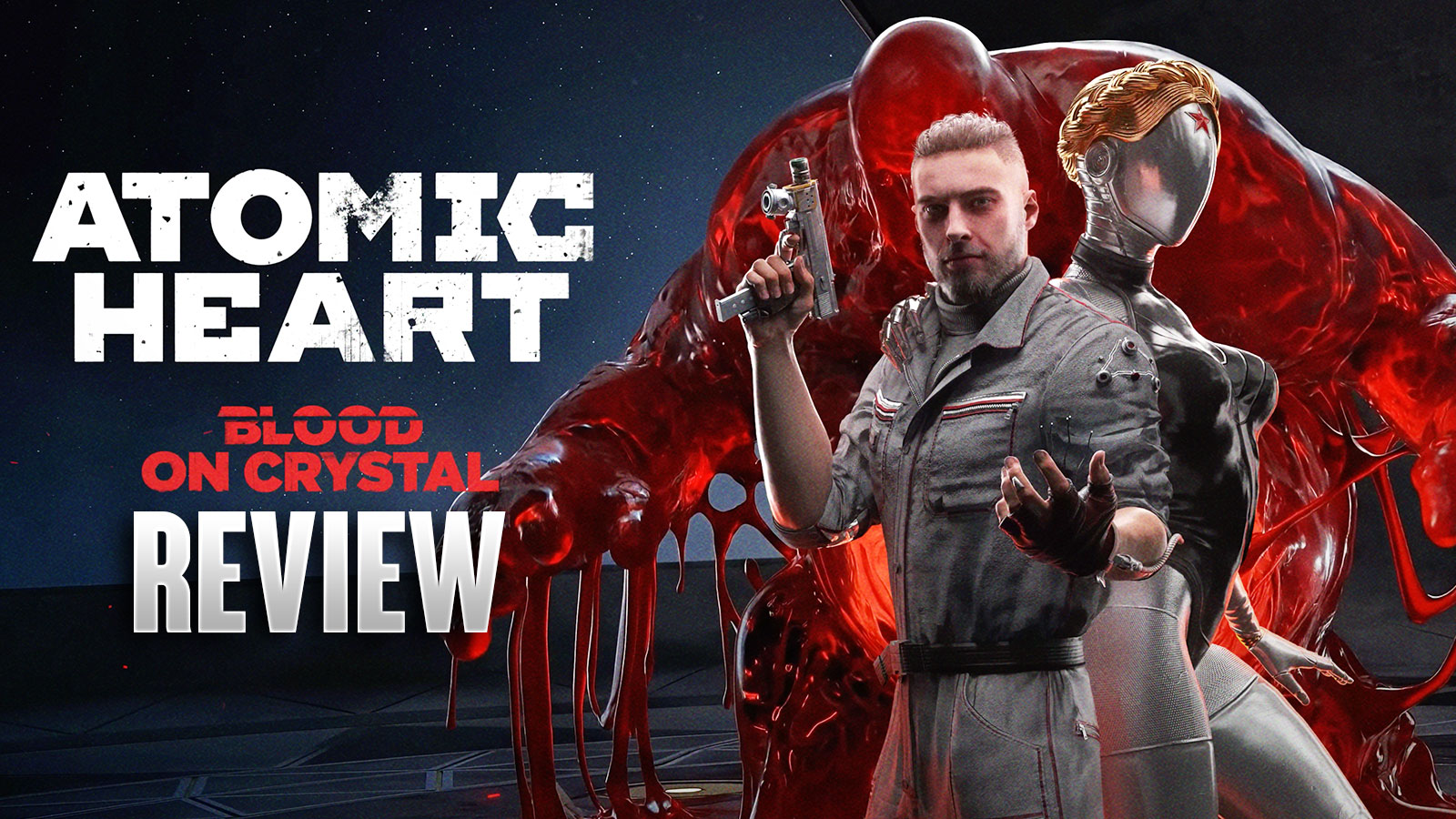
In this Atomic Heart Blood on Crystal DLC 4 Review, we finally got to play and finish Mundfish’s final chapter of Atomic Heart’s first part. This DLC acts as the conclusion of the story of the original game while also setting up the series’ future. With new enemies, facilities, and new ways to upgrade your character, Blood on Crystal aims to bring the best of everything the game and its other DLCs had to offer. But is it worth your time and money?
Atomic Heart Blood on Crystal DLC Review – What is DLC 4?
Blood on Crystal is the fourth and final story DLC of Atomic Heart, which can be purchased for $9.99 or included in the game’s Atomic Pass ($39.99). Furthermore, players who own either the Gold or Ultimate Edition of Atomic Heart also receive the Atomic Pass. It is available on PlayStation 5, PlayStation 4, Xbox Series X|S, Xbox One and PC Via Steam
WARNING: Spoilers Ahead!
Story – Atomic Heart Blood on Crystal DLC 4 Review
Putting a second spoiler warning here for the sake of those who did not complete the DLC yet, or have yet to play it.
Atomic Heart DLC 4 follows the game’s longer ending. Blood on Crystal’s introduction actually provides a recap on everything that has happened so far in the story. But for your convenience, we’ll provide a recap of events as well.
At the conclusion of Atomic Heart’s base story, P-3 discovers the true purpose of the Atomic Heart Project and confronts Dr. Dmitry Sechenov alongside CHAR-les. However, after defeating the Twins and shooting his boss, P-3 is then betrayed by CHAR-les, who turns out to be a much greater evil. CHAR-les connects himself with the “Jelly-Man” and sends our protagonist to Limbo.
In DLC 2 “Trapped in Limbo”, P-3 reunites with his wife, Ekaterina Blesna. Together, the two escape Limbo and regroup with Granny Zina (Blesna’s mother) in DLC 3 “Enchantment Under the Sea”. It is during this DLC that P-3:
- Explores a destroyed Chelomey, as well as the Neptune Complex
- Meets new allies – Nikolai, The Hunter, Nastya, and Samodelkin
- Recovers the Beta Connectors
- Recovers Blesna’s body
After defeating the final boss of DLC 3 and making it back to the surface, P-3 finally believes it is time to confront CHAR-les. And that includes a shortened explanation on how we got to Blood on Crystal.
The newest DLC story picks up right where Enchantment Under the Sea left off. P-3 and friends are ambushed on the beach by an endless onslaught of robots, but Granny Zina arrives just in time to bring them to safety.
The gang regroups at Professor Lebedev’s Orb laboratory, which is actually the same location from DLC 1. While P-3 rests, the group comes up with a plan to confront CHAR-les, which involves infiltrating the Wave Platform. But before beginning their mission, P-3 is fitted with a new partner for their Glove – NORA.
Yes, the naughty repair vendor (and DLC 1 boss) becomes your companion for the DLC, but she actually remains inactive until you enter the Crystal Complex. In the meantime, P-3 mostly communicates with other members of the team as he explores Wave. However, further exploration of the Platform reveals the existence of a new, top-secret complex called Crystal.
P-3, NORA, Nastya, Nikolai, and The Hunter all infiltrate the Crystal Complex, while Blesna (now in a Twin’s body), distracts the enemy from above.
Having two locations to explore in the DLC kept things fun and fresh. Wave provided a nice balance of external and internal locations, and also introduces new enemies for P-3 to face.
Firstly, you finally get to fight Burlaks, which appear in the base game. But you also get to fight another new robotic foe called a RACCOON. These enemies actually require you to damage a specific part on their bodies before using your glove to retrieve a Candle from their bodies. There a few unique variants of the RACCOON, including a special RACCOON that serves as a boss battle early in the story.
These new robot enemies were nice to fight, but I’m also still itching to take on a Burav. Perhaps we’ll get the chance to do so in Atomic Heart 2.
Overall, I think the Wave Platform was nice to explore. It served as a nice bridge between DLC’s ending before heading into the darker Crystal Complex. Atomic Heart is actually one of the few games where I like to “stop and smell the flowers”, meaning I actually like reading all the PEAR devices to learn more about each facility’s function.
Mundfish really dives into the science fiction aspect of things, explaining how everything works in great detail. It was what got me into the game in the first place. Complemented by Art Director Artem Galeev’s purposeful and creative designs, Atomic Heart has a fascinating lore and world that seems purposeful in its creation.
The storytelling gets even much better once you finally reach the Crystal Complex, which actually feels pretty lengthy. Overall, the DLC took me roughly six-to-eight hours to complete, with no area feeling rushed. In fact, the Crystal Complex felt as lengthy as the base game’s Vavilov Complex, which is arguably the biggest complex in the game.
Inside the Crystal Complex lies Sechenov’s greatest secret. In this facility, humans are transformed into Polymorphs, which are Polymeric Humans who can survive in harsher conditions, live longer, and rely on less sustenance gradually.
We get a glimpse of polymeric beings in the base game within the Pavlov Complex, but those were just experiments on animals that never fully became polymorphic beings. CHAR-les, himself, is a polymorphic intelligence who takes on the form of the jelly man at the end of the base game. But within Crystal are regular humans who’ve undergone the complete process.
The intended goal of the Polymorphs is to create a new shell for Humans, who could use their newfound abilities and resilience to travel the stars. From terraforming Mars, to uncovering the mysteries of the sea, Polymorphs could venture out and learn more about the world than humans ever could.
Furthermore, Polymorphs possess a longer life span, resistance to elements, and even the ability to harness the power of the elements. At first, the initial wave of Polymorphs were people who:
- Had disabilities or life-threatening diseases OR
- Former soldiers who lost appendages
But eventually, the experiments expanded to high-powered individuals who wanted to attain a longer life. However, becoming a Polymorph comes with serious side affects and other issues.
I won’t explain much more of the details. But I just love how the story shows you the affects of polymerization.
What happens to someone who replaces their human shell with a Polymeric one? And did you know polymerized animals can actually build a hive-mind intelligence together? One PEAR device explains that a Polymeric Wolf licks a Polymeric Sheep instead of eating it. While their collective intelligence is still small, it only grows greater when there is an increased number of Polymorph animals.
The conversations you have with some of the Polymorphic beings is absolutely fascinating. You don’t just fight Polymorphs, but you actually communicate with some of them. You learn about things that still make them human, and other things that show they are losing touch with humanity. An immortal shell actually costs more than one may think.
Some sections of the DLC require you to perform tasks for these Polymorphs, which also provide insight into the way they think. They refer to regular humans as Bygones, with some Polymorphs considering themselves above humanity. All of these conversations make you think about the facility, its projects, and how CHAR-les became to be… CHAR-les.
As P-3 explores the complex, you discover even more about the facility, its purpose, and CHAR-les’ true plan. I won’t spoil the ending, nor will I talk about some of the deeper plot elements, but I will say I was not disappointed.
My biggest gripe with DLC 3’s story was the conversations with Blesna, who I found uninteresting compared to CHAR-les’ conversations from the base game. I’m pleased to say that Blesna doesn’t appear as much, and CHAR-les gets plenty of screen time.
Furthermore, you also get opportunities to speak with the other characters. Nastya and Kolya in specific seem to get a lot more screen time. Meanwhile, the Hunter still remains somewhat mysterious, but you do learn a bit more about him. And although not present as much, hearing Lebedev is always welcome. Overall, I love the cast of heroes in Atomic Heart.
Of course, I’d be remiss not to mention CHAR-les, the DLC’s main antagonist. He is, without a doubt, the coolest character in Atomic Heart. And I know there were people who disliked the English Voice Acting, but I am NOT one of them. Eric Meyers absolutely nails the role, giving CHAR-les a voice that mixes genius & monster.
P-3 encounters his former Glove companion quite a few times during the story. And the result is nothing short of fantastic. From his dialogue to his delivery, CHAR-les keeps you hooked. He also makes for one of the most complex and interesting villains I’ve ever seen in a video game.
Throughout the entire Game and its DLCs, CHAR-les’ goal is not exactly made 100% clear to the player. It isn’t until you reach the end of DLC 4 where you finally begin to realize what his plans are. Again, no need to spoil things here, but it all leads to an epic story on a grand scale.
There’s other, more minor characters you meet with throughout the DLC as well. There’s a unique robot called Validol, who monitors the conditions of the Polymorphs. You need to complete a minor quest for him in order to gain access to the next area. He was hilarious, cool in design, and fun to interact with.
A lot of the Polymorphs have cool and interesting dialogue, too. It’s like talking to another being entirely, which creates cool opportunities for more unique interactions in Atomic Heart 2.
Overall, I loved the story of Blood on Crystal. From the beginning to the end I was hooked on what was going to happen. I first heard about Atomic Heart in 2018 when Mundfish revealed their first official trailer. There were doubts the game would even launch, and after five long years it finally released. But fans of the game had to wait an additional three years just to see the story’s end.
There were only a few things I think could’ve been done better in the story.
Firstly, and major spoiler here – But DLC 1 did not actually follow the short ending’s story. Instead, it turned out to just be a simulation cerated by Professor Lebedev. This was kind of a lazy way of saying “We’re not expanding upon the short ending”. Personally, it makes DLC 1 feel pointless to play now, considering it wasn’t technically real.
Secondly, I think finale felt a bit rushed. We didn’t even get to speak to the final Boss after beating him. And the ending finishes with this gag joke that felt a bit unnecessary. Personally, I prefer Atomic Heart to be mostly serious, though I think there’s room for comedy if done right (i.e. Validol, the Tereshkova from the VDNH, etc.).
But please do not let this discourage you from trying the final DLC out. The story will not disappoint you. In terms of story quality, it’s Atomic Heart’s best DLC yet.
Gameplay – Atomic Heart Blood on Crystal DLC 4 Review
In terms of gameplay, Blood on Crystal retains many similarities to the base game. However, there are some fundamental differences.
There is no longer a way to upgrade your character via neuropolymers. That means any Neuropolymers you acquire from enemies may not be used to upgrade your abilites like Shok, Blaze, or Whip. Instead, you need to discover upgrades within Crystal that just improve your character. There are 11 in total, and they do things like:
- Increase your Maximum HP
- Increase HP Recovery when outside of combat
- & more
Personally, I prefer using neuropolymers, but I respect the idea. And they do give an explanation as to why you can’t upgrade the way you used to.
Speaking of abilities, how you acquire them works much differently as well. Instead of just switching abilities at the repair vendor, you need to find CHANCE capsules. These capsules are spread throughout the facility and are usually required in some cases to navigate certain rooms.
Some rooms require you to use the Blaze ability, or the Whip. Others may suggest using a Polymeric Shield, though it’s not always necessary for you to use them. My only issue with this system is that it felt awkward.
Some enemies, like the Polymorphs, can change form. Some become covered in flames, while others encase themselves in an icy shell. Unfortunately, this sometimes means you may need to switch between CHANCE Capsules mid-fight to ensure you can take them out easily. If you’re playing on a hard difficulty, this can be quite difficult to manage, especially if you’re being swarmed.
Speaking of the enemies, I do like the wide variety of enemy types. The new Polymorph foes are fun to face if you have the right abilities. I also enjoyed the mechanical enemy types, such as the Burlaks and RACCOONs. Furthermore, Blood on Crystal also includes various enemies seen in other DLCs 1 and 3.
However, the variety in the weapon department feels lackluster. There’s no Zvezdochka, first of all, which really sucks. Instead, we only get the two melee weapons that were seen in DLC 1 and 3. And as for ranged weapons, you only have access to the Secateur, Shotgun, Assault Rifle, and Pistol.
Overall, there’s about six or seven weapons in the DLC, which feels disappointing. I also miss Mass Telekinesis, which was admittedly overpowered but fun to use. And not being able to upgrade abilities also felt like too much had been taken out.
I still find combat fun in Atomic Heart Blood on Crystal, but I much prefer the base game’s combat experience. I see what they tried to do here, but it just didn’t work for me.
However, combat sections were still fun this time around. There’s also less emphasis on fighting a hundred enemies in a single room. Instead, the pacing between combat, puzzles, and exploration felt greatly balanced. If only the arsenal of weapons was bigger, and there was more freedom in abilities and upgrades.
I also much prefer the Polymorph to the annoying crab boss from DLC 3. And speaking of boss battles, they felt much better this time around. The MO-R4Y boss from DLC 3 wasn’t fun to fight and felt rather frustrating. Blood on Crystal features much fairer but still challenging boss battles. The final boss in particular was a blast to take on.
Outside of Combat, DLC 4 emphasizes exploration of the Crystal Complex. The new door puzzles felt really engaging and fun to interact with. Furthermore, the complex itself is full of so much lore and interesting interactions that make you want to see it all.
One random thing I’m really glad to see is that P-3 automatically sprints. So many games often feel slow and require you to mash or hold the sprint button, which can hurt after a while. I know it seems small, but I hope this remains the case for future Mundfish titles.
Overall, I do love the gameplay of Blood on Crystal, despite its flaws. I wish there were more weapons, and I wasn’t crazy for CHANCE Capsules. But it was still fun to play through and I don’t feel discouraged from trying it out again. The boss battles felt engaging, the gunplay feels great despite its limitations, and the new enemy types keep things fresh.
Sound – Atomic Heart Blood on Crystal DLC 4 Review
In terms of Audio, Atomic Heart delivers some great music and sound effects with its experience. Funny enough, my favorite songs aren’t actually the ones from the action sequences. I actually love more subtle songs of Atomic Heart. From the PEAR devices, to the Repair Vendor shop theme, there’s so many songs and sounds that fit the theme of the game.
I also love all the sounds of the laboratories and machinery. It immerses me into the experience as I explore a facility with a unique design not seen in other games. The liquid-like sounds of the Polymeric substances, the whirring and beeping of machinery, it all makes for a sound experience (literally).
I personally love mixing Atomic Heart with classical music. Mundfish’s use of classic songs works so well with the retro-futuristic style of Soviet Russia. Overall, you can’t go wrong with the sounds of Atomic Heart.
Graphics – Atomic Heart Blood on Crystal DLC 4 Review
Atomic Heart remains one of the best looking video games on the market. The game’s interior locations are still among the prettiest and most visually pleasing. Much of the credit goes towards the brilliant art director, Artem Galeev. I don’t think I’ve ever seen a better, more creative artist in my lifetime.
What makes Artem Galeev’s work so incredible is his attention to purpose and detail. The robots not only look cool and extremely detailed, but there’s a reason as to why their designs are the way they are. Reading about these machines, as well as the new Polymorph enemies provides more insight on what they can do.
The Crystal Complex features a mix between retrofuturism and an ancient Egyptian vibe that all blends into something completely different. Wave also felt fun to explore, though I was much more enamored by Crystal.
Polymorph designs also look great. In particular, animal polymorphs all look so interesting because you can see their organs through their transparent shell. The enemies and locations are all complemented by propaganda posters, unique structures, and more.
I could go on for hours about the cool design of Atomic Heart. But I’ll just end this off by saying that you will NOT be disappointed by its visuals.
Verdict: Is Blood on Crystal Worth Your Time & Money?
Yes, Atomic Heart DLC 4 Blood on Crystal is well worth the time and money. If you already own the Atomic Pass, then there’s no excuse to try this final story DLC out.
It features the best story out of any of the DLCs, and sets up the future of the Atomic Universe perfectly. I also feel like, in case AH 2 or The Cube don’t pan out well, then at least we’ll have Atomic Heart 1 to always fall back on. One could always consider Blood on Crystal the true ending if the series ends up going south.
But I don’t think that will happen. Mundfish knows how to create an interesting world and story. This is on full display in DLC 4. And we can’t wait to see what they do with the future of the series.
Personally, my only gripes with the DLC include a limited arsenal of weapons and a somewhat rushed ending. But beyond that, it offers a fun new cast of enemies and boss battles, as well as a great story and facility to dive into.
I absolutely love Atomic Heart. It’s one of the few games I actually really get into when playing. Developer Mundfish took a long and difficult road to get here, but they managed to make it in the end. Despite all the controversies and unwarranted hate, this developer seems to have a bright future ahead in the Atomic Universe.
And, now it’s the dawn of a new era in the AH Universe. We look forward to seeing where it goes next.
Score: 9.5/10
Editor’s Note: ClutchPoints reviewed the PS5 version of the Atomic Heart Blood on Crystal DLC. Experience may vary depending on the platform you play on.
For more gaming news, visit ClutchPoints. Furthermore, subscribe to our gaming newsletter for more weekly info.
The post Atomic Heart Blood on Crystal DLC 4 Review – Dawn of a New Era appeared first on ClutchPoints.
What's Your Reaction?
 Like
0
Like
0
 Dislike
0
Dislike
0
 Love
0
Love
0
 Funny
0
Funny
0
 Angry
0
Angry
0
 Sad
0
Sad
0
 Wow
0
Wow
0