
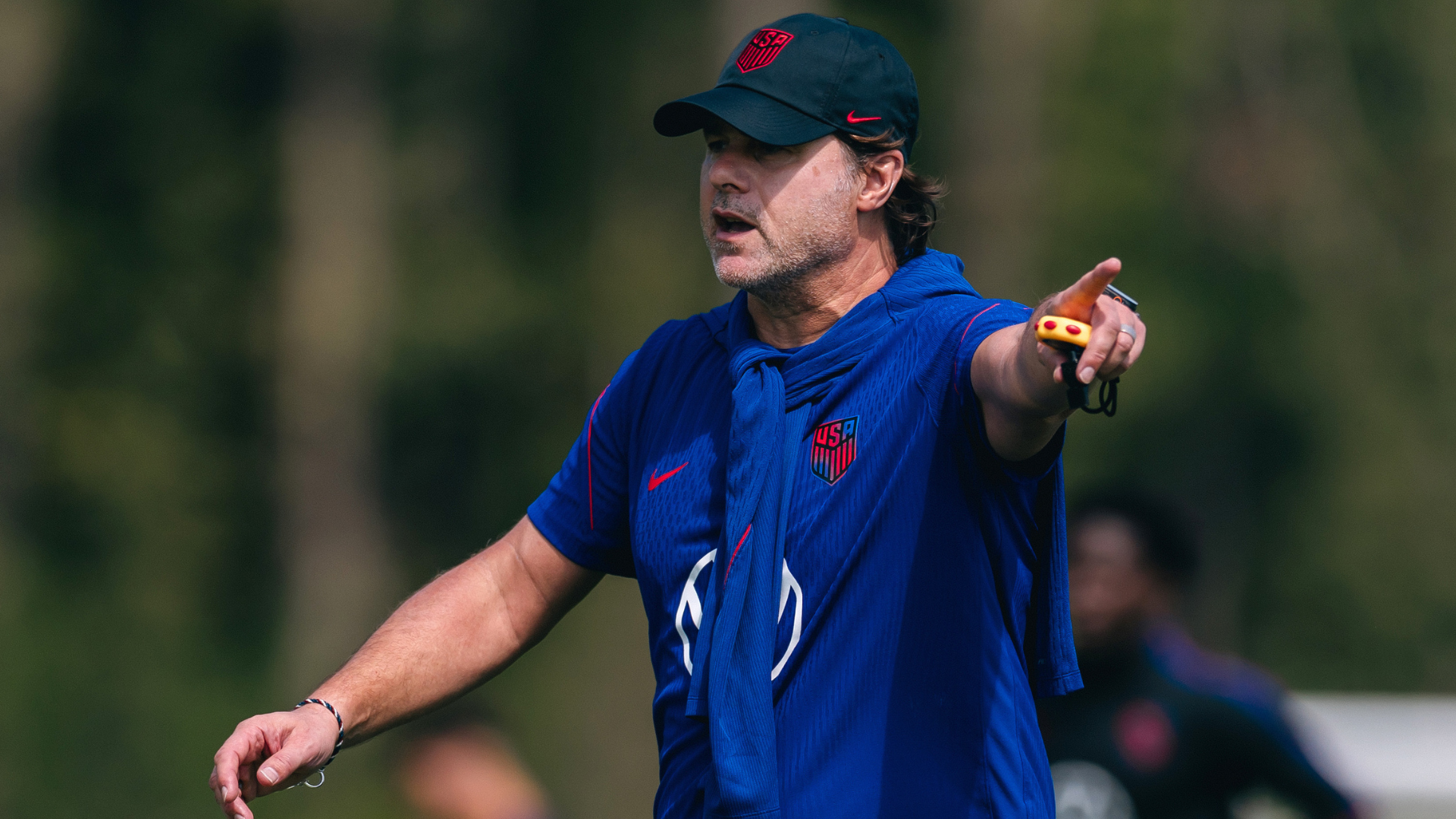
For the first time since U.S. Soccer's national training center opened in the suburbs of Atlanta, U.S. men's national team head coach Mauricio Pochettino actually had time to marvel at the size of the new build despite spending eight days working there in late spring.
"It was amazing with the possibly to be there [again]," he said Friday, "with less stress than [it] was with all the preparation for the World Cup."
The USMNT are officially back in session after a World Cup on home soil, their anticlimactic round of 16 exit somehow only acting as a set-up for the national team's next act. Pochettino will use the first international break of the new cycle to introduce a young group of players to the demands of the senior national team, boasting both an individual and collective potential that makes them perhaps the most exciting generation of talent the U.S. men's program has ever produced. Pochettino was unreserved in his generational shift, calling up 13 uncapped players and mixing them with 12 members of this year's World Cup team while including a few others for a new-look national team.
Expect a number of those fresh faces to be on display as soon as Saturday's friendly against Peru, the first of four in a jam-packed international window.
"We are going to mix a little bit, to play tomorrow maybe with some new players or young players with senior players," Pochettino said. "It's important, that mix. Hope that works and the rest of the games, too, that is our idea. That is what we plan and then, of course, when we observe, judge the players, maybe some players need more time. Maybe not to play the first game or the second, maybe the third. Maybe some players training with us, it's enough. They don't need to go to play."
Striking the balance appears to be atop Pochettino's list of priorities, at least in the short-term. This is far from the first changing of the guard the USMNT has experienced, the last one only taking place roughly eight years ago after a different generation of players failed to qualify for the 2018 World Cup. The veterans that today's rising talents are working alongside were the leaders of their own generational shift after the 2018 debacle, but as longtime midfielder Tyler Adams noted, this situation is not apples-to-apples.
"I think there's less pressure on these young kids to come in and perform immediately and more time to actually develop them, whereas, when I came in, it was off the cusp of obviously not qualifying for a World Cup and it was like, 'You guys basically need to play right now and need to perform right now so we can qualify for the next World Cup," Adams said Wednesday. "I look at this generation of players right now, and I think that they're in a great position, that they can go through the process properly and really just lean on guidance and go through and get their own experiences, have opportunities like the Olympics, as well, along that way and other competitions to really grow them for the next World Cup."
Pochettino echoed the sentiment.
"I think it's so important to provide the chance if they are ready," the coach said. "We are not talking that they need to perform. That's one of the things that we were talking [about] with them. They need to feel that they are ready to play [at] the next level…The important thing is that they need to feel that they are ready, we need to feel they are ready, and then perform or not perform -- that is not the question. We really believe that they have talent and sometimes, you need more time or experience, but at the moment, so far, I think we are in a really good place."
How to watch USMNT vs. Peru, odds
Date: Saturday, Sept. 26 | Time: 4:30 p.m. ET
Location: Inter.co Stadium -- Orlando, Fla.
TV: TNT | Live stream: HBO Max
Odds: USMNT -210; Draw +330; Peru +550
USMNT's new balancing act
Naturally, striking the right balance includes everyone making a strong first impression, including a group of rising talents who are poised to become national team regulars sooner rather than later. The headliner of the new recruits is 16-year-old Cavan Sullivan, who has seven goals and five assists for the Philadelphia Union this season.
"He's very quiet," defender Alex Freeman, now one of the veterans despite making his national team debut last year, said. "I think he's probably a little nervous, as I would assume. He's a young guy, youngest guy on the roster, only 16 years old but I can see that when he gets to the training, he's very driven. He wants to be able to get better and I feel like as a 16-year-old, you want to be able to make an impression and I think some of the things I would want to tell him is, come and make an impression but do it in the right way. Be disciplined. Maybe stay after, do extra stuff knowing that at the age of 16, you still have so much [room] to grow and so much [time] to do that. His ceiling's going to be on the roof. Knowing that he's already 16 in MLS, now what can you do with the national team? Can he come in and make an impact? I think Cavan's a player that is very versatile. He can play anywhere in the attack and I think it's now how can you come in and be able to be disciplined and be able to do the extra stuff that's going to come on the field and show?"
Pochettino, though, admitted that the onus of striking that balance goes both ways.
"I think if the young kids arrive in an environment that they smell respect, they smell the discipline, the normal discipline in a team that plays soccer or football, I think they are very natural," he said. "That was our plan. It's to create an environment that they can feel natural. We want them to behave in a natural way and because they are intelligent, they are smart, they perceive and feel the way that they need to act when they arrive."
Pochettino and his staff have had individual conversations with each of the newcomers in the hopes of making them comfortable, starting first by learning about the players as people before moving on to professional matters.
"It's about [getting] to know them, what they like, what they don't like, how they are, how they live, how their family [is], all the things that I think provide us the good information to know [them better] and to understand sometimes their mindset and the way that they behave," he said. "After the first approach, I think then we start to talk about the game, about things that you need to listen because even if they are young, they are smart and they are so intelligent and of course always, it's good to hear form them how they feel the game, when they find some position on the pitch, [on the field], how they feel, if they feel comfortable or not. I think after, more relaxed conversations about also the game and translat[ing] what we expect from them. I think it's so important, too, that they need to know what we expect from them."
The balancing act is off to a strong start, at least from a vibes standpoint.
"The mix in between senior players and the young, it's become very organic and natural now after a few days," he said. "It's a group of players that you don't feel that someone is called for the first time or someone ha[s] 100 caps. I think that is the important thing. Of course, the younger [players] show tremendous respect to the senior players. They are humble enough to listen but also the senior players, they are so good in the way that they treat the young kids because they also show respect and when the respect is reciprocal, mutual, that is the best way to build an excellent relationship."
The next few weeks, which include friendlies against Chile, Mexico and Canada, will also require Pochettino to find a balance between offering meaningful experiences and managing minutes as he works with a jam-packed schedule. The coach was critical of the decision to schedule four friendlies in 11 days, arguing it restricts the development process.
"Plenty of other countries only play three matches this window," he said. "I think it's a big risk because from tomorrow, there isn't any time to rest, lots of travel, too. We weren't involved in that planning. We understand it's a big risk, lots of players [are coming] from preseason or early season in Europe and lots of MLS players are in a crucial moment for MLS. For us it isn't the best way to do four games. I'd have preferred to have much more space between games to help the guys grow in the way that we want for the future."
A sense of optimism, though, runs through Pochettino's outlook on the next two weeks – and perhaps the next four years. Patience may be key in these fall friendlies but Saturday's clash against Peru is unmistakably the start of the road to the 2030 World Cup. The excitement of a new chapter in sports is undeniable in any context but for the USMNT, it is especially true.
"They have talent and they are showing their real talent because they have an amazing capacity and quality and then the energy was amazing," Pochettino said. "It's very contagious, that energy. Today, we were were talking with [a] few of them. Of course, during the week we talked with all [of them] but it's like after [you] talk with them, you feel younger. No, it's true. It's true. It's contagious."
Add CBS Sports on Google