
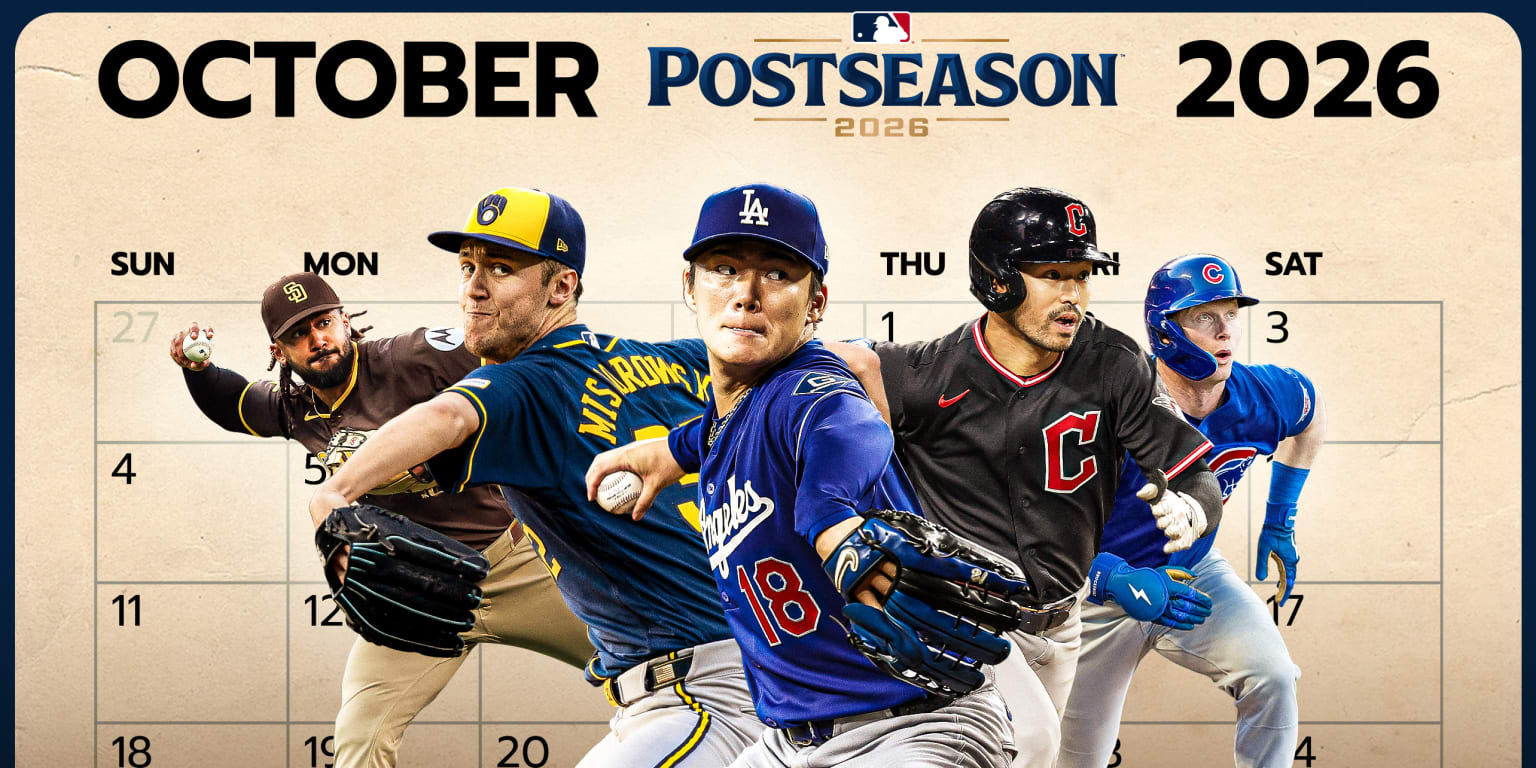
The best teams over 162 games and the clubs nobody wants to see in October are not necessarily the same.
The regular season and the postseason reward different things.
Over six months, baseball is a test of skill and depth. The weakest links eventually get exposed. A team can survive a thin rotation, a shaky middle-relief corps or a few light-hitting positions for a while – but it's much harder to hide those weaknesses over six months.
October is different.
The games are fewer, off-days greater. The urgency is heightened. Teams concentrate work among their best pitchers and lineups. Managers can shorten games with their best relievers. And one superstar hitter or ace can have an outsized influence on a short series.
Variance matters, too. A cleanup hitter can go 2-for-20 in April and the season keeps moving. Go 2-for-20 in October and the season might be over.
“Scary” is not necessarily the same as “best.” It is about concentration of talent, the ability to hide weaknesses, who is peaking at the right time, and the number of ways a team can make a short series tilt quickly.
I started with a simple framework: Which teams can shorten a series with two or three dominant starters? Which have a bullpen capable of essentially ending a game after five or six innings? Which lineups have enough power to avoid having to string together three or four hits against elite pitching? Which teams have deeper lineups to grind down opponents?
Who are the teams nobody wants to see in October?
The concentrated dynamo: the Dodgers
The Dodgers are the obvious answer.
Yes, they have some health question marks with Blake Snell and Shohei Ohtani. Yes, Edwin Díaz has not been the end-game piece they were hoping for in the bullpen. And, yes, their overall team slugging is down double-digit points from each of the last two years as well. But they are still a heavy World Series favorite no one wants to play.
A rotation led by Snell, Tarik Skubal, Yoshinobu Yamamoto and Tyler Glasnow is as good as it gets, and they are backed by a lineup that, while aging, still ranks as one of the best in the game. The market and models still believe they are the team to beat; FanGraphs gives them a 29.3% chance to win the title.
The team without a weakness: Brewers
While the Dodgers are the favorites, there's a case to be made that the Brewers are the scarier October opponent.
The Brewers, not the Dodgers, lead the Majors in run differential.
And after struggling out of the gate, Milwaukee is 82-44 since May 1 – five games better than the Rays, the next-ranking team. They've been above average in every month since April.
The terrifying thing about the Brewers is that there isn't an obvious way to attack them.
They have the most dominant pitcher in the game this year in Jacob Misiorowski, who unlike in his rookie year has shown no signs of slowing down. Misiorowski remains dominant in the second half with a 29% K-BB mark. His elevated velocity has held steady. And nearly as unhittable in the second half is Logan Henderson, who sports a 2.22 ERA, is holding opponents to a .171 average, and enjoys a 26.9 K-BB% mark since the All-Star break.
Getting the starter out doesn't make life easier either. The Brewers' reliever corps ranks fourth in ERA (3.41) and third in fWAR (6.6) out of all 30 teams.
Supporting those arms is an excellent defense.
And while the Brewers lack elite power, they string together quality at-bats with seven qualified Brewers hitters having an OPS+ of 100 or better, trailing only the Dodgers (eight) in the projected postseason field. The Phillies, by contrast, have two.
They are also trending the right way. The Brewers are 17-9 over the 30 days, tied for the second-best mark in baseball.
FanGraphs gives the Brewers the second-best title chances after the Dodgers (13.9%). They are a team built for the regular season and October.
OK, those are obvious contenders. What about other clubs?
The middling (potential) division winner: Guardians
After what was looking like a lost season just weeks ago, the Guardians are on the cusp of earning a playoff berth – and perhaps a bye –- in an extremely wide-open American League.
The Guardians were one of the teams that actually won the Trade Deadline. Those added reinforcements, along with some positive regression from first-half slumpers like Steven Kwan, picked up a sluggish offense. They rank eighth in the Majors in runs since Aug. 1 (216 entering Tuesday).
A less obvious October advantage? Cleveland leads baseball in the percentage of plate appearances in which it enjoys the platoon advantage, at 77%, compared with a league average of 58.3%. In a five-game or seven-game series against a manager trying to optimize every matchup, that can become consequential.
And what really makes this team dangerous is the pitching staff.
The Guardians are one of three teams projected to be in the field that roster two pitchers that rank in the top 10 of fWAR in the second half of the season (the Dodgers are another, along with the Phillies).
Gavin Williams and Parker Messick have emerged as front-line starters this year. Tanner Bibee is a strong No. 3. While middle relief has hurt the club all season, being able to move a starter to the relief group should build a better bridge to closer Cade Smith.
Most teams that spend much of a season hovering around .500 don't have this kind of top-end pitching.
The Guardians are also hot, tied for the second-best record (17-9) in the Majors over the last month – tied with the Dodgers, Brewers, Braves and Padres – entering play Tuesday. Only the Rays (19-8) are better – but the Rays don't quite have the Guardians’ top-end starting pitching depth.
As the playoff picture stands entering Tuesday, the Guardians would face the winner of the White Sox (+42 run differential) or Rangers (-34 run differential) in the ALDS, with AL East clubs competing on the other side of the bracket. That's an extremely favorable path for a team with sneaky upside.
The unusual build: Cubs
The Cubs are perhaps the strangest team on this list because their postseason case is built around the idea that an elite lineup and defense can overwhelm the quality and concentration of October pitching.
The Cubs lead the Majors in runs (835), home runs (217) and wRC+ (115) for the season, and -- third baseman Alex Bregman's uncertain status notwithstanding -- they're getting better.
In the second half they've posted a 125 wRC+, 25% better than league average, and they've combined for a 134 wRC+ over the last month. That's an incredible number.
The 2018 Dodgers are an interesting comp. They led the NL with a 111 wRC+, including a 134 mark over the last 30 days of the season – just like these surging Cubs. They were also an elite defensive team lacking an elite rotation.
Those Dodgers won a relatively modest 92 games in the regular season but advanced to the World Series. Perhaps the Cubs can, too. While an ace makes life easier, there are different paths through October.
The wild card among wild cards: Padres
If you believe in timing and momentum, believe in the Padres.
For much of the season they have been a confounding team, much like their face of the franchise, Fernando Tatis Jr.
Recall that Tatis Jr. did not homer until May 30, but he has hit 24 since the start of June, and 10 in the last month. He ranks eighth in the Majors with a 150 wRC+ since the start of June.
Tatis isn't the only San Diego star playing his best baseball when it matters most as Jackson Merrill leads the club with a 162 wRC+ over the last month. Ty France has matched that mark.
Over the last month, the Padres are third in baseball with a 118 wRC+.
Moreover, the pitching has become more interesting – deeper and healthier – at exactly the right time.
Nick Pivetta returned from his long absence to post a 1.93 ERA over three September starts.
Michael King has outperformed peripherals to become a 12-game winner with a 3.03 ERA. Robbie Ray, acquired at the Trade Deadline, gives them another veteran option.
They also have one great postseason advantage: If they can hand a lead over to the bullpen it's lights out with Adrian Morejon and Mason Miller closing out games.
The Padres own the end game, and at no time does that matter more than in October.