
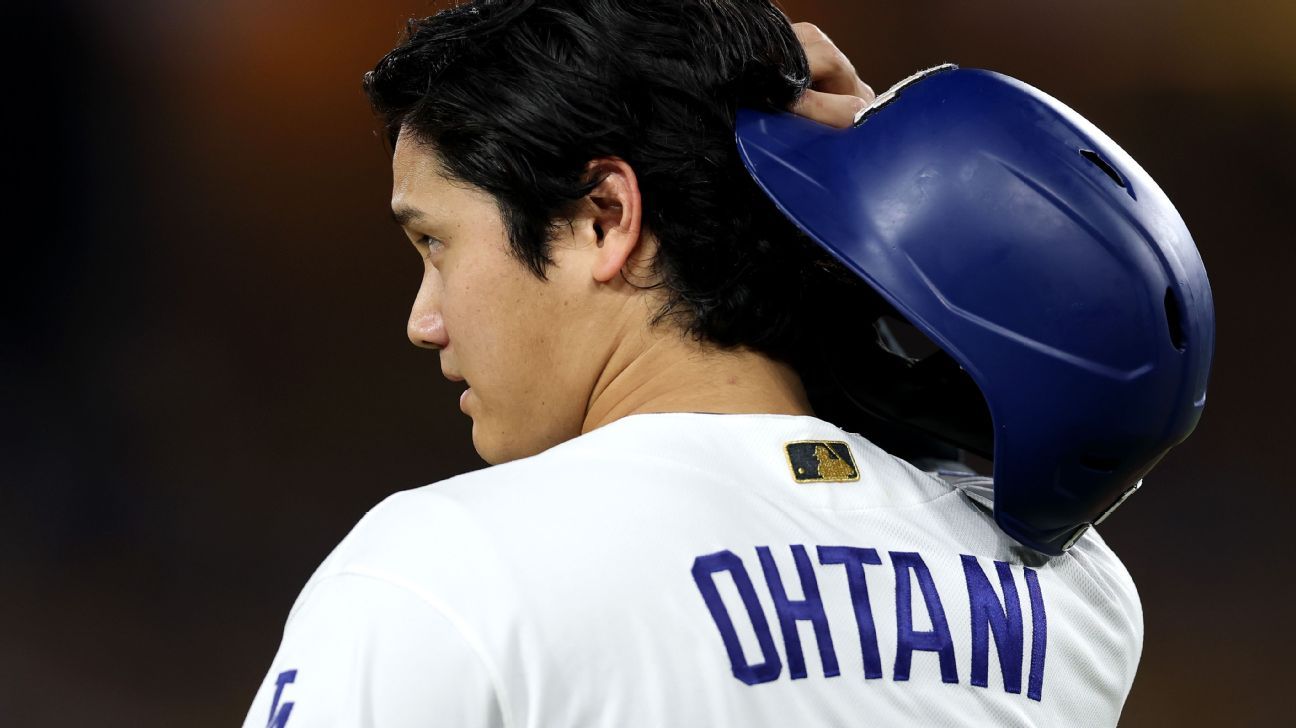
SHOHEI OHTANI WASN'T supposed to remain an exception.
At one point, he was expected to be a trailblazer.
When Ohtani arrived in the major leagues as a two-way player in 2018, he was thought to be carving a path for others to follow. He wasn't just unique; he was stretching the bounds of what was possible in a sport long defined by convention. His success was potentially groundbreaking. And yet, it has occurred in a vacuum.
No other two-way players exist in the major leagues, and very few of them are being developed in the minors. Over these past eight years, while consistently performing as one of the game's best hitters and frequently taking the mound as one of its best pitchers, Ohtani has stood alone. In that time, pitching has become even more advanced, a universal designated hitter was introduced, and breaking through as a two-way player has only grown more difficult. As it was before Ohtani, countless players who starred as hitters and pitchers at the amateur levels continue to specialize as they navigate the professional ranks.
Such as Michael Harris II, Carson Benge and Jo Adell, who were heavily scouted as pitchers but migrated to the outfield. Or Jac Caglianone and Bryce Eldridge, who were told in predraft meetings they'd have the opportunity to do both but never did. Or Jake Cronenworth and Nolan McLean, who pitched and hit in the minor leagues and left it there. Or Michael Lorenzen, who came as close as anyone but hasn't taken a major league at-bat in five years.
They've been left with wonder, but also, in some ways, relief.
"I kind of wish I would've done both," Harris, the Atlanta Braves' fifth-year center fielder, said. "At the same time, my arm doesn't hurt right now, so I'm happy with where I'm at."
Ohtani's road to being the first two-way player since Babe Ruth -- who juggled both roles when the sport was nowhere near as refined, and basically stopped pitching by the age of 25 -- has been littered with ailments, including Tommy John surgery in 2018, knee surgery in 2019, a second repair of his ulnar collateral ligament in 2023, shoulder surgery in 2024, and now, continual knee discomfort every time he toes the rubber.
Ohtani has not pitched in a game since July 3, and there's no telling when, if ever, he will again. Amid that, his offense fell off, prompting a stint on the injured list to address other ailments, most notably pain in his right arm. If Ohtani's four MVPs are a testament to what's possible when boundaries are pushed, his 2026 season is indicative of why nobody else is doing it.
Los Angeles Dodgers general manager Brandon Gomes called the chances of another two-way player someday following Ohtani "close to zero."
The bar just to be a designated hitter in the major leagues is exceedingly high, Gomes noted. Meeting that threshold while juggling all the work required of starting pitchers is immensely difficult. Performing both at high enough levels to fend off the public pressure to give one of them up, as Ohtani often does, feels impossible.
"I just don't know who can do that," said Gomes, who pitched in the big leagues for five years and previously ran the Dodgers' player development department. "You have to be so highly skilled, a freak of nature physically and also mentally confident enough to be like, 'I can throw a 12-pitch bullpen at 60% to conserve my energy, and I'm more than prepared to go pitch in a game.'"
Adell played alongside Ohtani with the Los Angeles Angels for four years and often marveled at how meticulous he was with his work. Ohtani could hit balls farther and throw them harder than just about anybody, but he was also uniquely in tune with how his body was working and what it needed on a given day. The Dodgers give Ohtani more leeway than any other player because of that.
The next two-way player would need to have transcendent talent, but also, in Adell's mind, a level of precision and focus that only Ohtani seems to possess.
"I think there's going to be probably a few more to maybe attempt to do what he's done, but it's very difficult," said Adell, now with the Cleveland Guardians. "It's really the workload management part of it. Because you get halfway through the year, and you're trying to get your bullpens in, you have arm fatigue, your swing's not feeling good, but you got to do both. It's a tough task."
LORENZEN STILL THINKS about one game from seven years ago.
The Cincinnati Reds were in Pittsburgh on Sept. 27, 2019, and Lorenzen started in center field. By the seventh inning, the score was tied and Lorenzen was summoned to pitch. He held the Pirates scoreless, came to bat in the top of the eighth, drove in the go-ahead run, threw another scoreless inning in the bottom half, then went back out to center field for the ninth.
"It was college again," Lorenzen said. "It was incredible. I wish I could still do that."
Since Ohtani debuted, no major leaguer has gotten closer to replicating him than Lorenzen. With the Reds in 2019, Lorenzen compiled 83â  innings as a reliever and 89 innings as an outfielder. Since then, though, he has been almost exclusively a pitcher. He laments not getting "a long enough leash" and believes the universal designated hitter, permanently implemented in 2022, "really screwed me." The expanded rosters instituted during the COVID-19-shortened 2020 season, which lessened the need for versatility, also didn't help.
When the Colorado Rockies signed Lorenzen to an $8 million contract this past offseason, they thought about gaining the extra roster flexibility by occasionally having him hit. But they never went through with it. Lorenzen, now a member of the Toronto Blue Jays, still hits off a pitching machine to keep his eyes acclimated to high velocity, just in case. He admits that it takes "a special mind" to be a two-way player in the major leagues, but he believes the lack of another is largely the product of a rule.
In an effort to lessen the prevalence of position players pitching, Major League Baseball began to categorize position players and pitchers in 2020 and stated that, with few exceptions, only pitchers can pitch. The rule also carved out a path for two-way status, a designation that essentially grants teams an extra pitcher. To qualify, for that season and the one after, a player needs to compile at least 20 innings as a pitcher and play at least 20 games as a position player, with at least three plate appearances in each of those games.
That last part, some players believe, is too onerous. So onerous, in fact, that it disincentivized two-way players at a time when guys such as Lorenzen, Jake Cronenworth, Jared Walsh and Matt Davidson were all aspiring to become one.
"It's unfortunate that that was the case because I think we would see a lot more guys if not for that," Cronenworth said. "It's just so hard to do it now."
An MLB official said the threshold was put in place to reward legitimate two-way players and prevent teams from leveraging the qualifications to gain two-way status by, for example, finding at-bats for pitchers in lopsided games throughout a season. The official added that the league has not heard any complaints from teams or players and is therefore not considering an adjustment to the rule.
With the Tampa Bay Rays' Triple-A affiliate in 2019, Cronenworth compiled 406 plate appearances but only made seven appearances on the mound, though he put up a 2.45 ERA. He was in the same organization that drafted Brendan McKay and Tanner Dodson as two-way players and saw it as a realistic part of his future.
Cronenworth joined the San Diego Padres in an offseason trade but was still throwing bullpens at their facility in the early part of spring training in 2020. Then the COVID-19 pandemic shut down the sport. When baseball returned, Cronenworth was strictly a position player. He hasn't pitched since.
He still thinks about what could have been.
"I know it would've been fun, that's for sure," said Cronenworth, now in his seventh season in the big leagues. "What would it have looked like? I have no idea. I was having fun and it was cool, and it was a lot."
BEFORE THE San Francisco Giants drafted Eldridge 16th out of high school in 2023, they showed him a 3D overlay of his swing and Ohtani's to show him how similar they were.
Like Ohtani, Eldridge could also pitch. As a senior at James Madison High School in Vienna, Virginia, he put up a 1.06 ERA with 66 strikeouts in 39â  innings on the mound and hit .422 with eight home runs and a 1.716 OPS in the batter's box.
But when he joined the Giants' minor league system, there was no pitching plan for him. He saw the writing on the wall then. A bum shoulder that materialized right around that time didn't help, either. Eldridge would occasionally remind coaches and team officials that he could pitch, but he never threw off a mound. Instead, he shot up to the big leagues as a 20-year-old first baseman last September.
"I would've loved that opportunity," Eldridge said. "I think I could've been good at it. But I'm happy where I'm at. I don't think I would be here at the age that I am if I were doing both."
Eldridge's case is the norm. As baseball becomes more difficult, its players specialize at earlier ages than ever. Even now, with teams seeing what's possible with Ohtani, the time, patience and money required to make a two-way player work in the professional ranks "would necessitate an extreme talent justification," a front office executive said.
"It's hard enough to develop starting pitching right now, much less develop a starting pitcher who also happens to be capable of hitting in a major league lineup," he added. "The talent simply doesn't exist, and even the ones that flash that type of potential get pushed to one path once they start to struggle. Ohtani isn't the guy with the torch, leading the way for others. He's the only guy. Nobody is following him."
When McKay was drafted fourth in 2017, he was considered the best two-way player to come out of college since Dave Winfield 44 years earlier. But injuries decimated his career. In the years since, only six players have been selected with a two-way designation, according to MLB's draft tracker. That number is incomplete but not by much.
There are only a handful of two-way players in the minor leagues, most of them in the lower levels. The most notable are Seong-Jun Kim and Josh Owens with the Texas Rangers, both of whom are in Single-A. The Athletics have one in Shotaro Morii, the Boston Red Sox have one in Conrad Cason, and the Cincinnati Reds just drafted one in Kenny Ishikawa. They're all at least three levels away from the major leagues. The chances of any of them maintaining both skill sets for very long is miniscule.
"I think people will," Benge said when asked if someone will follow Ohtani eventually. "But you also got to be the best in the world at both, so it's a pretty tough thing to do."
You also need leverage. Ohtani remained in Japan coming out of high school in 2012 because the Nippon-Ham Fighters lured him with a plan to develop him as both a pitcher and a hitter. When he finally decided to come to the United States to play in the major leagues, he picked his team based largely on who would help him be a two-way player at the world's highest level. The same occurred when he went into the free agent market after the 2023 season.
Three years later, his two-way status seems as fragile as ever.
Ohtani, who turned 32 in July, pitched like a potential Cy Young Award winner in the first half of this season, posting a 1.79 ERA in 14 starts. His production offensively continues to rank among the best in the sport, as evidenced by his 142 weighted runs created plus. But Ohtani's body has betrayed him for the better of these past three months.
Ohtani admitted last week he is "most likely" not going to pitch again this season, adding that he is "focusing on hitting moving forward." Given his age, the labor uncertainty that clouds over the sport and the overall fragility of juggling two roles simultaneously, it's probably fair to wonder if we'll ever see him pitch and hit simultaneously again. The Dodgers will basically let him try for as long as he feels capable, but nobody -- not even Ohtani himself -- knows how long that will last.
As for whether anyone will follow? That, too, is an open question.
"I think it's not the last time we see it," Eldridge said. "It's just -- I mean, that guy was built in a lab. I'm not quite sure where he came from. He's a stud. I think we'll see it in the future, especially as technology continues to get better and people have a better look at it, see how he went about his business and his routine. Maybe the coaches in Japan who helped him do that will write some sort of book or something."
ESPN's Jorge Castillo and Bradford Doolittle contributed to this report.