
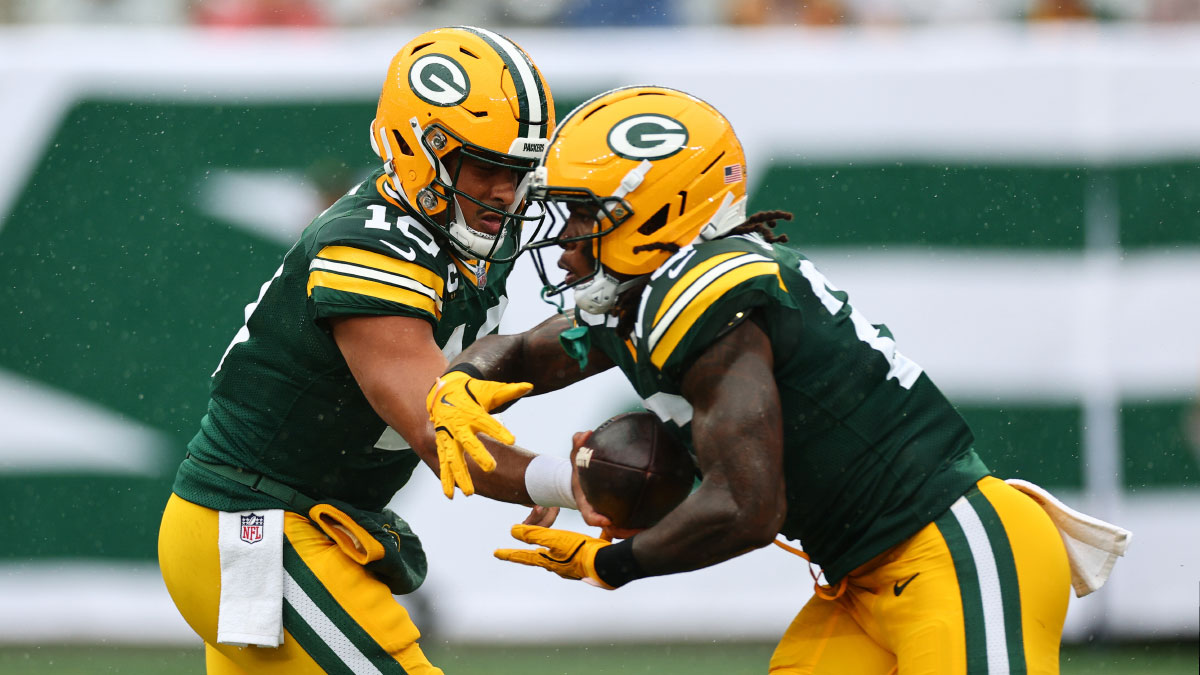
The Green Bay Packers enter November with a reason to protect their roster rather than dismantle it. Thursday's 27-19 win vs. the Carolina Panthers improved Green Bay to 5-3, keeping its deadline decisions focused on supporting a playoff push.
Still, competing does not require keeping every veteran or developmental player. General manager Brian Gutekunst can consider moving someone whose value elsewhere exceeds his current role, especially if the return helps address another position or replenishes draft capital.
With the NFL trade deadline set for November 10, Jonnu Smith, Keisean Nixon and Kaleb Johnson present three different cases. This ranking assesses plausible departures as of today. It does not suggest all three are available or that any departure is inevitable.
3. Kaleb Johnson's shrinking role creates a decision
Johnson ranks third because his place in the backfield has narrowed, but trading him again would require another team to see development potential worth acquiring.
The Packers acquired the 23-year-old from the Pittsburgh Steelers in August for a 2028 sixth-round pick. He has produced 104 rushing yards on 28 carries this season, averaging 3.7 yards per attempt without a rushing touchdown.
More revealing is his recent game-day role. Johnson was inactive vs. the Panthers, and Green Bay's latest published depth chart places him behind Josh Jacobs, MarShawn Lloyd and Pierre Strong Jr.
A team seeking an inexpensive developmental runner could view Johnson as an opportunity to evaluate a former third-round selection without paying a premium. Green Bay could consider a modest draft return if it no longer sees a realistic role for him.
However, the Packers should avoid treating his inactivity as proof that he has no future. They already invested a pick in acquiring him, and injuries can quickly change a backfield. A nominal offer would provide little reason to abandon that investment.
2. Keisean Nixon's contract invites consideration
Nixon ranks second because his expiring contract creates a decision, while his starting role makes any transaction harder to justify.
The veteran cornerback is playing the final season of the three-year deal he signed in 2024. Green Bay must weigh his remaining contribution against whatever another team might offer for immediate help in coverage.
The Packers have alternatives on the roster. Their latest published depth chart lists Carrington Valentine behind Nixon, with Brandon Cisse and Benjamin St-Juste at the other outside cornerback position. That gives the coaching staff options, although options are not the same as proven replacements.
A buyer would acquire experience without committing to multiple future seasons. For Green Bay, a worthwhile return could recover value before free agency, particularly if the organization prefers a different long-term arrangement at cornerback.
The obstacle is competitive. Trading Nixon would remove a starter from a team trying to reach the postseason. The Packers should require a convincing replacement plan, not assume younger players can absorb his assignments without consequences.
That condition keeps Nixon below Smith. His contract creates trade logic, but his importance to the current defense raises the threshold for actually completing a deal.
1. Jonnu Smith offers the clearest trade case
Article Continues BelowSmith offers the clearest combination of a reduced role, an expiring contract and a recognizable receiving resume.
The 31-year-old signed a one-year, $2 million contract in August. Through eight team games, he has six receptions for 94 yards and no touchdowns. He was inactive vs. Carolina, underscoring how limited his immediate role has become.
The Packers list Tucker Kraft ahead of Smith, with Mark Redman and Josh Whyle also available at tight end. That structure gives Gutekunst a more credible path to moving Smith than subtracting a starting cornerback.
For an acquiring team, the attraction would be experienced receiving depth at a manageable remaining cost. Smith's 2024 season with the Miami Dolphins included 88 catches, 884 yards and eight touchdowns, although buyers must evaluate his current ability rather than purchase that production on reputation. His 2025 production fell to 38 catches for 222 yards with the Steelers, a reminder that his earlier breakout does not establish present value.
A late-round selection or conditional pick would be a reasonable negotiating framework, not an established asking price. Green Bay should consider it only if the compensation outweighs keeping experienced insurance behind Kraft. A pick swap could also work if both teams value the smaller adjustment.
Smith leads this ranking because his departure would demand the smallest immediate adjustment. Johnson remains a development decision, and Nixon requires a defensive succession plan. The Packers can explore each market while recognizing that keeping all three might still serve their season best.