
Earlier this week, I ranked the NBA's top offenses. It's something I do before every season, and it's an agonizing process because, on paper, the best versions of most NBA offenses look great. I typically find myself worried that some team I rank in the 20s will make me look foolish simply because I underrated them in a crowded field.
Well, that's pretty much exactly what actually winds up happening with the defense rankings. Last year, I predicted that the Boston Celtics would have the No. 22 defense, and they wound up at No. 4. I had the Phoenix Suns at No. 23. They finished at No. 9. Building a high-level NBA offense is typically an arduous process that involves years of talent accumulation. Surprises tend to be more common on the defensive end.
The right culture and strategy, paired with a bit of shooting luck, can bolt a team up the leaderboard fairly quickly. In an 82-game season that wears down even the deepest of teams, you can get pretty far by playing hard and plucking low-hanging fruit. There are always some surprises at the end of the season, so let's start trying to figure out who those surprises could be. Below are my pre-season rankings of all 30 NBA defenses, a projection of how the defensive rating leaderboard will look at the end of the season.
1. Oklahoma City Thunder
- 2025-26 defensive rating: 106.5 (1st)
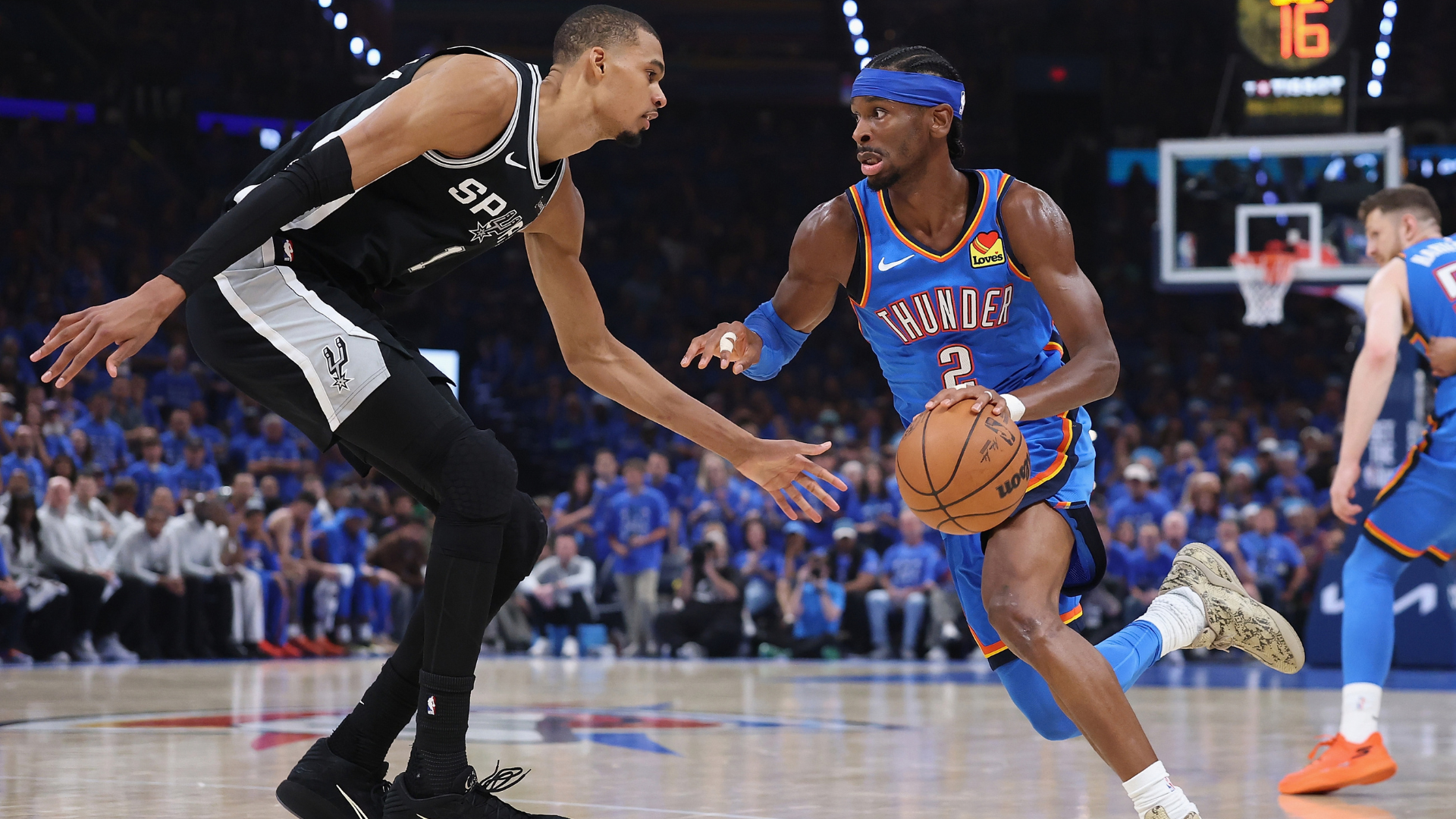
There are really only two candidates for No. 1, and the Thunder are probably the safer pick. Their excellent defense is less tied to a single player than San Antonio's, making it easier for them to withstand injuries. They're an elite turnover-generating defense that somehow barely ever fouls (well... at least according to the whistles, don't consult social media on this matter). After drafting Aday Mara to pair with Chet Holmgren and Isaiah Hartenstein, they easily have the deepest collection of rim protectors in basketball. They allowed the fewest fast-break points per game last season because they never turn the ball over. There are questions here, but they're so minor that they hardly matter. Losing Lu Dort chipped away at their stellar wing depth and probably cost them their best options for burlier scoring forwards. They're going to devote a fair number of minutes to younger players with plenty to prove defensively (Nikola Topić, Thomas Sorber, Bennett Stirtz), creating vulnerabilities that didn't previously exist. But we're splitting hairs here. The Spurs and Thunder will be dominant defensively, and either could finish No. 1.
2. San Antonio Spurs
- 2025-26 defensive rating: 110.4 (3rd)
There is a very real chance that this will be the first of many No. 1 defensive rankings for the Spurs during the Victor Wembanyama era. His presence speaks for itself. He is the most imposing rim-protector in modern NBA history. The Spurs are the best defensive-rebounding team in the NBA and a downright dominant one when he's on the floor. They never give anything up in transition. They never generate turnovers, but... why bother gambling when you never foul and just know you're going to force bad shots and get every rebound anyway? The leap here, aside from the potential for further Wembanyama improvement, boils down to the young players. Dylan Harper and Carter Bryant are both in line for bigger roles this season, and both were stellar rookie defenders. Pair them with Wembanyama and Castle, and there's just no ceiling on how good the Spurs can be.
3. Toronto Raptors
- 2025-26 defensive rating: 112.1 (5th)
Kawhi Leonard is probably the best defensive non-center of the 21st century. There are going to be Toronto lineups in which you could argue that he is the worst defender on the floor. That's how good and deep the Raptors are, because Leonard remains stellar in the right role. With Scottie Barnes and Collin Murray-Boyles covering everyone and Ja'Kobe Walter and Jamal Shead hounding the ball, opponents now get to face the harrowing prospect of Leonard taking lower-leverage defensive assignments and using that newfound freedom to get into every passing lane and generate a handful of turnovers every night. That's this defense's calling card. The Raptors may lead the league in turnovers generated, yet they're so good everywhere that they really won't have to compromise the integrity of their defense elsewhere to do so.

4. Detroit Pistons
- 2025-26 defensive rating: 108.9 (2nd)
Leonard is the best defensive non-center of the century... but Ausar Thompson is the best of today, and potentially the best one since Leonard's peak. He genuinely does everything. The Pistons get away with Jalen Duren's so-so rim protection because Thompson, in addition to torturing ball handlers, is a monster rim deterrent. No team generated more turnovers a year ago. The Pistons will need him to cut down on the fouls a bit, because the flip side of that turnover coin is that no team fouled as often as the Pistons did. Detroit has made a conscious choice to lean into physicality as an identity, and that extends well beyond Thompson. It's a shame he and Ron Holland share the same offensive deficiencies, because Holland is a killer defensive understudy. The questions here relate to the rest of the rotation. Isaiah Stewart is gone, and the backup center role now belongs to the more offensively inclined Paul Reed. The addition of Isaiah Joe was aimed at ensuring there would always be shooting on the floor, but that shooting comes at a defensive cost.
5. Houston Rockets
- 2025-26 defensive rating: 112.1 (6th)
Amen Thompson isn't quite as good defensively as his brother, but he was also asked to do far more offensively last season. With Fred VanVleet returning, Thompson can hopefully scale his defense back up a bit. There are wings for days here with Marcus Smart joining Jabari Smith and Tari Eason in one of the most versatile collections of perimeter defenders in basketball. Alperen Sengun may not be a great defender in his own right, but Ime Udoka loves to overwhelm opponents with size by pairing Sengun with Steven Adams in double-center lineups and playing them in zones. Udoka has never coached a team that has finished outside of the top 10 defensively, and this year should be no exception.
6. Miami Heat
- 2025-26 defensive rating: 113.6 (14th)
Historically, no team plays more zone than the Heat. It wasn't even close last season. They were in zones in 16.3% of their defensive possessions, per Synergy Sports. Only one other team was even above 6%. How will their scheme change with Giannis Antetokounmpo in place? He's slipped a bit defensively, but it's been years since he's had this kind of support. Bam Adebayo is a star defender. Davion Mitchell is a killer point-of-attack defender. Andrew Wiggins is solid. Pelle Larsson is underrated. Miami always rebounds well. The questions here come down to Antetokounmpo's calves and the defensively vulnerable players they'll have to use for offensive purposes, like Klay Thompson and Tim Hardaway Jr. Give Erik Spoelstra tools like this, though, and you're bound to wind up with an elite defense.

7. Boston Celtics
- 2025-26 defensive rating: 111.7 (4th)
No team allows fewer shots in the restricted area than the Celtics. It's not even close. Boston has a defined formula, and while it leaves some glaring holes, it makes them impenetrable in priority areas. They allow nothing at the basket or in the corners, they get every defensive rebound, and they give up nothing in transition because they never turn the ball over offensively. That's how you survive without generating turnovers of your own and giving up above-the-break 3s freely. They may not have a stellar on-ball defender to throw at opposing stars anymore, but they have incredible helpers and can switch across the entire positional spectrum with the right lineups on the floor. Don't overthink this. The Celtics are great defensively every year.
8. New York Knicks
- 2025-26 defensive rating: 112.3 (7th)
There were real questions before last season about whether a team that was vulnerable defensively at point guard and center could win a championship. Well, the Knicks answered those questions by Karl-Anthony Towns growing out of his defensive vulnerability. He was stellar last season, making it far easier for a Knicks team with great defenders everywhere else to protect Jalen Brunson. They allowed among the fewest shots in the paint in the NBA a season ago and were a great defensive rebounding team. They'll sorely miss the versatility Mitchell Robinson brought them off the bench, and the reality here is that their final backup center may not be on the team yet. But in a wing-obsessed NBA, it's hard to do better than OG Anunoby, Mikal Bridges and Josh Hart. There isn't a combination of stars in the NBA that those three can't guard.
9. Atlanta Hawks
- 2025-26 defensive rating: 112.9 (10th)
The Hawks were the only team in the NBA last season to finish in the top 10 of defensive rebounding rate and opponent turnover rate. Atlanta was among the best teams in the NBA at both taking away a team's first shot and preventing it from getting a second. The catch was that the Hawks were 19th in opponent effective field goal percentage, primarily because they give up a ton of shots at the rim. That's a reasonable tradeoff for all of the other things Onyeka Okongwu brings at center, though, and with Lu Dort coming in, the Hawks have one of the best groups of wing defenders in basketball.
10. Orlando Magic
- 2025-26 defensive rating: 113.6 (13th)
The Magic had back-to-back top-three defenses in 2024 and 2025. They slipped a season ago. New coach Sean Sweeney will attempt to course-correct, but the biggest issues here are health. When Jalen Suggs and Franz Wagner are healthy, the Magic are essentially a better version of what we described with the Hawks. They generate a ton of turnovers and get every rebound, except they're better at keeping opponents away from the basket. The trouble is that Suggs and Wagner have had a very hard time staying healthy lately, and Jonathan Isaac, perhaps the best per-minute defensive player in the NBA a few years ago, is already gone in large part because of his health issues. The Magic should be good. They have to prove they're healthy before they get called great again.

11. Indiana Pacers
- 2025-26 defensive rating: 117.9 (24th)
The whole here is better than the sum of its parts. There isn't a star defender here unless Ivica Zubac bounces back to his 2025 form, and Tyrese Haliburton has been a real liability at points. But everyone else ranges from "fine" to "good," and by virtue of never turning the ball over on offense, they severely limit transition opportunities for opponents. Their own breakneck pace wears teams out over the course of games, and they help themselves on that front with their full-court pressure. Adding Zubac could be transformative for their defensive rebounding, as Myles Turner is among the weakest rebounding centers in basketball.
12. Minnesota Timberwolves
- 2025-26 defensive rating: 112.5 (8th)
The Pacers are an "everyone is good" defense. The Wolves are a defense of extremes. Rudy Gobert and Jaden McDaniels are in the All-Defense conversation every year. LaMelo Ball and Jonathan Kuminga? Not so much, despite having the physical tools to hold up defensively. Anthony Edwards tends to save his best defensive work for late in games, and hopefully Ball's presence eases his offensive workload enough for him to scale up defensively. There are question marks all over the bench, and they weren't a great rebounding team even when their front court size was their identity. Their baseline is high so long as Gobert and McDaniels stay healthy, but they seemingly made the conscious decision to improve offensively at the expense of their defense, and they'll feel that this season.

13. Portland Trail Blazers
- 2025-26 defensive rating: 113.5 (12th)
Let's get the negative out of the way early. Ja Morant and post-Achilles Damian Lillard, should they indeed start together, have a chance to be among the worst backcourt defensive duos in NBA history. There's no beating around the bush. It's going to be a problem. The defense is airtight elsewhere, especially with Shaedon Sharpe out for a good chunk of the season. Toumani Camara is great. Jrue Holiday is great. Scoot Henderson is great. The hipster community's favorite center tandem (the emerging Donovan Clingan and the resurgent Robert Williams III) is great. Maybe Deni Avdija even bounces back defensively with less of an offensive burden on his shoulders. They're going to generate turnovers. They're going to protect the basket. They're going to get rebounds in Clingan's minutes. The question here is how good any defense can be with two deeply negative starters. This feels about right, and if one of the guards winds up coming off the bench, it will be even better.

14. Cleveland Cavaliers
- 2025-26 defensive rating: 114.1 (15th)
Cleveland has historically reaped the rim-protection benefits of playing two bigs together... but never the rebounding benefits. As valuable as the Evan Mobley-Jarrett Allen combination is, especially when it comes to ensuring a 48-minute baseline, there are major questions everywhere else. The Cavs traded for Peyton Watson in large part because the small forward next to Donovan Mitchell and James Harden needs to be able to guard any variety of perimeter player, from point guard through small forward, because neither has much of a chance against them. Watson has the versatility to do so, but this is by far the biggest defensive burden he's ever faced. One of Harden's defensive virtues has always been his ability to generate turnovers with his quick hands... but Cleveland mostly stopped generating turnovers around his arrival. You're going to be around average if you have the caliber of bigs the Cavaliers do, but problems elsewhere probably cap them here unless one or two of the younger players are surprising success stories.
15. Los Angeles Lakers
- 2025-26 defensive rating: 115.5 (20th)
We go from a team with two great defensive bigs to a team with one. If you're going to lean into offense to the degree that the Lakers have, getting a killer rim protector and playing a basic drop coverage scheme with someone like Walker Kessler at center makes plenty of sense. I have no earthly idea how they're getting stops in the minutes Kessler doesn't play, so his health is paramount here. Speaking of health, Matisse Thybulle was just about the perfect minimum-salary addition... if he can stay on the court. Luka Dončić teams are always slow offensively, so having defensive playmaking to generate transition opportunities is essential. Thybulle averaged just under 12 deflections per 48 minutes. There are potential defensive positives on this roster. Thybulle is the obvious one, but Jarred Vanderbilt and Adou Thiero stand out as well. The question is how much those guys can stay on the court -- both in terms of health and offensive viability. If they can, the Lakers are probably the third-best team in the West.
16. Philadelphia 76ers
- 2025-26 defensive rating: 114.4 (17th)
There's a pretty big range here, and it mostly comes down to Joel Embiid. His defensive mobility was pretty much gone last season. He's seemingly lost a fair bit of weight. If he can stay on the floor and actually move around a bit, the Sixers have something defensively. If not, things get harder. LeBron James is 42. He scales up defensively when it matters, but his night-to-night effort leaves something to be desired. Jaylen Brown is very good on the ball, but he doesn't bring all that much of it and he is no longer in Boston's excellent help ecosystem. With Paul George and Kelly Oubre gone, the Sixers don't have great defensive playmaking. They'll need VJ Edgecombe, just considering his youth and athletic upside, to step up in that regard. Nick Nurse has always been a great defensive coach, and he has interesting bench pieces here like Dean Wade and Adem Bona to work with. But Philadelphia's championship upside starts with its offense. The defense is probably going to lag behind.

17. Phoenix Suns
- 2025-26 defensive rating: 112.9 (9th)
The Suns built an identity last season as a gritty group of try-hards that out-hustled the rest of the league. How much of that identity is lost in the reshuffling of the roster? That has never been Jalen Green's M.O., for example, nor has it been Miles Bridges' despite his strong defensive tools. Losing Jordan Goodwin minutes means slipping defensively. How is the center rotation going to shake out? Mark Williams just re-signed on a three-year deal and Khaman Maluach will play more in his second year, but Oso Ighodaro is the best defender of the three at this point. Phoenix had a top-10 defense a year ago and has the tools to hang around that area this season, but I suspect their lineup choices, at least early on, lean more on perceived offensive upside and they take a step back.
18. Dallas Mavericks
- 2025-26 defensive rating: 115.5 (19th)
Masai Ujiri has only been running the team for an offseason, yet he's already "everybody is 6-9"-ified the Mavericks as he once did the Raptors. There are many pros to building this way, most notably in terms of switchability. There's something to be said for maxing out team size. This is still a very young group, though, one whose best rim protector, Dereck Lively, is still a major medical question mark. Max Christie is really the only reliable point-of-attack defender here as well, and he's merely fine rather than a major positive. Cooper Flagg profiles as a potential All-Defense candidate down the line, but the Mavericks probably aren't making the most of him by pairing him with so many power forwards. They'll probably be better at generating turnovers this year, but their rebounding without Lively will be a question. Give it a year or two. The Mavericks should eventually have a high-end defense. It's not there yet, especially with Dusty May, a coach making the transition from college to the NBA, at the helm.
19. Charlotte Hornets
- 2025-26 defensive rating: 113.5 (11th)
Ladies and gentlemen, may I present the best defensive rebounding team that does not employ Victor Wembanyama: the Charlotte Hornets. The Moussa Diabaté-Ryan Kalkbrenner-Hannes Steinbach trio should go a long way toward keeping the Hornets near the top of the league in this respect, and they'll need to stay there to survive in the possession-maxing era since they never generate turnovers. Much has been made of the Hornets having the NBA's best offense from early December on last season, but they also quietly had a top-10 defense during that span. There was a bit of shooting luck baked into that, though, and one of the benefits of a great offense is that it minimizes transition opportunities for your defense. Something closer to the middle of the pack feels more realistic for the Hornets.
20. Golden State Warriors
- 2025-26 defensive rating: 114.4 (16th)
This is right around where Golden State ranked after Jimmy Butler's injury a year ago, and the Warriors will have to hold on with limited resources until he and Moses Moody make it back midseason. Kristaps Porziņģis is already dealing with a mysterious health issue, and that just puts more pressure on Draymond Green and Al Horford to hold this thing together. The addition of Yaxel Lendeborg, one of the most pro-ready prospects in the 2026 NBA Draft, helps considerably here. That frontcourt trio should be able to switch a fair bit as Golden State prefers, and if Gary Payton II can still find minutes offensively, he'll help as well. But the reality of having a roster this old and this banged up defensively to start a season is bleak. They're an injury or two away from the Jenga tower collapsing here.

21. Washington Wizards
- 2025-26 defensive rating: 121.5 (30th)
Washington's best defensive trait is size. Aside from Trae Young, this team is huge. The Anthony Davis-Alex Sarr front-court is going to be imposing at the rim. Presumed starters Kyshawn George and AJ Dybantsa are both at least 6-8 and have a combined wingspan of nearly 14 feet. There's size and athleticism all over the bench. It's hard to take too much from a team tanking as shamelessly as the Wizards did a year ago, but Jamir Watkins has a real future as (at least) a defensive specialist. The two major caveats here are, of course, youth and the whole "aside from Trae Young" thing. In seven full seasons in Atlanta, Young's Hawks had exactly one above-average defensive ranking. He's among the NBA's most vulnerable defenders. That's not to say you can't build a high-level defense around him. Atlanta's personnel rarely put him in a position to succeed. But youth tends to be mistake-prone defensively, and until Davis signs an extension, we have to operate under the assumption that he could be traded (or, as is more often the case, get hurt). As is the case offensively, expect a modest improvement here, but they're still a ways away from where they need to get.

22. Memphis Grizzlies
- 2025-26 defensive rating: 118.4 (27th)
The highs defensively are going to be higher than this. There's real rim protection here between Zach Edey and Isaiah Stewart, and the Edey-Cameron Boozer duo should ensure that they rebound. There's real turnover-generation upside here as well, largely because Scotty Pippen Jr. is coming back. And if Kris Murray survives the roster crunch, he'll help a fair bit here, too. There are good defenders on this team. There are also a ton of rookies and real injury concerns, especially with Edey. The Grizzlies are also in such a transitional stage from a roster perspective that virtually every veteran will be susceptible to trade talks. Tuomas Iisalo's short-burst rotation strategy is another factor to watch here. Will defenders have more energy playing in shorter stints? Or will frustrations over a lack of offensive rhythm affect defensive effort? There's some variability here. The Grizzlies could approach average, but for now, it probably makes sense to start them in the bottom 10.

23. Utah Jazz
- 2025-26 defensive rating: 120.8 (29th)
The original theory of this team was that the rim-protecting duo of Jaren Jackson Jr. and Walker Kessler would be so good that the Jazz could overcome defensive deficiencies elsewhere, much like the Cavaliers have with Mobley and Allen. Well, the Lakers threw so much at the Jazz that Utah caved and traded Kessler. In the long run, that deal made sense. In the short run, it left Jackson with a distressing burden to bear. The Jazz had better hope Jusuf Nurkić is back soon, because Utah might be the worst rebounding team in basketball until he returns. Either we're going to see a lot of Josh Okogie early on, or the Jazz simply won't have a viable point of attack option to throw at opposing ball-handlers. Utah's offense could be great. They're just holding on defensively until they figure out their post-Kessler pivot.

24. Denver Nuggets
- 2025-26 defensive rating: 116.0 (21st)
Denver's saving grace defensively tends to be its rebounding, and the Nuggets ranked No. 1 on that front a season ago. Frankly, they'll need to do so again, because this team just isn't going to force enough misses to allow second chances on the ones that do come. A healthier Christian Braun helps. What EuroLeague "Best Defender" winner Alpha Diallo brings should be helpful. After that... avert your eyes. Peyton Watson is gone, and his absence underscores a really troubling lack of athleticism across the roster. DeMar DeRozan is set to play a critical role, and while his ball-handling will be needed, his defense has always been underwhelming. Aaron Gordon's health is becoming a perpetual concern. They never generate turnovers. They allow a ton of corner 3s. They avoid the absolute bottom of the list mostly because they're a veteran team with championship ambitions, so you'd hope effort won't become an issue, and because their offense is typically so good that they can minimize transition opportunities for their opponents. On paper, this might be the worst Denver defense of the Nikola Jokić era.

25. Los Angeles Clippers
- 2025-26 defensive rating: 115.2 (18th)
They have Jeff Van Gundy and a lot of very annoying on-ball defenders. No star enjoys an evening with Derrick Jones Jr. or Kris Dunn. Ready for a mind-bending stat? Last season was the first time Brook Lopez didn't lead the NBA in contested shots per game in a healthy season since the 2017-18 campaign. He's been one of the NBA's best stationary rim protectors for going on a decade now, but he's pushing the limits of what the word "stationary" can really mean defensively in his late 30s. There are already injuries everywhere. After years of heavily relying on older players, this season probably marks the team's transition toward its bench youth. Given the team's draft pick deficit, any veteran is fair game for trade rumors. Darius Garland is among the more vulnerable defensive guards in basketball. Things aren't looking great for the Clippers in any respect.

26. Brooklyn Nets
- 2025-26 defensive rating: 118.2 (25th)
The Nets have overperformed defensively whenever coach Jordi Fernandez has really been allowed to try. Brooklyn had the NBA's best defense between Thanksgiving and Christmas last season. You're really betting on the coach here if you expect the Nets to finish much higher than this, because the personnel is bleak. The notable positives are Day'Ron Sharpe, who's never been a full-time starter, and Keon Ellis, who mostly fell out of Cleveland's playoff rotation. Between the two of them, you're getting plenty of motor. Sharpe, in particular, has a chance to become a pretty interesting, switchable big that fits in a variety of pick-and-roll coverages. He's just not much of a rim protector yet, largely because he's undersized. After that? It's a lot of young players and offensively inclined veterans. Fernandez tried to make lemonade last season by structuring his defense around minimizing 3-point attempts, but given the holes elsewhere, there's only so much he can do.
27. New Orleans Pelicans
- 2025-26 defensive rating: 117.6 (23rd)
Full disclosure: when I initially typed out this list, I accidentally wrote "27. Herb Jones." That more or less sums up my feelings about the New Orleans defense. They have one All-Defense caliber player who can defend basically anyone in the NBA. And then, well, there's not too much more to say after that. Are the Pelicans really going to start Yves Missi at center? That's certainly the best defensive fit, but bringing recent lottery pick Derik Queen off the bench seems wasteful in a critical developmental season. A Zion Williamson trade would address this, but the Pelicans have thus far rejected overtures. After Missi, who's still a ways from his own peak as a rim protector, things just get bleak. This is a roster of individual shot creators, not defenders. Remember, despite being at the bottom of the standings a season ago, they were still trying to win because they didn't control their own first-round pick. They still ranked 28th in defensive rebounding rate and 17th in opponent turnovers per game while allowing the fifth-most shots in the restricted area and fourth-most corner 3s in the league. In a harder league, there's not much to cling to here.
28. Chicago Bulls
- 2025-26 defensive rating: 117.4 (22nd)
Nic Claxton suffered a hamstring injury at training camp, opening the door for an interesting potential lineup change. Jalen Smith has been the preseason starter at center, and his shooting opens the floor quite a bit for Chicago's young ball handlers. If the Bulls decide to lean in, their offense gets better. Their defense, however, gets worse. The question is by how much. Nic Claxton has been an All-Defense candidate in the past, but he's certainly slipped. The Bulls acquired him on the hope he'd bounce back, and given all of the big, athletic forwards on this roster, they have the personnel to lean into his strengths and switch. But this is still an exceedingly young group, with little at the point of attack or in the way of rim protection. The Bulls never generated turnovers a year ago, and their strong rebounding slipped without Nikola Vučević. Give it a few years. For now, the focus should be on surrounding Caleb Wilson and Matas Buzelis with shooting to facilitate their offensive growth. Defense can come afterward.
29. Milwaukee Bucks
- 2025-26 defensive rating: 118.3 (26th)
As with the Nets, you're betting on the coach if you believe in this defense. Taylor Jenkins led several great Memphis defenses. He has far, far worse defensive personnel this time around. Myles Turner was once a great rim protector and Kel'El Ware has the tools to one day become one. Neither is there now, and Turner's rebounding has always posed defensive issues for his teams. There's not a high-level point-of-attack defender to be found here, though not for lack of trying on Miami's part. The Heat tried to send Davion Mitchell to the Bucks in the Giannis Antetokounmpo trade, but Milwaukee, correctly in the long run, demanded Kasparas Jakučionis instead. This roster is half shooting guards. It's stuffed with young players years away from their final forms. The first year after trading away a franchise icon is rarely pretty.

30. Sacramento Kings
- 2025-26 defensive rating: 120.3 (28th)
Keegan Murray has been an above-average wing defender in the past. Dylan Cardwell's motor will keep you engaged when League Pass gives you an underwhelming late-night slate. A healthy Domantas Sabonis means the Kings will probably rebound well. That's more or less all I've got here. There wasn't exactly a selling point for last year's Sacramento defense. The Kings allowed the second-highest field goal percentage on restricted area shots a season ago and the third-highest corner 3-point percentage. They didn't generate turnovers or rebound especially well. They're starting a rookie point guard (Darius Acuff) and have several veterans probably bound for new teams in the near future. The Kings are at the beginning of a rebuild, and we're probably going to feel it defensively.