
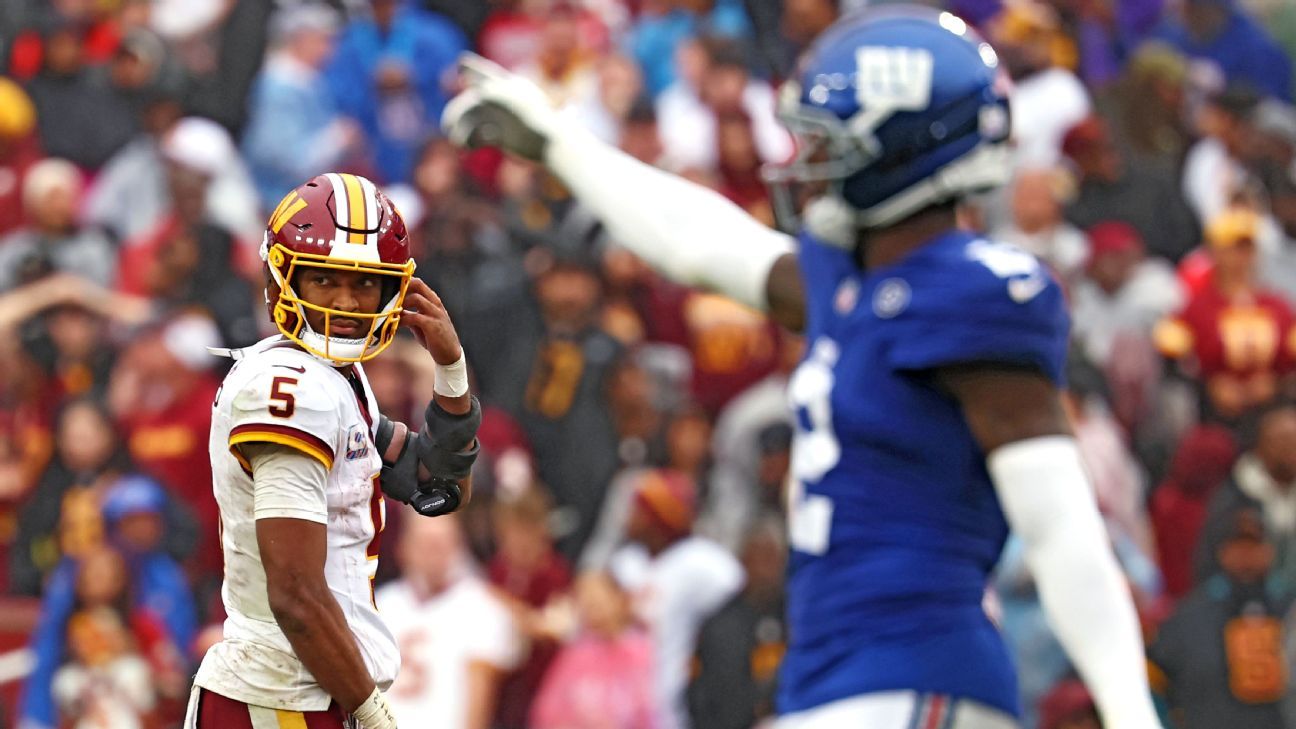
Two very different decisions -- one on the field and another off it -- had me asking the same question by Sunday afternoon on Week 5: What are they thinking?
There were the Commanders, who bizarrely decided to run the clock late in overtime against the Giants in field goal range and saw the game end without ever getting a chance to attempt the game-winning kick. And there were the Texans, who won their first game of the season and celebrated by making a surprisingly aggressive move on offense, trading second- and sixth-round picks to the Cardinals for a seventh-rounder and wide receiver Marvin Harrison Jr., who has underwhelmed during his pro career so far.
I love trying to explain the inexplicable, so let's give it a shot. Why did a 1-4 Texans team -- whose playoff chances sit at 23.2% after Sunday's victory, per ESPN's Football Power Index -- trade a significant future pick to acquire a player at a position where it already has Nico Collins? And what on earth were the Commanders attempting to do at the end of that game?
I'll try to answer both those questions today, starting with the decision to try to kick-start a frustrating season by trading for one of the league's most frustrating players.
Jump to:
The 1-4 Texans traded for Harrison?
The Commanders let the clock expire?


The Texans' trade for Marvin Harrison Jr.
Of course, the simple explanation for why the Texans traded for Harrison starts with one simple argument. We're about two and a half years removed from Harrison entering the 2024 NFL draft as arguably the most exciting and polished wide receiver prospect of his generation. Even amid a legendary run of Ohio State wide receivers that includes the likes of Jaxon Smith-Njigba, Chris Olave, Garrett Wilson, Emeka Egbuka and others, Harrison was seen alongside Jeremiah Smith as the two best pro prospects of the bunch.
Our various draft analysts saw Harrison as no worse than the third-best player overall in the class of 2024. There just aren't many players with Harrison's sort of scouting reports and college pedigree to ever enter the league. They don't come available via trade very often, and it's even rarer to get a shot at acquiring them just after they turn 24 years old.
The Texans have been through this under general manager Nick Caserio and don't regret their decision in the past. After drafting C.J. Stroud with the second pick of the 2023 draft, the Texans surprised everyone by trading two first-round picks and a second-rounder to the Cardinals to move up for edge rusher Will Anderson Jr. with the third overall selection. It was a move that seemed overly aggressive for a team that projected to be among the worst in football the following year, but it turned out to be a masterstroke.
The Texans were a playoff team with Stroud and Anderson, with the latter emerging as one of the most dominant defenders in all of football. Like Anderson, Harrison plays a premium position. And while we don't have access to Houston's scouting reports, this trade implies that it saw Harrison as a potential superstar entering the league after his run at Ohio State. Stroud, Harrison's college teammate with the Buckeyes, gave a glowing report to the organization and said that the wideout was "probably the hardest worker I've ever been around in my life."
The difference, of course, is that in Anderson, the Texans were trading up for a player with a great college résumé who hadn't yet played at the pro level. With Harrison, the Texans are trading for a player who has been outright disappointing as a pro over a multiple-season sample. He isn't a bad player, but he has hardly been great. Since 2024, he ranks 70th out of 130 wideouts in yards per route run (1.54) and 44th in receiving yards per game (47.8). He hasn't had great quarterback play, but Harrison has been roundly outperformed by Trey McBride and Michael Wilson within the same offense.
On one hand, Harrison's contract is extremely affordable, which is important for a Texans team that just paid Anderson and has deals for Stroud, Calen Bullock and Kamari Lassiter to come over the next 12 months. Harrison will make just $776,000 over the remainder of 2026 and $5.6 million in 2027. Even if the Texans decide to pick up Harrison's fifth-year option in 2028, that deal projects to come in at only $17.2 million.
That's a total of $23.6 million over the next three years, which is just a tiny bit more than what Jakobi Meyers is making per year on his existing contract. That number rises if you factor in the surplus value of the draft picks sent to the Cardinals, which throws another $33 million onto the pile -- but even $56.6 million over the next three years would be reasonable WR2 money right now. It'll look even cheaper as the cap rises over the next two seasons.
The Texans are obviously counting on Harrison delivering something more than solid WR2 performance and living up to his lofty predraft expectations. Will he get there? To answer that question, there were two places to look. First, I wanted to get a sense of why Harrison was struggling in Arizona to see whether a change of scenery might be likely to unlock the second-generation pro. Second, I looked back through history to find examples of highly drafted players turning things around in a second act with a new team.
What went wrong in Arizona?
The simplest answer is the one that Texans fans would fear the most. While there are mitigating factors and potential excuses to be made, the reality is that Harrison just wasn't able to get himself open often enough to get the sort of target share or rack up the sort of receiving production his draft status suggested was coming. While anyone with access to All-22 film and a lot of free time can undoubtedly find plays where he was open and didn't get the football, that's also true for any starting receiver in football.
During his time with the Cardinals, Harrison ranked last in the NFL among all wide receivers (with 50 targets or more over the past three years) in separation, averaging just 2.1 yards of separation when targeted, per NFL Next Gen Stats. Great receivers -- even ones that get plenty of attention from opposing defenses -- are typically able to create more space for themselves. The likes of Ja'Marr Chase and Justin Jefferson average over 3 yards of separation on their routes. In Arizona, McBride averaged 3.3 yards of separation on his targets during that time, while Wilson was at 2.5 yards.
In part because of those separation issues, Harrison didn't have a lot of chances to bring in easy targets. His expected catch rate over the past three years, using the Next Gen Stats model, was only 53.7%. That's fifth-lowest among wide receivers since the start of 2024. I'll get to the four below him in a minute.
By those expectations, the good news is that Harrison has roughly delivered about what the model would project given that low expected catch rate. He has caught 53.5% of his passes so far as a pro, almost exactly in line with the model's prediction. He has generated a total of 34 receiving yards over expectation across his 202 targets, which is also essentially a match for what the model suggests. You could make a case that Harrison has done an average job with below-average opportunities and hope that his expected catch rate will rise in Houston.
But my concern is that Harrison is not separating because he hasn't been explosive enough. The four other wideouts with lower expected catch rates are Alec Pierce, Tyquan Thornton, Marquez Valdes-Scantling and Christian Watson. Those are all deep threats who primarily make their money with their speed and ability to get open downfield. While they're going to draw targets that don't have great chances of being caught, the huge gains those receivers provide when they do bring in the football make up for the low catch rates.
Next Gen Stats also tracks speed, and given their route trees and athleticism, those guys unsurprisingly spike. Pierce hits at least 18 mph on 17.6% of his routes. Thornton's at 18%, while Watson gets there just under 20% of the time. Valdes-Scantling isn't on their level, but he's also in his 30s.
Harrison tops 18 mph on just 3.1% of his routes, which is both far below those players and way below the league average for qualifying wide receivers (6.5%). He has topped 20 mph on routes just four times as a pro, a shockingly low number for a player who topped 22 mph at the college level. Max speeds can be a product of the routes each receiver is called upon to run, but Harrison has been in the NFL long enough to run the full route tree.
If you try drilling down on the subset of players who both don't create a lot of separation (2.5 yards or less) and don't hit top speeds very often (getting over 18 mph on less than 4% of their routes), it's not a very promising group. There's Harrison and eight other players, most of whom aren't impactful NFL starters at this point of their careers. That list includes Keon Coleman, Gabe Davis, (very late-era) DeAndre Hopkins, David Moore and Nick Westbrook-Ikhine. Jauan Jennings is a better version of that player, but he also provides significant value as a blocker and after the catch.
The two exceptions are a pair of contested-catch stars in A.J. Brown and Mike Evans, players who create explosives for themselves by physically dominating defensive backs and create space by threatening those big plays and working back to the quarterback. That's the way Harrison probably has to succeed given his play style.
Those two are just much better at it than Harrison has been. Brown catches more than 54% of the tight- and neutral-window throws (3 yards of separation or less) in his direction that travel more than 10 yards in the air, the fourth-best rate in the league. Evans is at 49%. Harrison's at 40.2%, which is below the league average of 42%. And while quarterback effects could factor in there, both McBride (42.4%) and Wilson (45.7%) caught a higher percentage of downfield throws into tight or neutral windows than Harrison, all while getting open far more often in other situations.
So, in short, Harrison hasn't created much separation, isn't reaching the sort of NFL-level speed we associate with young wide receivers very often and hasn't been even average in contested or neutral catch situations downfield. His drop rate (5.0%) is worse than league average. And while his quarterbacks aren't award winners, just 16.4% of the throws in Harrison's direction have been off-target, which is lower than the league average of 20.6%.
Given those constraints, Harrison has generally done solid work. But he wasn't supposed to have those constraints. He was supposed to be a complete prospect, capable of running past players, outmuscling them or (most often) separating from them with elite route running. He hasn't done any of that consistently as a pro over a multiyear, multi-QB, multi-scheme sample. That has to be concerning given our expectations for him heading into the NFL.
Defenses weren't treating him like the guy they needed to stop in Arizona. At the end of the 2025 season, when the Cardinals played the Bengals, Cincinnati took top cornerback DJ Turner II and stuck him on Arizona's top wide receiver for the vast majority of the game. Only to the Bengals, that player was Wilson, not Harrison. Double-coverage rates are often exaggerated by announcers and fans (who often conflate a safety playing over the top as a double-team or bracket coverage on a specific player), but Next Gen Stats records only one true case of Harrison being double-covered over his first three seasons in the league.
Are there things the Cardinals could have done to make Harrison's life easier or factors that might influence those numbers? Probably, yes. Harrison was pressed at the line on 31.5% of his snaps, the 17th-highest rate in the NFL over the past three years. That might prevent Harrison from getting to top speed or creating easy separation as often as he might like. But there are also plenty of players who were pressed more often than Harrison who haven't had those issues, ranging from superstars such as Chase and Jefferson to role players such as Romeo Doubs and Kayshon Boutte. Nico Collins, Harrison's future teammate, has been pressed at the line on more than 37% of his routes over the past three years and has been far more productive.
Arizona also ran one of the more static offenses in football for most of Harrison's time with the Cardinals, using motion at one of the lowest rates in the game. Harrison has just four catches over three seasons on plays where he was put in motion before the snap or as it was imminent, producing a total of 39 receiving yards. The Texans use motion at the fourth-highest rate under offensive coordinator Nick Caley.
The Cardinals also rarely used Harrison in stacks and bunches during his time in Arizona, which can help prevent defenses from getting hands on receivers at the line and create communication issues on the defensive side. Harrison has run 26 routes out of stacks over his career, with just three of his 108 catches (2.8%) coming out of a pre-snap bunch. Zay Flowers, who has a league-leading 477 receiving yards over the past three years out of bunch looks, has caught about 16% of his passes as a pro out of stacks. About 11% of the catches by Texans wideouts over the past two years under Caley have come out of bunches.
These are the sorts of things I usually bring up as ways to make life easier for a receiver in his early-30s who might have lost a step and needs some help creating separation. It's not what I typically say about 24-year-olds, let alone first-round picks who were supposed to be as complete and impressive as Harrison was entering the NFL. To believe that Harrison's going to become that player, you have to basically believe that he's going to catch, move and run like a completely different player in Houston than the one we saw in Arizona.
I'm willing to believe that's possible given how high the hopes were for Harrison coming out of school. I just wanted to see whether anyone else had been able to pull this off in the past. Is there a meaningful track record of elite prospects who changed teams early in their careers and thrived in their new landing spots?
What does history tell us about the Harrison trade?
Teams typically don't want to move on from first-round picks this early in their careers, particularly if they're top-10 picks. In recent years, that's partly a product of how contracts are funded, with many first-rounders receiving most of their guaranteed money in an up-front signing bonus, leaving their teams with minimal cash to pay out over the remainder of their deals. The Cardinals, for example, paid $22.5 million of Harrison's $35.4 million rookie deal in a signing bonus before his pro career began. With just $12.9 million due over the next four years, even marginal performance from Harrison would typically be enough to justify a roster spot.
Still, players do get moved. We've seen two top-10 picks from the 2024 draft moved before the end of their third seasons in the NFL over the past two weeks alone, with Harrison (No. 4) dealt to the Texans and quarterback J.J. McCarthy (No. 10) shipped to the Giants. It's obviously too early to judge how those trades panned out. But what about the other times teams have traded away a top-10 pick before the end of his third season in the league? Have they been able to live up to their draft status in their new home?
The most famous example of an early-career trade leading to stardom in a second stop is Steve Young, who struggled with the Buccaneers before thriving with the 49ers. He doesn't fit here for a couple of reasons. One is that he was the first overall pick in the 1984 supplemental draft as opposed to the college entry draft. And while Young played only two seasons with the Bucs, he spent the 1984 season in the USFL before finishing the 1985 and 1986 seasons in Tampa, meaning he completed three full years before joining the 49ers.
Leaving aside other supplemental picks, players who were traded because they were suspended or players who were traded because they were holding out for more money, I can find 12 top-10 selections since 1980 who were dealt away before the end of their third season as a pro. None of them made it to a single Pro Bowl in their new homes or at any other point over the remainder of their careers. Those 12 players are:
McCarthy was just dealt to the Giants and made his debut in Sunday's tie with the Commanders.
QB Trey Lance lost his starting job via injury in 2022 and was deposed by Brock Purdy's emergence as the long-term answer in San Francisco. He was traded to the Cowboys for a fourth-round pick and has made two spot starts over the past two seasons (only one of which was in Dallas).
CB C.J. Henderson started just 10 games with the Jaguars before the Urban Meyer regime that inherited him dealt the 2020 ninth overall pick to the Panthers. Henderson has mostly been a reserve cornerback since then, although he's in the middle of his best year as a pro with the Falcons.
QB Josh Rosen was the 10th pick in the 2018 draft and didn't play well in his debut season with the Cardinals, leading Arizona to use the top pick the following year on Murray. Rosen was dealt to Miami during the 2019 draft for a second-round pick and started three more games with the Dolphins before retiring after the 2022 season.
CB Eli Apple was traded midway through his third season from the Giants to the Saints, where the 2016 top-10 pick was a solid starter on a 13-win team. Apple has bounced around the league and played regularly for the Bengals team that made it to the Super Bowl in 2021, but he was never able to convince another franchise to keep him around on a multiyear deal.
CB Justin Gilbert (eighth pick in 2014) was traded by the Browns after two nondescript seasons to the Steelers, where he spent one year as a reserve before violating the league's substance abuse policy. He never returned to the NFL.
LB/S Mark Barron (seventh pick in 2012) wasn't a great fit for Lovie Smith's scheme in Tampa and was traded in the middle of his third season to the Rams for two Day 3 picks. The linebacker/safety tweener started for several years with the Rams without ever making it to a Pro Bowl.
RB Trent Richardson, the third overall pick of the 2012 draft, might be Harrison's closest parallel as a college star who never really seemed to reach those same heights as a pro. The Browns traded him after just 17 pro games to the Colts for a first-round pick. Richardson was out of the league by the end of his third season as a pro.
LB Aaron Curry was regarded as one of the safest prospects in the 2009 class, but he wasn't able to make an impact in Seattle and was dealt before the end of his third season to the Raiders after losing his starting job to K.J. Wright. Curry didn't turn things around in Oakland and played his final two games with the Raiders in 2012.
Edge rusher Gaines Adams' case is much sadder. He was traded to the Bears midway through his third year in the league after being selected with the fourth overall pick in the 2007 draft, but Adams suffered a cardiac arrest during the offseason and tragically died at the age of 26.
Mike Williams is the lone wide receiver on this list and one of many wideouts with that name. This Williams was the 10th overall pick out of USC in the 2005 draft after sitting out the entire 2004 season. He caught just 37 passes over two years with the Lions before being dealt to the Raiders during the 2007 draft. Williams then spent two years out of football before joining the Seahawks in 2010, where his 65-catch season was enough to finish second in Comeback Player of the Year voting. A broken ankle the following year brought Williams's career to a close.
CB Bruce Pickens started eight games over two-plus years with the Falcons before being thrown in as part of the (lesser-known) Eric Dickerson trade. He started one more game as a pro.
LB Mike Junkin was compared to Lawrence Taylor by Browns scouts before the 1987 draft, but he was traded after two seasons to the Chiefs and was out of the game a year later.
You have to go back to the 1970s to find top-10 picks from the college draft who were traded early in their careers and thrived elsewhere. Ahmad Rashad might be the best-case scenario for Harrison as the fourth overall pick in the 1972 draft. He spent two years with the Rams before being dealt to the Bills, missing a year with a knee injury and then emerging as a four-time Pro Bowler with the Vikings. Ken Burrough was also traded after one year before making two Pro Bowls in the 70s with the Oilers. But we're talking about an entirely different era of football in terms of scouting and player movement.
This isn't a big sample, and in the case of someone like Steve Young, it's absolutely fair to point out that a highly regarded player changed situations after a disappointing start and eventually emerged as a Hall of Famer. We just don't see teams willing to trade away top-10 picks very often, and when we do, it's often because the team that has seen them in practice and on game day every week doesn't think they're all that good.
The Texans would still get some utility out of Harrison if he settles in as a solid receiver, which seems like the most likely scenario. At his modest salary, even WR3-level production wouldn't be a disaster for the Texans over the next couple of years. Houston also gets the rest of the season to evaluate him before deciding on his fifth-year option, which would allow the team to save paying out that 2028 salary if Harrison doesn't meet its expectations.
If Harrison is just an ordinary, nondescript second or third wideout behind Collins, though, the opportunity cost will feel more painful for Caserio. The Texans still haven't solved their offensive line and run game issues, and as their young stars get more expensive, it's going to be more difficult to surround them with veterans on both sides of the ball. That Day 2 pick could have yielded a lineman or allowed them to trade for a high-end veteran like Joe Thuney (who was dealt for a fourth-round pick in 2025). It could have landed a long-term replacement for Dalton Schultz or a running back to finally fill what has been a problem position for years.
It's always good to add talent, but wide receiver wasn't high on Houston's list of needs. And while bringing in receiving help can make life easier for the run game, I'll remind you that the Texans traded a second-round pick in 2024 for Stefon Diggs, hoping that the former Bills star would give them a dominant second option next to Collins. Diggs' brief run with the Texans ended after eight games due to a knee injury, but the offense struggled both with and without him in the lineup -- mostly because the run game and offensive line were among the worst in football.
Had the Texans made this move in August after Jayden Higgins tore his ACL, it would have made a lot of sense. They were a team with championship expectations after three consecutive seasons with a postseason victory. They desperately needed to surround Stroud with as much talent as possible after a difficult run in the playoffs, if only to help build the young quarterback's confidence back up. With a perennially elite defense, building a solid offense gave the Texans a real chance at competing for the top seed in the AFC.
At 1-4, that case is much more difficult to make. Stroud has been excellent this season and seems to have his confidence back, playing well even when Collins was sidelined by a hamstring issue. The Texans have seen their playoff odds drop by 34.3% from the preseason via the Football Power Index, and while they have the league's second-easiest slate of opponents from here on out, they're already pretty far behind the likes of the Chiefs and Jaguars in the AFC. They've also been a middling defense, although Anderson and Co. just delivered their best game of the year in blowing out the Titans.
I can't fault the Texans for taking this swing. This might be Houston's chance to land a Hall of Fame-caliber talent as he enters the prime of his career. Harrison's still a tantalizing prospect, and he's young enough to still look back at the college tape and scouting reports and essentially throw away everything that happened in Arizona. History and Harrison's work with the Cardinals just suggest that the sort of dramatic turnaround the Texans are hoping to see is a long shot.

The Commanders' mismanagement of the final minute of OT
If you want to know how much of a disaster the end of this game was for the Commanders, ask the Giants. After coming back from 14 points down in the fourth quarter, the Giants were in position to win this game in overtime, only for running back Cam Skattebo to fumble in field goal range. A stunned Giants team then allowed 51 yards on the next four plays, pushing the Commanders into position for their own game-winning field goal with 55 seconds to go.
After those seconds came off the clock and the tie was confirmed, Giants defenders celebrated like they had just won the Super Bowl. John Harbaugh, who actually has won a Lombardi Trophy, might not have been any less ecstatic. "I wanted to get off the field before they could take it away from us," said Harbaugh, describing the tie like it was free money he found on the ground. If the Giants could have fit the stadium's goalposts on the plane back to New Jersey, you get the feeling that they might have torn them down before leaving.
The Commanders, of course, felt every bit as rotten after the late-game scenario played out. Having watched it quite a few times, let's try to lay out what did (and did not) happen to get a sense of what went wrong for Jayden Daniels & Co.
With 55 seconds to go, the Commanders were facing a first-and-10 on the Giants' 26-yard line. The Commanders were obviously already in field goal range for rookie Drew Stevens, but amid rainy conditions, this had been an adventurous game for kickers. Stevens missed the opening extra point of the game wide left, while Giants kicker Dominic Zvada had missed field goal attempts from 46, 50 and 57.
You would hope that Stevens would be able to make a 44-yard attempt if the Commanders didn't get any additional yardage, and given that Skattebo had just fumbled while the Giants were in position to kick a 42-yard field goal, there had to be some trepidation on the part of coach Dan Quinn and first-year offensive coordinator David Blough. The Commanders could have essentially kneeled twice and brought Stevens on for a field goal here while draining the clock and preventing the Giants from getting the ball in case of a missed kick. Instead, they elected to try to pick up additional yardage.
Rachaad White runs for 2 yards
Nothing wild here, as the Commanders run a simple shotgun handoff to White for 2 yards. With 50 seconds on the clock as White's tackled, the Commanders don't need to be in any sort of rush. If they want to run the clock down as much as possible, they can line up, kneel inside of 40 seconds on second down on Stevens' preferred hashmark, spike the ball again with several seconds left on third down and then kick on fourth down to win the game.
The Commanders want more yards, which seems aggressive. Their operation is slow and complicated. They change personnel from 11 to 13, getting two tight ends on the field. They huddle up for the playcall. In this window, it's absolutely essential for Blough or whoever else is talking to Daniels to remind the quarterback of the game situation. The Commanders are out of timeouts. Daniels can't take a sack, and given that we know the Commanders are choosing to throw the ball, the pass either needs to be incomplete or to someone who can immediately get out of bounds.
By the time Daniels gets back to the line of scrimmage, there are 17 seconds left on the game clock. Blough's playcall includes motion from the tight end, which takes another four seconds. By the time the Commanders snap the ball, the game clock is down to 12 seconds. There's no way they can run the ball with enough time to reliably spike it on the next snap.
The operation leading to this final play was a disaster. There's no reason the Commanders even needed to run another offensive play, let alone a pass play. It's absolutely the wrong time to be changing personnel and calling a play that requires pre-snap motion. There are too many moving parts that could both go wrong and require attention with the game on the line, distracting the quarterback from managing a unique game situation. Was the playcall Washington got to really better than running inside zone or whatever run concept Blough likes most out of 11 personnel with 30 seconds left on the game clock and spiking the ball afterward?
The Commanders snap the ball with 12 seconds left and chaos ensues
Passing the ball in this situation isn't in itself a disaster, although it wouldn't be my first choice. The Giants had been zero blitzing Daniels throughout the game to try to force sacks or quick throws. With the proper instruction, this play isn't a disaster. Daniels takes the snap and looks toward tight end Ben Sinnott in the flat, but Kayvon Thibodeaux has dropped into coverage and takes away his throwing lane. That's not the end of the world. Throw the ball away over Sinnott's head, stop the clock and kick the field goal.
Very clearly, the information that needed to be conveyed to Daniels was not passed along before communication cut off with 15 seconds to go on the play clock. Daniels does not play out this sequence like someone who knows time is at all of the essence, likely because he believes the Commanders still have a timeout. After the throw to the flat is taken away, Daniels doesn't throw the ball away or look toward any of his other receivers. He goes to tuck and run with the ball to pick up an extra yard or two, making it back to the line of scrimmage.
Sure looked like that was a designed pass play on the final snap from the Commanders to get a few seconds off the clock before the kick. (Commentators said take a knee, which is very clearly wrong.) Daniels doesn't throw the ball, guessing he thought they had a TO. https://t.co/XwQ1mR7VFx
— Bill Barnwell (@billbarnwell) October 11, 2026
Daniels even stays down for a second or two after the tackle before he realizes what has happened, which isn't the action of someone who knows that the Commanders need a miracle spike to stop the clock. Blough's playcall also doesn't help matters here, as two of Washington's receivers are 14 yards downfield by the time Daniels takes the 0-yard sack. They need to floor it back to the line of scrimmage, line up correctly and give Daniels enough time to spike the ball to have any hope of winning the game. While they realize something's up, they're barely back on Washington's side of the ball before time expires.
In an ideal world, you would love it if your starting quarterback was aware of the game and timeout situation and knew to throw the ball away to stop the clock in that situation. That's harder than it seems, especially when the Commanders were suddenly marched onto the field by a fumble and had been moving the ball ever since without a timeout. (It's worth nothing that the broadcast, which included a former NFL veteran on color commentary, was advocating for a run with 18 seconds left and also didn't realize what was wrong until after Daniels went down.) There's a reason Daniels took responsibility after the game. He's partially to blame.
Of course, there's also a reason Quinn took responsibility after the game, too. It's his job to make sure that the big-picture game management decisions are communicated appropriately, even if that's as part of a conversation between Blough and Daniels. Handling a situation like this might be as much about preparing during the offseason as it would be in the moment. Blough's a first-time offensive coordinator in his fifth game calling plays. Daniels is a wildly talented quarterback, but this was his 27th start as a pro. Quinn also used a timeout on defense 36 seconds into overtime after an incomplete pass by the Giants, which was one of the reasons the Commanders didn't have one to finish the game here.
It's a disaster. The Commanders weren't guaranteed a victory if they had just kneeled, spiked and attempted a field goal given the conditions on the ground, but they gave up a chance to even attempt that game-winning kick out of sheer sloppiness and poor decision-making, all to run a play to target their third-string tight end that Daniels seemingly wasn't prepared to execute.
In my opinion, this isn't the sort of mistake that should get Quinn fired, but it's right up there with the Tyrique Stevenson Sr. Hail Mary in this same building as the sort of late-game disaster that ends up being tied to a coach as a primary memory after he has lost his job. It's a tie that feels like a loss and a fiasco that will linger in the minds of Commanders fans for years to come.