
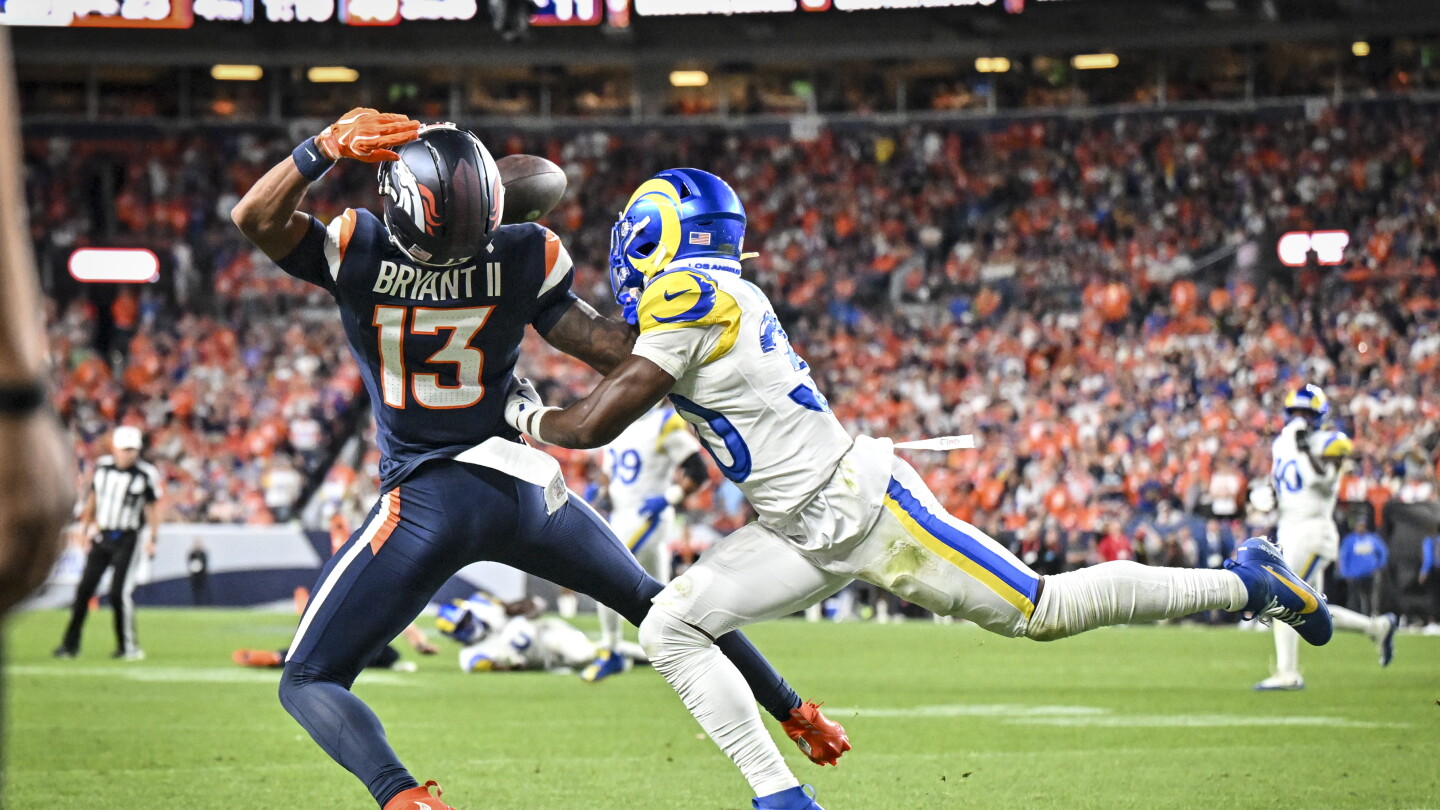
Sunday night’s instant classic between the Rams and Broncos had a back-to-the-future moment, when teams coached by Sean McVay and Sean Payton were involved in a potential pass interference situation with the game on the line.
The controversial non-call from the 2018 NFC Championship between the Rams and Saints happened just outside the L.A. five yard line. The controversial call from Sunday night happened in virtually the same spot on the field.
There are different opinions about the play. Some saw interference. Some did not.
Personally, I saw interference. Rams defensive back Josh Wallace used his right hand to shove Broncos receiver Pat Bryant just before the ball arrived.
And the operative rule, which lists seven different prohibited acts by the defender when the ball is in the air, starts with this one: “Contact by a player who is not playing the ball that restricts the opponent’s opportunity to make the catch.”
If the ball is arriving and the defender shoves him away from it, common sense says that was and is contact that restricts the opponent’s opportunity to make the catch.
The only question is whether Wallace was “playing the ball.” While on one hand he was hoping to make the interception (and did), the shove with the left hand wasn’t part of the effort to make the catch. It was part of the effort to ensure that the intended receiver couldn’t.
Chances are that it was a technique Wallace has learned, at some point in his time as a defensive back. A subtle, well-timed shove may not be seen by an official who is trying to sort through everything else that’s happening.
Bryant, for his part, flopped after he was shoved. The SGA-level reaction, while cartoonish, doesn’t change the fact that Bryant was shoved.
After the ridiculous non-call from 2018, which prompted a New Orleans boycott of Super Bowl LIII, the NFL decided to make pass interference calls and non-calls subject to replay review. The good idea was very poorly executed, and it lasted only one year.
Interference, or lack thereof, is a judgment call. Some could look at that play and see interference; others could look at the same play and reach the opposite conclusion.
That’s one of the biggest problems with the former officials who take jobs in broadcasting and periodically pontificate with the benefit of a frame-by-frame, 4K monitor. The question isn’t whether the former official (some of whom are former officials for a reason) subjectively believes pass interference happened. The question is whether the official who was required to make the call in real-time with the naked eye abused his or her broad discretion.
One of the biggest problems with the TV referees is that they focus only on giving us their own interpretation of what they saw. In many cases, who cares? We all see the same thing. In those moments, those who do the job best remind us of the standard that applies to the decision that was made.
For the Broncos-Rams play, the best explanation would have been this one: “If probably wouldn’t have thrown a flag if I was in that position, but there’s enough there to justify someone else making a different decision.”