
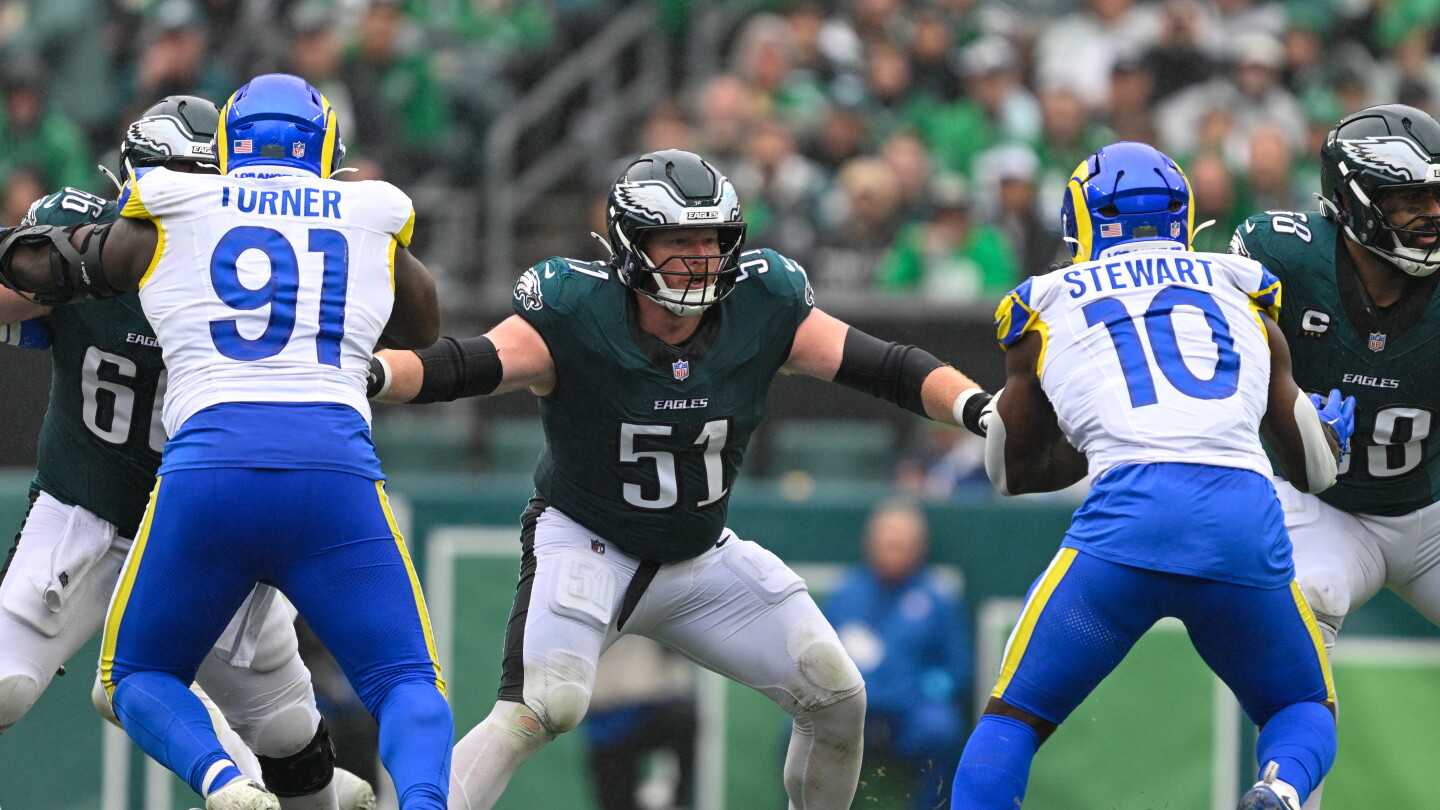
On Tuesday, Eagles right tackle Lane Johnson retired. On Wednesday, the Eagles traded center Cam Jurgens to the Ravens.
The sudden disappearance of 40 percent of the Eagles’ offensive line raises obvious questions about their plans for the balance of the season.
Consider the comments from G.M. Howie Roseman after the team sent Jurgens to Baltimore.
“We weren’t looking to move Cam,” Roseman said, via Zach Berman of The Athletic. “Obviously, the Ravens have been looking for a center. . . . Kind of told them wasn’t anything we were looking to do. Over the last 24 hours, it got to the point where we felt like it could be a win-win for them. Obviously, getting a player who’s been a two-time Pro Bowl center and obviously for us, being able to get the picks we’re able to get, and use that money also to sign players. Had a chance to watch Drew [Kendall] here play center is doing a nice job. Have a young player there.”
The Eagles sent Jurgens and a 2027 seventh-round pick to the Ravens for a 2027 fifth-round pick and a 2028 second-round pick.
“I think for us, when you talk about the two and the five, moving from the seventh to the fifth,” Roseman said. “We’ve had success in the fifth round, plus the money, plus you [have] Drew playing, we felt like we were getting four players for one, and just felt like for us, you know, with all these guys that we got coming up, a lot on the defensive side of the ball that we want to re-sign and want to extend, felt like that that was a good situation.”
The most significant aspect of Roseman’s explanation is the timing of the acceleration of the talks. “Over the last 24 hours,” he said.
It points to the retirement of Johnson as the moment at which the Eagles decided to further undermine the current season in the name of setting themselves up for a brighter future. It’s not tanking in the classic sense; it’s a conscious, clear-eyed evaluation of the prospects of the 2026 Eagles coupled with an analysis of the future focus of the roster construction.
By moving Jurgens now (obviously, they could have traded him after the season), they maximize the return from a team that was desperate for help now at the center position, they offload the ongoing salary obligation to Jurgens, and they position themselves to keep players like cornerbacks Quinyon Mitchell and Cooper DeJean, both of whom are eligible for new contracts after the current season.
Still, by moving Jurgens one day after Johnson retired, it feels like the Eagles are throwing in the towel on 2026. Which opens the door to more trades that could hamper the Eagles in the short term while allowing them to properly shape the roster in the long term.
And here’s the reality. The Philly defense is a strength. The offense has become a liability, with fewer than 250 yards gained in two straight games and a dismal two-for-21 showing on third down in back-to-back losses.
With the Vikings discovering that a potent defense and a no-frills offense that focuses more on protecting the ball than having explosive plays can provide a formula for winning (their streak dating back to 2025 stands at nine games), other teams will be paying attention. Which means that everyone should be paying attention to what the Eagles do between now and the trade deadline with other key pieces of an offense that is struggling to stay on the field.