
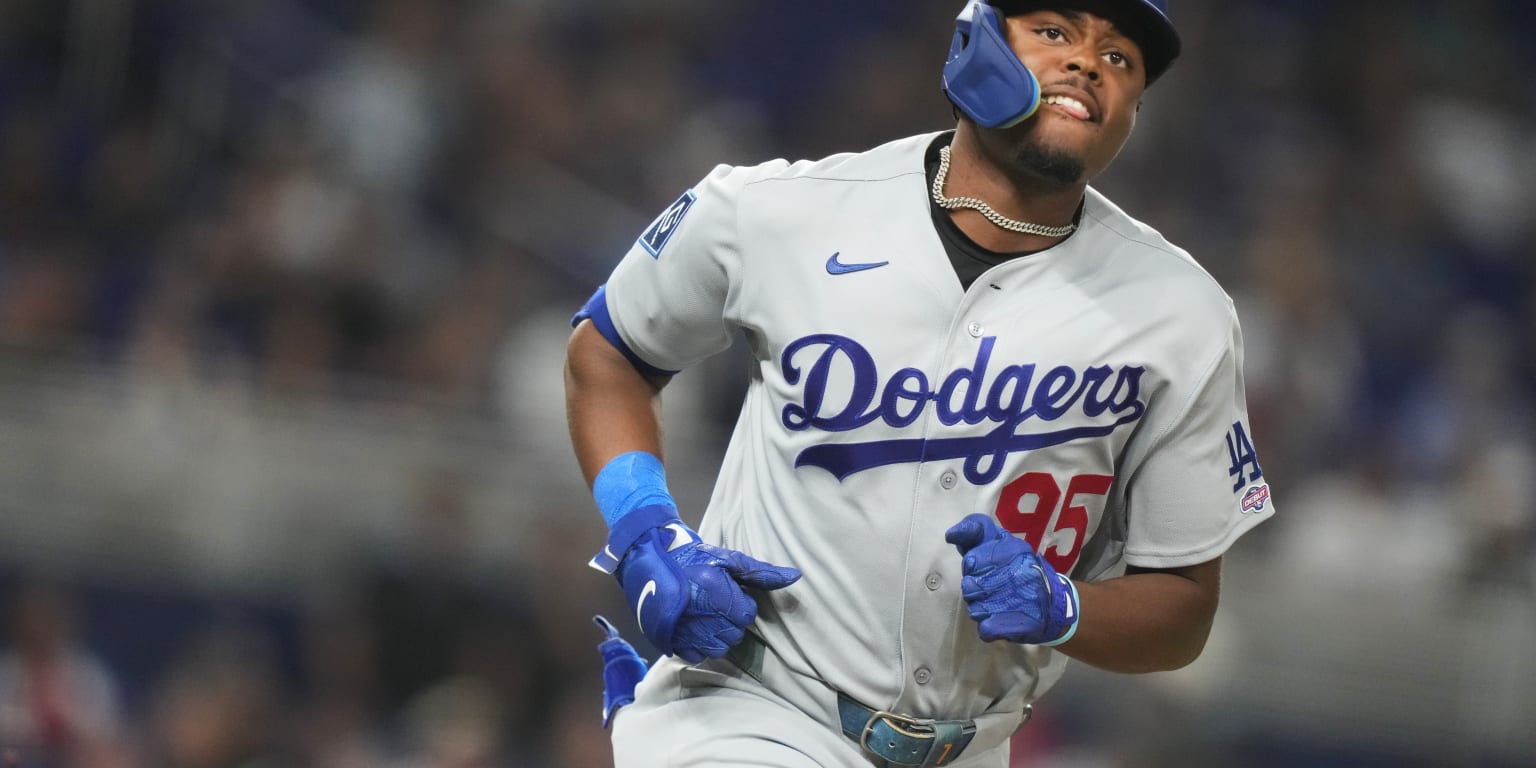
Josue De Paula’s first Major League hit was something to behold.
On Sept. 13 at loanDepot park in Miami, the Dodgers rookie turned on a 98 mph fastball from Marlins righty Eury Pérez for a massive three-run home run: 108.2 mph off the bat and 416 feet into the right-field seats. In a game in which De Paula first walked and later roped a 101.9 mph double off the wall in right-center, it was the titanic homer that put Dodgers fans on notice.
It was the breakout game for MLB Pipeline’s No. 6 overall prospect during an impressive 11-game debut stint in the big leagues. Now, will De Paula be part of the Dodgers’ postseason plans?
Manager Dave Roberts seemed to think it was possible, saying the sweet-swinging lefty had earned the right to be “a part of the conversation” for the club’s NLDS roster when De Paula was optioned to Triple-A Oklahoma City on Sept. 23.
Here’s a look at how De Paula fared during his time in the Majors and what he could bring to the Dodgers during the 2026 postseason.
Power and plate discipline
In his 42 plate appearances with the Dodgers, De Paula put up some eye-popping offensive numbers: He posted a .323 batting average, a .500 on-base percentage and a .581 slugging percentage, scored seven runs and had seven RBIs. Most notable, though? De Paula drew 11 walks and struck out only five times.
Those 11 free passes rank as the third most in any Dodgers hitter’s first 11 career games, trailing only Andy LaRoche (2007) and Jim Gilliam (1953), who both had 12 walks.
Not only were opposing pitchers evidently cautious when pitching to De Paula -- who slashed .303/.401/.547 with 27 home runs this season for Double-A Tulsa -- but the lefty steadfastly refused to expand the zone. He swung at just 18 of the 97 out-of-zone pitches he saw for an excellent 18.6% chase rate, fitting right in on a Dodgers team whose 27.5% chase rate in 2026 ranked third best in the Majors. That’s not a fluke for De Paula, either: He drew 81 walks and struck out just 87 times this season in Double-A.
As good as his plate discipline is, De Paula can flat out mash, too. Twelve of the 26 balls he put in play in the big leagues were hard hit (95+ mph exit velocity), including five above 100 mph. Nine of those 26 (34.6%) registered as pulled-air contact; while De Paula’s Major League sample size is admittedly quite small, National League MVP favorite Pete Crow-Armstrong led MLB with a 34.0% pulled-air rate in 2026.
De Paula's quality-of-contact metrics back up his early success: He had a .311 expected batting average, a .496 expected slugging percentage and a .437 expected wOBA in his first big league stint.
"He's just a special hitter," Roberts said. "Hitters don't see the ball that quickly out of hand; it's a gift. Just the ability to [limit] chase, I think that lines up in the postseason. And no moment is going to be too big for that kid."
Where does he fit in?
Evidently, De Paula’s offensive skill set could serve the Dodgers well in October. But what is his pathway to playing time?
That’s where things get a little difficult.
The rookie, who split his time with Tulsa between left and right field, made just two appearances in the field for the Dodgers, playing six total innings in left. Not willing to compromise what ranks as an average defensive outfield, the Dodgers plan to use De Paula as a designated hitter. There’s just one problem: Some guy wearing No. 17 currently occupies that spot.
Yes, Shohei Ohtani's presence will make De Paula’s path to postseason at-bats harder, although the Dodgers are certainly happy their superstar is back in the lineup. When De Paula was optioned to the Minors, it was as the corresponding move for Ohtani’s return from the injured list. Dalton Rushing's return from the IL two days later might also make it harder for De Paula to find postseason at-bats.
But there’s a reason De Paula became the first Dodger to bypass Triple-A and head right to the Majors since 2014. Used correctly -- presumably to face right-handed pitchers, against whom De Paula hit .314 with a 1.016 OPS in Double-A -- he can be a postseason weapon as a pinch-hitter or, if Ohtani is out of the lineup, at DH. The 6-foot-3, 185-pound De Paula has below-average sprint speed but still managed to steal 31 bases in 41 tries in the Minors this season, so he can be a threat on the basepaths as well.
While October baseball might prove to be overwhelming for the 21-year-old, De Paula could be a big piece of the Dodgers' success this postseason, whether it's in the NLDS or potentially further down the line.