
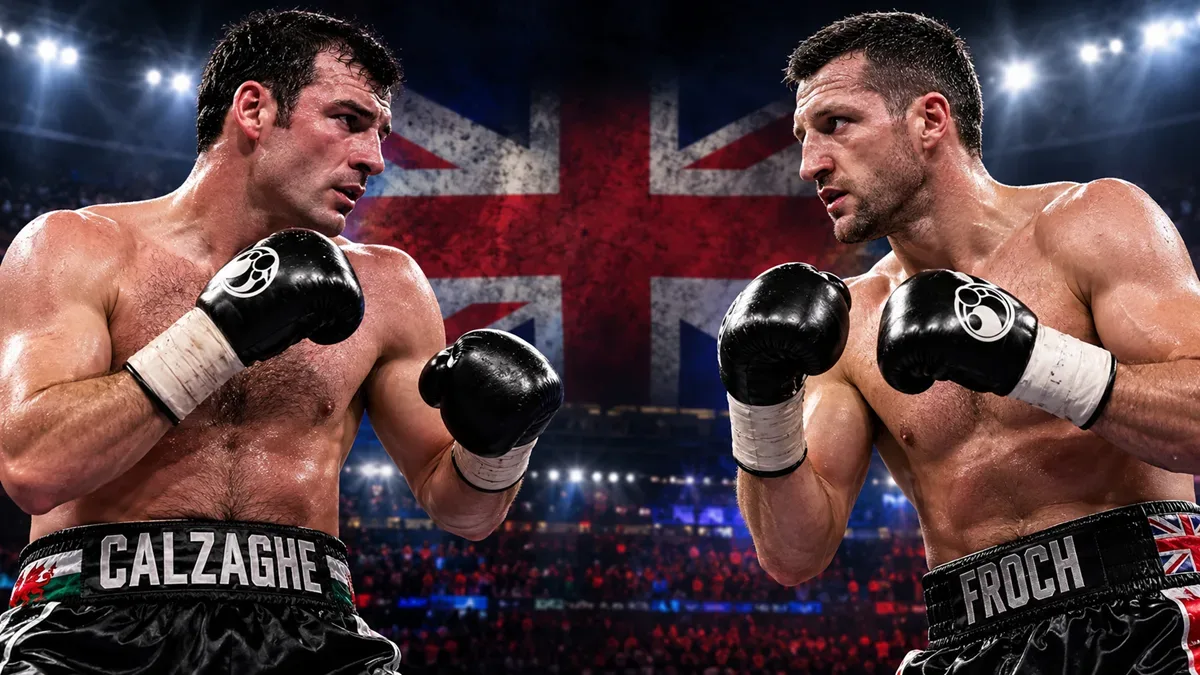
Joe Calzaghe against Carl Froch remains one of British boxing’s most intriguing fights that never happened. Both became world champions, both defeated elite opponents, and both believed they could beat the other. Yet their careers never produced a meeting inside the ring.
Who would have won? Calzaghe’s speed, movement and exceptional work rate make him the stronger choice in a hypothetical contest between the two at their peak. However, Froch’s punching power, durability and relentless pressure would have presented serious problems.
Calzaghe retired undefeated in February 2009, having won all 46 professional fights. Froch finished his career with 33 wins and two defeats after his final appearance in May 2014. He formally announced his retirement the following year.
Their rivalry developed as Calzaghe approached the end of his career and Froch emerged as a world-title contender. The Welshman pursued major fights against Bernard Hopkins and Roy Jones Jr, while Froch continued his rise through the super-middleweight division.
The result was a missed opportunity that still divides British boxing supporters.
Why Calzaghe and Froch never fought
Timing played a major role in preventing the contest.
By 2007, Calzaghe had held the WBO super-middleweight championship for a decade. He had already defeated Chris Eubank, Jeff Lacy and several leading contenders.
Froch, meanwhile, was building his reputation as an unbeaten challenger. Although he had established himself as a serious prospect, he had yet to win a world championship.
Calzaghe strengthened his position in November 2007 by defeating previously unbeaten Danish champion Mikkel Kessler in Cardiff.
The victory unified major super-middleweight titles and confirmed his standing among the world’s leading fighters.
Froch wanted an opportunity against the Welshman, but Calzaghe had other plans.
In April 2008, Calzaghe moved up to light-heavyweight and defeated Hopkins by split decision in Las Vegas. Seven months later, he beat Jones by unanimous decision at Madison Square Garden.
Froch captured his first world title in December 2008, defeating Jean Pascal by unanimous decision to claim the vacant WBC super-middleweight championship.
However, Calzaghe announced his retirement in February 2009.
Their careers had overlapped, but their periods as established world champions barely coincided.
Did Calzaghe avoid fighting Froch?
Froch repeatedly suggested that Calzaghe had deliberately avoided facing him.
The Nottingham fighter believed he possessed the strength, determination and punching power to defeat the unbeaten champion.
Calzaghe rejected that interpretation. He maintained that he had already established himself at world level and wanted major contests against internationally recognised opponents.
Their disagreement continued long after both men retired.
The distinction between their positions matters. Froch’s claim that Calzaghe avoided him reflects his personal assessment rather than a fact.
Calzaghe had legitimate reasons to pursue Hopkins and Jones. Equally, Froch’s later achievements showed that he would have been a credible opponent.
Neither fighter’s comments can establish what would have happened had they met.
Joe Calzaghe’s unbeaten career and greatest victories
Calzaghe developed into one of Britain’s most successful world champions under the guidance of his father and trainer, Enzo Calzaghe.
The Welsh fighter turned professional in 1993 and captured his first world championship four years later.
In October 1997, he defeated former champion Chris Eubank by unanimous decision to claim the vacant WBO super-middleweight title.
That victory began a remarkable reign.
Calzaghe successfully defended the WBO championship 21 times and remained a world champion at super-middleweight until moving up in weight.
His greatest strengths included exceptional hand speed, accurate combinations and the ability to maintain a demanding pace.
Unlike fighters who relied on one powerful punch, Calzaghe often overwhelmed opponents through sustained activity.
He could throw combinations, change angles and immediately return to his attack.
His southpaw stance also created problems for orthodox opponents.
How Calzaghe dismantled Jeff Lacy
Calzaghe’s victory over Jeff Lacy in March 2006 remains one of his finest performances.
Lacy entered their contest in Manchester unbeaten and held the IBF super-middleweight championship.
The American had developed a reputation for aggressive punching and physical strength.
However, Calzaghe dominated the fight.
He repeatedly beat Lacy to the punch, landed rapid combinations and controlled the distance.
The judges awarded Calzaghe a comprehensive unanimous decision.
Lacy struggled to match the Welshman’s speed and accuracy throughout the contest.
That performance provides an interesting comparison with Froch, who also preferred an aggressive approach.
However, Froch was a different opponent. His durability, experience and ability to recover from difficult situations eventually became central to his success.
The victory over Mikkel Kessler
Calzaghe faced another significant test against Kessler in November 2007.
The Danish champion entered their unification contest unbeaten and brought considerable technical ability.
Kessler’s disciplined boxing and powerful straight punches caused problems during the early exchanges.
Nevertheless, Calzaghe adjusted his approach.
He increased his activity, controlled the distance and gradually established an advantage.
The judges awarded him a unanimous decision after 12 rounds.
The result remains particularly relevant because Kessler later fought Froch twice.
Calzaghe completed his career with victories over Hopkins and Jones in 2008, retiring with 46 wins, 32 knockouts and no defeats.
Carl Froch’s rise to the top of the super-middleweight division
Froch followed a different route to world championship success.
The Nottingham fighter turned professional in March 2002 and gradually established himself as one of Britain’s leading super-middleweights.
His approach contrasted sharply with Calzaghe’s.
Froch preferred to apply pressure, exchange powerful punches and wear down opponents through physical strength.
He could appear vulnerable defensively, but his durability and determination made him difficult to discourage.
His first world-title opportunity arrived against Jean Pascal in December 2008.
Froch defeated the Canadian by unanimous decision in Nottingham to capture the vacant WBC championship.
The victory marked the beginning of a demanding period against elite opposition.
Jermain Taylor and the dramatic final-round stoppage
Froch’s first world-title defence against Jermain Taylor in April 2009 demonstrated his ability to recover from adversity.
Taylor knocked Froch down in the third round and established a substantial lead on two judges’ scorecards.
Froch struggled with the American’s speed during several exchanges.
However, he continued advancing and gradually increased the pressure.
With just 14 seconds remaining in the final round, Froch secured a stoppage victory.
The finish became one of the defining moments of his career.
It also showed why a fight against Calzaghe would have remained dangerous even if the Welshman had established an early points advantage.
Froch could remain competitive deep into a contest despite losing rounds.
Embed from Getty ImagesThe Super Six tournament and Andre Ward defeat
Froch entered the Super Six World Boxing Classic, which brought together several leading super-middleweights.
The tournament tested his ability against opponents with different fighting styles.
He defeated Andre Dirrell by split decision in 2009 before losing to Kessler in April 2010.
Froch recovered by defeating Arthur Abraham later that year and Glen Johnson in 2011.
However, Andre Ward proved too strong in the tournament final in December 2011.
Ward used his positioning, defensive awareness and technical skills to frustrate Froch.
The American won by unanimous decision.
Froch’s defeat offered an important lesson. He could struggle against opponents who controlled distance, disrupted his rhythm and prevented him from setting his feet.
Calzaghe possessed several of those qualities, although his style differed considerably from Ward’s.
Froch’s victories over Bute, Kessler and Groves
Froch rebuilt his position among the world’s leading super-middleweights after losing to Ward.
In May 2012, he stopped previously unbeaten IBF champion Lucian Bute in the fifth round in Nottingham.
He then defeated Yusaf Mack before facing Kessler for a second time in May 2013.
Froch won the rematch by unanimous decision, avenging his earlier defeat.
His final two fights came against George Groves.
Their first meeting in November 2013 ended with a controversial ninth-round stoppage victory for Froch.
The rematch took place at Wembley Stadium on 31 May 2014.
In front of approximately 80,000 spectators, Froch knocked Groves out in the eighth round to retain his world titles.
It proved to be his final professional contest.
Froch formally retired on 14 July 2015 with 33 victories, 24 knockouts and two defeats.
Calzaghe vs Froch: How their records compare
Both fighters achieved considerable success at super-middleweight, although their careers developed in different periods.
The comparison highlights Calzaghe’s unbeaten record and Froch’s experience against leading opponents.
| Career statistic | Joe Calzaghe | Carl Froch |
|---|---|---|
| Professional fights | 46 | 35 |
| Wins | 46 | 33 |
| Defeats | 0 | 2 |
| Knockout wins | 32 | 24 |
| Stance | Southpaw | Orthodox |
| First world title | 1997 | 2008 |
| Final fight | 2008 | 2014 |
| Retirement announced | 2009 | 2015 |
Calzaghe’s record reflects his sustained dominance and ability to remain unbeaten throughout a lengthy professional career.
Froch’s record includes two defeats, but he avenged one against Kessler and faced a succession of demanding opponents.
Neither record alone determines the outcome of a hypothetical meeting.
What Mikkel Kessler’s fights reveal about the rivalry
Kessler provides one of the most useful comparisons because he fought both British champions.
Calzaghe defeated the Dane by unanimous decision in November 2007.
Froch subsequently faced Kessler twice, losing their first meeting in April 2010 before winning the rematch in May 2013.
These results provide evidence of how both fighters performed against the same opponent.
Calzaghe’s victory came against an unbeaten Kessler, who entered their contest with considerable confidence and championship experience.
The Welshman adjusted his tactics as the fight progressed and secured a clear decision.
Froch’s first meeting with Kessler proved more difficult.
The Dane’s accurate punching and disciplined approach helped him win a competitive contest in Denmark.
However, Froch improved in the rematch.
He established his jab more effectively and produced a stronger performance over 12 rounds.
The results favour Calzaghe in a direct comparison, but boxing does not work through simple calculations.
Fighters develop, styles create different problems, and circumstances influence performances.
Kessler’s results provide useful context rather than a definitive answer.
How Calzaghe’s speed could have troubled Froch
Calzaghe’s greatest advantage would probably have been his hand speed.
The Welshman could throw rapid combinations and change angles before opponents established their attacks.
His southpaw stance would also have created challenges for Froch, who fought from an orthodox position.
Calzaghe often controlled exchanges through activity rather than relying on individual power punches.
Against Froch, that approach could have helped him build an early lead.
He would have needed to establish his jab, move away from Froch’s right hand and avoid becoming trapped against the ropes.
His performance against Lacy demonstrated how effectively he could frustrate an aggressive fighter.
Meanwhile, the Ward defeat exposed Froch’s difficulties against opponents who combined technical skill with effective movement.
However, Calzaghe was not impossible to hit.
Hopkins knocked him down in the opening round of their 2008 contest. Jones also scored a first-round knockdown later that year.
Froch possessed the power to exploit similar openings.
Calzaghe would therefore have needed to combine his attacking volume with disciplined defence.
How Froch’s power could have changed the contest
Froch’s strongest route to victory would have involved sustained pressure.
He would have needed to limit Calzaghe’s movement and force the Welshman into prolonged exchanges.
Froch’s right hand could have been particularly dangerous against a southpaw opponent.
His physical strength and ability to maintain pressure over 12 rounds also offered potential advantages.
Rather than chase Calzaghe around the ring, Froch would have needed to cut off his escape routes.
That approach could have forced Calzaghe to exchange punches at closer range.
Froch’s durability would also have mattered.
He demonstrated against Taylor that he could recover from difficult periods and remain dangerous late in a fight.
Nevertheless, Calzaghe’s high work rate could have made it difficult for Froch to win enough rounds.
Froch would have needed to land the cleaner, more damaging punches while preventing his opponent from controlling the pace.
Embed from Getty ImagesWho would have won over 12 rounds?
A prime-for-prime meeting between Calzaghe and Froch would have presented a fascinating tactical contest.
Calzaghe would likely have attempted to establish a fast pace from the opening bell.
His speed and combination punching could have allowed him to score consistently while avoiding Froch’s heavier attacks.
Froch, meanwhile, would have looked to increase the pressure as the contest developed.
His best opportunity might have arrived during the middle and later rounds, particularly if he could slow Calzaghe’s movement.
The outcome would have depended heavily on whether Froch could consistently close the distance.
If Calzaghe controlled the centre of the ring and maintained his usual activity, he would have had a strong chance of winning on points.
However, Froch’s punching power would have prevented him from becoming comfortable.
The case for a Calzaghe points victory
Calzaghe’s performances against Kessler and Lacy support the argument that he could have controlled a contest against Froch.
His ability to throw combinations, change angles and adapt during fights would have presented problems.
Froch’s defeat against Ward further strengthens that argument.
Although Calzaghe and Ward approached boxing differently, both possessed the technical ability to disrupt an opponent’s rhythm.
Calzaghe also demonstrated impressive stamina throughout his career.
He rarely allowed opponents to dictate the pace for extended periods.
Over 12 rounds, those qualities could have produced a clear points advantage.
The case for a Froch stoppage
Froch’s most convincing route to victory would have been a stoppage rather than a technical points contest.
He possessed the strength to trouble Calzaghe and the determination to continue attacking despite setbacks.
His dramatic victory over Taylor demonstrated how quickly he could change a fight.
However, Froch would have needed to land consistently rather than rely on a single opportunity.
Calzaghe recovered from knockdowns against Hopkins and Jones, showing his ability to respond under pressure.
Stopping the Welshman would therefore have required an exceptional performance.
What the fighters said about their missed showdown
The disagreement between Calzaghe and Froch continued after both men retired.
Froch remained convinced that he could have defeated his fellow British champion.
Calzaghe maintained that he had pursued more significant opportunities during the closing stages of his career.
The dispute was particularly visible in April 2009, after Froch’s dramatic victory over Taylor.
Froch called for Calzaghe to return to boxing and face him.
Calzaghe rejected the proposal and made clear that he had no intention of ending his retirement.
Contemporary reporting by The Guardian documented the disagreement and Calzaghe’s refusal to return.
The rivalry resurfaced repeatedly in later interviews.
Both fighters continued to defend their achievements and question how the other would have performed in a direct contest.
Their contrasting opinions have helped keep the debate alive.
Would the fight have been one of Britain’s biggest boxing events?
A Calzaghe–Froch contest would have attracted considerable interest among British boxing supporters.
Both men held world championships, represented different parts of Britain and possessed contrasting personalities.
Calzaghe had already demonstrated his drawing power in Cardiff.
His victory over Kessler in 2007 attracted a crowd of around 50,000 at the Millennium Stadium.
Froch later helped deliver one of Britain’s biggest boxing nights when he defeated Groves at Wembley in 2014.
The scale of those events suggests that a meeting between the two champions could have generated substantial interest.
However, there is no reliable basis for assigning a precise attendance figure or projected revenue to a fight that never happened.
The venue, promotional arrangements and timing would all have influenced its commercial appeal.
A contest in 2008 would also have featured a different version of Froch from the established champion who defeated Bute, Kessler and Groves several years later.
That distinction is important when considering the missed opportunity.
The verdict: Calzaghe’s technique against Froch’s power
Calzaghe would be the stronger choice in a hypothetical meeting between the two at their peak.
His hand speed, movement, stamina and ability to adjust during contests provide the most convincing reasons to favour him.
Froch’s defeats against Kessler and Ward suggest that opponents with strong technical skills could disrupt his approach.
Calzaghe possessed the qualities to exploit those difficulties.
However, Froch would have been a dangerous opponent.
His power, resilience and willingness to exchange punches could have created problems that Calzaghe rarely encountered during his championship reign.
A Calzaghe victory by unanimous decision appears the most plausible outcome, although a Froch stoppage remains possible.
Ultimately, neither fighter can claim a proven advantage from a contest that never occurred.
Calzaghe finished his career unbeaten. Froch built an outstanding record against some of the division’s leading names.
Their rivalry remains compelling because both men achieved enough to support their arguments, yet neither had the opportunity to settle the question in the ring.

World In Sport Forum
Continue the discussion
Join other fans in the World In Sport Forum and debate the biggest talking points from this article.