












IND vs SA 2025: ‘Beat whatever is put in front of us’ - Ten Doeschate addresses India’s battle with dew
India found themselves in a challenging position with the ODI series against South Africa tied at 1-1 ahead of the deciding match in Visakhapatnam on Saturday, December 6. The Men in Blue have also been battling an unusual streak of misfortune at the toss, having now lost 20 consecutive tosses, including both in the first two ODIs, situations that proved costly.
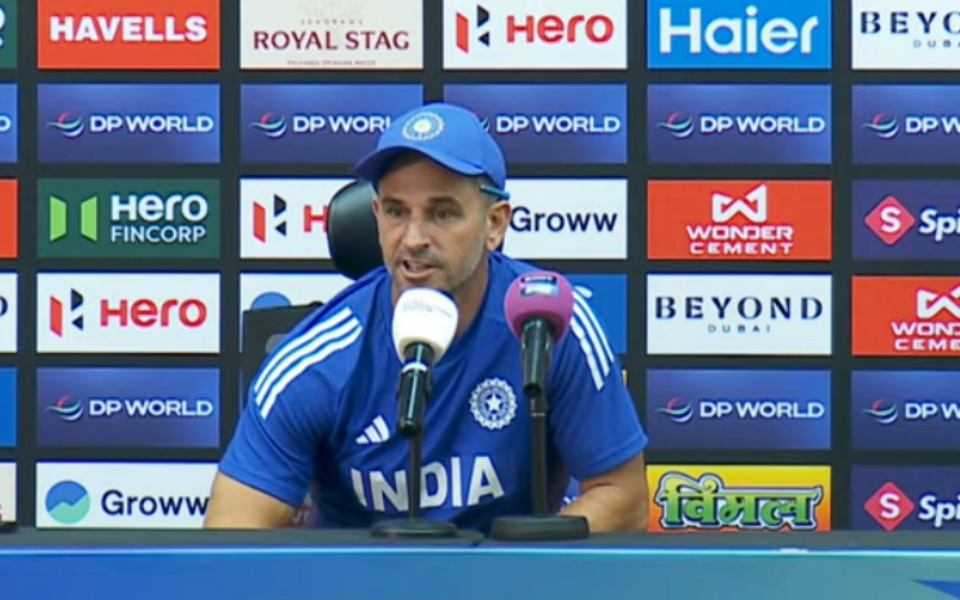
Both matches were heavily influenced by the dew factor, which India struggled to manage while bowling under lights. Several Indian bowlers conceded over seven runs per over, making it difficult to contain the South African batting lineup. The Proteas narrowly fell short in the series opener in Ranchi but staged a strong comeback in Raipur. Indian assistant coach Ryan ten Doeschate also addressed the issue, acknowledging the significant impact of dew on the games and confirming that the team has been working behind the scenes to better adapt and prepare for such conditions.
"The dew factor is, we're actually trying to put a number on it and it varies between 10 and 20% [in terms of] what a big difference it makes [to the result]. I think we're one in a million statistically at the moment [the probability of losing 20 straight tosses], so if we can go two million tomorrow, that'll be pretty impressive,” said Ten Doeschate in the pre-match press conference.
"But again, it's a bit of a joke, but the responsibility or the preparation is to beat whatever is put in front of us and eventually we're going to win a toss anyway. We are doing all the practical prep stuff, guys bowling with wet balls. Again, you know, like setting up our store to get a premium score, figuring out how to defend, what is best to bowl with the wet ball when there is dew on the grass,” he added.
ODI cricket is now functioning differently compared to previous years. Earlier, two new balls were used, one from each end, which made run-scoring easier for batters and tilted the balance of the format in favour of the batting side. However, the ICC has introduced a rule change, after the 34th over, the bowling team can choose one of the two balls to continue with for the final 16 overs. This adjustment is aimed at restoring balance between bat and ball, ensuring the ball wears more and offering bowlers greater assistance in the latter stages of an innings.
"The two balls. if I just think about it logically, the whole point of going to one ball after 34 overs is that the ball does get a chance to wear and to get a bit softer. But the flip side is that [when there is dew] you have got one ball that is getting more wet essentially. I think the umpires have been very good in allowing ball changes, but then of course you end up getting a slightly harder ball which negates the whole point of going down to the one ball,” said Ten Doeschate.
"But like I said, the thing that has impressed me about this group this week is that we know the challenges, I haven't heard anyone complain and the main thing is all about, you know, it is our responsibility to find ways around these challenges and that is just another one we have got to find a solution for,” he added.
India managed to post scores close to the 350-run mark in both games, yet even those totals proved insufficient as the South African batters handled the chase with composure. Ten Doeschate acknowledged that India’s batters are now reassessing the targets they set, keeping the changing conditions and dew factor in mind. He also suggested that starting matches earlier could help minimise the impact of dew and create a more even contest between bat and ball.
"At the start of the first game, we thought 320 sort of par, and then we put a premium at 350 and we thought that the game in Raipur was the same. We thought 360, even given the dew coming, it was a good effort to get that score. You always want more runs and again the conversations have been around how can we maximise. What we said about guys starting in slightly later on, what are the better options, we just had a good chat around that,” said Ten Doeschate.
"I think it is, you know, the fact that the dew kind of falls as the second inning starts, it means the dew is there for the whole time. So a different start time could bring that effect down a little bit if you started two hours early. That is a solution but obviously there are so many moving parts at play in terms of broadcasting etc. So I guess it is a futile conversation,” he added.
Throughout South Africa’s tour, India have relied on their all-rounders in the Test matches while turning to specialist players in the ODIs. With the ODI series locked at 1-1 soon after India’s 2-0 defeat in the Tests, the atmosphere in the dressing room has become a bit tense as the team looks to regain momentum.
"I guess that is a bit of an anomaly. You know, you would think Test Cricket, you would have more specialists but it is just where we are at the moment in the cycle and the guys we think at the moment are the best guys to represent the team. Ideally, in Test cricket, you have a more solid base of batters and bowlers but we feel at the moment the guys who are doing the job for us just happen to be allrounders. I just think it is picking your best XI and that is just the way it is in the world,” said Ten Doeschate.
"It is a very different personnel of players, but the guys are very aware of the responsibility of what they are representing. We always want to win, but certainly when a few losses do start stacking up and performances are below what we expect from ourselves. I think there is a slight aspiration to win the series tomorrow,” he concluded.
What's Your Reaction?
 Like
0
Like
0
 Dislike
0
Dislike
0
 Love
0
Love
0
 Funny
0
Funny
0
 Angry
0
Angry
0
 Sad
0
Sad
0
 Wow
0
Wow
0



.jpeg)