
Each October, some reliever takes over the postseason.
ItâÂÂs not always the biggest name and star â though it can be â but sometimes, a lesser-known or even out-of-nowhere arm gets hot at exactly the right time in exactly the right games, and ends up pushing his team to greater success than youâÂÂd have thought. (Consider this the relief version of Ernie Clement, a decent but below-average hitter who spent a month last year hitting like Ted Williams.)
Looking at recent Win Probability Added in the playoffs â a useful metric here because it does account for the situation and context of the game in terms of score, outs and runners on â you can see who the most impactful relievers were over the last several postseasons.
- 2025: Will Vest (DET), Eric Lauer (TOR), Roki Sasaki (LAD)
- 2024: Luke Weaver (NYY), Lucas Erceg (KC), Alex Vesia (LAD)
- 2023: Kevin Ginkel (AZ), Josh Sborz (TEX), Ryan Pressly (HOU)
- 2022: Pressly (HOU), Emmanuel Clase (CLE), Bryan Abreu (HOU)
- 2021: Tyler Matzek (ATL), Will Smith (ATL), Garrett Whitlock (BOS)
ItâÂÂs kind of an odd group, right? Ginkel and Sborz werenâÂÂt well-known before 2023, and havenâÂÂt contributed all that much since then, but the D-backs and Rangers donâÂÂt meet in the World Series without their contributions. Sasaki and Sborz each entered their respective postseasons with an ERA north of 4.40; Lauer is a well-traveled swingman; only Clase and Pressly really rose to the level of what youâÂÂd think a star-level reliever would look like.ÃÂ
ThereâÂÂs not a connective thread of handedness, pitch mix, or even velocity. ItâÂÂs pretty random, and thatâÂÂs somewhat the point here. In a month-long postseason thatâÂÂs played under different circumstances than the regular season, in terms of days off and manager aggressiveness, it really can be anyone who steps up for the best weeks of their career to make a real postseason difference.
So: Who could that anyone be in 2026?
ThereâÂÂs obviously some art to this as well as science, because even the greatest reliever in the world canâÂÂt make his team score runs or be given leads to protect. (This is why Mason Miller didnâÂÂt rate highly last year â he was as dominant as a pitcher could be, but faced just nine hitters as the Padres lost in the Division Series.) WeâÂÂre also looking at a muddled American League where itâÂÂs not entirely clear who makes the postseason.ÃÂ
All that said â and setting aside the stars like Miller, Josh Hader and Louis Varland â who might be that next Ginkel? These are the ones we like.
Jordan Hicks, RHP, White Sox
Hicks, perhaps, has been âÂÂtoo famousâ for this exercise in the past, but heâÂÂs now on his fourth team in the last four seasons, with an even 5.00 ERA since 2024 â a good reminder that in the world of baseball in 2026, even âÂÂthrowing extremely hardâ is not a guarantee for success. Hicks missed much of last year with shoulder soreness and wasnâÂÂt terribly effective (6.95 ERA) when he was available for the Giants and Red Sox. He had a 5.60 ERA for the White Sox when he injured his lat in mid-May this year.
Not great, right? Hicks missed a month, but ever since returning in June, heâÂÂs been one of the best relievers in baseball. ThatâÂÂs not hyperbole; since coming back on June 21, he has a 39% strikeout rate. ThatâÂÂs not only a massive improvement on his pre-injury 17% rate, but itâÂÂs the sixth-best of any reliever in that time. WhatâÂÂs changed? ItâÂÂs pitch mix, a little, as heâÂÂs gone from mostly sinker/sweeper to working back in a four-seamer that still averages 99 mph, making him less predictable.
But itâÂÂs also simply the way he throws the ball. As MLB.comâÂÂs Jared Greenspan explored in August, Hicks notably changed his arm slot while he was out, which helped to add five inches of induced break to that four-seamer. Hicks always threw hard, and he still does. Now, for the first time in years, heâÂÂs getting outs, too.ÃÂ
(That we might have also included Hagen Smith or Bryan Hudson here, to go along with Grant Taylor, tells you a little about how good this White Sox bullpen has been.)
Erik Miller, LHP, Red Sox
Miller, a teammate of Hicks in San Francisco in 2024-25, found himself on the move at the Deadline in one of the more interesting under-the-radar deals, going to Boston in exchange for former top prospect Marcelo Mayer. Since the start of June, MillerâÂÂs strikeout rate of 39% is fourth best on the same list that Hicks was on, with the unrelated Mason Miller still on top.ÃÂ
That encompasses the end of his time as a Giant, so itâÂÂs not like he just got good with Boston. That said, there have been meaningful changes since the trade, with Miller abandoning his four-seamer and changeup and going fully sinker/slider. (Yes, the opposite of what Hicks did. Not every pitcher succeeds in the same way.) The effects have been noticeable, with the strikeout rate jumping from a strong 32% to an elite 40%, and the ERA dropping from 2.76 to 1.23.
ThereâÂÂs risk here, in that his walk rate remains untenably high, always a concern in the playoffs. But youâÂÂll still take a lefty striking out 40% of hitters -- and limiting hard-hit balls better than any other pitcher in the game -- every single day.
Brandyn Garcia, LHP, D-backs
It will be very difficult for both Arizona and San Diego to make the playoffs, but they do end the season with a three-game set at Petco Park that may just decide a Wild Card spot, so letâÂÂs consider that âÂÂthe playoffs are getting started early,â because in a very real sense for these teams, they are. Mostly, we wanted the chance to talk about Garcia, who wasàacquired last summer from Seattle in the Josh Naylor trade. Garcia posted a forgettable 5.84 ERA in a dozen games after the trade, then didnâÂÂt make the Opening Day roster in 2026.
Recalled on May 1, Garcia ditched last yearâÂÂs changeup and slider in favor of a tweak seen so often in pitching these days that itâÂÂs almost become a meme: He learned a cutter, to go with the 97 mph sinker and the 88 mph sweeper. The new cutter is 5 mph harder than the old slider was, and it pairs much better with the sinker. The end result? A 2.03 ERA, a 32% strikeout rate, and a role as one of the highest-leverage relievers in the Arizona bullpen.
Didier Fuentes, RHP, Braves
Fuentes was a well-regarded prospect when he came up last year, just days after turning 20 years old, and it really couldnâÂÂt have gone much worse â in four starts, he allowed a 13.85 ERA. ItâÂÂs one of the highest single-season ERAs in history, among those who recorded a similar number of starts and innings. After an excellent spring, Fuentes was given a spot start in April, during which he allowed four first-inning runs.
He hasnâÂÂt been seen in the rotation since, and itâÂÂs not hard to see why. Since moving to the bullpen full-time after that lone April start, Fuentes has posted a 1.79 ERA in 60 innings, often going multiple frames at a time, and heâÂÂs notably increased his strikeout rate in the second half, upping it from 28% to 36%. Given the state of baseball these days, a reliever throwing 97 mph is actually more âÂÂexpectedâ than âÂÂstandout,â but paired with a relatively low arm slot and a new gyro slider that replaced his old sweeper, Fuentes has essentially put together a full season of elite relief pitching. He remains the youngest pitcher on a big league roster, more than a year after his debut.
Bradgley Rodriguez, Padres
Just what the Padres needed: another firebreathing reliever. You already know Miller, and you should know Adrián Morejón, who was an All-Star last season. But itâÂÂs easy to lose track of a new name in the best bullpen in baseball, Rodriguez. (Literally a âÂÂnew name,â as Bradgley, pronounced BRAD-glay, is the only Bradgley on record in baseball history.) At a high level, you could simply look at his 2.38 ERA, note that itâÂÂs a top-five mark among rookies this year, and move on, satisfied.
But thereâÂÂs more to this story, starting with the fact that the 22-year-old who averages 98.2 mph on his fastball doesnâÂÂt actually use his fastball as his primary pitch. Instead, heâÂÂs one of the very few pitchers who throws his changeup more than 40% of the time, and if you do that, it had better be good. (2026 All-Star Bryan Baker and Airbender king Devin Williams are two of the only three others who do it.)àÃÂ
It is, of course, very good, allowing a .134 average and piling up +12 runs of value, making it the fourth-best changeup of the season. Rodriguez is more of a good bat-misser than a great one. Instead, he allows some of the weakest quality of contact of any pitcher in the game. Again, just what the Padres needed.
DL Hall, LHP, Brewers
Is Hall, a 2017 first-round pick and a centerpiece of the Corbin Burnes trade, âÂÂtoo famous?â Given his career 4.32 ERA entering the season and the fact that heâÂÂd never thrown 50 innings in a season around various injuries, weâÂÂll go with it. Hall did get injured again, missing nearly two months with a pectoral strain, but when heâÂÂs been healthy, heâÂÂs been fantastic, sporting a 2.04 ERA and jumping his strikeout rate from last yearâÂÂs 17% to this yearâÂÂs 27%.
ItâÂÂs not that hard to see whatâÂÂs changed.
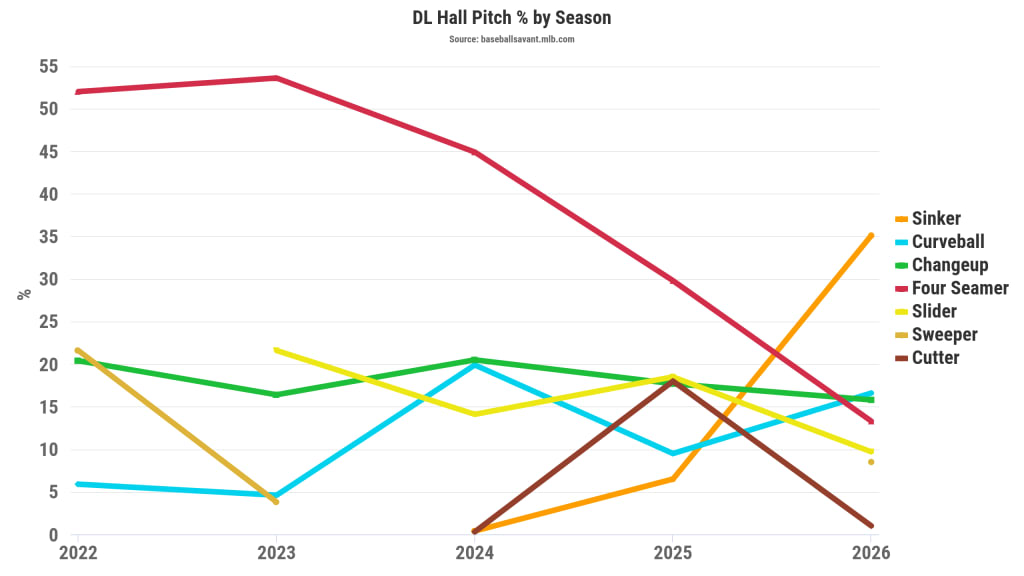
ItâÂÂs not that last yearâÂÂs four-seamer was a bad pitch, necessarily, but without any particularly interesting or outlier movement, it was heavily dependent on velocity, which worked a little less as his velocity had started to back up a little. The sinker, with some more interesting and unpredictable movement, has worked a lot better.
Daniel Espino, RHP, Guardians
Regardless of whether youâÂÂre a Cleveland fan or not, it should bring you joy as a fan of baseball simply to see Espino pitching and doing it well, given the seemingly endless shoulder injuries that brought his career to a halt. Espino made his debut in the Cleveland system in 2019, but threw only 134 2/3 innings over the next seven seasons, missing 2023 and âÂÂ24 entirely, then throwing just 2/3 of a Triple-A inning in 2025.
Finally healthy enough to contribute, Espino made his long-awaited MLB debut this June, and while heâÂÂs been up-and-down since, he also has a 40% strikeout rate â in, admittedly, just a dozen innings â while averaging 98.8 mph on the fastball. HeâÂÂs pitched five times in September, striking out nine without a single walk, and while thereâÂÂs no doubt the samples are small, the issue here has always been health, not stuff.
Consider this: Among pitchers who have seen at least 70 swings on their four-seamer, EspinoâÂÂs swing-and-miss rate is second best, on a list where Morejon, Jhoan Duran, Jacob Misiorowski, and Mason Miller are immediately after him. ItâÂÂs hard to fake that, even in just a few outings.
Edgardo Henriquez, RHP, Dodgers
Henriquez wouldnâÂÂt have been the final name listed here, originally. He might have been the first, if not for the lower back pain that sent him to the 15-day injured list on Monday, putting his availability for the postseason in jeopardy. His regular season is now over. But heâÂÂs here because the Dodgers havenâÂÂt yet ruled him out for October, and because heâÂÂs been that good.ÃÂ
Henriquez, 24, has touched 100 mph more times this year than any pitcher outside of Jacob Misiorowski and Mason Miller, and while that hasnâÂÂt led to an elite strikeout rate â 29% is above-average, but plenty others do better â it has led to truly elite contact quality suppression. Only one pitcher, Tyler Rogers, does better at preventing quality contact, so that means that no pitcher who throws overhand does this better than Henriquez. That manifests in a pretty obvious way â Henriquez has allowed just one home run all season long, and even that comes with a caveat,àbecause it came at Coors Field.
ItâÂÂs not that Los Angeles canâÂÂt and wonâÂÂt shift excess starters into the bullpen; we saw them do just that with Sasaki last year. But Henriquez, little-known to the larger baseball world, would be a huge loss if heâÂÂs unavailable or limited. Remember: For all the firepower they have on the mound, it was Will Klein who delivered some of the biggest work of the 2025 World Series for the Dodgers.