
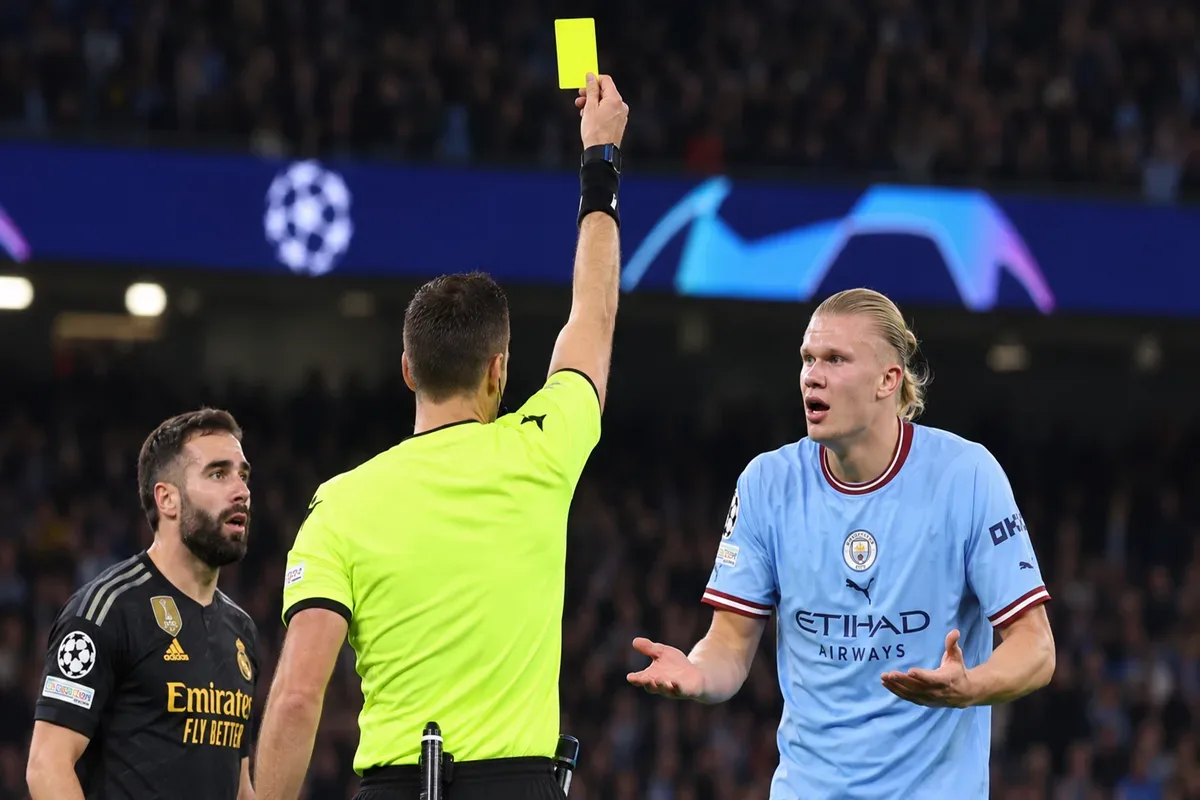
A player who collects too many yellow cards in UEFA competitions faces an automatic suspension. However, the number of bookings required depends on the competition and the stage of the tournament.
From the 2026/27 season, players in the men’s UEFA Champions League, Europa League and Conference League receive a one-match suspension after four accumulated yellow cards in the league phase and subsequent knockout rounds. Further suspensions follow their sixth, eighth and subsequent even-numbered bookings.
UEFA previously imposed the first suspension after three yellow cards. The new threshold gives players more room before they face a ban, although different rules still apply during qualifying.
The rules also differ in women’s club competitions, the Nations League and the European Championship.
This guide explains when yellow cards lead to suspensions, when bookings expire and how the regulations affect players during the knockout stages.
The information reflects UEFA’s regulations for the 2026/27 club season, the 2026/27 Nations League and the 2026–28 men’s European Championship cycle, checked on 26 October 2026.
How many yellow cards lead to a UEFA suspension?
Under Article 63.02 of UEFA’s 2026/27 men’s club competition regulations, players and team officials receive an automatic one-match suspension after reaching the relevant yellow-card threshold.
From the opening league-phase fixture, those thresholds are:
- Four yellow cards: one-match suspension.
- Six yellow cards: another one-match suspension.
- Eight yellow cards: another one-match suspension.
- Every subsequent even-numbered yellow card: a further one-match suspension.
These regulations apply to the Champions League, Europa League and Conference League. UEFA confirmed the updated arrangements in its official explanation of yellow and red cards, published in October 2026.
For example, consider a player who receives one yellow card in each of their first three Champions League appearances.
That player remains available for the fourth fixture, provided no other disciplinary sanction applies.
However, if they collect another yellow card in that fourth match, they reach the suspension threshold and must miss their team’s next competition fixture.
After serving the suspension, the player can return. Their next accumulated suspension follows when they reach six qualifying yellow cards, unless the competition’s reset provisions intervene.
These thresholds apply to team officials as well as players. Managers and coaching staff can therefore face bans for accumulated cautions.
Embed from Getty ImagesHow do yellow cards work during qualifying rounds?
The qualifying phase operates differently from the main league phase.
Before the league phase begins, players and team officials receive a suspension after three yellow cards that have not resulted in a red card.
Additional suspensions follow the fifth, seventh and subsequent odd-numbered yellow cards.
However, UEFA also provides a reduction mechanism during qualifying.
After every two qualifying rounds in UEFA men’s club competitions for which a player has been registered and eligible, UEFA reduces their outstanding yellow-card accumulation by one, provided that caution has not already resulted in an accumulated-booking suspension.
This adjustment helps prevent players from accumulating excessive disciplinary risk across several early qualifying rounds.
It does not operate in the same way as the league-phase system.
Do qualifying yellow cards carry into the league phase?
No.
UEFA clears all yellow cards and pending yellow-card suspensions at the end of the qualifying play-offs.
Players who reach the league phase therefore begin with a fresh yellow-card accumulation.
However, the reset does not cancel outstanding red-card suspensions. Those penalties remain enforceable under the applicable disciplinary rules.
That distinction is important for clubs progressing through qualifying.
A player with two outstanding yellow cards after their final qualifying match can enter the league phase without those cautions counting against them.
By contrast, a player sent off in qualifying may still have to serve a suspension after their team progresses.
Do yellow cards carry into the knockout rounds?
Yes. Yellow cards accumulated during the league phase generally carry forward into the knockout rounds.
UEFA does not automatically reset the disciplinary count when the league phase finishes.
A player who collects three yellow cards during the league phase and receives another in a knockout match will reach the four-card suspension threshold.
The same principle applies across the knockout phase play-offs, round of 16 and quarter-finals.
This matters because the knockout structure creates additional matches for some clubs.
As explained in World in Sport’s Champions League format guide, teams finishing in the top eight advance directly to the round of 16. Those placed ninth to 24th must contest knockout phase play-offs.
Clubs entering those additional fixtures face more opportunities for yellow-card accumulation.
A player already close to suspension can therefore reach the threshold before their team reaches the last 16.
The suspension applies automatically once the relevant accumulation threshold has been met.
What happens if a player receives their fourth yellow card in the quarter-finals?
A player who receives their fourth accumulated yellow card during a quarter-final must serve a one-match suspension.
If their club progresses, that ban carries into the semi-finals.
For example, suppose a defender enters the second leg of a Champions League quarter-final with three yellow cards.
They receive another booking, but their team wins the tie.
The defender must miss the first leg of the semi-final, despite UEFA clearing accumulated yellow cards after the quarter-finals.
The reason is straightforward: the reset clears yellow-card totals, but it does not cancel a suspension already triggered by those cards.
When do UEFA yellow cards reset?
UEFA has two important reset points in the men’s Champions League, Europa League and Conference League.
The first occurs after the qualifying play-offs. Both accumulated yellow cards and pending yellow-card suspensions expire before the league phase.
The second occurs after the quarter-finals, when accumulated yellow cards expire before the semi-finals.
However, unlike the qualifying reset, the quarter-final reset does not remove an outstanding suspension already incurred through accumulated bookings.
Under Article 63.04, players therefore enter the semi-finals without their earlier yellow-card totals, although any outstanding bans remain applicable.
This protects players from carrying months of accumulated bookings into the final stages.
At the end of the season, UEFA also clears outstanding yellow cards and pending accumulated-yellow-card suspensions in these men’s club competitions.
Embed from Getty ImagesCan a player miss a UEFA final through yellow cards?
The quarter-final reset significantly reduces the risk of missing a final because of accumulated yellow cards.
In the men’s Champions League, Europa League and Conference League, players begin the semi-finals with their previous yellow-card totals cleared.
Consequently, receiving one yellow card in each leg of a semi-final does not, by itself, trigger a suspension under the four-card threshold.
However, clubs must still account for any existing disciplinary sanctions.
A player suspended through accumulated cautions in the quarter-finals must serve the ban even after their yellow-card total resets.
Bookings during penalty shoot-outs can also create unusual disciplinary situations, so clubs must consider any separate sanctions that arise.
A red card presents a clearer risk.
A player sent off during the second leg of a semi-final will ordinarily be suspended for the final if their team progresses.
UEFA may also impose longer sanctions for serious misconduct.
The practical difference is that accumulated yellow cards expire at defined stages, while red-card suspensions remain subject to separate disciplinary procedures.
What happens when a player receives a red card?
Yellow-card accumulation and red-card suspensions are separate disciplinary processes.
Under UEFA’s men’s club regulations, a player or team official sent off by the referee is normally suspended for the next UEFA club competition match.
A dismissal can follow either a direct red card or a second caution during the same match.
When a player receives two yellow cards in one match, the referee sends them off. The dismissal triggers the applicable red-card suspension.
Yellow cards that lead to a dismissal do not count towards the ordinary accumulated-yellow-card thresholds.
UEFA’s disciplinary bodies can increase a red-card suspension when the offence warrants a stronger sanction.
For example, serious misconduct may lead to a longer suspension or an extension of the punishment to other competitions.
The applicable sanction depends on the offence and any disciplinary decision.
Do UEFA suspensions apply in domestic league matches?
Ordinary accumulated-yellow-card suspensions in UEFA competitions do not automatically become domestic league suspensions.
A player serving a Champions League suspension does not normally miss a Premier League match merely because of that European booking accumulation.
Domestic competitions administer their own disciplinary systems.
However, serious misconduct can result in additional or extended disciplinary action where the relevant regulations permit it.
For that reason, clubs must distinguish between accumulated cautions, automatic red-card bans and any separate disciplinary decisions.
Are the women’s UEFA competition rules different?
Yes. The 2026/27 women’s UEFA competitions retain different accumulation thresholds from the men’s Champions League, Europa League and Conference League.
In the UEFA Women’s Champions League, players and team officials receive a one-match suspension after three yellow cards from the start of the league phase.
Further suspensions follow the fifth, seventh and subsequent odd-numbered yellow cards.
This means the men’s increase to four yellow cards has not been applied to the Women’s Champions League phase for 2026/27.
The women’s competition also has its own qualifying procedures.
Players face suspension after three yellow cards during qualifying, while UEFA applies a reduction to eligible outstanding cautions after every two qualifying rounds.
At the end of the third qualifying round, yellow cards and pending yellow-card suspensions expire before the league phase.
Accumulated yellow cards also expire after the quarter-finals, although outstanding bans remain applicable.
This follows the same broad late-stage protection used in the men’s competitions.
What about the Women’s Europa Cup?
The UEFA Women’s Europa Cup has its own disciplinary reset points.
From the round of 16, players and team officials face suspension after three accumulated yellow cards, with further bans following the fifth, seventh and subsequent odd-numbered cautions.
The competition clears qualifying yellow cards and pending accumulated suspensions after the second qualifying round.
Unlike the Women’s Champions League, it clears accumulated yellow cards after the semi-finals rather than the quarter-finals.
That difference reflects the competition’s separate format and regulations.
How do yellow-card suspensions work in the Nations League?
The UEFA Nations League uses a different threshold from UEFA’s men’s club competitions.
Under Article 60.02 of the 2026/27 Nations League regulations, players and team officials receive a one-match suspension after two yellow cards during the league phase.
Additional suspensions follow the fourth, sixth and subsequent even-numbered cautions.
The lower threshold means players can face suspension after fewer bookings than in the Champions League.
The Nations League also has a reset after the quarter-finals.
Under its 2026/27 regulations, yellow cards that have not produced a suspension and pending accumulated-yellow-card suspensions expire when the quarter-finals finish.
All outstanding yellow cards and pending yellow-card suspensions expire when a team’s involvement in the competition ends.
These specific provisions should not be confused with the rules governing the European Championship or UEFA club competitions.
What are the yellow-card rules at the European Championship?
UEFA EURO has separate rules for its qualifying competition and final tournament.
For the 2026–28 men’s European Championship cycle, UEFA’s official EURO disciplinary regulations establish different accumulation thresholds.
During qualifying, players and team officials receive a suspension after three yellow cards. Further suspensions follow the fifth and any subsequent caution, as specified in the regulations.
During the final tournament, a suspension follows two yellow cards, with another suspension following the fourth.
These lower thresholds reflect the different disciplinary framework used for international tournaments.
When do yellow cards reset at EURO?
Yellow cards that have not resulted in a suspension expire after the qualifying group stage.
They do not carry into the qualifying play-offs.
Likewise, outstanding yellow cards from the play-offs expire before the final tournament.
Pending accumulated yellow-card suspensions from qualifying also expire when the qualifying competition finishes.
During the final tournament, accumulated yellow cards expire after the quarter-finals.
That means a player who has received one yellow card during the tournament can enter the semi-finals with their accumulation cleared.
However, a suspension already triggered by a second yellow card in the quarter-finals must still be served.
UEFA’s regulations therefore separate outstanding disciplinary penalties from individual yellow cards that have not yet produced a suspension.
Why does UEFA clear yellow cards before the semi-finals?
The late-stage reset limits the impact of accumulated cautions on the final stages of a competition.
Without a reset, a player could reach a final after collecting bookings across several earlier rounds and miss the decisive match through an accumulated-yellow-card suspension.
Clearing the totals after the quarter-finals reduces that risk.
However, UEFA does not remove every disciplinary consequence at that point.
Players remain accountable for suspensions already triggered, dismissals and serious misconduct.
The balance allows tournament organisers to maintain disciplinary standards while reducing the likelihood that minor accumulated offences prevent players from appearing in major finals.
Embed from Getty ImagesFrequently asked questions
How many yellow cards cause a Champions League suspension?
From the 2026/27 league phase, players face a one-match ban after four accumulated yellow cards, followed by their sixth, eighth and subsequent even-numbered cautions.
Do Champions League yellow cards reset after the league phase?
No. Yellow cards normally carry into the knockout phase. UEFA clears accumulated cautions after the quarter-finals, although pending suspensions remain enforceable.
Can a player miss the Champions League final after receiving a yellow card in the semi-finals?
A single semi-final booking does not trigger an accumulated-yellow-card suspension under the 2026/27 men’s club rules. A player can still miss the final because of a red card or another outstanding disciplinary sanction.
Are Champions League and Europa League suspension rules the same?
Yes. In 2026/27, the men’s Champions League, Europa League and Conference League share the same main accumulation thresholds and reset provisions.
Do yellow cards from qualifying count in the league phase?
No. UEFA clears qualifying yellow cards and pending accumulated-yellow-card suspensions after the qualifying play-offs. Red-card suspensions remain separate.
Do two yellow cards in one match count towards an accumulation ban?
Two yellow cards in the same match produce a dismissal. The resulting red-card suspension applies separately from the accumulated-yellow-card system.
Do yellow cards carry over into the following season?
No. Accumulated yellow cards and pending yellow-card suspensions in the men’s Champions League, Europa League and Conference League expire at the end of the season.
Are UEFA yellow-card suspension rules the same in every competition?
No. The men’s UEFA club competitions, Women’s Champions League, Women’s Europa Cup, Nations League and European Championship have different thresholds or reset provisions.
Understanding UEFA’s suspension rules
Yellow-card suspensions form an important part of UEFA’s disciplinary system, but the rules are not identical across competitions.
For the 2026/27 men’s Champions League, Europa League and Conference League. The main change is the increase from three to four yellow cards before a league-phase or knockout-stage accumulation suspension.
Qualifying still follows a three-card threshold, while other UEFA tournaments have \their own rules.
The most important distinction is between accumulated bookings and suspensions already incurred.
A yellow-card reset does not always cancel an outstanding ban. Players and clubs must therefore consider both the number of cautions collected and the stage at which they occurred.
Understanding those differences helps explain why a player can miss an important European fixture despite the competition reaching a disciplinary reset point.

World In Sport Forum
Continue the discussion
Join other fans in the World In Sport Forum and debate the biggest talking points from this article.