
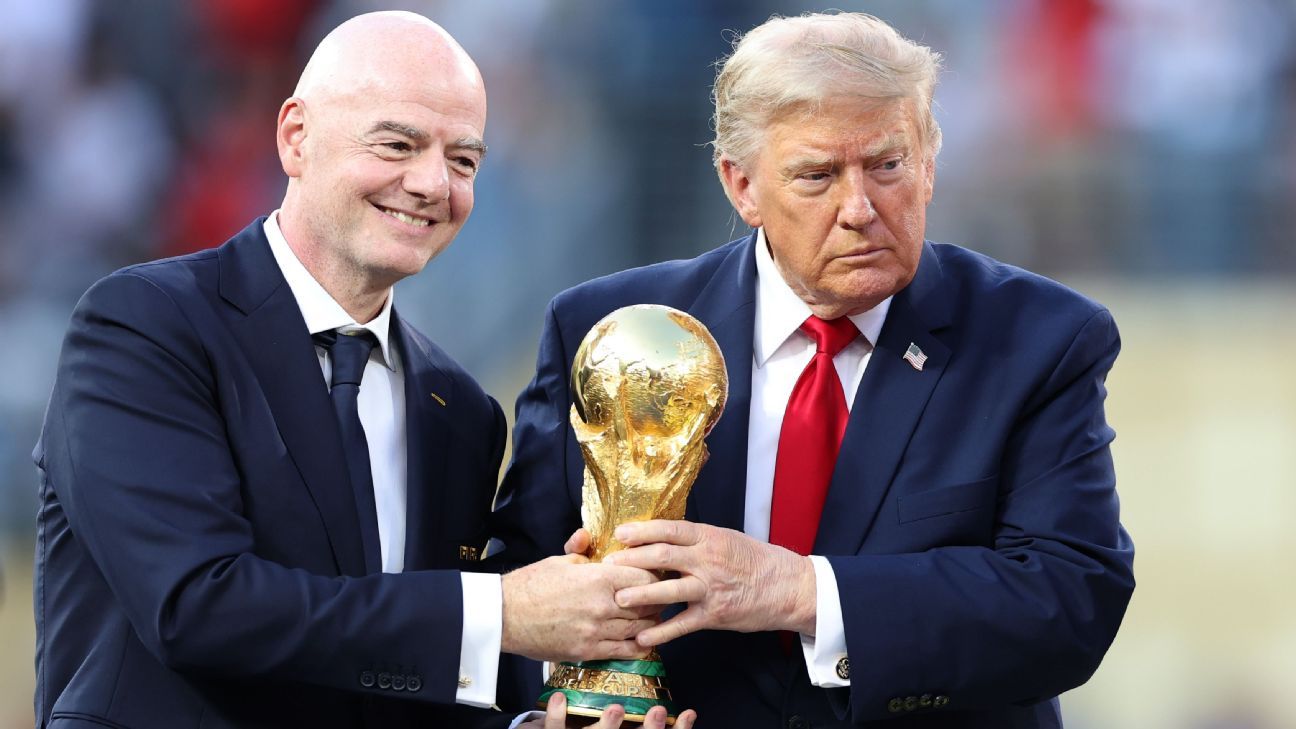
FIFA is set to amend its rules to prevent a repeat of the controversial reversal of the World Cup suspension issued to United States forward Folarin Balogun, sources have told ESPN.
On Thursday, FIFA president Gianni Infantino will chair the first session of the 37-member FIFA council since his secretive and divisive World Cup sell-off plan was revealed -- and dropped within days -- 11 weeks ago.
At the top of the agenda items is a motion to amend FIFA rules to prohibit the suspensions of automatic one-match bans in the future. The decision by FIFA's disciplinary committee to suspend the ban imposed on Balogun sparked outcry that it amounted to political interference, after U.S. President Donald Trump admitted he had personally asked Infantino to review the ban.
FIFA members have criticized Infantino for his ties to Trump and potential conflicts of interest.
But a change to the FIFA rule alone is unlikely to satisfy those still seeking clarity on how Balogun's ban came to be suspended, including Football Association chair and FIFA vice president Debbie Hewitt, who wrote to Infantino last month calling for the release of documents related to the Balogun case.
Infantino has always insisted the disciplinary committee's decision was made entirely independently of him.
On Thursday, Hewitt and other fellow council members are also expected push Infantino for more information about the now-abandoned FIFA Forward Enterprise (FFE) proposal, which sought to bring private investment into a company that would run the commercial interests of the World Cup and other competitions.
Confrontation over these issues comes ahead of a Nov. 18 deadline for candidates to enter FIFA's presidential election, which will be held four months later in Rabat, Morocco.
Infantino is facing the biggest crisis in his near 11-year presidency amid calls for him to resign.
He was cruising toward a fourth and final term through 2031 when the World Cup final was played July 19 near New York. The private investor plan was revealed nine days later.
Deep into an untypically long agenda, a four-part section promises to be fiercely debated in the basement meeting room at FIFA's slate and glass headquarters next to the Zurich zoo.
The four items to be reviewed: Infantino's quickly withdrawn proposal to sell a permanent stake in tournament rights to private investors led by Joshua Kushner, paying FIFA's 211 member federations from its $5 billion-$6 billion reserves, FIFA disciplinary procedures, and its governance standards.
FIFA didn't immediately reply to a request for comment about the planned scope and goals of the discussion.
At the core of all four subjects is Infantino's increasingly executive, one-man leadership style that led his own -- and now departed -- chief operating officer Kevin Lamour to call the intended FIFA Forward Enterprise spinoff "the project of one person."
However, it is unclear if most of the 211 federations want to vote out a president who has sent them multiple more millions of dollars from FIFA, a not-for-profit under Swiss law that they effectively own.
FIFA presidential elections have since 2007 been scheduled in the year after a men's World Cup.
The timing allows sitting presidents to steer a bonus from World Cup revenues, which in Sepp Blatter's time was $250,000, during the official election period. For the 2027 FIFA election, the official period started in April this year at the Congress held in Vancouver.
At the council Thursday, Infantino is expected to propose the 211 members each get $15 million extra in the 2027-30 commercial cycle, on top of the $10 million already promised.
That offer appears to counter UEFA and allies proposing last month that FIFA could afford to give each member a one-off $10 million payment from cash reserves. The UEFA-backed offer was in the context of suggesting FIFA had no need to raise $4.2 billion from private investors in exchange for a 20% permanent stake in the FFE subsidiary that would run commercial rights to all World Cups and Club World Cups.
That $4.2 billion would have funded Infantino's offer in July of $20 million to each member federation who approved the sell-off plan by a mid-September deadline.
UEFA filed court applications in the U.S. in August seeking authorization of evidence discovery from FIFA and Kushner's investment firm for a possible criminal complaint against Infantino in Switzerland. UEFA lawyers claim the $4.2 billion could be a "fraudulently off-market price promoted by Infantino for his own benefit."
FIFA asked U.S. courts to reject the discovery requests, and accused UEFA of running a " smear campaign. "
How and why a peace prize was created by Infantino and given to U.S. President Donald Trump at the World Cup draw last December in Washington, D.C. is part of formal complaints by the Norwegian football federation to FIFA's ethics and governance officials.
It is also an additional item on Thursday's agenda, which German media reported was at the request of FIFA Council member and German Football Association president Bernd Neuendorf.
A third case revealed in media reports last week also raised questions about how Congo DR -- whose federation has close ties to Infantino -- was not disciplined despite goalkeeper Lionel Mpasi being ineligible for four qualifying games he played in.
Information from ESPN reporters Jeff Carlisle and Gabriele Marcotti was used in this report as well as information from The Associated Press and PA.