
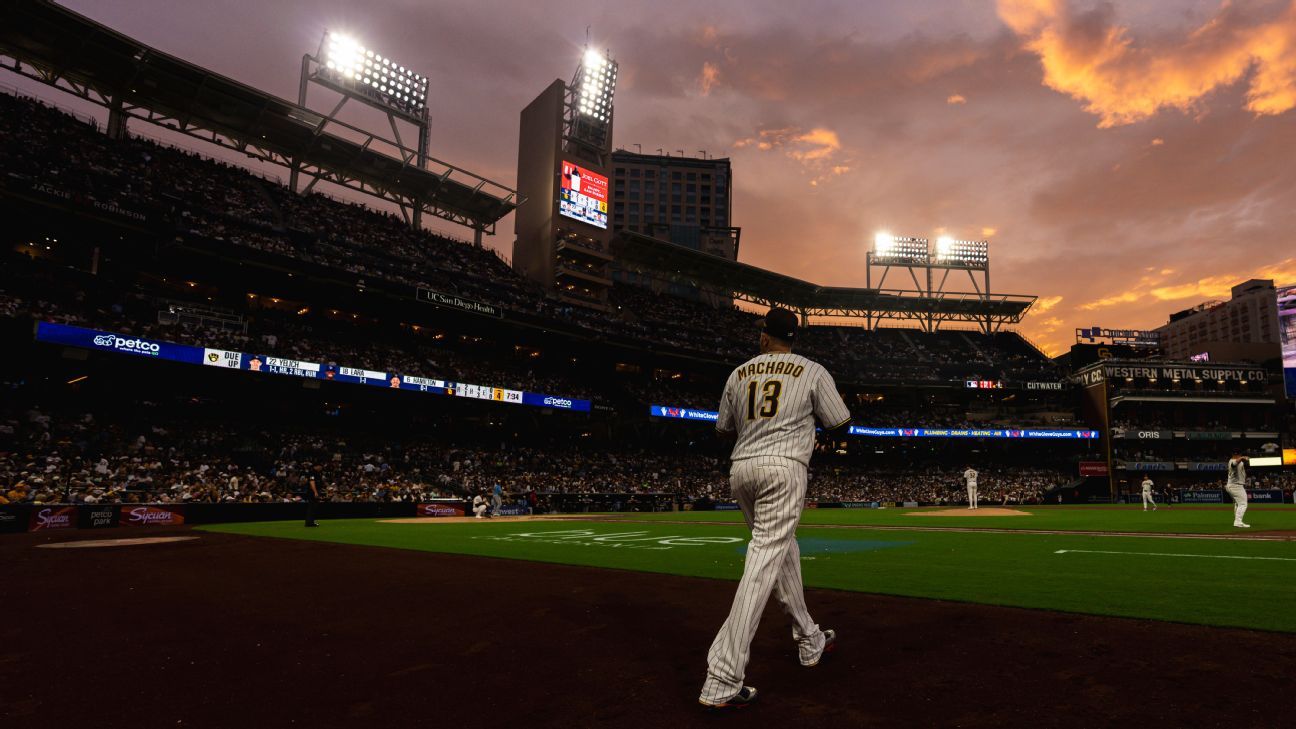
ON THE DAY the San Diego Padres' new ownership group was introduced, Manny Machado did some quick math. When the team was sold in 2012, he noted, the purchase price was $800 million. Fourteen years later, the franchise had sold for $3.9 billion -- nearly five times the amount.
"In my business, I wish I could do that investment," said Machado, the Padres' star third baseman. "That's a great return."
At a time when Major League Baseball is attempting to upend its economic model by instituting a salary cap, the Padres have emerged as a beacon for players and union officials who believe a level playing field can exist without one.
In their minds, the Padres' late owner, Peter Seidler, provided the blueprint -- by pouring money into a small-market franchise, elevating the roster to championship contention, turning the ballpark into a destination spot and, after his death, netting a record sale price. Seidler might have absorbed losses along the way, but, in their minds, it was worth it. His peers, they believe, could and should follow.
To others, particularly those who pine for a cap-and-floor system in a new collective bargaining agreement, that rationale is incomplete.
They see the Padres as an outlier and a cautionary tale. Their sale price was inflated as a Southern California franchise in a one-sport town. Their trajectory -- spending so high that a loan was needed for liquidity, a generational talent in Juan Soto traded for the purpose of getting under the luxury tax threshold, a barren farm system and an unsustainable payroll -- is the plight of a team unable to hang with bigger spenders in an open market. Even if other franchises wanted to follow in the Padres' footsteps, they can't, league officials and rival owners argue. Their situation is unique.
MLB and the MLB Players' Association are in the midst of a contentious labor fight, and the Padres have become a convenient symbol for both sides. Of inspiration or caution. Of business acumen or reckless spending. Of the possibilities under a free-market system or the pitfalls that come with one.
"You can say it's unique, you can say it's not," said Padres infielder Jake Cronenworth, a member of the MLBPA's executive subcommittee. "But every club has the ability to do what we did -- invest in a good product on the field, invest in the community, and see what happens."
TODAY'S PADRES WOULD be unrecognizable to the 2019 iteration. That team ranked 24th in payroll and ultimately missed the playoffs for a 13th consecutive year.
"No one wanted to play here," said Machado, who joined the team that spring. "We were in the bottom tier of organizations."
The following year, in November 2020, Seidler assumed full control of the Padres, taking over as chairman after his business partner, Ron Fowler, stepped down. Over the next three years, the payroll jumped from $180 million to $225 million to more than $250 million by 2023, trailing only the New York Yankees and New York Mets.
The Padres now set franchise attendance records on a near-annual basis, surpassing 3 million fans every year since 2023. In 2026, they notched their fifth consecutive winning season and should soon capture their third straight playoff berth. Both would be firsts in franchise history. And though the payroll dropped significantly the year after Seidler's death in November 2023, the Padres elevated back into the top 10 in 2025 and 2026.
"When you invest in your team, you invest in your organization, not only do you get good players to come and want to play and put yourself in good situations to go win a championship," Machado said, "but you also get a lot of fans to come out here and support."
The Padres, who were one of the largest recipients of revenue sharing in the early 2010s, have paid into revenue sharing every year since 2023, an indication of their massive growth under Seidler. They did so despite ranking 24th in market size, as outlined by the current CBA. As Machado sees it, the Padres' success -- in a significantly limited market, with Mexico to the South, the Pacific Ocean to the West, the desert to the East and the Dodgers to the North -- means others can also do it.
"But you got to want it," Machado said. "And ownership wanted it here."
The Padres' new owners, José E. Feliciano and Kwanza Jones, have expressed a similar level of desire. Their plans, though, remain vague, at least in part because there's no telling what MLB's economic model will look like beyond this season.
At the least, their local media revenue should receive a boost. In May 2023, the Padres became the first team to lose their regional sports network, a product of the Diamond Sports Group bankruptcy proceedings that prompted the cancellation of a 20-year, $1.2 billion local media deal. They've been in a sort of limbo since.
MLB will sell all of its national rights and most, if not all, of its local rights after the 2028 season, a development that is widely expected to bring a major influx of cash. In the leadup to that, both the league and the union have made proposals that would prompt more sharing of local media revenue than under the current system.
"If that does happen," Padres CEO Erik Greupner said, "I think no team stands to benefit more than the Padres."
MLB has touted the equal distribution of local media as part of its cap-and-floor proposal, while the MLBPA has pitched a change in revenue sharing that would prompt teams to share more of their local media while keeping more of their stadium revenue. It's an idea that is in many ways inspired by what Seidler accomplished.
As Bruce Meyer, MLBPA interim executive director, said in June: "We want to encourage more San Diegos."
Union leaders don't view Seidler as a man who spent recklessly in hopes of winning a championship before his death, with little care for the future. They see an owner who operated his franchise like a shrewd businessman and knew the best way to make money was to invest in his product. Greupner, Seidler's right-hand man for the entirety of his ownership, said Seidler viewed the Padres through decade-long increments. Spending lavishly on players was merely "the first step" toward building revenues high enough to support bigger payrolls.
To Cronenworth, an oft-referenced Seidler quote speaks perfectly to that: There's a risk to doing nothing.
"And it's true," Cronenworth said. "It's true in investments, it's true in our own personal lives. It's true in everything. But if you don't take that risk, you never know what's on the other side."
IN THE MINDS of baseball's owners, the success of a team in Southern California is too unique -- the location too coveted -- to copy.
The Padres' sale price trumped the previous record for a baseball franchise set in 2020, when Steve Cohen purchased the Mets for $2.4 billion. Just eight days after Feliciano and Jones were introduced on Aug. 24, longtime Los Angeles Angels owner Arte Moreno reached a handshake deal to sell his team to Stan Kroenke for $4 billion.
According to Forbes, the Padres' operating income -- a measure of earnings before interest, taxes, depreciation and amortization -- was a combined negative-$270 million from 2020 to 2023 before jumping to plus-$32 million in 2024 and finishing basically flat in 2025. That they sold for a record amount in spite of that, not to mention a reported $300 million in debt, is notable.
And then the Angels, who were essentially run into the ground for the past decade, topped that price, a shock to many in the industry. But people in league circles were quick to note that the valuation of MLB franchises continues to lag behind that of the NBA and the NFL: The NBA's Portland Trail Blazers, a team in a far less appealing market, sold for $4.25 billion. And though league officials stress that their cap proposal is motivated by a desire to give fans in smaller markets an equal shake, there's no denying that maximizing franchise values also is a major motivation.
In their eyes, the fact that the Minnesota Twins and Washington Nationals were taken off the market is just as telling, if not more so, than the Padres and Angels blowing away the market.
"If you're in Southern California, if you're in the San Francisco Bay Area, if you're the Yankees -- yeah, you're going to get a huge number," a source with extensive experience advising major league owners on sales said. "But good luck being the Kansas City Royals. Or the Cleveland [Guardians]. Or the Detroit Tigers. I mean seriously. There's a huge split in asset values."
With the Angels, Kroenke essentially purchased a blank canvas -- one with no debt, few payroll obligations and the potential for a new ballpark. With the Padres, Jones and Feliciano purchased a relatively finished product -- one with a potentially onerous future.
The Padres have a bloated payroll, with a combined $810 million still owed to Machado, Fernando Tatis Jr., Xander Bogaerts and Jackson Merrill after this season. Seven years from now, in 2033, the four of them will still be owed $116 million. By that point, Machado and Bogaerts will be playing in their age-40 seasons.
"It's going to get ugly," a rival general manager said of the Padres' future payroll obligations.
Some would argue it already is. Machado, Tatis, Bogaerts and Merrill absorbing an outsized portion of the Padres' commitments has prompted longtime GM A.J. Preller to supplement the team's depth on the trade front, continually drying up the Padres' farm system in the process. ESPN's Kiley McDaniel ranked them last going into this season.
Preller is widely considered as good as anyone in the industry at developing coveted prospects. In recent years, he has also excelled at finding production from players who have been cast aside elsewhere, namely Ty France, Gavin Sheets, Dustin Harris, Walker Buehler and Jeremiah Estrada. If not for them, the Padres would be teetering. Every year, rival front office executives believe, the Padres' margin for error only seems to diminish.
"To me, those are all opportunities," Feliciano said when asked how he viewed the pros and cons of his investment in the franchise. "Look at how much we have accomplished -- how much this team has accomplished, being from a small market and all those things. To me, the theme is that we've been able to exceed expectations. And we have been able to surprise people."
People in league circles would argue it's a surprise because what they've done is not realistic. Not without operating under losses, which prompted the Padres to take out a $50 million loan to address short-term cash-flow shortages and cover player payroll commitments in September 2023, as first reported by The Athletic. Not without being run by someone like Cohen, whose net worth is at least three times greater than that of 26 other owners, according to Forbes.
So, maybe the Padres are an outlier. Maybe they're a cautionary tale. Or maybe they're a shining example -- a reflection of what's possible with the right intentions.
To the people inside the organization, all that matters is that, someday, for the first time, they're champions.
"We've been so internally focused on what we're trying to accomplish here, in what we've been trying to grow here, that we'll leave it to those outside the organization that may have an opinion on what that means to the industry," Greupner said. "For us, we want to win a World Series championship. We've been trying to win in business and baseball in a way that can lead to that outcome."