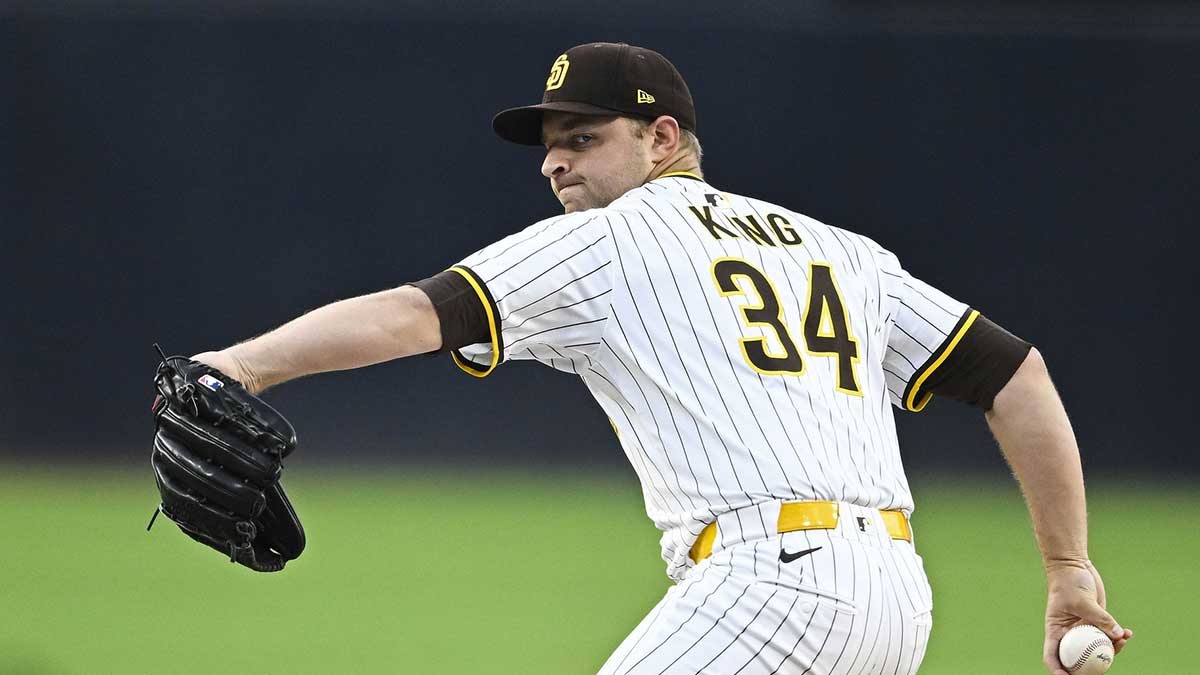
Michael King made the first major bet of his offseason by walking away from comfort.
MLB Network’s Jon Heyman took to X, formerly Twitter, on Thursday to report that King opted out of his player option and will become a free agent.
“Padres star RHP Michael King declined his player option today and will be a free agent. Will be one of the most coveted players on market.”
After a strong contract year with the San Diego Padres, the right-hander entered free agency after leaving roughly two years and $53–58 million on the table, plus a $5 million buyout, in search of longer-term security.
The timing makes sense. King finished the 2026 regular season 12-10 with a 3.21 ERA, 1.18 WHIP, 159 strikeouts, 185 innings and 32 starts. He then raised his value in October with a 0.64 ERA over 14 postseason innings.
With Tarik Skubal leading the class, King profiles as the clear No. 2 or No. 3 starting pitcher available. His free agency will have plenty of suitors, but three destinations stand above the rest.
1. San Diego Padres
The Padres remain the cleanest fit.
San Diego has the need, the familiarity and the first shot. The Padres hold an exclusive five-day negotiating window until November 2, and mutual interest exists between the two sides. Given everything that has worked, a reunion is the most logical outcome.
The Padres rotation is facing a severe reset. San Diego is losing Robbie Ray, Casey Mize, Walker Buehler, Lucas Giolito and Griffin Canning, while Nick Pivetta could also be gone depending on his club option. That is not a minor hole. It is a massive drain for a team still built to compete.
The internal options are thin. Randy Vasquez, JP Sears and Jhony Brito can cover innings, but none replaces a dependable front-end starter. Joe Musgrove and others carry uncertainty. The Padres rotation needs stability, and the right-hander is already proven in that role.
The fit goes beyond roster math. He thrived at Petco Park and has expressed fondness for San Diego as a second home. His Padres career includes a 3.15 ERA across 77 starts, giving the organization a clear picture of what it is buying.
Continuity matters. A pitcher-friendly home park, a familiar environment and a postseason-tested profile make this a sensible match for both sides. New ownership also has incentive to make an early statement. Re-signing King would bolster the Padres rotation and show that the franchise is not stepping back.
2. Chicago Cubs
The Chicago Cubs have one of the biggest rotation rebuilds in baseball.
Chicago is losing Shota Imanaga, Kevin Gausman and David Peterson to free agency, while Matthew Boyd and Clay Holmes declined player options. Even with Justin Steele and Cade Horton returning, the Cubs need multiple starters. They cannot patch this group with depth signings alone.
That is where the 31-year-old fits.
He would give the Cubs exactly what their staff lacks in bankable innings and high-end reliability. His 185 innings and 32 starts are just as important as his 3.21 ERA. For a Cubs team trying to accelerate its contention window, volume matters. So does postseason trust.
The Cubs also have significant money coming off the books, giving them a realistic path to pursue a major starter without treating it like a one-player offseason. The price will not be cheap, but Chicago is positioned to spend on a pitcher who directly addresses its biggest need.
Wrigley Field is not Petco Park, but his value is not tied to one ballpark. The right-hander has shown he can handle a full starter’s workload, hold up over a long season and pitch in October. That profile travels.
Steele and Horton give the Cubs a foundation. Adding a durable veteran would give them structure. For a club trying to move from interesting to dangerous, that distinction matters.
Article Continues Below3. New York Mets
The New York Mets are the financial wild card with a real baseball fit.
David Stearns has made adding starting pitching a public priority, whether through high-end arms or reliable veteran options. New York has a young core headlined by Nolan McLean, Christian Scott, Zac Thornton and others, but the Mets need established starters to support that group.
This fit checks several boxes.
The personal fit also makes sense. He was born in New York, went to high school in Rhode Island, pitched at Boston College and began his major league career with the New York Yankees. An East Coast return would be natural.
Then there is Steve Cohen’s payroll flexibility. If the Mets decide he is worth a nine-figure deal, they can get there. New York does not need to wait out the market or hope for a discount.
The Mets rank third only because the Padres offer a cleaner reunion and the Cubs have a louder rotation emergency. But if the right-hander reaches the open market cleanly, New York has the money, need and ambition to become a serious threat. That separates these three from the rest of the field, as each can give King a major role, a competitive roster and the long-term security he was chasing when he bet on himself.