
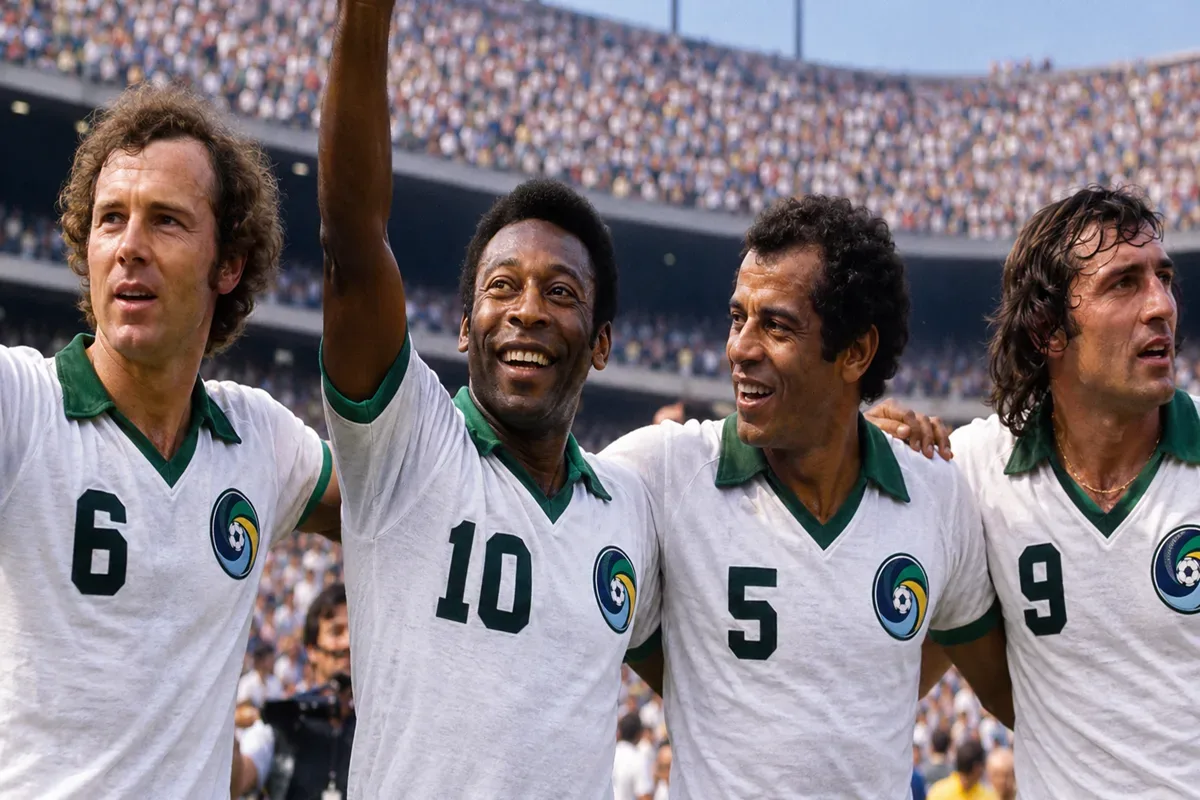
Between 1977 and 1980. the New York Cosmos won three North American Soccer League (NASL) championships. attracted crowds approaching 80.000 and brought some of football’s greatest players together in the United States.
Pelé. Franz Beckenbauer. Carlos Alberto and Giorgio Chinaglia helped transform the Cosmos into an international attraction. Their success also gave American football something it had rarely experienced: sustained national attention. major television exposure and a professional club capable of drawing audiences comparable to established American sports.
The Cosmos won the Soccer Bowl in 1977 and 1978. lost their title in 1979 and reclaimed it in 1980. Their achievements established them as the NASL’s leading club during the competition’s most prominent period.
Yet the story extends beyond results. The Cosmos demonstrated that football could attract enormous American audiences when elite players. competitive success and commercial ambition came together.
Their rise also exposed the limitations of a league that expanded rapidly without establishing the financial stability needed to sustain its popularity.
How Pelé changed the Cosmos
The transformation began before the championship years.
Founded in 1971. the Cosmos won their first NASL title in 1972. However. they struggled to establish a significant following in a sporting market dominated by American football. baseball and basketball.
Warner Communications backed the club. with chairman Steve Ross becoming an important figure in its development.
The organisation wanted more than domestic success. It hoped to establish football as a major spectator sport in North America.
Signing Pelé in June 1975 represented the decisive breakthrough.
The Brazilian had won three World Cups and established himself as one of the most recognisable sportsmen in history. His arrival immediately gave the NASL an international profile.
As explored in World in Sport’s account of Pelé’s move to American football. the transfer brought attention to a competition that had previously struggled for mainstream recognition.
However. his influence initially exceeded the team’s results.
The Cosmos failed to reach the playoffs in 1975 and suffered another postseason elimination in 1976.
Individual reputation alone could not overcome weaknesses in the squad.
The club responded by recruiting experienced international players and strengthening its competitive foundations.
Italian striker Giorgio Chinaglia arrived from Lazio in 1976. Peruvian midfielder Ramón Mifflin and Brazilian defender Nelsi Morais also contributed to the squad’s development.
By 1977. the Cosmos had assembled a stronger foundation around their most celebrated player.
1977: Beckenbauer and Carlos Alberto arrive
The 1977 season marked the beginning of the Cosmos’ defining championship period.
Franz Beckenbauer joined from Bayern Munich in May. bringing exceptional experience and tactical intelligence.
The German had captained West Germany to victory at the 1974 World Cup and helped Bayern win three consecutive European Cups.
His influence went far beyond his reputation.
Beckenbauer could control possession from deep positions. organise defensive movements and dictate the pace of matches.
His ability to advance with the ball allowed the Cosmos to build attacks without sacrificing their defensive structure.
World in Sport’s profile of Franz Beckenbauer examines how his interpretation of the libero position changed expectations of central defenders.
The Cosmos also recruited Carlos Alberto. captain of Brazil’s 1970 World Cup-winning team.
His arrival strengthened their defence while adding another accomplished footballer comfortable in possession.
Carlos Alberto brought leadership. positional awareness and attacking quality from full-back.
Together. the two defenders gave the Cosmos an exceptional level of international experience.
Pelé remained the team’s creative figurehead. while Chinaglia provided a consistent goalscoring threat.
The combination made the Cosmos stronger than a collection of famous individuals might suggest.
They had players capable of controlling different phases of a match. although their attacking emphasis could still leave defensive spaces.
English winger Steve Hunt also became an important contributor. His movement. pace and delivery offered an alternative to the more measured passing of the established stars.
The squad’s development eventually produced the balance required to challenge for the championship.
Embed from Getty ImagesGiants Stadium and the growth of Cosmos Country
The Cosmos moved to Giants Stadium in East Rutherford. New Jersey. for the 1977 season.
The stadium provided the capacity needed to accommodate the growing interest surrounding Pelé and his teammates.
Nevertheless. attendances did not immediately match the club’s ambitions.
The first five home matches of the season attracted an average of 20.381 spectators.
Beckenbauer’s arrival helped accelerate the increase.
On 19 June 1977. a crowd of 62.394 watched Pelé score a hat-trick against the Tampa Bay Rowdies.
The result demonstrated the appeal of combining international stars with entertaining football.
Crowds continued to increase as the season progressed.
On 14 August. 77.691 supporters attended a playoff match against the Fort Lauderdale Strikers.
The Cosmos won 8–3 in front of what was then a record crowd for an American club football match.
Football historian Roger Allaway’s analysis of the Cosmos’ 1977 attendance boom
Society for American Soccer History
documents how the club’s growing popularity transformed expectations of professional football in the United States.
Importantly. supporters were increasingly attending matches because of the team’s reputation. rather than simply the opportunity to watch Pelé.
The Cosmos became a cultural attraction.
Giants Stadium provided the setting. while the players supplied the performances required to maintain interest.
The stadium’s association with the club became so strong that the surrounding area acquired the nickname Cosmos Country.
Soccer Bowl 1977: Pelé becomes a champion
The Cosmos entered the 1977 playoffs with significant expectations.
Despite their expensive squad. they still needed to demonstrate that their collection of international stars could deliver a championship.
Their postseason campaign culminated in a meeting with the Seattle Sounders on 28 August.
The final took place at Civic Stadium in Portland. Oregon.
Hunt opened the scoring for the Cosmos. but Seattle responded through Tommy Ord.
With the contest finely balanced. Chinaglia scored the decisive goal in the second half.
The Cosmos won 2–1.
For Pelé. the victory provided a fitting conclusion to his competitive playing career.
He had joined the club with the ambition of helping football grow in America. Two years later. he departed as an NASL champion.
The championship also strengthened the Cosmos’ credibility.
Their commercial success was now supported by significant competitive achievement.
That mattered for a league hoping to persuade supporters that its leading clubs offered meaningful sporting contests rather than exhibitions featuring famous players.
Pelé’s retirement brings an era to a close
Pelé played his farewell match on 1 October 1977 against Santos. the Brazilian club where he had established his reputation.
The exhibition took place at Giants Stadium before 75.646 spectators.
In an unusual arrangement. Pelé played the opening half for the Cosmos before representing Santos after the interval.
He scored for New York with a free-kick. and the Cosmos eventually won 2–1.
The occasion celebrated a career that included World Cup victories in 1958. 1962 and 1970.
His achievements with Brazil had already secured his place among football’s greatest players.
World in Sport’s analysis of Brazil’s 1970 World Cup champions explores the team in which Pelé and Carlos Alberto established their enduring international reputations.
The farewell also presented the Cosmos with their greatest challenge.
Their most famous player had retired. but the organisation needed to preserve the audience and competitive standard he had helped establish.
Replacing Pelé’s cultural influence was impossible.
Maintaining the team’s success was a more achievable objective.
1978: Winning without Pelé
The 1978 season offered a direct test of the Cosmos’ strength.
Without Pelé. the club could no longer rely on the presence of football’s most recognisable player to sustain interest.
Yet the squad remained formidable.
Beckenbauer continued to influence matches through his distribution and positional intelligence.
Carlos Alberto provided defensive experience. while Chinaglia maintained his importance as the team’s leading attacking figure.
Dennis Tueart. the former Manchester City winger. added another significant attacking option.
Yugoslav midfielder Vladislav Bogićević also strengthened the team’s creative resources.
Under manager Eddie Firmani. the Cosmos developed a side capable of combining attacking freedom with the organisation necessary to win major matches.
Their performances carried them into another Soccer Bowl.
On 27 August 1978. they faced the Tampa Bay Rowdies at Giants Stadium.
A crowd of 74.901 watched the defending champions secure a 3–1 victory.
Tueart scored twice. while Chinaglia contributed the other goal.
The result gave the Cosmos consecutive NASL championships.
It also demonstrated that Pelé’s retirement had not immediately reduced their competitive effectiveness.
The club had created a successful team around experienced players rather than relying entirely on one international superstar.
Their popularity remained remarkable.
The Cosmos averaged 47.856 spectators for home league matches in 1978. their highest seasonal average during the original NASL era.
Embed from Getty ImagesHow the Cosmos played
The Cosmos’ success reflected more than their ability to recruit established players.
Their strongest teams possessed several complementary qualities.
Beckenbauer offered composure and control from deeper positions. His passing helped move opponents away from defensive areas and create space further forward.
Carlos Alberto provided another player capable of progressing possession through accurate distribution and intelligent movement.
In midfield. technical players supported the transition between defence and attack.
The forward line relied heavily on Chinaglia’s finishing. movement and willingness to attack dangerous positions.
During the Pelé years. the Brazilian’s creativity also helped connect the midfield and attack.
The Cosmos could therefore threaten opponents through several different approaches.
They could build patiently. use individual skill to break defensive lines or move the ball quickly towards their forwards.
However. their style carried risks.
The attacking responsibilities of their most accomplished players sometimes required teammates to cover considerable space.
Strong opponents could exploit transitions. particularly when the Cosmos committed players forward.
Their financial advantages also allowed them to assemble a level of individual quality unavailable to many NASL rivals.
Consequently. their dominance should not be interpreted as evidence of an entirely superior tactical system.
The combination of experience. technical ability and resources remained central to their success.
Giorgio Chinaglia: The goalscorer behind the success
Pelé attracted international attention. but Chinaglia became the Cosmos’ most productive long-term attacking player.
The Italian arrived in 1976 after helping Lazio win Serie A in 1974.
His direct style contrasted with the more creative approach associated with Pelé.
Chinaglia concentrated on scoring goals.
He attacked central areas. occupied defenders and converted opportunities with considerable consistency.
He also possessed a demanding personality. which occasionally created tensions within the squad.
Nevertheless. his contribution to the club’s championship success was substantial.
Chinaglia scored in the Soccer Bowl victories of 1977. 1978 and 1980. as well as the team’s subsequent triumph in 1982.
In 1980. he scored 32 goals in 32 regular-season matches before adding another 18 during the playoffs.
Those figures illustrate his importance.
While the Cosmos could attract spectators through their international reputation. Chinaglia regularly supplied the goals needed to turn that attention into victories.
His performances also demonstrated how the NASL could benefit from experienced European footballers who remained effective competitive players.
1979: Vancouver end the championship run
The Cosmos entered 1979 hoping to secure a third consecutive championship.
Their squad continued to evolve.
Dutch international Johan Neeskens arrived after his successful spells with Ajax and Barcelona.
A leading member of the Netherlands’ Total Football generation. Neeskens brought athleticism. tactical discipline and experience at the highest level.
His international career included appearances in the 1974 and 1978 World Cup finals.
The development of that Dutch generation is examined in World in Sport’s history of the Netherlands’ Total Football team.
Despite their strong squad. the Cosmos experienced managerial changes and failed to reach the Soccer Bowl.
The Vancouver Whitecaps proved their most significant obstacle.
Vancouver won the opening match of their conference championship series 2–0.
The Cosmos responded at Giants Stadium. winning the return match through the NASL’s shootout procedure.
However. the Whitecaps prevailed in the deciding mini-game. again requiring a shootout to separate the teams.
The result eliminated the defending champions.
Vancouver subsequently defeated Tampa Bay 2–1 in Soccer Bowl 1979.
The defeat highlighted an important reality.
The Cosmos possessed enormous resources and exceptional players. but the league still contained opponents capable of disrupting their dominance.
Vancouver’s achievement also showed that the NASL’s competitive appeal extended beyond its most commercially successful club.
1980: The Cosmos reclaim their title
The Cosmos returned to championship contention in 1980.
Their squad included Chinaglia. Beckenbauer. Carlos Alberto. Neeskens and Paraguayan midfielder Julio César Romero.
German manager Hennes Weisweiler took charge during the season after Júlio Mazzei had managed the team earlier in the campaign.
Despite the changes. the Cosmos finished first in the overall regular-season standings.
Chinaglia again supplied much of their attacking output.
His remarkable postseason scoring record helped New York advance through the playoffs.
The Cosmos faced the Los Angeles Aztecs in the National Conference final.
After winning the opening match 2–1. they secured their place in the Soccer Bowl with a 3–1 victory in the return fixture.
Chinaglia scored all three goals in that second match.
The championship decider took place on 21 September at RFK Stadium in Washington. DC.
Fort Lauderdale provided the opposition.
This time. the Cosmos controlled the result more convincingly.
Chinaglia scored twice. while Romero added another goal.
Goalkeeper Hubert Birkenmeier helped secure a clean sheet as the Cosmos won 3–0.
According to the New York Cosmos’ official historical record.
New York Cosmos
the victory delivered the club’s fourth NASL championship overall. following their earlier triumphs in 1972. 1977 and 1978.
Three championships in four seasons confirmed their position as the outstanding team of this period.
For Beckenbauer. the victory completed his first spell with the Cosmos. He subsequently returned to West Germany. later making another appearance for New York in 1983.
Embed from Getty ImagesThe NASL boom and its financial limitations
The Cosmos’ success helped generate wider interest in the NASL.
Other clubs recruited established international players. hoping to benefit from the attention surrounding the competition.
The league included prominent footballers such as George Best. Rodney Marsh. Johan Cruyff and Eusébio at different stages of its development.
These signings helped attract publicity and provided supporters with opportunities to watch internationally recognised players.
However. they also increased financial pressure.
Clubs attempted to compete for talent without necessarily possessing comparable revenue or stable attendance figures.
The league expanded rapidly. reaching 24 teams in 1978.
That growth reflected commercial optimism but created challenges.
Several franchises struggled with operating costs. inconsistent attendances and the financial demands of maintaining competitive squads.
The NASL also experimented with rules designed to appeal to American audiences.
Its system included bonus points for goals and shootouts to determine matches that would otherwise finish level.
These innovations distinguished the competition from most established football leagues.
They also reflected the NASL’s attempt to adapt the sport to a market accustomed to different sporting conventions.
Although the approach created excitement. the league struggled to balance entertainment with financial stability.
The Cosmos could sustain major expenditure through powerful corporate backing.
Many rivals lacked comparable resources.
American players and the development of the sport
The Cosmos’ international reputation sometimes overshadowed the American players who contributed to their success.
Werner Roth captained the club during its championship years and provided defensive leadership.
Goalkeeper Shep Messing was another recognisable member of the 1977 team.
Rick Davis subsequently developed into an important American player during his time with the Cosmos.
Their presence mattered because the NASL was attempting to establish domestic football alongside its international attractions.
Young American footballers could train and compete with players who had won World Cups and European competitions.
That experience exposed them to different tactical approaches and higher professional standards.
However. the Cosmos’ reliance on imported talent also highlighted the limitations of the domestic player-development system.
The United States had not yet established the professional pathways associated with more mature footballing nations.
The NASL’s commercial model depended heavily on established international names rather than producing sufficient homegrown stars.
The Cosmos therefore contributed to football’s visibility without solving every underlying development problem.
Why the Cosmos’ legacy extends beyond trophies
The Cosmos’ achievements between 1977 and 1980 remain significant because they combined sporting success with exceptional public interest.
Their 1978 average attendance of 47.856 demonstrated the scale of their appeal.
Yet the league’s wider problems persisted.
As the early 1980s progressed. attendances declined across parts of the NASL and franchises continued to face financial difficulties.
The original league eventually ceased operations after the 1984 season.
The Cosmos suspended their operations in 1985.
Their collapse revealed the difference between attracting attention and establishing a financially sustainable competition.
Nevertheless. the club’s influence did not disappear.
Pelé’s arrival helped introduce football to audiences who had previously shown limited interest in the sport.
Beckenbauer. Carlos Alberto. Chinaglia and their teammates reinforced the idea that American clubs could attract elite international talent.
The scale of the Cosmos’ crowds also challenged assumptions about football’s potential in the United States.
Major League Soccer eventually began play in 1996. although it emerged under a different structure and economic model rather than as a direct continuation of the NASL.
The Cosmos’ experience offered lessons about both commercial opportunity and the dangers of excessive spending.
For modern American clubs. the challenge of balancing international recruitment with domestic development remains familiar.
Where the 1977–1980 Cosmos belong in football history
The Cosmos were unusual among the great teams of the 1970s.
Unlike Bayern Munich. Ajax or Liverpool. their achievements did not involve European club competitions.
Their success came within a league whose quality. resources and competitive structures differed substantially from those of established European football.
Direct comparisons therefore require caution.
Yet the Cosmos accomplished something those European clubs did not need to attempt.
They helped introduce elite professional football to a market where the sport remained outside the sporting mainstream.
Their accomplishments were measurable: three championships in four seasons. record attendances and victories over competitive NASL opponents.
They also demonstrated the importance of building a functioning team around established stars.
Pelé provided the initial attraction. but the Cosmos remained champions after his retirement.
Beckenbauer brought authority and intelligence. Carlos Alberto contributed defensive quality. Chinaglia consistently delivered goals. while supporting players helped turn individual talent into collective success.
The 1979 defeat showed that their dominance was not absolute.
Their response in 1980 demonstrated that the club could recover from disappointment and win another championship.
The Cosmos did not permanently establish the NASL as a leading professional competition.
However. between 1977 and 1980. they showed that football could command substantial audiences in the United States.
That achievement remains as important to their story as the three Soccer Bowls they won.
Fan verdict
Were the New York Cosmos one of football’s greatest teams of the 1970s. or was their importance primarily in helping the sport grow in America?
Did Pelé’s arrival matter more than the championships that followed?
Share your view in the comments and join the discussion in the World in Sport Forum.

World In Sport Forum
Continue the discussion
Join other fans in the World In Sport Forum and debate the biggest talking points from this article.