
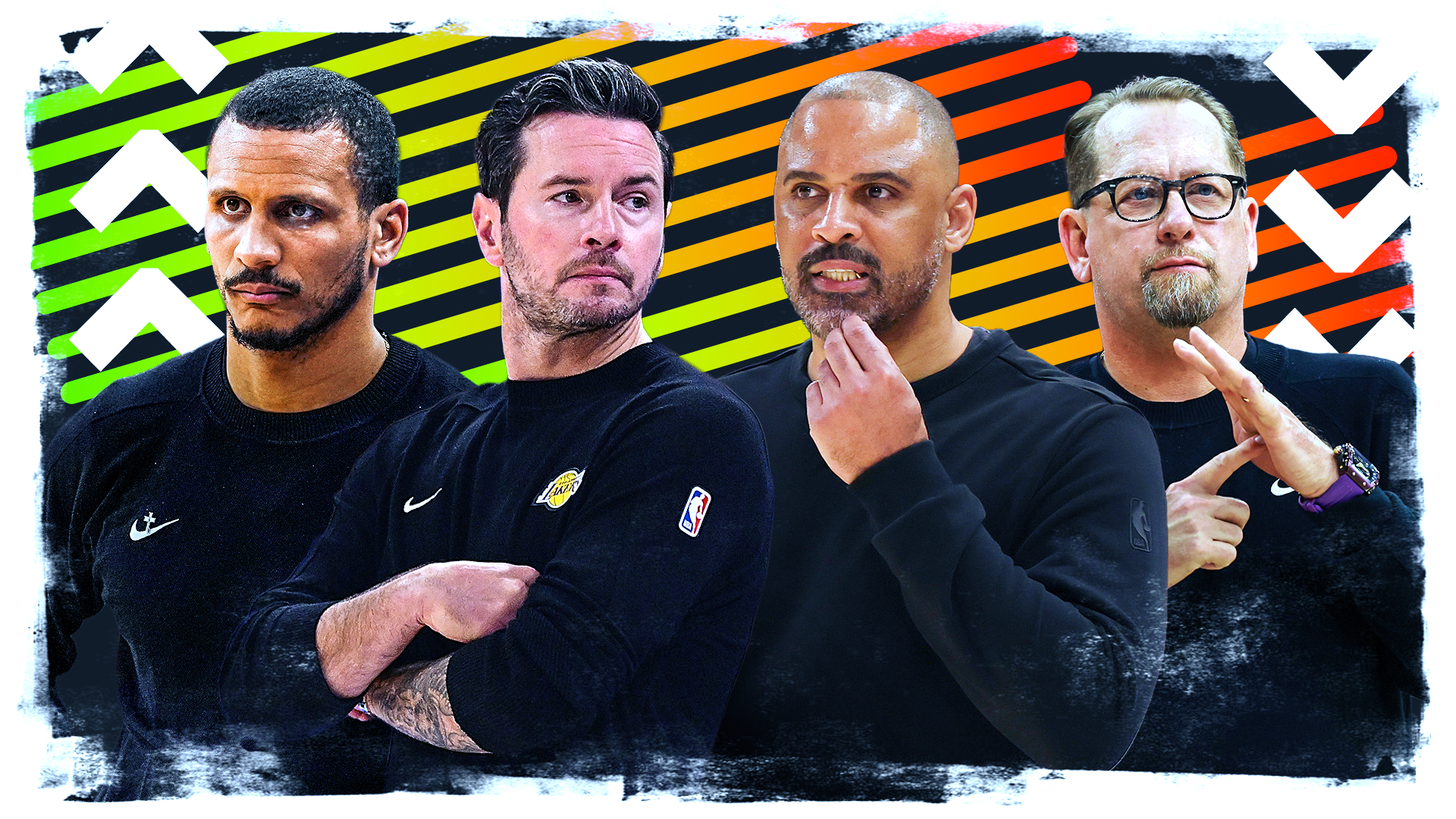
There is no harder group to evaluate in professional basketball than the coaches. It's not a single job. It's a dozen tied together by a title. You're a strategist and a therapist and a human resources manager and a public relations official and a split-second decision-maker all rolled into one, and you almost never get credit for it because most of the job is invisible. For players, the whole job is on display. For coaches, most of it is getting those players ready and keeping them engaged behind closed doors.
As I point out every year, any attempt to rank them is at best an incomplete endeavor and at worst, closer to a futile one. They're all juggling hundreds of decisions we don't get to see, yet we judge them on the few that we do. They're all working with different resources, and they're all kept on increasingly short leashes.
We didn't quite reach the heights of stunning coaching turnover we saw in 2024 and 2025, but in fairness, that's because most of the accomplished coaches had already been fired. Erik Spoelstra and Steve Kerr are the only remaining coaches in the NBA hired before the start of this decade. Only eight sitting head coaches have held their posts for the last four full seasons. The coach is almost always the fall guy when things go wrong. Every coach is either on the hot seat or a bad year away from getting there. It may not be totally fair for us to judge coaching performance, but it's not as though teams tend to judge coaches fairly either.
So what can we judge when it comes to coaches? These are the traits that come to mind:
- Track record. This is obvious. A great coach tends to win a lot of games in the regular season and advance deep into the postseason.
- Performance against expectations. Sometimes, a great coach is stricken with a limited roster. Can he make lemonade out of those lemons? Some coaches happen to consistently find themselves with elite talent. What does it say about them if they can't make the most of it?
- Points of emphasis. Do your teams take the right kinds of shots? Do they allow the right kinds of shots? Do you have ways of generating turnovers without excessive fouling? Do you balance rebounding and transition on both ends of the floor? Essentially, is your team doing the right things on paper? Are you plucking the low-hanging fruit?
- Creativity. Have you found unorthodox uses for under-valued players? Are there things that you do that other coaches don't? Can you draw up a nice out-of-bounds play?
- Player development. Do your draft picks pan out? Do you find productive players on the margins? Do players leave your team and get better? Do players leave your team and get worse?
- Rotation management. Are you playing the right players? Are you overusing your best players? Are you underusing them? Do you have specific lineup quirks that help or hurt your team consistently?
- People management. Again, we are working with very limited information here, but based on what we can see, do your players like you? Do they play hard for you? Are you operating in lockstep with your GM? Are you constantly battling with ownership? Can you manage the politics of your locker room?
There is no set rubric here. There are, however, a few traits I'm choosing to emphasize this year. The first is playoff performance. Every April, we're reminded of how different the regular season and postseasons actually are. A coach consistently winning in January means less to me if he consistently comes up short in April and May. The second is recent performance. The NBA changes quickly and coaches need to be able to adapt with it. If a coach had a particularly shaky year last season, that's going to factor in heavily here. Those are the coaches with the most to prove this season.
Before we begin, I open each list with the same, all-important qualifier: there are far more good coaches than bad ones in the modern NBA Teams are getting better and better at identifying strong candidates, and the correlation between coaching acumen and job security is distressingly inconsistent. Winning in the NBA has much more to do with players than coaches. Most of these coaches could succeed with the right players. Only a few of them actually have them. There is no curve on this list. Most sitting NBA head coaches are good at what they do, but somebody has to populate the lower end of the list. With that in mind, let's start ranking.

30. Doug Christie, Kings
The NBA has never been more militant about tanking than it was last season. The Indiana Pacers and Utah Jazz were both fined for tanking-related offenses. The rules were changed to discourage tanking after the season. But when the Sacramento Kings were investigated for tanking after a truly puzzling intentional foul against the Golden State Warriors, they successfully pleaded incompetence.
The Kings had no redeeming qualities as a team last season, no small areas of success that at least pointed to what they hoped to be before everything went wrong. They ranked 26th in offense, 28th in defense and 25th in rebounding. They lost both the free-throw and turnover battles. Save a couple of nice developmental wins down the stretch, the Kings spent last season in the toilet watching the coach they fired 21 months ago win the NBA championship. If you're defending Christie, you're applying the incompetence defense to his organization. He works for the Kings, after all. No coaches succeed there. Yet no Kings coach since Reggie Theus in 2009 has overseen a Kings team with a worse record. Even by Kings standards, last year was a disaster.
29. Brian Keefe, Wizards
Last season's rank: 25
You rarely see opposing players criticize coaches, but Bam Adebayo pinned his 83-point game squarely on Keefe. "You should be blaming their head coach," Adebayo said. "Get that first. I was not the one letting me go one-on-one the whole game until I had 70, and then you started to send a double." Few coaches have ever been given less to work with than Keefe, who took over the Washington Wizards on an interim basis in the middle of a tank that is only now just ending. The Wizards seem to have seen enough to at least give him the chance to coach a team that's actually trying. But as was the case with Christie, we just haven't seen any obvious, optimistic signs yet. There's no single thing the Wizards could hang their hat on last season. The onus is on him to prove he deserves the chance to coach this team as it attempts to turn the corner toward winning.
28. Sean Sweeney, Magic
Last season's rank: N/A
Historically, this list opens with the first-time head coaches. It's an acknowledgment of how little we know about what happens behind the scenes for an NBA team. Basketball isn't football. Assistants don't come with easily discernible titles and responsibilities. Sweeney has ascended to his first head coaching job with an excellent reputation around the league. He's been a highly-regarded assistant for five different teams, and the Magic have every reason to believe he will belong far higher on next year's version of this list than he does this year's. Until we see it, the first timers start at the bottom (unless, as is the case this season, there are holdover coaches with enormously disappointing track records).
27. Micah Nori, Trail Blazers
Last season's rank: N/A
Nori, like Sweeney, is a first-time head coach, but he gets the slight nod by virtue of his experience during the 2024 postseason. Chris Finch was obviously still present as the Minnesota Timberwolves reached the Western Conference Finals, but Nori had to take on an expanded, in-game coaching role after Finch tore his patellar tendon in a collision during the first round. That's not the same as being an acting head coach, but it's experience that should prove helpful as Nori takes over the Portland Trail Blazers.
26. Dusty May, Mavericks
Last season's rank: N/A
May gets a slight nod over Nori and Sweeney by virtue of having head-coaching experience, but he remains behind the rest of the pack because that head-coaching experience came at the college level. There just isn't much recent history of coaches making that jump. Brad Stevens was a major success and Billy Donovan is a solid NBA coach, but they both came after more than a decade of college head coaching. The only other coach to make that leap since is John Beilein (who, like May, left Michigan for the NBA). Beilein was a disaster with the Cavs. The Mavericks are taking the long view with this hire. Cooper Flagg is still only a teenager, so May will have time to find his bearings and adjust to the pros. Considering his well-earned reputation as a tactician at the college level, though, the Mavericks have every reason for optimism.
25. Jamahl Mosley, Pelicans
Last season's rank: 16
Mosley is now with the Pelicans, but his time with the Magic shows why he's ranked low on this list. It's not a great sign for a coach when his own franchise player criticizes his team's process. "Teams, a lot of times, adjust at halftime, and I think that's why we struggled a lot in the second half, just cause we don't really adjust to their adjustments," Magic forward Paolo Banchero said in March. Mosley's run with Orlando culminated in blowing a 3-1 series lead against the Detroit Pistons in the first round of the 2026 playoffs. In Game 6, Mosley's Magic were held to just 19 total points in the second half. Those offensive woes were far from an adjustment problem. In five seasons at the helm, Mosley never coached an offense that ranked higher than No. 18.
The Magic spent most of their draft capital trying to give him the scoring punch he needed, and he still couldn't muster an above-average offense. His calling card, despite those offensive struggles, had always been defense, but after the Magic fell to around league-average last season, it became clear that was a roster that badly needed a change.

24. Tuomas Iisalo, Grizzlies
Last season's rank: 26
Iisalo's early coaching tenure has been defined by his unorthodox approach to managing the rotation. His preference is to play players in shorter shifts -- ideally four or five minutes at a time -- in order to keep them fresher. It's an interesting concept in an NBA that is growing increasingly obsessed with depth to combat injuries. It has also seemingly irritated key players, as Ja Morant had a very public spat with Iisalo last season and Jaren Jackson Jr. reportedly shared similar frustrations. They're both gone now.
This season, with a young, rebuilding roster, is the perfect venue to experiment further with this approach. Morant and Jackson were seasoned stars used to a certain approach to keep them in rhythm. Might younger, less accomplished players prove slightly more pliable? We'll see, but whenever a coach tries something new like this, it's on him to prove its viability. It doesn't matter how revolutionary a coach's principles are if he can't get his players to buy into them.

23. David Adelman, Nuggets
Last season's rank: 15
David Adelman runs into some of the same issues that Michael Malone once did: how much credit can a coach, any coach, get for offensive success with Nikola Jokić? Adelman was Denver's de facto offensive coordinator for years, yet having one of the greatest offensive players in NBA history makes dividing player and scheme enormously tricky. Malone lost his job in part because he couldn't fix a leaky defense built around iffy personnel, and Adelman struggled with the same issues and even worse health a year ago. Still, Denver's first-round loss to Minnesota was completely unacceptable. The Nuggets were far from full strength, but the Timberwolves were far thinner. Ayo Dosunmu and Jaden McDaniels ended Denver's season. Failing to prevent that, even with a limited roster, falls on the coaching staff.
22. Jordi Fernandez, Nets
Last season's rank: 14
Fernandez has dealt with some of the same tank-based limitations that Keefe has, but he's at least flashed what he could be when given appropriate talent down the line. Fernandez had the Nets playing well enough early in the 2024-25 season that they had to trade Dennis Schröder at literally the first possible moment to derail his success. They had the NBA's best defense between Thanksgiving and Christmas last season behind Fernandez's aggressive scheme. They minimize mid-range shots and take plenty of 3s. They rebound relentlessly. The Nets have struggled in countless ways since Fernandez took over, but the outline of something sustainable exists here. The Nets do plenty of the right things. They just need the right players to execute those things.
21. Tiago Splitter, Bulls
Last season's rank: N/A
Splitter is one of the hardest coaches in the league to fairly evaluate. He took over immediately after opening night for the Blazers last year when Chauncey Billups was arrested. He didn't have a training camp to install his own system; he had to do so on the fly with a fairly injured team. He did a great job of doing so, all things considered. Portland made the playoffs. The Blazers played fast and generated a ton of turnovers and shot a bunch of 3s despite having few players who could make them. We can't really read anything into Portland not bringing him back either, given the ... let's call it "unconventional" way in which Tom Dundon has done things as an owner. The glaring red flag here: Portland ranked dead last in the NBA in points per possession after timeouts. That's less than ideal, but on all fronts, we're dealing with a small sample. There's plenty of promise here.

20. JB Bickerstaff, Pistons
Last season's rank: 20
Bickerstaff's calling card is getting young teams to defend. He does so very well: the Pistons jumped from No. 25 to No. 10 to No. 2 under his tutelage. The Cavaliers moved from No. 30 to No. 25 to No. 5 to No. 1. A lot of this is tied to the ascent of star defensive players like Evan Mobley and Ausar Thompson, of course, but building a defense-first culture this quickly is a major asset.
The questions here come in the postseason. Bickerstaff has held the higher seed in four playoff series: a five-game loss to a New York Knicks team without the injured Julius Randle, a seven-game win over a Magic team with virtually no playoff experience built around a 21- and 22-year-old, a separate seven-game win over a No. 8 seeded Magic team that probably only happened because Franz Wagner got hurt in Game 4 when Orlando held a 3-1 lead, and finally, a seven-game loss to his former Cleveland team in the second round last season.
Considering the talent he's had and seeds he's reached, the lack of playoff success says something. There have been a handful of coaches over the years with reputations for turning teams around quickly, but not being equipped to take them over the top. Think Scott Skiles or Tom Thibodeau. Impeccable regular-season track records. Shakier playoff histories. There's value in getting a team from Point A to Point B. The onus is on Bickerstaff to prove that he can take this talented Pistons team from Point B to Point C.

19. Jordan Ott, Suns
Last season's rank: 30
Nothing matters if a coach can't get his players to buy in, and after years of Phoenix cycling through coaches who couldn't do that, the Suns finally seem to have landed on one who can. Ott's debut season in Phoenix was a rousing success, based in large part on his ability to get his players to play hard for him. The Suns were near the top of the league in several of the NBA's defined hustle stats, notably deflections and loose-ball recoveries, and they surprised just about everyone with a No. 9 overall defensive ranking. Offensively, Ott seems to come from the Joe Mazzulla "all jumpers, all the time" school of offense. You can survive without getting to the rim or the line as Boston has, but you have to minimize turnovers to do so. The Suns didn't, though their offensive rebounding was Celtics-esque. All in all, Ott's first season at the helm went about as well as the Suns could have hoped for. If he keeps stringing together seasons like that he'll climb up this list quickly.
18. Nick Nurse, 76ers
Last season's rank: 12
We've reached the two coaches on this list that I personally found the hardest to rank. In both cases, I've ranked them in the top five of previous lists because the highs are dizzying. The lows, however, are deeply concerning. Nick Nurse's 2019 championship run was legendary. No coach has thrown more creative coverages at Stephen Curry. Most of his Toronto tenure, at least through the 2021-22 season, was stellar. The best basketball of Joel Embiid's career came not when he won the 2023 MVP award, but in the first half of his follow-up campaign, when Nurse unleashed him as a playmaker.
So again, there's plenty to like here. Should we be concerned that his last six teams have ranked 22nd or worse on points per possession after timeouts? With Thibodeau out of the league, Nurse is about as stubborn about overusing his starters as any coach in the NBA (a trait he ironically shares with the next coach we'll cover). We're in the depth era. His rosters haven't had enough of it, but he doesn't help by being stingy with his minutes. And then there's the Jared McCain trade. Daryl Morey took all of the heat for it, but based on what he'd seen from McCain last season, he had every reason to make the deal. What does it say about Nurse that McCain's season did a 180 the moment Mark Daigneault got his hands on him? With a new front office in place and sky-high expectations, this is going to go one of two ways: Nurse will have a great year, and the Sixers will be an inner-circle title contender, or he's going to be the fall guy. There's no in-between.
17. Ime Udoka, Rockets
Last season's rank: 5
Again, Udoka and Nurse share a number of notable traits. They both overuse their starters. They're both stellar defensive tacticians, with Udoka's work in Boston producing historic numbers and his own unique zone defense nearly stifling Curry in the 2025 playoffs. Udoka, like Bickerstaff and the Skiles-Thibodeau types of the past, is great at building a culture quickly. He's an innovator in some respects as well. He was at the forefront of the NBA's offensive rebounding craze and took it to its logical extreme by playing Alperen Sengun and Steven Adams together. Few coaches would have tried that. Those lineups were enormously effective.
But losing Adams and Fred VanVleet last year exposed some very real offensive shortcomings that Celtics fans have been warning us about since the 2022 playoffs. The Rockets ran some of the most stagnant, uninspired offense in basketball last season. Udoka's reluctance to give Reed Sheppard major minutes as one of the only reliable shooters on the team felt unnecessarily stubborn. Udoka wants to lean into defensive personnel. Sometimes your roster doesn't cooperate, and that lack of flexibility is a real issue for the Rockets. Houston landed perhaps the NBA's best shooting coach in Chip Engelland this offseason, but they made no other efforts to bring in a dedicated offensive coordinator to their staff. It's up to the existing group to prove that last year's offensive mess is solvable.
16. Taylor Jenkins, Bucks
Last season's rank: N/A
We're in the beginning of a run of coaches who have mostly met or exceeded regular-season expectations, but have little on their playoff résumés. Jenkins earned two No. 2 seeds in Memphis. His teams consistently outperformed regular-season expectations, and did so with plenty of injuries to key players. Just look at how well they handled Ja Morant's absences over the years. He was an early adopter of the NBA's pivot back toward offensive rebounding, and his defenses, at least during the healthy seasons, were near the top of the league. Jenkins' stint in Milwaukee is going to be informative on a number of levels. He's a difficult coach to separate from his former environment.
He was great at cultivating depth and developing players in Memphis, for instance, but it's hard to know how much of that was him and how much of it was a front office known for strong drafting. Was offensive rebounding a choice, or the natural result of coaching Steven Adams? His time with the Grizzlies ended shockingly in March of 2025, but the tea leaves had been sitting on the counter, waiting to be read for months. Memphis forced out five of his assistant coaches. How involved was he really in the implementation of Noah LaRoche's anti-pick-and-roll offense? He'll have his fingerprints all over a rebuilding Bucks team, but considering how well he did with the early Grizzlies, they should be in good hands.

15. Kenny Atkinson, Cavaliers
Last season's rank: 10
Atkinson has always been a pick-and-roll maestro, but he manages to run such a scheme without letting his offense get too heliocentric. He's always been at his best with several ball-handlers, and the absence of Ty Jerome, coupled with Evan Mobley's offensive regression, really stung last year's Cavaliers. Still, the principles here are sound. Atkinson teams run straightforward yet effective offense that creates high-value shots. He has a reputation for player development that has followed him across several jobs, but stood out most with a Brooklyn Nets team that made the playoffs built around castoffs and spare parts. Jerome soared under his guidance. So did Spencer Dinwiddie. Turning D'Angelo Russell into an All-Star is a pretty strong résumé boost.
His brief playoff track record is disappointing. Cleveland was dealing with plenty of injuries, but wasn't even really competitive with the Pacers in 2025. Mike Brown destroyed him in the Eastern Conference Finals. Atkinson had no answer whatsoever to the five-out lineup that swung Game 1, allowing Jalen Brunson to hunt James Harden into extinction on the way to a 21-point fourth-quarter comeback. The Knicks successfully bait-and-switched Cleveland into fouling Mitchell Robinson, only to remove him once they reached the bonus. The infamous quote about a hypothetical, analytical series lead will live forever, but in truth, it was far from Atkinson's biggest issue in that series.
14. Darko Rajakovic, Raptors
Last season's rank: 23
Typically, when you think of teams that minimize turnovers offensively, you think of teams that don't move the ball much. Oklahoma City comes to mind here. Indiana is the gold standard when it comes to finding the balance between the two, but Toronto might be silver. Rajakovic's offense includes plenty of ball movement, yet few teams in the NBA have been dogmatic about the possession game. They had the seventh-lowest turnover rate in the NBA last season, yet only the Pistons, Thunder and Suns forced more turnovers on the other end.
Their player development has been very strong under Rajakovic as well. Case in point: second-round pick Jamal Shead just got a three-year extension, and former first-round pick Ja'Kobe Walter is trending in that direction. If there's a concern here, it would be Toronto's troubling record against winning teams last season, but their near-upset of the Cavaliers in the playoffs while missing both Immanuel Quickley and Brandon Ingram suggests that this flaw is by no means permanent. Rajakovic showed just how resourceful he could be in that series, outcoaching Atkinson and nearly taking the victory despite being shorthanded.
13. Quin Snyder, Hawks
Last season's rank: 9
Snyder's Atlanta tenure has showcased some impressive versatility. His best Utah offenses were slow and deliberate. The Hawks are fast and whip the ball around the court. He built his Jazz defenses around one, all-encompassing rim-protector in Rudy Gobert. In Atlanta, he has a smaller, quicker center in Onyeka Okongwu that has forced him to get a bit more creative with his coverages. With the Jazz, he built a regular-season juggernaut.
He hasn't had the pieces to do that in Atlanta quite yet, and the East is so unforgiving now that his team is probably a few moves away from having that chance. That may not be the worst thing. The Hawks traded away their former franchise player in Trae Young for nothing last season. They appear fully committed to the style Snyder wants to play, and if his Utah track record is any indication, he'll be able to turn that style into a consistent winner. Still, with some playoff hiccups on his résumé, above-average is where Snyder belongs on a list like this. He's a good coach. You prove you're a great one in the spring.
12. Steve Kerr, Warriors
Last season's rank: 4
Kerr is a unique case. He's an undeniable Hall of Famer, despite some of the frustrations Warriors fans have long had with him. Nobody gets to tell you to run more Stephen Curry pick-and-roll when you've won four championships. He did so with a wholly unique style. No modern team has replicated Golden State's movement, both in terms of the ball and, more importantly, the players.
The question here is, at this point, if Kerr is equipped to coach any team besides the Warriors. Curry, specifically, powers Golden State's motion offense. We're in the possession-maxing era, and the Warriors have always treated a high turnover rate as an acceptable tradeoff for ball-movement and open shots. It may not be anymore. The recent developmental struggles are notable here as well, considering all of the resources that went into the younger of Golden State's infamous two timelines. Kerr has been near the top of the coaching profession for essentially his entire Golden State run, and his coaching legacy is cemented. But if you were trying to win the 2027 championship with a random group of players, Kerr has slipped just a bit down the list.
11. Charles Lee, Hornets
Last season's rank: 28
This is one of the points on the list that will likely cause some contention. The last batch of coaches has long regular-season track records, but spotty playoff histories. The next few are relatively new. They've been impressive in their regular seasons, but haven't had time to make much of a playoff impression yet. To some extent, we're projecting.
How many of you would have predicted that the lowly Hornets, who started 4-14, would have the NBA's best offense over the regular season's final four months or so? Lee brought several Mazzulla ball tendencies over from Boston, most notably in terms of 3-point volume, but he made the style his own by using guards to screen for guards as much as any team in the NBA. No team emphasizes rebounding to the degree that Charlotte does. The minutes the Hornets spent without their best rebounder last season, Moussa Diabaté, would still rank sixth in the league in rebound rate. The Hornets took a conscious step back by trading LaMelo Ball. Much of their confidence in doing so likely comes from having Lee as their coach. He built the system Ball thrived in last season, and he'll build the next great Charlotte offense as well.
10. Will Hardy, Jazz
Last season's rank: 11
No team, save perhaps the Wizards, has tanked as overtly as the Jazz over the past few years. One of the main reasons the Jazz have been as blatant about it as they've been is that giving Hardy an inch has meant watching him take miles. He had sorely undermanned Utah teams in the playoff race around both the 2023 and 2024 trade deadlines, so the Jazz traded away key players to kneecap him on both fronts. In four seasons, Lauri Markkanen has played only 18 games after March 1. Hardy's best players tend to disappear around Valentine's Day. Not anymore. The Jazz are trying to win now. For some, that makes this the first fair moment of evaluation for Hardy.
Given the offensive creativity he's already showcased and the roster full of shooting he now has, He should do quite well. Hardy has manufactured impressive ball and player movement out of rosters that haven't been equipped for it. He took the "Markkanen as a small forward" concept that Cleveland experimented with to the extreme and helped make him an All-Star as a result. Hardy has more questions to answer than anyone at this range of the list, but considering the Jazz already extended him through 2031, they seem to have every confidence that he'll answer them.
9. Mitch Johnson, Spurs
Last season's rank: 27
It would be easy to just remember the Finals. The blown leads. The hesitance to use timeouts to draw up plays in end-of-game situations. The refusal to admit that Dylan Harper was clearly the second-best player on the team in that series and needed to play more. That series reflected badly on Johnson and on the Spurs as a whole.
Let's not forget that Mitch Johnson made the NBA Finals in his first full season as a head coach. Having Victor Wembanyama is by far the biggest reason that happened, but the Spurs won the minutes that he missed last season, and they used him about as well as they reasonably could have for most of the season. Putting Wembanyama in a one-man zone seems obvious now, but it was a clever tactic to maximize perhaps the scariest rim-protector of all time. Few coaches would have bothered replacing Harrison Barnes in the starting lineup given San Antonio's early-season success, but the decision to start Julian Champagnie full-time supercharged San Antonio's season by giving the Spurs the extra shooting boost they needed. The Finals were rough. That shouldn't turn you away from Johnson forever.
8. JJ Redick, Lakers
Last season's rank: 13
Before training camp, Redick noted that "for the first time in my three years with the Lakers, this is probably the first time I feel the pieces actually fit together." He has a point. Redick has obviously had talent in his two years as a head coach, but hardly a thoughtfully constructed team. That's what tends to happen when your team makes an out-of-nowhere blockbuster for a top-five player. Redick has certainly benefitted from Luka Dončić's presence, but he's had to make lemonade out of the lemons he's had everywhere else.
He's had no serviceable rim-protectors, so he built the most switch-heavy defense in the NBA and made it far more effective than it's had any right to be. He hasn't had the shooters he's wanted, but last year's Lakers set the record for the highest 2-point percentage in NBA history. His first playoff run was defined by what was perceived as a rookie mistake -- playing his five starters all 24 minutes in the second half of a Game 4 loss to Minnesota -- but his second included an incredibly impressive playoff upset in which one of his stars (Dončić) missed the whole series and another (Austin Reaves) sat the bulk of it. That has been the defining trait of Redick's early career. He figures it out with an odd mishmash of players. This year, he seemingly has the sort of team that he wants, and if his work with the Island of Misfit Lakers over the past two seasons is any indication, he's going to do quite well with it.

7. Ty Lue, Clippers
Last season's rank: 3
Lue has a real argument as the best "draw up a play" coach in the NBA. His Clipper teams have never ranked lower than No. 11 in points per possession after timeouts, and they're frequently far higher. He hasn't had the playoff success in Los Angeles that he had in Cleveland, but in fairness, he's virtually never had a fully healthy team in that context either. Reaching Game 6 of the Western Conference Finals with Kawhi Leonard out in 2021 still says quite a bit. Any coach with the cache to tell LeBron James to "shut the f--- up" has the respect of his locker room. Lue is renowned for his playoff adjustments, but they often stand out so much because they come a game or two later than they probably should have. This season is going to represent an entirely new sort of test for Lue. Remember ... he lasted only six games in Cleveland after James left. We've never seen him lead a team without substantial veteran star power. We're going to learn a lot about him as a coach this season.
6. Chris Finch, Timberwolves
Last season's rank: 8
Even if it's almost always at Denver's expense, it's notable that the Timberwolves outperform playoff expectations basically every year. They just clinched a playoff series victory with essentially their entire guard rotation injured. They probably came a Karl-Anthony Towns shooting slump away from the 2024 NBA Finals. They tricked Victor Wembanyama into becoming a full-time 3-point shooter en route to stealing Game 1 on the road against the eventual Western Conference champions. Players aren't the only ones who can be playoff risers. At this point, Finch has to be treated as one too.
All Finch has done for parts of six seasons in Minnesota is make disparate pieces work together cohesively. He built an above-average defense around Karl-Anthony Towns and Jarred Vanderbilt before he even got Rudy Gobert. He's made offenses with every conceivable variety of big man work. Finch, at his core, is a problem solver. He tailors his style to the tools at his disposal, and that makes the prospect of him building a new sort of team around LaMelo Ball's unique skill set that much more exciting.
5. Mike Brown, Knicks
Last season's rank: 18
The top four, frankly, is the tier that has truly separated itself. Really, anyone in the top nine could make a credible argument for No. 5. Brown is proof of just how fluid and context-dependent a list like this can be. I had him No. 18 last season and No. 13 two years ago. Last season gave him the best roster he's ever had, and he soared into his best season as a head coach. He addressed virtually every concern we had with the Thibodeau-led Knicks without sacrificing what made that team work. They took more 3s and introduced more movement into the offense. They experimented with different lineups and used the bench more. Yet they didn't suddenly stop offensive rebounding or start turning the ball over constantly.
Really, though, Brown is here because he just went on the ultimate heater. Every lever Brown pulled in the playoffs, starting in Game 4 of the Hawks series, was the correct one. Turning Karl-Anthony Towns into a passing hub gave the Knicks the best playoff offense of all time. Closing Game 1 of the Eastern Conference Finals with Landry Shamet led to a historic comeback. Leaning on Jose Alvarado down the stretch in Game 4 of the NBA Finals helped create another. Brown's success here just underlines what the right marriage between a coach and a team can do for both sides. Neither side gets here without the other.
4. Joe Mazzulla, Celtics
Last season's rank: 7
Mazzulla is up there among the harder coaches to rank in the NBA. He's the league's best regular-season coach, bar none. He's dogmatic about his playing style, but it undeniably works. The Celtics shoot a ton of 3s. They never turn the ball over. They grab every offensive rebound. They protect the basket. They never foul. Do all of this well enough and, for the first 82 games of the season, it doesn't matter if you never get to the rim or shoot free throws yourself. You're going to win a bunch of regular-season games. Winning 56 of them largely without Jayson Tatum and missing half of the rotation from his championship team was Mazzulla's opus.
The playoff track record is troubling. Think of how we covered Bickerstaff's history as a higher seed in the playoffs. Mazzulla escapes some of that scrutiny as a former champion, but his other three seasons as a head coach have ended in enormously disappointing upsets: a conference finals loss to a No. 8 seed, a second-round upset with consecutive blown 20-point leads, and a blown 3-1 lead in the first round. Tatum's injuries have factored into all three series to some extent, but in context, these were all bad losses. Mazzulla's teams can get a bit too fixated on his principles, with their refusal to adjust their shot selection with those huge leads against the Knicks being the starkest example. Similarly, his commitment to a clearly compromised Kristaps Porziņģis in that series was a major issue. It's been five months, and his Game 7 starting lineup against the 76ers this year still doesn't make sense. For now, Mazzulla deserves top-tier benefit of the doubt. Another loss or two like that and questions would justifiably arise.
3. Erik Spoelstra, Heat
Last season's rank: 2
Once you get to the top three, it's going to come down to preference. Spoelstra has been the default No. 1 answer for much of the past decade or so, and it's warranted. Two championships. Six Finals trips -- the last two with bottom-half-of-the-bracket seeds and without LeBron James. No team develops second-round picks and undrafted free agents as consistently as the Heat do. Spoelstra is an exceedingly malleable strategist, with last year's adoption of the LaRoche offense and a blistering pace among his more notable stylistic pivots. The Heat always defend. Their culture is so strong that they've literally put it on the jerseys.
We're splitting hairs at this point, but it's now been four straight years in the Play-In Tournament. Spoelstra's after-timeout numbers have always been a bit underwhelming relative to expectations. Miami's game management hasn't been quite as bulletproof in recent years as it was in the past. Spoelstra even pulled a Chris Webber and called a timeout the Heat didn't have in 2024. He and the next two coaches are in a tier, but our top two picks have just had more recent success.
2. Mark Daigneault, Thunder
Last season's rank: 6
Notably, NBA players voted Daigneault the NBA's best coach in 2025 through The Athletic's annual poll. He came up just behind Mazzulla last season. Oklahoma City's culture is renowned across the sport, and it seemingly carries the Thunder no matter who's on the floor. The Thunder without Shai Gilgeous-Alexander last season still had a net rating that would've placed them in the top-10 in the league across the full season, and they're 22-19 without their MVP across the past four seasons. The Thunder were among the first teams to truly embrace the importance of turnover margin and have built their historic defense around steals and the fast-break points they generate. Practically every player this coaching staff touches turns to gold.
If there's a question here, it comes down to separating organization from coaching staff. The measure of a coach -- at least in a strategic sense -- is his ability to solve problems, and the Thunder are usually at such a talent advantage that problems scarcely arrive. They did in the Western Conference Finals due to injury. The Thunder lost. Daigneault's 2025 championship run was littered with questionable decisions. His "foul up-three" approach cost the Thunder Game 1 against the Nuggets, and changing his starting lineup before the Finals was an unforced error. Daigneault has built an almost impenetrable structure in Oklahoma City. The Thunder are a machine. He just hasn't built the sort of strategic track record our No. 1 pick has.
1. Rick Carlisle, Pacers
Last season's rank: 1
Ignore everything you saw last season, or at least remember that all of that misery was the result of Carlisle taking a No. 4 seed to Game 7 of the NBA Finals in the first place. Carlisle has always been a playoff overachiever. Think of the stars he left in his wake on the way to the 2011 title. No team pushed the 2014 Spurs further than Carlisle's Mavericks did as a No. 8 seed. There is no better playoff tactician than Carlisle. He once nearly stole a playoff series by surprisingly inserting Boban Marjanović into the starting lineup after spending most of the season without him even in the rotation. He'll try anything, and almost everything he tries winds up working.
That's his single best trait as a coach. Carlisle is as stylistically flexible as any coach in basketball. He's built dominant offenses around Luka Dončić dribbling the air out of the ball, and he's built dominant offenses around Tyrese Haliburton's up-tempo passing machine. He disarmed LeBron James in the Finals with Tyson Chandler and a zone. He looked at his 2024 roster, realized the defensive personnel wasn't good enough, shrugged and seemingly just decided "well, if we can't guard anywhere, we can at least run everybody off the line and give up the fewest 3s in basketball." The Pacers made the conference finals, so clearly, it worked. If you need a single basket, he might be the coach you choose to draw up the play. His full-court football sets are downright beautiful. The Pacers built their roster around second-draft players like Haliburton, Aaron Nesmith and Obi Toppin. If that doesn't sell you on his player-development track record, the memory that he was Jalen Brunson's first NBA coach should.
The last time we saw Carlisle in serious games, he was out-coaching the No. 2 finisher on this list. Carlisle pushed Daigneault to the brink despite an inferior roster and a lower seed. That's all he ever does. He's never had the sort of undeniable rosters that most Hall of Fame coaches get, but his teams are universally scarier than they have any right to be simply because he's the one leading them from the sidelines.