
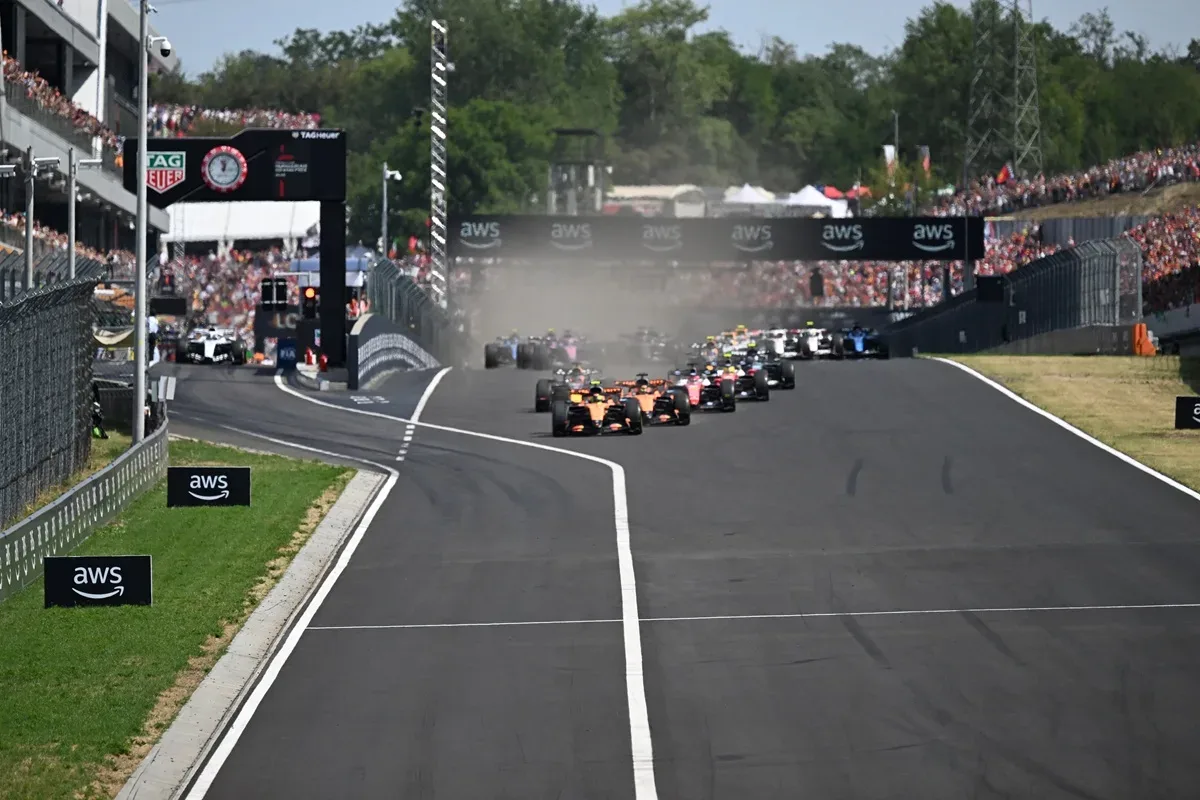
F1 grid penalties alter the starting order after qualifying for reasons including power-unit changes, sporting infringements and parc fermé breaches. Under the 2026 regulations, power-unit penalties are cumulative, while drivers with more than 15 unserved places are placed behind other classified drivers.
The guide distinguishes grid penalties from pit-lane starts, explains how multiple penalties are applied, and covers carry-over penalties, qualifying classifications, component usage limits and the absence of a separate season-long gearbox allocation system.
Formula 1 grid penalties can change the starting order after qualifying has finished.
A driver might qualify third but start 13th after taking a new power-unit component. Another may lose places for impeding a rival. A team can also make changes under parc fermé conditions that force its driver to start from the pit lane.
The system becomes more complicated when several drivers have penalties at the same race.
Under the 2026 FIA Formula 1 Sporting Regulations, grid penalties are applied through a defined process rather than simply moving every penalised driver backwards one at a time. Drivers with more than 15 cumulative unserved grid-place penalties are also treated differently when the final order is formed
This guide reflects the FIA regulations in force as of 24 September 2026.
For a wider introduction to race weekends, qualifying and championship rules, see the World in Sport guide to F1 rules explained.
What is an F1 grid penalty?
A grid penalty moves a driver away from the starting position they would otherwise have earned.
The penalty normally applies to the Sprint or Grand Prix starting grid, depending on why and when it was imposed.
There are several routes to a grid penalty.
A driver can exceed their permitted allocation of power-unit components. The stewards can impose a grid drop for a sporting infringement. A penalty from an earlier incident can carry forward to a later race. Certain parc fermé breaches can instead result in a pit-lane start.
That is why the qualifying classification and the official starting grid are not always the same.
World in Sport’s guide to F1 qualifying explains how Q1, Q2 and Q3 initially establish the order before any penalties are applied.
Embed from Getty ImagesWhy does F1 use grid penalties?
Grid penalties allow Formula 1 to punish certain infringements without always changing a driver’s previous race result.
They also support technical restrictions designed to stop teams using an unlimited number of major components during a season.
Power-unit limits are a clear example. Teams have to manage reliability across the championship instead of fitting fresh components whenever performance begins to fall.
Once a driver exceeds the permitted allocation, using another restricted component can bring a grid penalty.
Sporting grid penalties serve a different purpose. Stewards can move a driver backwards for infringements committed during qualifying or other sessions when a grid drop is considered appropriate.
How do F1 power-unit grid penalties work?
The 2026 rules place limits on the number of specified power-unit elements each driver may use during a championship.
The baseline allocation includes three internal combustion engines, three turbochargers, three exhaust sets, two energy stores, two of each control-electronics unit, two MGU-K units and five of each specified power-unit ancillary component.
However, the 2026 regulations also provide an additional unit for each of those listed power-unit elements during the 2026 Championship. They provide the same concession as when a power-unit manufacturer did not supply engines in 2026 and is in its first year of supplying them.
That distinction matters when following component usage during the season.
| Power-unit element | Baseline allocation | 2026 additional allowance |
|---|---|---|
| Internal combustion engine | 3 | 1 additional unit |
| Turbocharger | 3 | 1 additional unit |
| Exhaust set | 3 | 1 additional unit |
| Energy store | 2 | 1 additional unit |
| Control electronics | 2 of each unit | 1 additional unit |
| MGU-K | 2 | 1 additional unit |
| Specified power-unit ancillary components | 5 of each | 1 additional unit |
These allocations belong to the driver for regulatory purposes.
If a driver is replaced during the season, the replacement is treated as the original driver when assessing power-unit usage. A substitute therefore does not automatically receive a fresh allocation.
How many places are an F1 engine penalty?
Once a driver exceeds the permitted number of a particular power-unit element, the first additional element of that type brings a 10-place race grid penalty.
Further additional elements of the same type bring five-place penalties.
The penalties are cumulative.
| Power-unit change | Grid penalty | When applied |
|---|---|---|
| First additional element of a type beyond the permitted allocation | 10 places | First competition in which it is used |
| Later additional element of the same type | 5 places | First competition in which each additional element is used |
A driver taking extra components of several different types can therefore accumulate a much larger penalty at one event.
For example, suppose a driver exceeds their permitted allocation of both the internal combustion engine and turbocharger for the first time at the same Grand Prix.
As a simplified illustration, those two 10-place penalties would combine to produce 20 cumulative grid places.
That does not mean the driver is simply moved exactly 20 physical positions from their qualifying result. Once cumulative penalties exceed 15 places, the FIA’s grid-formation procedure becomes important.
When is a new power-unit component considered used?
A component does not avoid a penalty simply because the driver completes only a short run.
Under the regulations, a relevant power-unit element is considered used once the car’s timing transponder shows that it has left the pit lane.
Teams therefore have to consider carefully when introducing components into a driver’s pool.
There is another restriction when several copies of the same penalised component are introduced during one competition. If more than one new example of that same element is introduced. Only the last one fitted may subsequently be used at later competitions without another penalty arising from that particular introduction.
Are there still gearbox grid penalties in F1?
Gearbox penalties need careful explanation because older F1 guides can give a misleading picture of the current rules.
The 2026 Sporting Regulations do not contain the previous season-long restricted gearbox allocation system alongside the current power-unit allocation rules. Article B8’s component limits now focus on the power unit.
That does not mean teams have complete freedom to change anything around the gearbox at any point in the weekend.
Parc fermé regulations still restrict changes once the car enters parc fermé conditions. Work outside the permitted exceptions can result in the driver being required to start from the pit lane.
Fans should therefore distinguish between an allocation-based grid penalty and a pit-lane start caused by breaking parc fermé conditions.
What sporting offences can cause a grid penalty?
Not every grid penalty comes from mechanical components.
The stewards can drop a driver any number of grid positions following an incident during a lap-time classified session such as practice, Sprint Qualifying or qualifying.
One familiar example is impeding another driver during qualifying.
The exact sanction depends on the incident and the stewards’ decision rather than a universal fixed number of places for every offence.
Under the current regulations, a grid penalty arising from a driving infringement during Sprint Qualifying normally applies to the Sprint grid. Other applicable qualifying-session grid penalties are served in the race.
Stewards can also impose a grid drop for a later Sprint or race following an incident during a race session.
Another route involves reprimands. A driver who reaches five reprimands in the same championship, with at least four imposed for driving infringements, receives a 10-place race grid penalty.
A driver who cannot serve certain race penalties because of retirement or being unclassified can also receive a grid penalty for their next race at the stewards’ discretion.
Embed from Getty ImagesHow are multiple F1 grid penalties applied?
This is the part that often creates confusion.
The FIA does not simply take the qualifying order and move each penalised driver backwards in isolation.
The grid is effectively rebuilt.
For the race, classified drivers with 15 or fewer cumulative unserved grid penalties are first given a temporary position based on their qualifying classification plus their penalties.
If two or more penalised drivers arrive at the same temporary position, their qualifying order determines their relative priority.
Unpenalised classified drivers are then placed into the available positions in qualifying order. The penalised drivers are subsequently moved forward to fill any remaining empty grid slots.
This explains why a five-place penalty does not always produce a final starting position that appears exactly five places below the driver’s qualifying result.
Other penalties change which positions remain available.
What happens if an F1 driver has more than 15 grid-place penalties?
A separate rule applies once a classified driver has accumulated more than 15 unserved grid-place penalties for the race within the relevant 12-month period.
That driver starts behind all other classified drivers.
If several drivers fall into this category, their qualifying classification determines their order relative to one another.
Consider a hypothetical example.
Driver A qualifies fourth but receives 20 grid places.
Driver B qualifies 10th and receives 25 places.
Both fall into the more-than-15 category. They move behind the other classified drivers, but Driver A remains ahead of Driver B because A qualified higher.
The penalties are therefore still meaningful even when neither driver can physically move 20 or 25 places backwards on a 22-car grid.
Can a driver start from the pit lane instead?
Yes.
A pit-lane start is different from a normal grid-place penalty.
One important route involves parc fermé.
For a standard-format weekend, a car enters parc fermé from the first time it leaves the pit lane during qualifying until the start of the race. Subject to the permitted exceptions and FIA approval procedures, teams cannot freely replace parts, alter the set-up or change the car’s configuration during that period.
If a team breaches those conditions, the relevant driver must start the race from the pit lane.
On an alternative-format weekend, parc fermé breaches before the Sprint can require a pit-lane start for the Sprint, while specified breaches after qualifying can require one for the Grand Prix.
A driver starting from the pit lane joins only after the cars starting on the grid have begun the race under the prescribed procedure.
Can an F1 grid penalty carry over to another race?
Some can.
The regulations allow stewards to impose a drop of any number of grid positions for the next Sprint or race in which the driver participates during the following 12 months.
Certain penalties that cannot be served during a race because a driver retires may also be converted into a grid penalty for the next race.
Power-unit penalties operate differently. They apply at the first competition in which the additional restricted component is used.
The reason for the penalty therefore matters as much as its size.
Does a grid penalty change the qualifying result?
No.
Qualifying classification and starting-grid position are separate.
A driver can still be officially classified as the fastest qualifier even if a penalty means they start further back.
For example, a driver could finish qualifying first and therefore head the qualifying classification, but a 10-place grid penalty would alter where they line up for the race.
That distinction matters when reading results or historical records.
The published starting grid reflects the adjustments made after qualifying.
What happens if a driver withdraws after the grid is set?
The FIA publishes a provisional and then a final starting grid.
If a car is withdrawn early enough, the grid can be closed up.
Under the 2026 regulations, the provisional race grid must be published at least two hours before the scheduled formation lap. The final grid appears one hour before it.
A car withdrawn or unable to start after the specified cut-off leaves its grid position vacant rather than causing another reshuffle.
This is another reason the grid shown immediately after qualifying might not be the order seen at the start.
Why teams sometimes choose to take penalties together
Teams sometimes introduce several new power-unit elements at the same event when a driver is already facing a substantial grid drop.
That is a strategic choice rather than a special regulatory exemption.
If a driver is likely to start near the back because of one component change. A team may decide that the same weekend offers an opportunity to add other fresh components to the usable pool.
The trade-off is immediate track position against reliability and component availability for later races.
Circuit characteristics can influence that decision. Starting further back may be less damaging at a venue where overtaking is easier than at one where passing opportunities are limited.
The 2026 technical rules changed the power-unit architecture significantly, making current regulations particularly important when comparing modern component limits with older seasons.
World in Sport’s guide to the 2026 F1 rule changes covers that wider reset.
Embed from Getty ImagesCommon F1 grid-penalty misunderstandings
One common mistake is assuming that every engine change causes a penalty.
It does not.
Drivers may use components within their permitted season allocation without receiving an allocation penalty.
Another misconception is that a 10-place penalty always means starting exactly 10 positions lower than qualifying.
That is also not guaranteed. Several drivers can have penalties at the same event, and the FIA’s grid-formation procedure determines the final order.
A pit-lane start is not simply another name for a back-of-grid penalty either. It follows a different procedure and can arise from matters such as prohibited changes under parc fermé.
Finally, the rules can change between seasons. Component limits and procedures from previous F1 eras should not automatically be applied to 2026.
Frequently asked questions
How many places are the first F1 power-unit penalty?
The first additional element of each power-unit type beyond the permitted allocation carries a 10-place race grid penalty. Later additional elements of that same type carry five-place penalties.
Do F1 engine penalties add together?
Yes. Power-unit grid penalties are cumulative. Taking several additional restricted elements at the same competition can therefore create a combined penalty greater than 10 places.
What happens when an F1 driver gets more than 15 grid places?
A classified driver with more than 15 cumulative unserved race grid penalties is placed behind the other classified drivers. If several drivers are in that group, their qualifying order determines their relative starting order.
Can an F1 driver qualify on pole but not start first?
Yes. Qualifying determines the initial classification, but grid penalties or a pit-lane-start requirement can change the actual starting position.
Does changing an F1 gearbox automatically cause a grid penalty?
Not under a separate season-long gearbox allocation system in the 2026 Sporting Regulations. However, unauthorised changes while the car is under parc fermé conditions can lead to a pit-lane start.
When does a new F1 power-unit component officially count as used?
The relevant element counts as used once the car’s timing transponder shows that the car has left the pit lane with it fitted.

World In Sport Forum
Continue the discussion
Join other fans in the World In Sport Forum and debate the biggest talking points from this article.