
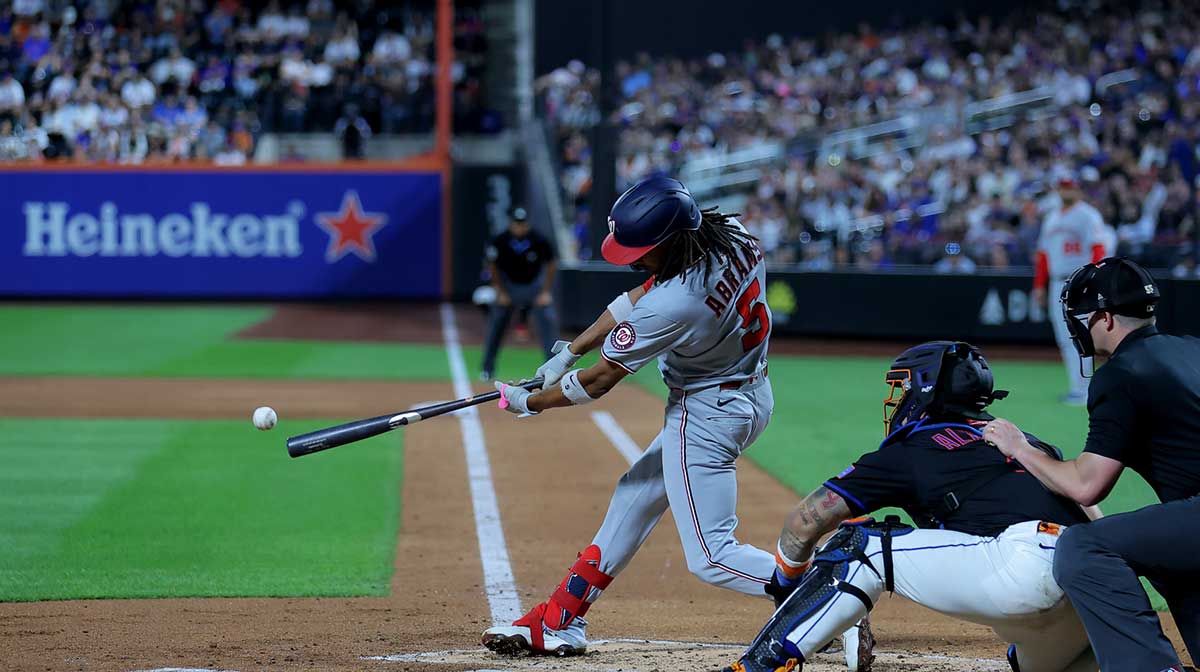
The Los Angeles Dodgers should pursue CJ Abrams with a package that addresses the Washington Nationals' pitching needs while strengthening their own infield. Emmet Sheehan, Christian Zazueta and Alex Freeland would give Washington immediate options and future upside for a hitter entering his prime.
The Athletic's Jim Bowden underscored why pursuing Abrams or Cincinnati Reds star Elly De La Cruz would make sense for the Dodgers while noting the organization's confidence in its emerging prospects.
“Taking a big swing to try to trade for the Nationals’ Abrams or the Reds’ De La Cruz also would make a lot of sense for them. That said, they feel several of their top prospects, such as outfielders Josue De Paula, Mike Sirota and Eduardo Quintero, are getting closer to being major-league ready.”
This package is an editorial proposal, not a reported offer or the Nationals’ established asking price.
Hypothetical trade
Dodgers receive CJ Abrams
Nationals receive Emmet Sheehan, Christian Zazueta and Alex Freeland
Why CJ Abrams fits the Dodgers' infield
Abrams would bring a different dimension to an already formidable Dodgers lineup. He finished 2026 batting .261 with 33 home runs, 106 RBIs, 34 stolen bases and an .833 OPS. At 26, he offers power and speed across two remaining seasons of team control.
The clearest fit is second base. The Nationals began preparing Abrams for that position in August, making it a more credible plan than automatically displacing Mookie Betts at shortstop.
That transition still requires evaluation. Moving off shortstop does not guarantee better defense, and the Dodgers should assess his positioning, footwork and comfort before assuming they have solved the position.
Tommy Edman's versatility provides a way to accommodate the addition. Los Angeles could use him across the infield and outfield rather than tie his opportunities exclusively to second base. Abrams would receive regular at-bats while Edman helps cover rest days and injuries.
The Dodgers would also be choosing Abrams over a longer commitment to a free agent or continued reliance on their existing options. His appeal is established production without requiring a contract extending deep into his thirties.
Why the Nationals should consider this package
The Nationals need starting rotation help. Washington's incentive begins with Sheehan. The 26-year-old right-hander recorded a 4.57 ERA, 132 strikeouts and 33 walks across 112 1/3 major league innings in 2026.
That ERA prevents calling him a finished frontline starter. However, his strikeouts and walk total give the Nationals something more substantial than distant projection. He could compete for a rotation spot immediately while remaining under team control through 2029.
Zazueta adds another possible starter on a different timeline. The 22-year-old posted a 3.65 ERA with 144 strikeouts and 20 walks in 103 2/3 innings between High-A and Double-A.
That combination makes him a meaningful piece rather than a throw-in. His ability to miss bats while limiting walks gives Washington a second opportunity to improve its pitching beyond Sheehan's immediate contribution.
He still must prove himself against more advanced hitters. The Nationals should value his development potential without planning their Opening Day rotation around a pitcher who has not reached the majors.
Freeland gives Washington another major league option for the infield. The 25-year-old switch-hitter batted .234 with a .327 on-base percentage and four home runs in 2026.
Article Continues BelowThose numbers do not replace Abrams' offense. Freeland would instead compete for playing time while providing another option as Washington evaluates its younger infielders. His inclusion gives the Nationals a player to use now rather than making the entire return depend on pitching development.
Together, the package would address multiple needs while accepting that no incoming player duplicates Abrams.
Both clubs must account for the cost
Sheehan's departure would cost the Dodgers usable innings, while trading Zazueta would thin their next wave of pitching depth. Los Angeles should proceed only with a credible plan to absorb those losses.
The Dodgers should also resist treating Washington's willingness to consider offers as desperation. Abrams remains a productive hitter the Nationals can retain while pursuing pitching through other channels.
For the Nationals, the decision comes down to whether Sheehan's immediate value, Zazueta's upside and Freeland's usefulness collectively outweigh two more seasons of Abrams. Quantity alone is insufficient; Washington must believe in the individual players.
Los Angeles should present this offer to give both clubs a clear direction. The Dodgers acquire an impact everyday hitter, while the Nationals turn one player into pitching and infield options. Neither side receives certainty, but both gain a path toward a stronger roster.