
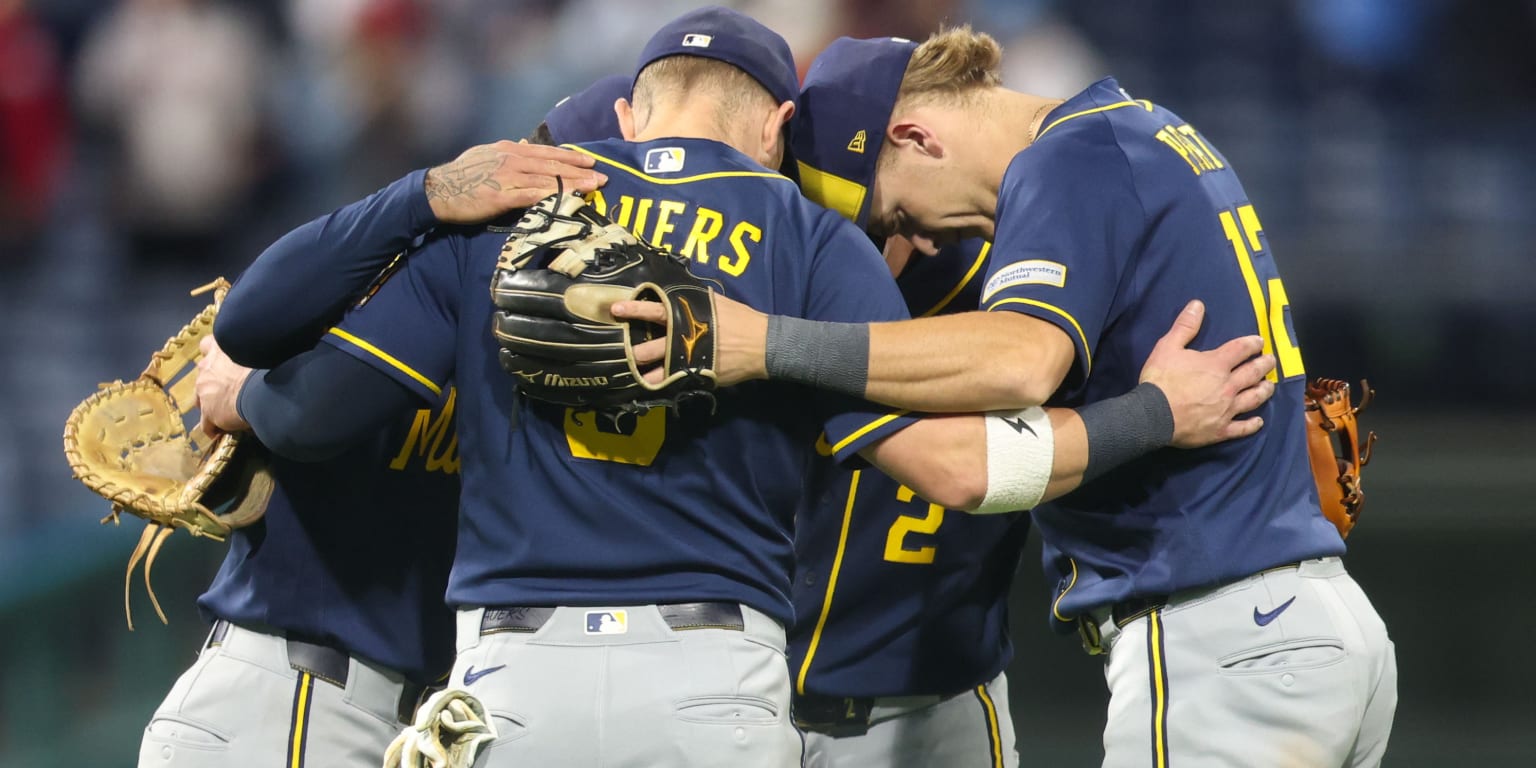
As the quartet of Wild Card Series were raging this week, the four teams who had achieved first-round byes – Milwaukee and Los Angeles in the National League, Cleveland and Tampa Bay in the American League – were watching comfortably from home. They enjoyed a few days of rest and got their starting rotations lined up exactly how they want as they awaited the first-round survivors traveling to their cities.
“But,” the annual question goes, which was even posed on national broadcasts this week, “did they lose momentum?”
You get the point behind the concern, anyway. Baseball is a daily game, where timing is absolutely everything, and taking nearly a week off from seeing competitive pitching – where practice and simulated games are a weak facsimile of the real thing – isn’t a substitute for actual baseball.
Whenever a player coming off a bye has a poor series, this is what gets pointed to, which also papers over the fact that any hitter, no matter how great, is capable of having a bad few days against great pitching. It doesn’t even require a bye, is the point. You may have noticed that Cubs stars Alex Bregman and Pete Crow-Armstrong just combined to go 0-for-15 with a walk against excellent San Diego pitching. In a short series, it happens.
Still, this is the question that comes up every year, at least since we’ve gone to this format in 2022, and it mostly stems from 2023, when three of the four bye teams (Braves, Dodgers, and Orioles) lost in the Division Series. It must have been, the theory goes, because sitting around for a few days cost them their timing and allowed the teams who kept playing to keep warm, to not lose steam.
There’s a lot of nuance lost there, of course, primarily due to the fact that no team with a first-round bye has ever lost in the first round. It’s a perfect 1.000 winning percentage. Surely, the Red Sox, Astros, Cubs, and Phillies would love to have such luxurious problems as “worrying about momentum,” as opposed to packing up the clubhouse for the long, cold winter.
The teams that made it out of the Wild Card Series overcame the risk of having their season end early, and they still have to start the Division Series on the road. But there's another penalty, too: They don’t get to reset their rotations in the same way as the bye teams. Take the Rays-Yankees series, for example. While Tampa Bay gets to start its ace, Drew Rasmussen, in Game 1, you’ll notice that Cam Schlittler of the Yankees, universally expected to be this year’s AL Cy Young Award winner, won’t be available for the opener.
So: What of it? Let’s look back to look forward.
What happened to the previous bye teams?
There’s now been 16 Division Series since the format change of 2022. The teams that had the bye won nine times. The Wild Card Series winner, who had kept playing, won seven times.
That breaks down, for the bye teams, to 2-2 (2022), 1-3 (2023), 3-1 (2024) and 3-1 (2025).
While it’s been just four seasons, the further that 2023 gets in the rearview mirror, the more it seems like an outlier.
Still, 9-7 isn’t that much of a gap, and even then, simply looking at seeding or regular season record isn’t good enough to clearly call anything here a favorite or an upset. Just look at 2023, when it was very clear even before the 104-win Braves lost to the 90-win Phillies that record wasn’t telling the real story, or when what seemed to be a stunning upset of the Dodgers by the D-backs made a lot more sense after you learned that the Dodgers' rotation was so tattered that Clayton Kershaw went ahead and made his start with a clearly injured shoulder.
What does this tell us? Nothing, really. You’d expect the team with the bye to be mildly favored, since they played better and by definition won more games. But you’d obviously never expect a 100% win rate, because you’re still talking about not only two Major League teams in a best-of-five series, which has some “flip a coin” properties, but also two postseason-quality Major League teams.
So, then: How often should the bye team be favored? You’d like to think it’s better than 50/50, and it is. You know for certain it’s not 100%, and it’s not.
One way to do this is to go back to look at the series-by-series projections offered by FanGraphs, because the results, we must say, are delightful. You can go back to the start of each of the 16 Division Series under the current format, to see what the projections said at the time, which will give you things like “the Brewers had a 55/45 edge over the Cubs last year,” and, “the biggest upset was that the 2024 Phillies had a 66/34 edge over the Mets and lost anyway.” Put that all together, and you get this:
- Projected winning percentage of the 16 bye teams: .576
- Actual winning percentage of the 16 bye teams: .563
That, really, is perfect. Bye teams are mostly a little better and so they’re expected to win a little more than the other team and in reality, they do exactly that.
If “losing momentum” was a real concern, then that would reflect here. It doesn’t. It may in fact be true that hitters suffer from sitting and waiting, but it hasn’t shown up in any noticeable way in terms of wins and losses.
If past trends hold true, you’d expect two or three of the bye teams – again, Milwaukee and Los Angeles in the National League, Cleveland and Tampa Bay in the American League – to advance, but not all four of them. If one of those four teams fail, it won’t be because they’d lost steam. It’d be because the Padres, or the Braves, or the White Sox, or the Yankees, are all good teams easily capable of winning a best-of-five series.
It is, after all, the playoffs. It’s the second round of the playoffs, at that. There are no guarantees. There are no certainties. All we know for sure is that the teams who got the bye did not have their seasons end already. They all, for sure, would not trade that comfort for the risk of having to had survive a best-of-three.