
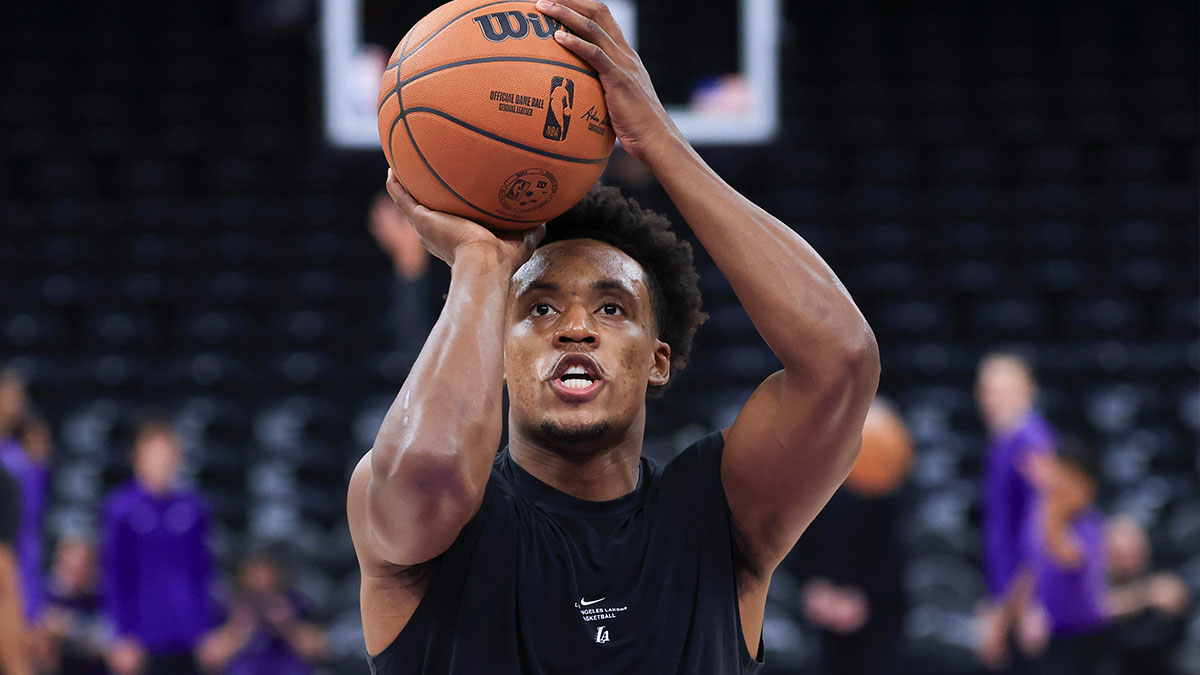
LOS ANGELES – When the Los Angeles Lakers revamped their roster in the offseason, one of the players they targeted early was veteran guard Collin Sexton. Now in his ninth season in the NBA, the former lottery pick was brought on to add both ball-handling and scoring punch off the bench. But one key aspect that Sexton also brings to the Lakers is his leadership.
With the departures of LeBron James and Marcus Smart from last season’s roster, the Lakers lost some of their strongest voices in the locker room. And that’s where Sexton steps in. He suffered a calf injury before the season began, sidelining him for all of preseason and the team’s season opening win against the Golden State Warriors.
But even with him being limited to what he could do on the court during practice, Collin Sexton still made himself a valuable piece of the Lakers roster in the early-goings with his leadership and his voice behind the scenes and on the bench. His experience in the league has helped shape his style as a leader.
“I think for me, just coming in with the right attitude each and every day no matter the circumstances, no matter the wins or losses. I’ve had ups and downs so I feel like every day, coming in as a person that other guys can lean on and someone that’s gonna come in and work his a** off,” Sexton said following Lakers’ shootaround on Oct. 23.
“I feel like the leadership role is something that I always carry each and every day. I just come in to be a leader and be a good person. I think being a good person allows you to be a leader, allows people to follow you as well.”
Sexton’s leadership style isn’t a conventional one. He’s vocal, he’s animated, he can be intense. Or as Lakers head coach JJ Redick puts it, it’s a little bit of insanity. It permeates into his game on the court, and that’s something that Redick feels is good for the team.
“I think there’s a level of insanity with him and I think our team responds to insanity,” Redick said following the Lakers’ win against the Utah Jazz this past Sunday. “It’s a good thing. He comes into the game and you know he’s in the game. I think defensively he’s trying to apply ball pressure. He’s trying to make hard closeouts. He’s trying to push the basketball. He’s trying to touch the paint. There’s an intensity to all that stuff and our guys responded.”
Sexton has appeared in three games now for the Lakers since his injury return. He’s averaging 9.0 points, 1.3 rebounds, 2.3 assists and 1.0 steals albeit only shooting 39.3 percent from the field and 15.4 percent from the 3-point line.
It’s a small sample size though, and conventional wisdom suggests that his shooting efficiency will increase to his career averages as he gets more comfortable with his new teammates and shakes off the injury rust. But if there’s one player on the roster who knows and understands Sexton already, it’s Walker Kessler.
The duo were teammates with the Jazz for two seasons, and were also familiar with each other prior to the NBA having both grown up in the Atlanta area. Kessler has come to know why Sexton’s nickname is ‘Bull,’ and he’s a big fan of that intensity.
Article Continues Below“He’s a bull, there’s a reason why that’s his handle. He’s a maniac. I love Bull. Every possession, offense, defense, he’s got a certain chip on his shoulder, just plays with a certain tenacity,” Kessler said during his postgame press conference after the Lakers’ win against the LA Clippers on Oct. 23.
“He gets the guys going with his energy. He’s everywhere, screaming, balling his fists, you all can see it. That kind of stuff is contagious.”
Following his injury rehab, Sexton admitted that it was disappointing to not be able to get out on the court and help his teammates, but through it all, he always kept a positive attitude. He can find that balance between bringing the intensity, and knowing when to settle in to a more calm leadership approach. And that’s why his value to the Lakers goes beyond the box score.
“I think one thing I was able to do is to stay present by just continuing to be a leader,” Sexton said. “Use my voice as much as I can and just continue to come in with the right attitude and the right approach. Sometimes those are things that you really can control. So that’s how I was.”