
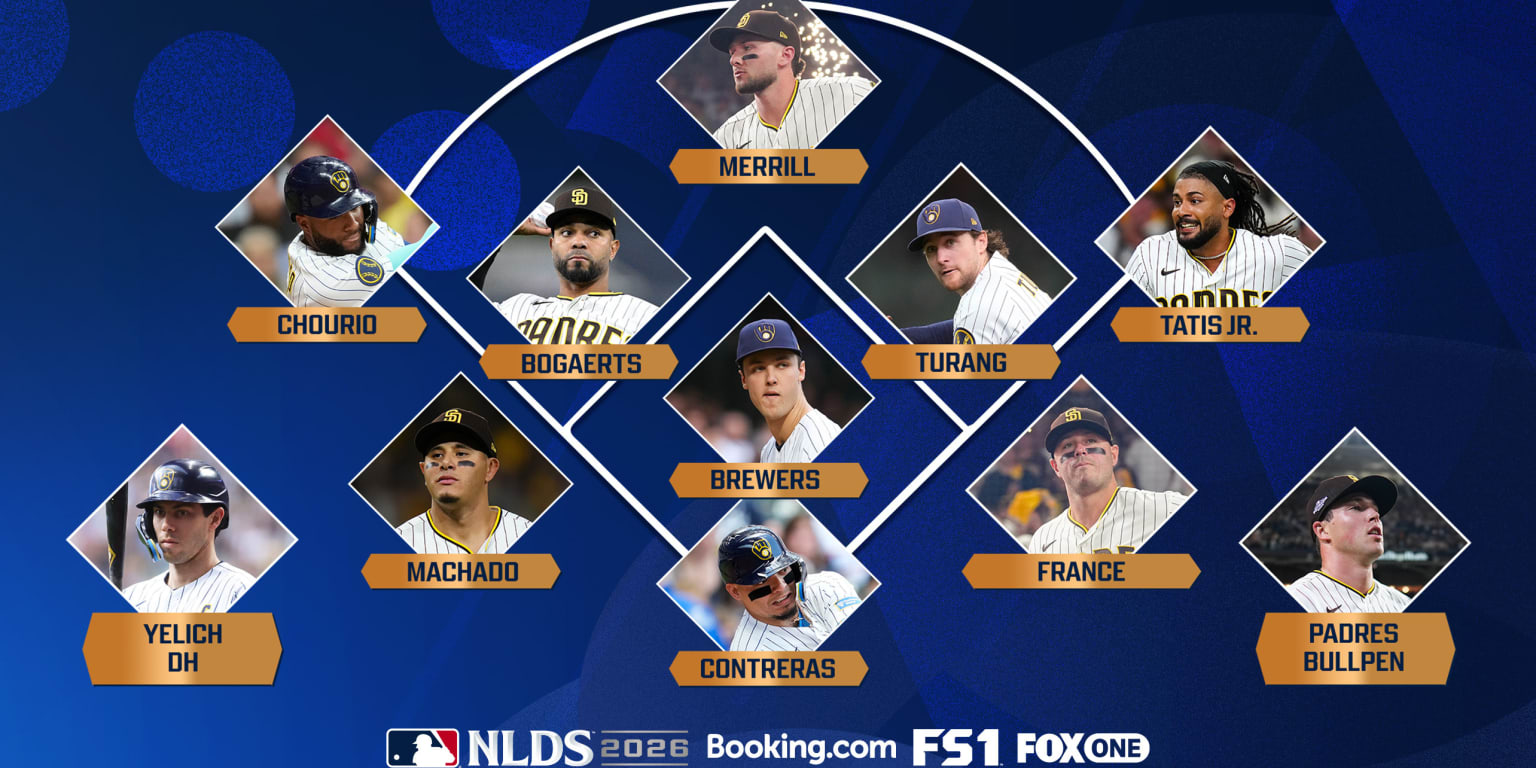
The Brewers and Padres each played their inaugural season in 1969. And for the first time in the 57 years since, Milwaukee and San Diego will meet in the postseason when the two face off in the National League Division Series.
This will be a clash of clubs who are much more evenly matched than is immediately evident. When you look under the hood of this matchup, there are many similarities beyond the fact that neither has won a World Series championship.
Here’s a breakdown of which club has the advantage at each position going into the best-of-five series:
Catcher
Ethan Salas (the Padres’ No. 1 prospect and MLB Pipeline’s No. 21 overall prospect), all of 20 years and 121 days old when he became the youngest catcher to appear in a postseason game on Wednesday night, didn’t seem fazed on the big stage, delivering a sacrifice fly to drive in San Diego’s second run in a 4-1 Wild Card Series-clinching win over the Cubs.
Salas is part of a Padres triumvirate of backstops along with Luis Campusano and Freddy Fermin. Campusano was solid at the plate during the regular season (.795 OPS with eight home runs in 248 plate appearances) and great at throwing out base-stealers (+4 caught stealing above average, 90th percentile). Fermin is a light hitter but an excellent defensive catcher.
While the Padres find that the three complement one another well, and the trio has been productive, the Brewers have a three-time All-Star behind the plate -- one who can slug and also nab baserunners with the best of them. William Contreras, who posted a .758 OPS with 18 homers during the regular season while throwing out 34.2% of base stealers, also comes with significant postseason experience.
Advantage: Brewers
First base
This one’s a tough call, because both clubs got career performances out of their starting first basemen during the regular season.
For the Brewers, Jake Bauers launched 26 home runs with an .874 OPS during his age-30 campaign, helping fuel Milwaukee’s lineup in a record-setting season. And for the Padres, Ty France belted 21 homers with an .865 OPS in his age-31 season.
But in this case, the scale tilts in favor of France thanks to his superior defensive ability at first -- France’s +7 outs above average was second in the Majors only to the Braves’ Matt Olson (+12), and his +10 fielding run value also ranked second to Olson’s +12.
We’ll go with the more well-rounded first baseman here, though both clubs have enjoyed well-above-average offensive production from the position in 2026.
Advantage: Padres
Second base
The Brewers’ young starting second baseman enjoyed a career-best performance this year, and his production both at the plate and in the field made him one of the most valuable position players in the game during the regular season.
Brice Turang’s 6.1 FanGraphs WAR led all Major League second basemen by a wide margin after he posted an .816 OPS with 21 homers, 100 RBIs and 102 runs scored while playing sensational defense at the keystone position -- the 26-year-old’s 23 defensive runs saved ranked second among all position players in the Majors.
The Padres’ starting second baseman is no slouch, either. Jake Cronenworth is a two-time All-Star and has become a fan favorite in San Diego for his gritty style of play. But the 32-year-old has had a rough year, producing a career-low .629 OPS in a season limited to 109 games due to injury.
Advantage: Brewers
Shortstop
The Brewers got little production at the plate from their shortstops during the regular season. Collectively, players who appeared there for Milwaukee this year finished with a .648 OPS.
Cooper Pratt made his Major League debut at short on June 26, at which time he was ranked by MLB Pipeline as the organization’s No. 4 prospect. He appeared in 74 games at short, hitting .281/.350/.368 and demonstrating why he won a Gold Glove Award in the Minors. But he’s still just 22 years old and has only competed at the Major League level for about half a season.
Prior to Pratt’s call-up, Joey Ortiz was entrenched at short and was scuffling offensively with a .198/.281/.247 slash line. He slid over to third base and caught fire at the plate to raise his season OPS to .730 when all was said and done.
On the other side of the ledger, the Padres have four-time All-Star and five-time Silver Slugger Award winner Xander Bogaerts at short. While he has had a highly-decorated career, the veteran -- who turned 34 on Thursday -- turned in his worst offensive campaign since he was a rookie in 2014, finishing the regular season with a .676 OPS and 13 homers.
In short: At short, we’ll give the nod to the player with the most postseason experience (56 playoff games) and best resume, including a double and a homer in the Wild Card series against Chicago.
Advantage: Padres
Third base
As with Milwaukee’s shortstop situation, third base has been a position from which the Brewers got little slugging -- a .370 slugging percentage with eight homers, to be exact.
The hot corner has primarily been manned for the Crew by Ortiz and, before him, David Hamilton. Ortiz provided a bit of a boost for the position offensively, but it wasn’t enough to lift it into the “productive” category.
The Padres, meanwhile, have had third base locked down by a potential future Hall of Famer for nearly a decade. Manny Machado didn’t have the regular season he would have liked this year, but he still belted 30 home runs and remained elite defensively, leading all players at the position with a fielding run value of +8 (to be fair, Ortiz was right behind him with +7 despite having far fewer innings played there).
Once again, experience is a factor here, and it’s once again lopsided in favor of the Padres with this being Machado’s eighth postseason.
Advantage: Padres
Left field
As we move into the outfield, get ready for the “Jackson Two” -- as in, Jacksons Chourio and Merrill.
Chourio continues to prove why he’s one of the brightest young stars in the game after another strong all-around performance this year. With his 25 homers and 23 steals during the regular season, he became the first player in MLB history with three 20-20 campaigns before the age of 23. He also posted an .837 OPS and played stellar defense in left.
The Padres’ left field situation took a major hit when they lost Ramón Laureano for the season as a result of June surgery to repair a torn labrum in his right hip. That left the duty of patrolling left to a revolving door involving Samad Taylor, Jase Bowen, Dustin Harris and Austin Hayes.
Advantage: Brewers
Center field
And now, we turn to center field, where another Jackson will be stationed during this NLDS. That would be Merrill, who -- much like Bogaerts and Machado -- didn’t have the regular season he expected of himself but nonetheless remains a star capable of doing damage at the plate and preventing it in the field.
While Merrill’s .743 OPS was a career-low, he did connect for a career-high 26 home runs and swiped a career-best 27 bases while continuing to play elite defense in center. His 4.2 fWAR ranked fourth among MLB center fielders, and he was somewhat unlucky at the plate, with an expected slugging percentage of .491 (91st percentile), more than 50 points higher than the actual figure.
The Brewers have Garrett Mitchell in center, and he had a strong season for Milwaukee, his first Major League campaign of more than 69 games as a result of injuries. In his age-27 season, he played in 145 games and hit .262/.354/.416 with 11 homers and 14 steals. Defensively, he produced +7 OAA and he possesses nearly elite sprint speed (29.8 feet per second).
Both players are well-rounded and can impact a game in many ways. In the end, this one comes down to the difference in power potential at the plate.
Advantage: Padres
Right field
It’s hard for any right fielder to compete with Fernando Tatis Jr., let alone the Brewers’ Sal Frelick.
Frelick is a contact specialist at the plate -- his 10.1% whiff rate ranked in the 99th percentile of qualified batters, according to Statcast, and his 9.9% strikeout rate ranked in the 97th percentile. But in a season limited by a torn labrum in his right shoulder, he took a step back offensively, finishing with a .614 OPS over 384 plate appearances.
And then there’s Tatis, one of the most electric players in the game and one who, following an inexplicable power outage early on in the regular season, got red-hot at the plate and surged into the playoffs with 20 homers over his final 63 games. Overall, he finished with a .289/.358/.470 slash line along with 25 homers and 38 steals.
Defensively, Tatis -- a two-time Gold Glove Award winner and a two-time Platinum Glove Award winner in right field -- was again sterling.
Tatis carried over his hot streak at the plate into the Wild Card Series against the Cubs, setting the tone with a leadoff homer in Game 1 before delivering a signature moment with aggressive baserunning later in the contest. He’s capable of being a one-man wrecking crew.
Advantage: Padres
Designated hitter
The Padres have primarily used Miguel Andujar, Gavin Sheets and, more recently, Austin Hays as designated hitters this year. The collective output for San Diego from the DH position has been meager -- a .213/.289/.338 slash line with 12 homers during the regular season.
The Brewers, meanwhile, haven’t gotten a ton of production from the DH slot, either. But their primary DH is none other than Christian Yelich, who has had an impressive career even though he hasn’t reached the heights he touched as arguably the game’s best hitter from 2018-19.
This year has been another in which back issues caused the 34-year-old to miss time. Overall, Yelich posted a .692 OPS, the lowest of his career. Still, he’s been on the postseason stage before and he’s always a threat to deliver a clutch hit.
Advantage: Brewers
Starting pitching
The Brewers have the most electric arm on the planet atop their starting rotation. NL Cy Young Award frontrunner Jacob Misiorowski shattered velocity records and blew hitters away with his overpowering stuff en route to a Major League-best 1.80 ERA and 252 strikeouts.
The Miz is quite possibly the hardest-throwing starting pitcher in baseball history, and having to beat him at any time is a tall order, let alone the postseason. The 24-year-old right-hander is followed in the rotation by another 24-year-old righty -- Logan Henderson has been huge for the Brewers, delivering a 2.47 ERA over 18 starts during the regular season in the wake of Kyle Harrison’s season going south.
After those two, things get muddled for Milwaukee.
For the Padres, there is plenty of veteran experience but the results were spotty during the regular season. Michael King has anchored the group and Nick Pivetta has been good since returning from the injured list last month. But San Diego’s Trade Deadline acquisitions -- Robbie Ray (5.02 ERA since being traded) and Casey Mize (7.46 ERA before injuring his ankle) -- have underwhelmed.
Advantage: Brewers
Relief pitchers
The Brewers have Misiorowski. The Padres have Miller -- Mason Miller.
The most dominant closer in the game today, Miller tips what is a close comparison between the respective bullpens in San Diego’s favor.
The Padres’ ’pen led MLB with a collective fWAR of 8.9. The Brewers’ relief corps led the NL with a 3.40 ERA (San Diego’s bullpen finished third, at 3.53). But the Padres’ group posted a 3.33 xERA, far and away the best in the Majors (Milwaukee’s ’pen had an xERA of 3.58, tied for second with the Dodgers).
Trevor Megill, Abner Uribe, Aaron Ashby and Co. have been outstanding for the Brewers this year. But that Padres bullpen, with the likes of workhorse southpaw Adrian Morejon along with fellow lefties Yuki Matsui and Wandy Peralta, as well as reliable righties Bradgley Rodriguez and Jason Adam -- most of whom are capable of giving manager Craig Stammen multiple innings -- is frighteningly formidable.
Advantage: Padres
Prediction
This is a great October matchup, one that is evenly matched in several areas. The key will be scoring early, given the strong bullpens on both sides. The respective lineups have been good, but San Diego’s has been the best of any in the Majors since the beginning of September.
San Diego is the hottest team in baseball right now. Milwaukee won a Major League best (and franchise record) 103 games in the regular season and will be well-rested following a first-round bye. It’s easy to see this series going the limit.
In the end, it could all come down to home-field advantage. The Brewers have that, and they tied the Rays for the best home record in MLB this year -- 55-26 at American Family Field. The Padres were great at Petco Park, too (51-30). But the Crew will be home if there’s a decisive Game 5.
Brewers in 5.