
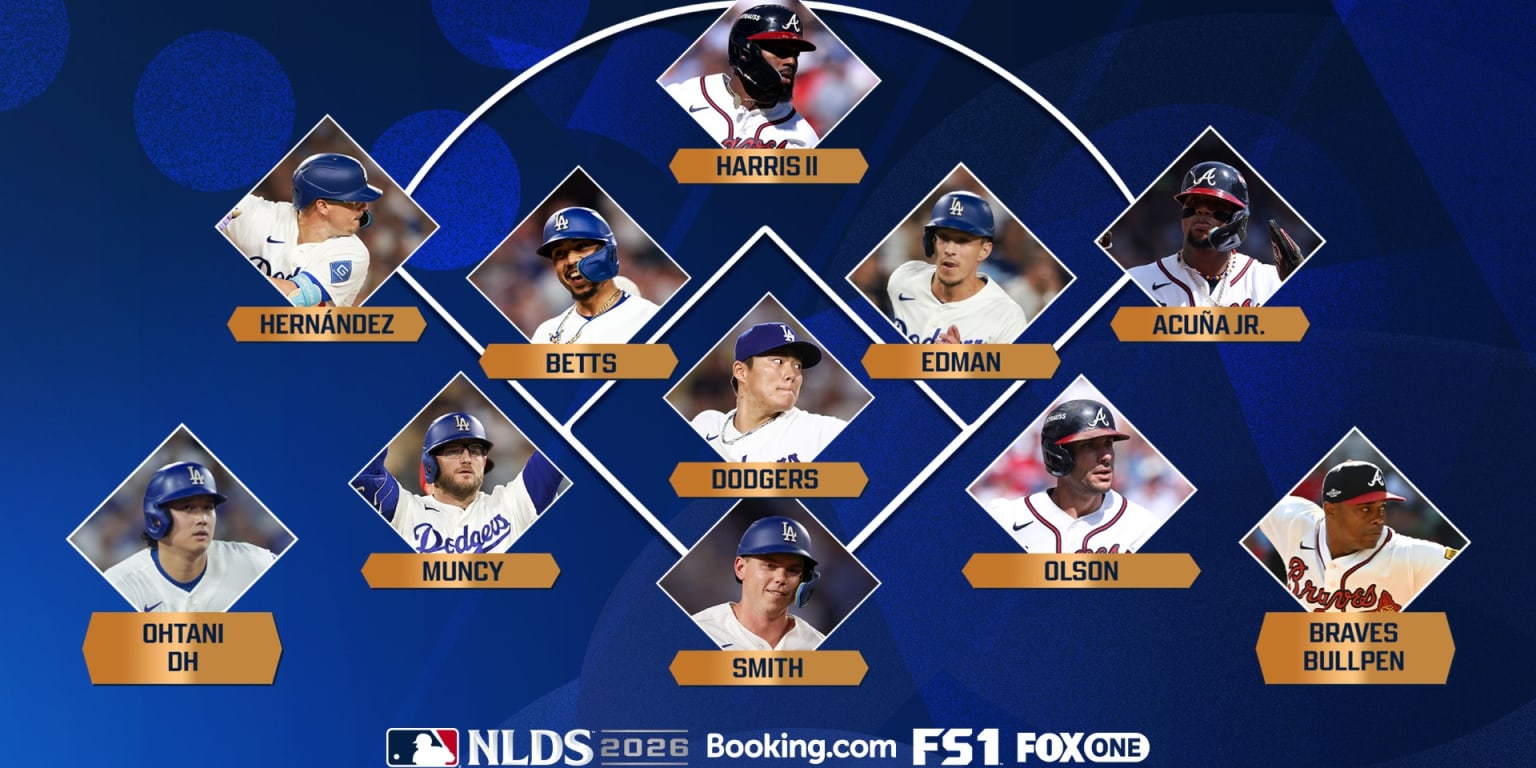
They are the Senior Circuit’s surest things. The Dodgers, with their 14 consecutive postseason appearances to go along with three World Series crowns this decade. And the Braves, with their 19 NL East titles and two titles in the Wild Card Era.
Naturally, they’ve run into each other a time or two, including consecutive NLCS rounds in 2020 and '21. So it’s really no surprise that they’re running into each other again in the best-of-five NL Division Series that begins Saturday at Dodger Stadium.
The Braves won five of the six regular-season meetings this season while holding the mighty Dodgers to a meager .580 OPS along the way. Does Atlanta have what it takes to take down the two-time defending champs? The Dodgers have the talent to combat it all, of course, including the rest that came from avoiding the Wild Card Series.
So how does this series set up, position by position? Let’s take a look.
Catcher
The most important active streak in MLB is on the line this postseason. No, not the Dodgers’ streak of two straight titles -- but MLB’s streak of six straight World Series champions with a Will Smith (either the catcher or the since-retired pitcher) on the roster. Though the Dodgers’ Smith missed about three months this season with a neck issue, he slashed .290/.400/.548 in 21 games after his return. Since his arrival in 2019, his .829 OPS is the best among qualified catchers.
As accomplished as Smith is, there’s a good argument to go with the Braves’ Drake Baldwin here. He followed up his Rookie of the Year Award season with an All-Star campaign, slashing .284/.358/.459 with 25 homers and 21 doubles. But because Baldwin roughly splits his time between catcher and DH, and Sean Murphy has had an injury-marred campaign, it’s reasonable to give Smith the edge.
Edge: Dodgers
First base
Matt Olson vs. Freddie Freeman. It’s the Braves’ 2021-22 offseason all over again.
The Braves went with Olson and so will we. The Braves’ Iron Man smashed 41 homers with 34 doubles while providing his typically outstanding defense (as we saw with some standout plays in the Wild Card Series clincher). His production slid in the second half, but the power is massive.
Freeman’s age-36 season saw him nursing a right knee issue down the stretch, and his power production largely disappeared in the second half. He had just one homer and nine doubles after the All-Star break. Freeman is still a perpetual on-base threat, and he’s obviously no stranger to stepping up on the postseason stage, with an .853 OPS in 79 games. But Olson gets the nod here.
Edge: Braves
Second base
Ozzie Albies is a perpetual power threat, as we saw with his big blast in Game 3 of the Wild Card Series against the Phillies. But there’s no denying his overall production has dropped the last few years, including a lowly .293 OBP this season.
This was the third straight season Tommy Edman played in fewer than 100 games for the Dodgers. Still, in his 84 games, he managed a respectable .714 OPS. With neither guy having a barn-burner offensive season, we’ll side with Edman on account of his superior defensive range. (Of course, the Dodgers can also turn to Miguel Rojas to hit a game-tying homer in the ninth, because apparently that’s his thing.)
Edge: Dodgers
Shortstop
In a lost season for Ha-Seong Kim (51 games, 15 hits) due to injury, the Braves gave the majority of starts at short to Mauricio Dubón. The latter proved to be a solid, versatile pickup with essentially league-average production, and the former can rewrite the story of his season if he can come up clutch in the postseason. But the Braves’ overall output here is lacking.
Though the lightning bat speed that was once his hallmark has been lost to Father Time, reports of Mookie Betts’ demise proved premature this season. He found his offensive form and started crushing fastballs in the second half with a .279/.357/.492 slash. And it remains a marvel that one of the great defensive right fielders we’ve seen has made such a strong late-career shift to short.
Edge: Dodgers
Third base
Remember what we just said about rewriting the story of your season? Austin Riley did a bit of that with his clutch go-ahead home run in Game 1 of the NL Wild Card Series. That came on the heels of a disastrous offensive year in which his production was 20% worse than league average.
But Max Muncy needs no such rewrite. This was the third straight season that his offensive production was more than 25% better than league average. He continues to provide patient at-bats, high walk totals and a high barrel rate in his mid-30s.
Edge: Dodgers
Left field
Lane Thomas could potentially return to the Braves after missing much of September and the Wild Card Series with a left intercostal strain. If not, it’ll continue to be a Dubón/Mike Yastrzemski platoon in left.
Though Teoscar Hernández hasn’t been able to reclaim the elite production of his first season with the Dodgers in 2024, he finished this season strong with a .341/.420/.545 slash in September. The strikeouts and defense are always concerns, but Hernández’s raw power remains a big asset. He’s homered in six of the seven postseason series he’s played for the Dodgers.
Edge: Dodgers
Center field
After his bat made him essentially unplayable in last year’s postseason, Andy Pages cut down his strikeout rate, nearly doubled his walk rate and emerged as an All-Star with an .811 OPS, 23 homers and 26 doubles. He’s also a terrific defender, but did miss 27 games late with a fracture in his left hand.
But Michael Harris II was probably the best center fielder not named Pete Crow-Armstrong this season. He rated third in outs above average at the position with a plus-13 mark while delivering a .294/.321/.491 slash with 26 homers, 36 doubles and 12 steals. He kept it going with the three-run shot that got the Braves going in Game 3 against the Phillies.
Edge: Braves
Right field
The prevailing storyline about Kyle Tucker’s first season with the Dodgers after signing a four-year deal with a massive $60 million average annual value is that he was a bust. His OPS+ was 3% below league average, and his defensive metrics took a large downturn. Something might have clicked for him in September, though, as his .354 OBP with six homers, three doubles and a triple were decidedly more Tucker-like.
Still, the edge is obvious here. Even if Ronald Acuña Jr., after all those knee woes, is not as electric as he was in his 2023 MVP season, his OPS+ was still 18% better than league average. And a late-season stance change had him slashing .307/.347/.602 in September.
Edge: Braves
Designated hitter
It says a lot about Shohei Ohtani that a .275/.377/.512 slash with 30 homers and 26 doubles qualifies as a down year. But after injuries forced him to stop pitching and necessitated an IL stint in September, it will be interesting to see if Ohtani, who has a .940 OPS in 33 career postseason games, can catch fire.
As mentioned above, you’ll see Baldwin here for the Braves when he’s not catching. Otherwise, it’s Dominic Smith, who had a .563 OPS from June onward.
Edge: Dodgers
Starting pitching
Adding Tarik Skubal to a rotation that was already set to feature reigning World Series MVP Yoshinobu Yamamoto, Blake Snell and Tyler Glasnow gives the Dodgers the single greatest pitching edge of any team in this tournament. If they pitch to their capabilities, it’s going to be incredibly difficult to take down the defending champs. Skubal’s four-seamer has actually improved since the trade to L.A., which is a scary thought.
The Braves have the disadvantage of being the third-best division winner and exhausting the pitching options in the three-game Wild Card Series. Chris Sale had a magnificent age-37 season that padded his Hall of Fame case, but he just pitched relief in the Wild Card clincher and hasn’t started a game on fewer than five days’ rest since April. Tyler Mahle has been a Trade Deadline revelation and Grant Holmes has also been terrific. But the Braves are down to those three healthy, experienced starters.
Edge: Dodgers
Bullpen
OK, clearly, the Dodgers have the edge in a lot of spots above. But given the importance of locking down leads in the postseason, the Braves have an extremely important edge here.
Edwin Díaz’s disastrous first season with the Dodgers left Tanner Scott handling the bulk of the ninth-inning duties down the stretch. The Dodgers also lost veteran Blake Treinen to a season-ending right shoulder injury. So the bullpen is a potential sore spot, and, as was the case in the run to the 2025 title, Dave Roberts won’t necessarily be able to paint by numbers. But the strength of the rotation bleeds into the bullpen, which had a relief ERA inside the Top 10 while taking on the third-fewest innings in MLB.
The Braves can significantly shorten games with Raisel Iglesias, Robert Suarez, Dylan Lee, Didier Fuentes and company. Though the rare mistakes of Lee and Fuentes in Game 2 extended the Wild Card Series, that doesn’t undo a full season’s worth of evidence that Atlanta has one of the best high-leverage setups in the league.
Edge: Braves
Prediction
Has age caught up with the Dodgers? We’ve seen some signs of it with the decline in run production and some of the bumps and bruises they’ve endured this season. They might have more than double the World Series odds of any other team in the field, but that doesn’t mean they’re immune to cold bats or bullpen blowups. The Braves proved it in the regular-season series.
That Dodgers rotation, though. It’s simply hard to bet against it vs. a restless Braves team.
Prediction: Dodgers in four.