




College basketball’s 21 best men’s players during 2025-26 season, ranked


The sprint to March Madness starts now. Selection Sunday is just two months away, and a clear championship picture is already forming at the top of men’s college basketball. The good teams are really good this year, but there’s also a deep pack of sleepers with Final Four aspirations who can send the favorites spiraling into the sport’s long offseason.
The sense of discovery is one of the best parts about every college basketball season. There’s always players who take a sophomore leap to turn into superstars (see: Vanderbilt’s Tyler Tanner), or freshmen that outperform any reasonable expectation (see: Illinois’ Keaton Wagler). The biggest surprises come in the NCAA tournament, and there’s no way all four No. 1 seeds are going to make the Final Four again … right?
America might still have football fever, but basketball’s time in the spotlight is just around the corner. Let’s get ahead of it by ranking the 21 best players in men’s college hoops for this season. For the purposes of this list, we only picked one player per school.
21. Jeremy Fears Jr., G, Michigan State: Fears is the ultimate college floor general with a ridiculous 50 percent assist rate and +4 assist-to-turnover ratio.
20. Nick Martinelli, F, Northwestern: Martinelli is averaging one of the most efficient 24 points per game you will ever see with 66.8 percent true shooting. The bruising power forward is the top name on every opposing scouting report for Northwestern, and still no one can stop him.
19. Thomas Haugh, F, Florida: The 6’9 forward is an elite connector on the wing as a bouncy finisher (23 dunks in 16 games), a versatile defender, and a willing shooter.
18. Keyshawn Hall, F, Auburn: The Tigers hit the jackpot with the UCF transfer, landing a 6’7 forward who can rip the nets from three (44.8 percent), bully his way to the foul line, and hold down the defensive glass.
17. Alex Karaban, F, UConn: Yes, he’s still in college, and yes he’s still the player who makes UConn’s whirling offense go. Karaban is back to being a sniper from deep this year (43.8 percent from three), he rarely turns the ball over, and he’s money from the foul line.
16. Darius Acuff, G, Arkansas: Acuff is putting Arkansas on his back as a true freshman with his ridiculous creation ability off the dribble, magnet-ball three-point shooting, and panoramic playmaking vision.
15. Labaron Philon, G, Alabama: The Alabama sophomore is a drive-and-kick master with impossible shiftiness and a deadly floater.
14. Bennett Stirtz, G, Iowa: Stirtz just checks every box for a lead guard: he’s an efficient three-level scorer, an excellent decision-maker, and he can create a clean shot for himself or his teammates out of thin air.
13. Christian Anderson, G, Texas Tech: Anderson’s U19 FIBA World Cup domination for Germany has opened the door for a breakout sophomore year, where he’s shined with more on-ball usage and improved three-point shooting.
12. Graham Ike, C, Gonzaga: Gonzaga’s veteran big man combines interior scoring punch with frontcourt playmaking with dominant rebounding.
11. Darryn Peterson, G, Kansas: It feels totally possible Peterson could be the best player in college basketball by the end of the year, but he hasn’t been able to finish games for Kansas as he’s endured strange cramping issues. It feels like we haven’t seen the best of him yet, and he’s still scoring 48.9 points per 100 possessions, a truly ridiculous number. To put that in context, the NBA’s leading scorer Shai Gilgeous-Alexander is averaging 45.9 points per 100 possessions this year.

10. Kingston Flemings, G, Houston
It feels wrong to give one player credit for Houston’s success, because everyone knows it starts with Kelvin Sampson’s deeply ingrained system. Flemings still has a case as a top-10 player in the sport, and if he’s not quite there yet, he could be by tournament time. The point guard felt like the most overlooked of the Cougars’ three McDonald’s All-Americans entering the season, but quickly emerged as an indefensible piece for his quick-twitch driving, his effortless ability to create space for his pull-up jumpers, and his disruptive defense. It’s so hard to keep Flemings from his spots with his instant stop-and-go and change-of-direction moves off the dribble. If the shooting holds (40 percent from three) and can increase in volume even a little bit, the Cougars have the type of lead guard who can lead a Final Four run.
9. Bruce Thornton, G, Ohio State
Thornton is a college hoops throwback in the truest sense: a four-year guard at one school who has been among the sport’s best players for three straight seasons. He’s been better than ever this year, quickly becoming the best three-level scorer in the sport by hitting 74 percent of his rim attempts, 58 percent (!) of his mid-range shots, and 44 percent from three. Thornton is more of a scorer than a playmaker at least on this Buckeyes team, but he’s still an important caretaker of the rock with a 3.1 assist-to-turnover ratio. His 34-point, six-assist game against Illinois in December (on 7-of-8 shooting from two, 6-of-9 shooting from three) is one of the best performances of the season. It’s shocking that a 6-foot-2 guard who can barely dunk (he has two in his college career) can be this insanely efficient as a scorer, but that’s Thornton’s game. Part of the reason he’s perpetually underrated is because he’s never played an NCAA tournament game. Ohio State still has a lot of work to do if it wants to send its senior off into the sunlight the right way.
8. Motiejus Krivas, C, Arizona
Senior guard Jaden Bradley and freshman forward Koa Peat could have been the pick for Arizona too, but I’m going with the big man Krivas for his dominance inside to start the season for the No. 1 Wildcats. Krivas essentially missed all of last season with a left leg injury, but he’s roared back to form this season as one of the best rim scorers and rim protectors in the country. Krivas is only averaging 11 points per game, but that’s partially because he’s only playing 59 percent of the minutes as he returns from injury. His impact is easy to see on the rest of the stat sheet: he’s at 67.2 percent true shooting, with a top-20 mark in offensive rebounding (16.5 percent o-board percentage), a top-75 block rate of 7.8 percent, and shockingly good 82 percent free throw shooting. Having a 7-foot-2 big man who can dominate inside and make his free throws is a cheat code for Arizona. There just won’t be many suitable matchups for him come March.

7. Caleb Wilson, F, North Carolina
In almost any other year, Caleb Wilson’s all-out domination for a traditional blueblood as a true freshman would be one of the bigger stories of the season. This year, he’s just another member of a historic class of first-year players. Wilson’s motor is his superpower, busting his ass on every possession as a long and hyper-mobile 6’10 forward who dunks everything, crushes the glass, and can hound opposing guards with full-court defense. He can’t shoot threes at all, but he still adds a lot of value offensively with his passing, finishing, and mid-range shooting. It’s so hard to keep Wilson off the free throw line when he puts his head down, but North Carolina will want to see him hit more than the 70 percent of his freebies he’s been making so far. Wilson obviously has awesome physical tools, and he has an elite mentality to match. He feels like a lock to go No. 4 overall in the 2026 NBA Draft, and wow some fans along the way once UNC gets into March Madness.
6. A.J. Dybantsa, F, BYU
Dybantsa has it all: length, explosiveness, shot-making, and a picture-perfect college system to accentuate his strengths. The 6-foot-9 freshman is a takeover scorer in the truest sense, with punishing drives to the hoop and a sweet shooting stroke that’s impossible to contest thanks to his 7’1 wingspan. Someone as big and as strong as Dybantsa shouldn’t be so flexible. I love that he rarely bails out the defense by settling, and BYU head coach Kevin Young deserves a lot of credit for developing a system that leaves the paint wide open for his attacking style. Just about the only thing holding Dybantsa back is his lack of activity on the defensive end, where it feels like he should be so much more disruptive given his tools. At the end of the day, the Cougars have other guys who can help get stops, but no one else has a player like Dybantsa who can consistently score even against perfect defense.
5. Tyler Tanner, G, Vanderbilt
Tyler Tanner was solid as a freshman, but he’s been spectacular for Vanderbilt as a sophomore. It’s hard to believe a player under 6-foot tall that weights 160 pounds can be this dominant on both ends, but Tanner’s improvement as a shooter has unlocked the rest of his special gifts. The point guard has a menacing combination of speed and quickness off the bounce that routinely leaves defenders in the dust, and he’s the rare small guard who will finish a drive by dunking on your head. Tanner already had 13 slams, and is pacing to set the dunk record for a guard under 6’1. Going from a 26.6 to 38.8 percent three-point shooter has made him so much harder to defend, and his decision-making as a lead guard is also elite with a 3.0 assist-to-turnover ratio. Unlike most small guards, Tanner is somehow highly disruptive defensively, with a monstrous 4.8 percent steal rate. Of course he can get overwhelmed on straight line drives by bigger guards, but he makes up for it in so many other areas. Vanderbilt is very much for real,
4. Braden Smith, G, Purdue
Smith was the obvious choice as the best guard in college basketball coming into the year, and a half-season of greatness from Tanner isn’t enough to knock off the Purdue senior’s four-year track record of excellence in these rankings. Smith is the little engine who could for the Boilermakers, guiding the country’s best offense with a historic 129.5 team offensive rating by his brilliant playmaking and deadly shooting. Smith’s 46.6 percent assist rate is a new career-high and the No. 3 mark in the country. He’s making 40 percent of his threes, with nearly 40 percent of them coming off self-created opportunities without an assist. Smith doesn’t have much finishing might at his size, but he’s an absolutely killer from mid-range, where he’s knocking down 48 percent of his looks with 90 percent of them being self-created. He has the ball on a string as a handler, and he’s so shifty that almost no defender can stay with him even with a length advantage. Smith represents everything great about college basketball, and the final chapter of his historic career could be the best one yet.

3. Joshua Jefferson, F, Iowa State
Jefferson transferred from St. Mary’s to Iowa State after his sophomore year, and immediately blossomed into one of the best players in college hoops. We ranked him as a top-20 player in the NCAA tournament last season, and he’s so, so much better this year. Jefferson is an absolute brute at 6’9. 240 pounds, but he’s special because he plays a high-IQ game at that size at both ends of the floor. His best skill is his passing ability, with a fantastic 27.8 assist rate to show for it. It’s hard to stop Jefferson one-on-one as a scorer, but as soon as multiple bodies converge, he’s able to find an open teammate. The big improvement in his game this season is as a shooter: after making 18 threes at a 31 percent clip last year, he’s already made 16 threes at a 36.4 percent clip this year. Jefferson is also an impactful defender at the college level as a hulking interior presence who cleans the glass. The Iowa State men haven’t been to the Final Four since 1944, but Jefferson gives them a chance to get there this year.
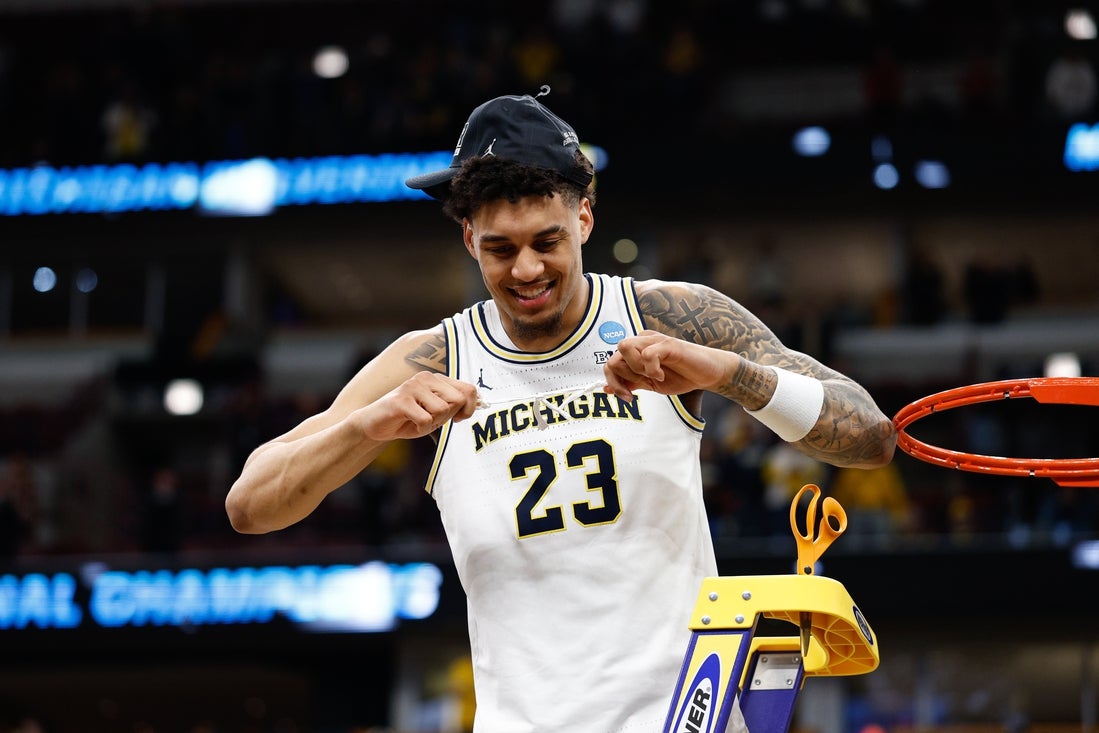
2. Yaxel Lendeborg, F, Michigan
Michigan finally has a loss on its resume after falling to Wisconsin in Jan. but this is still tracking as one of the best teams in the modern history of the sport. Yaxel Lendeborg’s versatility and unselfishness is perhaps the biggest reason why. Lendeborg’s journey from JUCO to UAB to the center of Michigan’s absurd dominance is the best story in college hoops right now, and this season has proven how singular his skill set really is. Most programs would play him at center as at 6’9 with a 7’4 wingspan, but next to Aday Mara and Morez Johnson in a supersized front court, Lendeborg has shifted seamlessly to the wing where he’s upped his three-point rate and shown he can thrive even in an off-ball role. His intersection of size and skill is usually only reserved for the best NBA players in the world, so it’s wild to see a 23-year-old this talented still playing at this level. He didn’t even start playing organized basketball until age-15, sending him down an unusual development path that led him to this moment. Lendeborg could absolute win the Wooden Award as the nation’s most outstanding player this year, and he’s going to be impossible to matchup with in March. He’s an outlier in every sense, and he’s impacting winning to an absurd degree so far this year.
1. Cameron Boozer, F, Duke
Boozer was the most decorated winner high school basketball has seen in the modern era, so it should come as no surprise that it has immediately translated to college hoops. Duke’s latest super freshman brings an elite intersection of size, strength, and intelligence with a rapidly rising skill level to boot. Giving the ball to Boozer is a free pass to an efficient offensive possession: he can play both sides of the pick-and-roll, overpower his defender as a driver, whip passes to open teammates all over the floor, and clean the offensive glass. Boozer isn’t super explosiveness athletically and he can be a bit stiff in tight spaces, but it doesn’t really matter. He’s so efficient from every area of the floor, and almost always makes the right play. It’s wild to consider that Duke replaced a generational talent in Cooper Flagg with another freshman who is every bit as good as him.
What's Your Reaction?
 Like
0
Like
0
 Dislike
0
Dislike
0
 Love
0
Love
0
 Funny
0
Funny
0
 Angry
0
Angry
0
 Sad
0
Sad
0
 Wow
0
Wow
0