
October brings a different pitching environment – a more difficult one for batters.
Generally, teams with better pitching advance to the postseason. Those teams then concentrate more innings in their best arms, shedding their weaker links. More frequent off-days, and a greater sense of urgency, can create an uptick in stuff.
Consider that since 2001, the MLB-wide strikeout rate is two percentage points greater in the postseason compared to the regular season (21.7% to 19.7%). That gap is fairly consistent year to year.
Since Stuff+ metrics have been available, dating back to 2020, postseason pitchers average a 107.8 Stuff+ mark, compared to 100 in the regular season. To put it simply, they throw nastier pitches. That marks a significant bump in quality.
It's a different, more difficult game for hitters in October. So which offenses are equipped to survive it? There is no single answer. But the teams that appear best positioned share several characteristics:
- They can better handle elite velocity
- They make pitchers work
- They are unusually resistant to the breaking balls that often produce the ugliest October swings.
The question isn't necessarily which offenses were the best in the regular season. It's which offenses give elite pitching the fewest ways to beat them.
Can your club beat the October fastball?
Elite postseason pitching generally begins with velocity.
Average four-seam fastball velocity during the pitch-tracking era (since 2008) sits at 94.3 mph for the postseason, versus 93.2 mph in the regular season. It's climbing year over year, and sits at what would be a record average of 96 mph early in this year’s playoffs.
If a team cannot handle elite velocity, it's likely going to be in trouble. And it's not just that fastball velocity increases in October, it's that it sets up everything else in an arsenal. So one useful test for an October offense is simple: Can a team handle top-end velocity?
The Padres' performance wasn't simply a product of what they did in April through August, either. They remained No. 1 against 96-plus mph fastballs in September and posted a sizzling .441 wOBA against them.
There is some underlying support for the performance, too. San Diego tied for second in the Majors in bat speed (72.8 mph), while Milwaukee also ranked in the top five. That matters because October pitching increasingly asks hitters a question they have to be ready to handle. What happens when the velocity ticks up a few miles per hour? Can they handle the heat?
Can your club make the pitcher work?
There is another way to attack elite pitching: expedite its removal from the game. The more quickly a team can get into its opponents’ middle relief, the greater its advantage.
And plate discipline might be able to travel better to the postseason than some other skills. Consider that while stuff spikes from the regular season to the postseason, command does not. Since 2020, Command+ is slightly below the regular-season league average in the postseason. Walk rates are remarkably similar since 2001, with an 8.5% mark in the regular season, compared to 8.4% in the postseason.
Moreover, since 2020, pitches are thrown in the zone at a slightly greater rate in the regular season (42%) compared to the postseason (41.3%). This is not to suggest hitters should simply wait for walks. Rather, it's that even elite October pitchers remain vulnerable to long plate appearances and mistakes against discerning lineups. They don't become command artists.
A pitcher can throw a 98-mph fastball. He can also throw 27 pitches in an inning. The offense that can consistently turn a difficult plate appearance into a 10-pitch battle eventually wears down an opponent.
That's where the Brewers are particularly interesting. Milwaukee finished the regular season tied for first in pitches seen per plate appearance, at 3.97. The Guardians were tied for sixth at 3.93, the Dodgers ninth at 3.92 and the Padres followed at 3.89. The Brewers also led the Majors in on-base percentage, at .341.
The Brewers are not the most overpowering team in the field, but they make every pitcher work. Against elite postseason starting pitching, that is a skill that matters and travels.
Combatting playoff spin
Then comes the nastiest part of the October pitching problem. These are the pitches that inspire GIF creation – the filthy breaking balls. Postseason baseball produces plenty of helpless swings over the top of sliders and curves that take hard lefts and rights away from the hitting zone.
Another useful test is how offenses perform against breaking balls with above-average movement. Against breakers moving at least 9 inches horizontally, the Rays, Braves and Brewers ranked first, second and third in wOBA, respectively, during the regular season. The Padres ranked eighth and the Dodgers 10th. Against breakers with at least 9 inches of vertical movement, the Rays, Braves and Dodgers ranked among the top 10, with the Padres also above average.
The results become even more interesting when we consider swings and misses. The Rays and Brewers were the only teams in the postseason field with whiff rates below 30% against those high-movement horizontal breaking balls.
That is a meaningful postseason skill – even if it simply means spoiling a pitch to fight another day.
Avoiding the empty swings
This brings us to perhaps the simplest component of the profile: contact. If strikeouts rise in October, avoiding them becomes relatively more valuable.
The Rays ranked first in the Majors at avoiding strikeouts during the regular season (18.8%). The Dodgers ranked fourth, the Guardians fifth and the Padres 10th. The Braves and Phillies were also above average.
Against pitches 96 mph and faster, Tampa Bay had the second-lowest rate of misses per swing in MLB, while Cleveland ranked seventh.
The common thread isn't necessarily power. It's resistance to nasty stuff.
- The ability to spoil elite velocity
- The ability to spoil elite movement
- The ability to resist expanding when a pitcher gets ahead, and then capitalize when that pitcher finally makes a mistake
At the core of all of that is avoiding empty swings.
***
There is no silver bullet here in October.
But October does create a different offensive environment because it's a different caliber of pitching, generally.
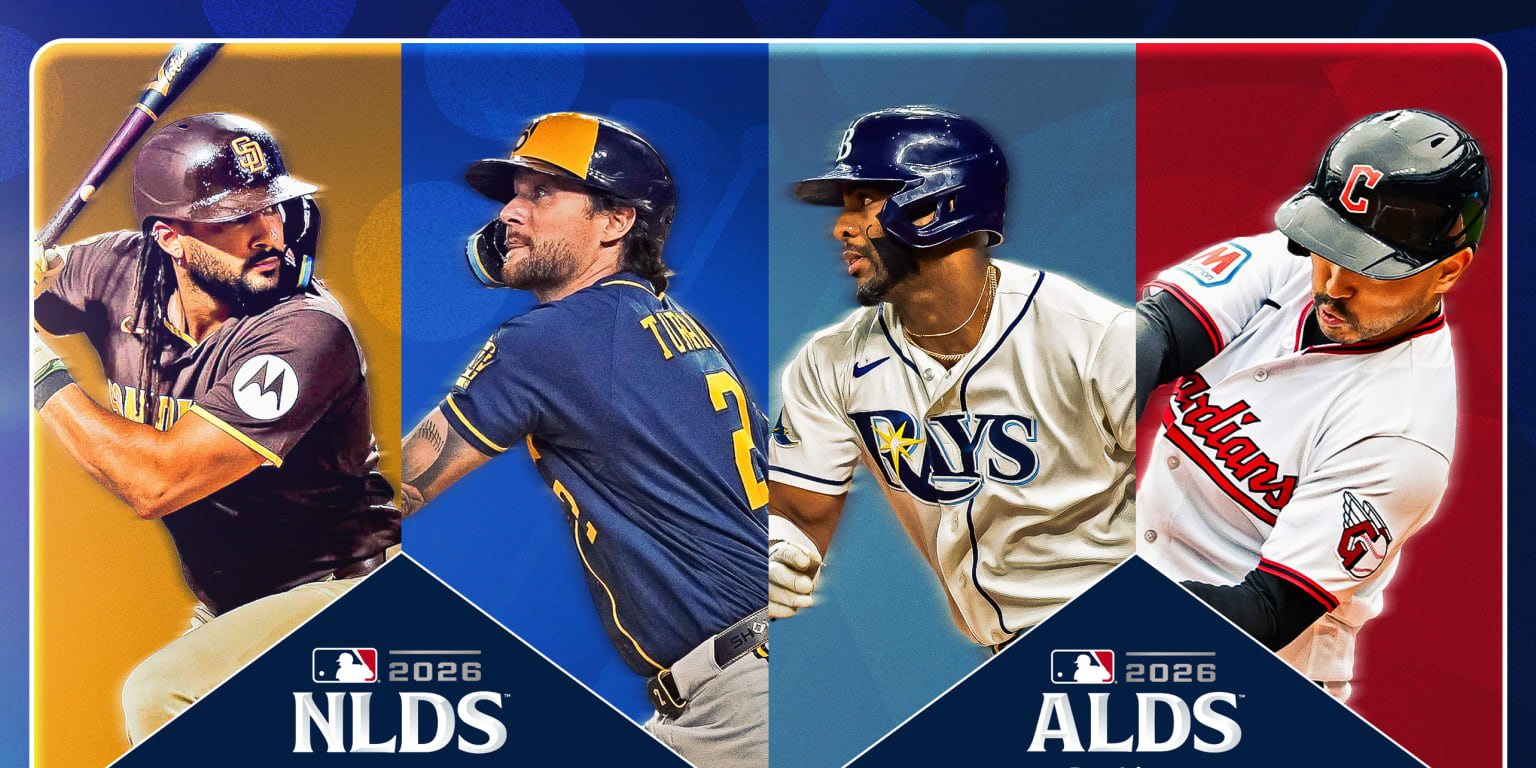
Some teams are better equipped. The Padres have demonstrated an ability to punish high velocity. The Brewers make pitchers work. The Rays are unusually difficult to force into swings and misses. The Guardians, perhaps more quietly, check many of these boxes, too.
Those clubs don't necessarily include all the best offenses in the field, but they are better equipped for what they will face moving forward in October.