
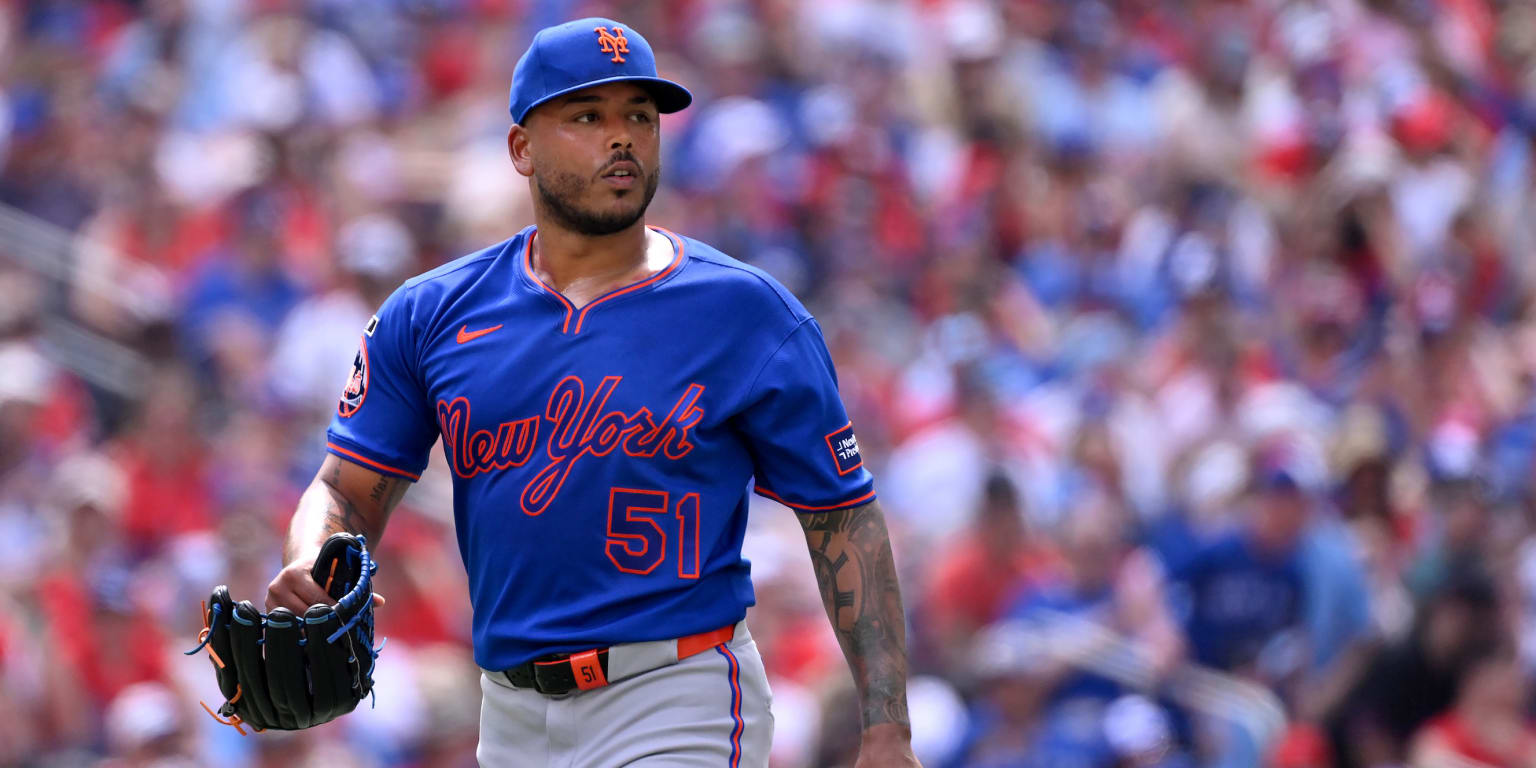
NEW YORK -- As Freddy Peralta's final pitch of American League Championship Series Game 2 dove beneath Petey Halpin’s bat, Peralta let out a yelp and clenched his fist, expending any last emotion left in reserve. Peralta had just held the Guardians scoreless over six innings, the longest postseason start of his career. Along the way, he had thrown three of the five fastest pitches of his life, including a 99.4 mph fastball that set a career high.
The scene could not have been further from the one three months earlier in Toronto, where Peralta was visibly emotional after allowing five runs over four innings -- part of a longer stretch that saw the two-time All-Star produce a 6.89 ERA over 10 starts. So ineffective was Peralta that as the Trade Deadline approached, it wasn’t even clear that the last-place Mets would receive a tempting enough offer to trade him.
“I don’t feel good,” Peralta said after that start in Toronto. “But just trying to come back and make the adjustments.”
Peralta’s eventual ability not only to do that with the Rays, but to do so quickly and emphatically, ranks among the most staining aspects of the Mets’ 2026 season. When the team acquired Peralta in January, fans and club officials alike heralded him as the type of frontline starter who could lift their rotation to new heights. It instead took a change of scenery for Peralta to succeed.
In Tampa Bay, where Peralta has been a key part of the Rays’ rotation, the right-hander has a 0.81 ERA over his last seven starts, as well as a 0.79 mark in three playoff appearances.
“When I got traded here, I just felt different,” Peralta said after Tuesday's outing. “For some reason I got here, and I felt like myself again.”
For the Mets, the pertinent questions are how this occurred, why it never happened under their watch and how they can avoid situations like this in the future.
According to multiple members of New York’s hierarchy, the types of adjustments Peralta made in Tampa Bay -- moving quicker down the mound to increase his fastball velocity, achieving a higher arm slot, using the upper third of the strike zone more liberally with his fastball, and relying more extensively on his changeup down in the zone -- are the same things the Mets asked him to do.
Peralta, however, never fully achieved them in New York. Instead, he has lavished praise on Tampa Bay pitching coach Kyle Snyder, as well as bullpen coach Jorge Moncada and even bullpen catcher Charlie Valerio for their messaging.
“We were unable to get him to do what Tampa through their processes has been able to get him to,” president of baseball operations David Stearns said recently. “I think the goals were the same. We just couldn't quite get him over the hump.”
After the season, despite several changes to their coaching staff, Stearns and newly installed full-time manager Andy Green kept their Major League pitching group intact. That implies confidence in pitching coach Justin Willard, whose work with Peralta is just one line on a longer resume. Peralta aside, Willard enjoyed plenty of success with young pitchers Nolan McLean, Christian Scott and Zac Thornton, among others. The Mets finished 17th in the Majors in staff ERA, up one spot from 2025.
For Willard and his colleagues, then, Peralta’s story simply offers a series of lessons -- how to communicate ideas with players and get them to buy into team messaging, as well as how to reduce noise around them when they struggle, particularly in New York.
“Our pitching group at the Major League level, I think, did a really good job with a number of our other players,” Stearns said. “I’m really pleased with that. In the case of Freddy, we were unable to get him over the hump.”
While Willard and his colleagues don’t have all the answers, their hope is that Peralta’s season at least gave them a few.