
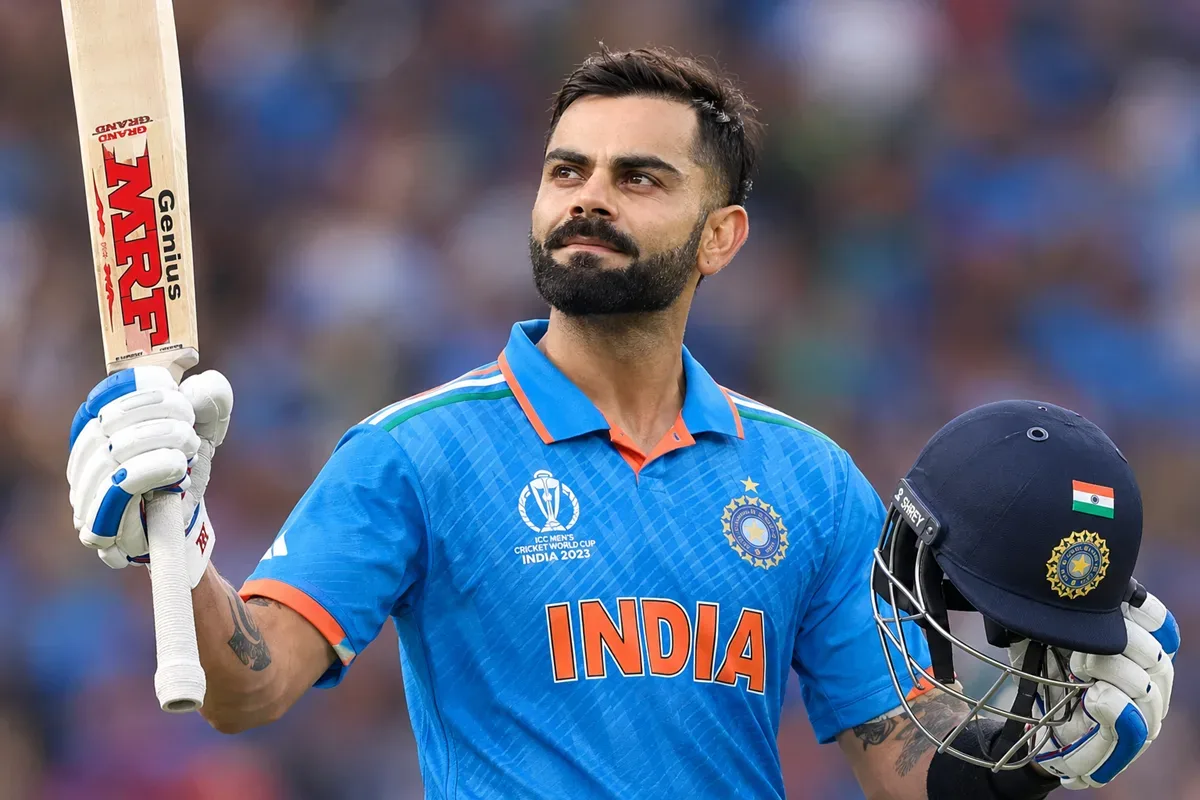
Virat Kohli has helped define modern international cricket through his consistency, competitive intensity and ability to win matches under pressure. From a promising teenager in Delhi to India’s most successful Test captain. The leading century-maker in one-day international history, his career has crossed generations, formats and changing expectations of batting.
Born on 5 November 1988, Kohli developed into one of the most influential batsmen of his era. His outstanding record in run chases, combined with his commitment to fitness and demanding leadership style, helped reshape India’s approach to international cricket.
By October 2026, he had scored 55 ODI centuries, 30 Test hundreds and one T20 international century. His 86 international hundreds placed him second only to Sachin Tendulkar, while his contribution extended far beyond individual statistics.
Kohli retired from T20 internationals after India’s 2024 World Cup victory and ended his Test career in May 2025. However, he continued to represent India in ODIs and remained an important player for Royal Challengers Bengaluru in the Indian Premier League.
His legacy rests on more than the volume of runs. It also reflects his influence on India’s cricketing standards, his ability to recover from difficult periods and his determination to remain competitive across an unusually long international career.
Early life and cricket development in Delhi
Virat Kohli was born in Delhi into a Punjabi family. His father, Prem Kohli, worked as a lawyer, while his mother, Saroj Kohli, supported the family’s upbringing of three children.
Cricket became an important part of his childhood. Recognising his interest and ability, his family encouraged him to pursue structured coaching rather than rely solely on informal neighbourhood matches.
In 1998, Kohli joined the West Delhi Cricket Academy, where coach Rajkumar Sharma played a significant role in his development.
The academy provided regular practice, technical instruction and exposure to competitive cricket. Sharma helped develop Kohli’s batting fundamentals, particularly his balance, footwork and ability to play through the off side.
Kohli progressed through Delhi’s age-group teams before earning selection for the senior domestic side. His performances demonstrated an ability to construct innings while maintaining an attacking approach.
However, his early career also included a deeply difficult personal experience.
In December 2006, while representing Delhi against Karnataka in the Ranji Trophy, Kohli learned that his father had died.
He returned to bat the following morning and scored 90, helping Delhi avoid the follow-on. The innings became one of the most widely documented episodes of his early career.
It demonstrated his willingness to continue competing under exceptionally difficult circumstances. Nevertheless, the personal loss was much more significant than the cricketing result.
His development continued through domestic and youth international cricket, ultimately creating the opportunity to represent India at Under-19 level.
The Under-19 World Cup breakthrough
Kohli’s first major international achievement came in 2008, when he captained India to victory at the ICC Under-19 Cricket World Cup in Malaysia.
India defeated South Africa in the final, giving Kohli an early experience of leading a successful national side.
The tournament highlighted more than his batting ability. He had to manage different personalities, make tactical decisions and respond to changing match situations.
Those responsibilities provided an introduction to the leadership demands he would later face at senior international level.
Later that year, Kohli made his ODI debut against Sri Lanka in Dambulla on 18 August 2008.
He initially faced considerable competition for a regular place in India’s batting order. Established players such as Sachin Tendulkar, Virender Sehwag, Gautam Gambhir and Yuvraj Singh occupied prominent positions.
Consequently, Kohli needed to demonstrate versatility. He adapted to different batting positions and worked towards becoming a dependable top-order batsman.
His performances gradually earned greater responsibility, particularly in the number three position that eventually became central to his international career.
Embed from Getty ImagesEstablishing himself in India’s batting order
Kohli’s development accelerated as India built towards the 2011 Cricket World Cup.
His willingness to take responsibility during run chases became increasingly valuable. Rather than relying entirely on boundaries, he combined controlled strokeplay with quick running between the wickets.
That approach gave India greater stability during the middle overs.
Kohli was part of the Indian side that won the 2011 World Cup on home soil. In the final against Sri Lanka at Mumbai’s Wankhede Stadium, he scored 35 and shared an 83-run partnership with Gautam Gambhir.
The partnership helped India recover from 31 for two while pursuing a target of 275.
Gambhir’s 97 and MS Dhoni’s unbeaten 91 ultimately secured the six-wicket victory. Kohli’s contribution was smaller, but it came at an important stage of the chase.
The success established him as a World Cup winner at 22.
A year later, he produced one of the defining performances of his early international career.
Against Pakistan in the 2012 Asia Cup, Kohli scored 183 from 148 deliveries as India successfully chased 330 in Mirpur.
The innings included 22 fours and demonstrated his ability to maintain a high scoring rate without depending heavily on six-hitting.
It also strengthened his reputation as one of the world’s most effective ODI batsmen when chasing substantial targets.
His growing status placed him among the greatest Indian batsmen of the modern era, although his career was still developing.
Transforming India into a Test cricket powerhouse
Kohli made his Test debut against the West Indies in June 2011, but his development in the longest format was less straightforward than his rise in ODI cricket.
Early difficulties against high-quality fast bowling exposed areas of his technique that required improvement.
His response became a central feature of his career.
During India’s tour of Australia in 2014–15, Kohli produced four Test centuries. He scored hundreds in both innings of the Adelaide Test, despite India losing a closely contested match.
His performances demonstrated that he could combine attacking batting with the patience required for lengthy Test innings.
When MS Dhoni retired from Test cricket in December 2014, Kohli assumed the captaincy permanently.
He brought a notably aggressive approach to the position.
India placed greater emphasis on fast bowling, physical preparation and taking 20 opposition wickets. Kohli regularly supported five-bowler combinations when team balance and conditions allowed.
His captaincy coincided with the emergence and development of a formidable bowling attack featuring Ravichandran Ashwin, Ravindra Jadeja, Mohammed Shami, Ishant Sharma and Jasprit Bumrah.
Kohli was not solely responsible for their success, but his backing of attacking bowling strategies became an important feature of the team’s identity.
The defining achievement arrived during the 2018–19 tour of Australia.
India won the four-match Test series 2–1, becoming the first Indian men’s team to secure a Test series victory on Australian soil.
Cheteshwar Pujara’s batting and the contributions of India’s bowlers proved crucial. Nevertheless, Kohli’s leadership formed an important part of the achievement.
He finished his captaincy career with 40 victories from 68 Tests, making him India’s most successful Test captain by wins.
His record reflects both the quality of the players available to him and the competitive standards established during his tenure.
His personal Test career ended with 9,230 runs from 123 matches, including 30 centuries and a highest score of 254 not out against South Africa in Pune in 2019.
Those figures placed him among India’s leading Test batsmen, although his final batting average of 46.85 also reflected a difficult period towards the end of his career.
Image Embed: Virat Kohli captaining India during the historic 2018–19 Test series victory in Australia, celebrating with his team-mates.
Mastering one-day international cricket
While Kohli achieved considerable success in Tests, his ODI performances established his strongest statistical claim to a place among cricket’s greatest batsmen.
His batting combined traditional technique with modern scoring efficiency.
He rarely needed to dominate every delivery. Instead, he maintained pressure through singles, twos and carefully selected boundaries.
This approach proved particularly effective in run chases.
Kohli developed an exceptional understanding of required scoring rates. He could absorb pressure when wickets fell, rebuild partnerships and accelerate without allowing the target to move beyond reach.
His consistency helped India approach difficult chases with greater confidence.
At number three, he frequently entered before the innings had developed. That required him to assess conditions quickly and adapt to different situations.
His partnerships with Rohit Sharma became especially important in India’s ODI success.
Together, they offered contrasting but complementary methods. Sharma could attack early, while Kohli often controlled the middle overs before increasing the scoring rate.
Their partnership became a significant feature of India’s batting during the 2010s and early 2020s.
The 2023 World Cup and Tendulkar’s century record
Kohli produced one of his most important individual achievements during the 2023 Cricket World Cup in India.
He scored 765 runs in 11 matches, breaking Sachin Tendulkar’s record for the most runs in a single men’s ODI World Cup.
His campaign included three centuries and six half-centuries.
The defining moment came in the semi-final against New Zealand at the Wankhede Stadium.
Kohli scored 117 and registered his 50th ODI century, surpassing Tendulkar’s previous world record of 49.
India posted 397 for four and secured a 70-run victory.
The milestone carried particular significance because Tendulkar had been one of Kohli’s childhood cricketing influences.
However, the tournament also highlighted the limitations of individual excellence.
Despite winning ten consecutive matches, India lost the final to Australia in Ahmedabad.
Kohli scored a half-century, but Australia successfully chased India’s total of 240 to win by six wickets.
His outstanding tournament could not prevent the defeat.
The contrast illustrated an important distinction in assessing his career: individual records strengthened his reputation, but major tournament victories remained collective achievements.
T20 cricket and a World Cup farewell
Kohli also established himself as a leading T20 international batsman, although his methods differed from those of more explosive power-hitters.
He generally favoured conventional cricket strokes, precise placement and calculated acceleration.
His 82 not out against Pakistan at the Melbourne Cricket Ground during the 2022 T20 World Cup remains one of his defining international performances.
India had slipped to 31 for four while chasing 160.
Kohli rebuilt the innings alongside Hardik Pandya before producing two remarkable sixes against Haris Rauf in the penultimate over.
India eventually won from the final delivery, with Kohli finishing unbeaten on 53 balls.
The performance demonstrated his capacity to judge a difficult chase and deliver under extreme pressure.
Two years later, he played another significant innings in the 2024 T20 World Cup final against South Africa.
Following a disappointing personal run earlier in the tournament, Kohli scored 76 from 59 balls in Barbados.
India won by seven runs, with his contribution earning the Player of the Match award.
He announced his retirement from T20 internationals immediately afterwards.
He finished with 4,188 runs from 125 T20 internationals, averaging 48.69.
The retirement brought a successful conclusion to his international career in the shortest format, although he continued playing franchise T20 cricket.
Setbacks, criticism and technical adjustments
Kohli’s career was not a continuous sequence of success.
His 2014 Test tour of England exposed difficulties against deliveries moving away from his bat. James Anderson and England’s seam attack repeatedly challenged his technique outside off stump.
Kohli managed only 134 runs in five Tests.
Four years later, he returned to England and produced a markedly improved performance, scoring 149 at Edgbaston and accumulating 593 runs across the series.
That improvement demonstrated his willingness to make technical adjustments and reconsider his approach.
Nevertheless, similar difficulties resurfaced later in his Test career.
During the 2024–25 Border-Gavaskar Trophy series, Australian bowlers repeatedly dismissed him while he attempted to drive deliveries outside off stump.
His willingness to attack remained a strength, but the same instinct sometimes created unnecessary risks.
He also experienced an extended period without an international century between November 2019 and September 2022.
Questions about his form, consistency and place in the team intensified during this period.
His return to scoring hundreds, beginning with an unbeaten 122 against Afghanistan in September 2022, demonstrated that he could recover from a lengthy setback.
Kohli’s confrontational manner also attracted criticism throughout his career. His animated celebrations and occasional exchanges with opponents divided opinion.
Supporters regarded his intensity as an important competitive quality. Critics sometimes questioned whether his reactions were excessive.
Both perspectives formed part of his public reputation.
Royal Challengers Bengaluru and IPL success
Kohli’s association with Royal Challengers Bengaluru represents one of the longest relationships between a leading player and a single IPL franchise.
He joined the team for the inaugural competition in 2008 and remained with the club throughout his career.
His strongest individual IPL campaign came in 2016.
He scored 973 runs, including four centuries, setting a single-season record that remained unmatched through 2026.
Despite his performances, Bengaluru lost the final to Sunrisers Hyderabad.
The continued absence of an IPL title became an important criticism of his otherwise remarkable career.
Kohli stepped down from the franchise captaincy after the 2021 season, but remained a central figure in the batting order.
His long wait finally ended in 2025.
Royal Challengers Bengaluru defeated Punjab Kings by six runs in the final, securing their first IPL championship after 18 seasons.
Kohli contributed 43 runs, while the team’s bowlers defended 190 to secure the victory.
The triumph carried particular significance because he had remained with the franchise through numerous disappointments.
Bengaluru followed that success by retaining the title in 2026.
In the final against Gujarat Titans, Kohli scored an unbeaten 75 from 42 deliveries as Bengaluru successfully chased 156.
According to the official IPL match report, his innings helped deliver a five-wicket victory with 12 balls remaining. The result gave Kohli his second IPL championship.
Image Embed: Virat Kohli celebrating Royal Challengers Bengaluru’s IPL title success, reflecting the conclusion of his long wait for franchise championship honours.
Batting technique, fitness and competitive mentality
Kohli’s batting style is built around balance, timing and the ability to score efficiently throughout an innings.
His cover drive became one of his most recognisable strokes.
When playing well, he transfers his weight smoothly towards the ball and maintains a stable head position. This allows him to generate timing without relying entirely on physical power.
His strong wrists also help him score through midwicket and square leg.
Against spin, he uses his footwork and placement to prevent bowlers from establishing prolonged control.
However, his most distinctive quality has often been his running between the wickets.
He turns defensive placements into scoring opportunities and frequently converts singles into twos.
This requires exceptional fitness, awareness and communication with batting partners.
His dedication to physical conditioning became an influential feature of Indian cricket.
Under his captaincy, India placed considerable emphasis on fitness standards and athletic fielding.
Kohli’s personal preparation provided an example, although improvements in India’s fitness culture also depended on coaches, support staff and fellow players.
His batting also reflects a clear understanding of risk.
Unlike a purely attacking batsman, he can spend substantial periods accumulating runs before increasing the tempo.
That flexibility helps explain his sustained success in ODI cricket.
Records, honours and career statistics
Kohli’s achievements across all three international formats establish the statistical scale of his career.
As of 3 October 2026, his principal international batting records included:
- Tests: 123 matches, 9,230 runs, 30 centuries and an average of 46.85.
- ODIs: 15,109 runs, 55 centuries and a batting average of 58.79.
- T20 internationals: 125 matches, 4,188 runs, one century and an average of 48.69.
- Combined international centuries: 86.
- Test captaincy: 40 victories from 68 matches.
- Most runs in a single men’s ODI World Cup: 765 in 2023.
- Most runs in a single IPL season: 973 in 2016.
His international achievements include the 2011 Cricket World Cup, the 2013 and 2025 Champions Trophies and the 2024 T20 World Cup.
He also received the ICC Men’s Cricketer of the Year award in 2017 and 2018 and the ICC Men’s ODI Cricketer of the Year award four times.
These individual honours demonstrate the consistency of his performances across different stages of his career.
However, the records should be considered alongside the strength of his teams and the changing demands of international cricket.
The later career and 2027 World Cup ambitions
Kohli announced his Test retirement on 12 May 2025, ending a 14-year career in the longest format.
His decision followed a difficult period in which his batting returns had declined from the standards established during his peak.
Nevertheless, his performances in limited-overs cricket remained important to India’s plans.
During the 2025 Champions Trophy, he scored an unbeaten century against Pakistan and 84 in the semi-final victory over Australia.
India subsequently defeated New Zealand in the final.
Kohli maintained his ODI involvement throughout 2026, including the England tour that formed part of India’s continuing white-ball preparations.
His place in India’s long-term plans became a significant discussion, as examined in World in Sport’s assessment of Kohli and Rohit Sharma ahead of the 2027 World Cup.
In September 2026, Kohli provided another reminder of his batting quality.
He scored an unbeaten 139 from 88 deliveries against the West Indies, helping India secure an eight-wicket victory.
The innings took him beyond 15,000 ODI runs and brought his 55th century in the format.
The ICC’s official records update confirmed that he became only the second batsman after Tendulkar to reach 15,000 ODI runs, achieving the milestone in a record 315 innings.
Kohli also indicated that the 2027 World Cup would be his final international tournament.
His continued involvement offers India experience and batting stability, although selection decisions must also consider current form, fitness and the development of younger players.
The challenge is no longer simply to extend his personal records. It is to maintain the standards required to contribute to another major international campaign.
Virat Kohli’s lasting influence on cricket
Kohli’s place in modern cricket rests on a combination of sustained batting excellence, leadership and an unusually demanding approach to preparation.
His ODI record stands apart. Few players have combined such a high batting average with comparable run-scoring volume and success in difficult chases.
His Test career also deserves recognition beyond its final statistics.
As captain, he helped India achieve greater consistency overseas and supported the development of a pace attack capable of winning matches in difficult conditions.
At the same time, his career illustrates the pressures faced by elite batsmen.
Periods of technical vulnerability, declining form and public criticism challenged his reputation. He did not always find immediate answers, and his aggressive approach sometimes invited unnecessary scrutiny.
Those experiences make his achievements more meaningful without removing the need for balanced assessment.
Within the wider history of Indian cricket, Kohli belongs among a small group of players whose influence extends beyond their statistical records.
He helped change expectations surrounding fitness, competitiveness and the role of a modern international batsman.
His career also provides a link between India’s 2011 World Cup generation and the younger players preparing for the next phase of international cricket.
Whether his final international appearance produces another major trophy will influence the conclusion of his playing story.
It will not, however, determine the overall value of his career.
Kohli has already established a record of achievement that combines individual excellence with significant team success.
His lasting contribution is the standard he maintained over nearly two decades, and the influence that standard has had on the way India approaches international cricket.

World In Sport Forum
Continue the discussion
Join other fans in the World In Sport Forum and debate the biggest talking points from this article.