
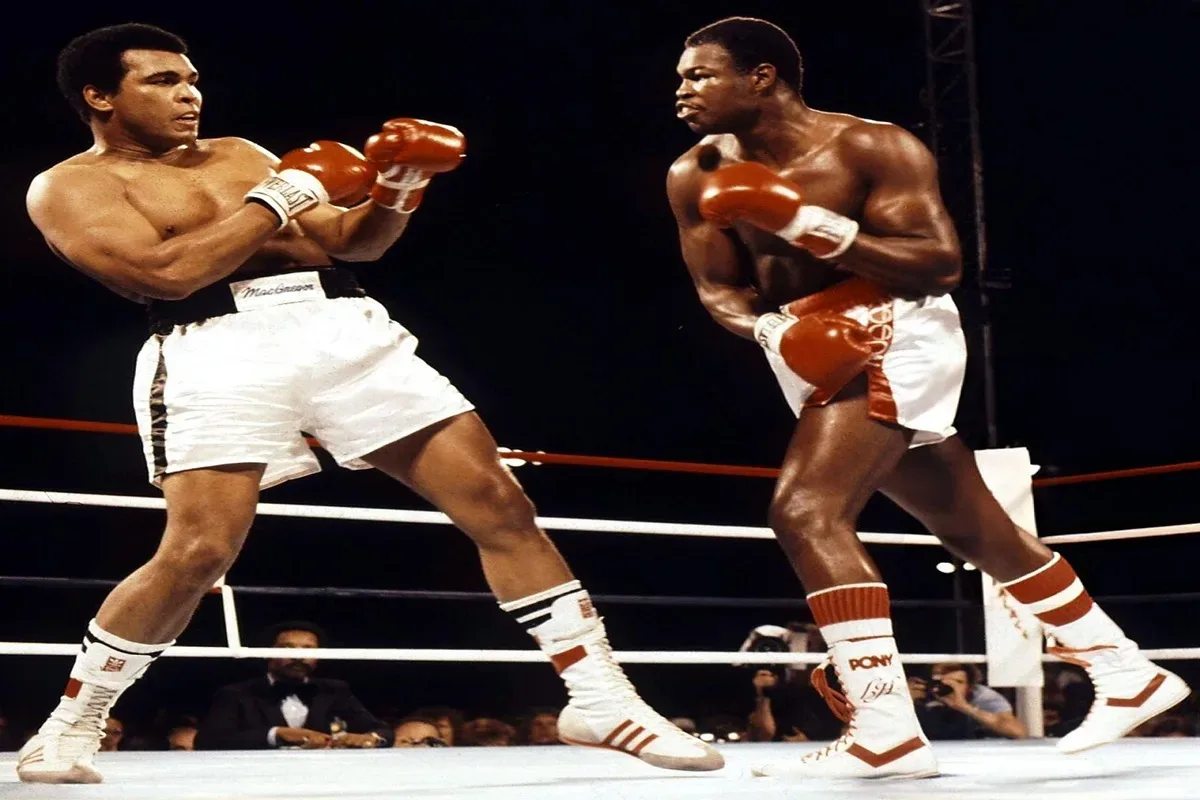
Larry Holmes had one serious problem during his reign as heavyweight champion of the world. He wasn’t Muhammad Ali. Unfortunately for Holmes, he’d arrived immediately after a man who had become much more than a boxer.
Ali wasn’t simply the heavyweight champion. He was probably the most famous athlete on earth, and perhaps the most recognisable man on the planet. Following Ali as heavyweight champion was a little like following Sinatra onto a nightclub stage. You might be terrific, but the audience was still talking about the guy who’d just left.
Holmes was terrific, and I’ll go considerably further than that. Larry Holmes is one of the three greatest heavyweight boxers I’ve ever seen, and I’ve been watching heavyweights for more than sixty years.
He had one of the finest left jabs in heavyweight history. He could box. He could fight, and he could take a hell of a punch. Earnie Shavers hit him with the sort of right hand that should’ve ended the evening, and Holmes somehow got back up. He won his first 48 professional fights and reigned as heavyweight champion for more than seven years.
Embed from Getty ImagesThe champion who followed Muhammad Ali
Holmes also had another problem, and this one was entirely of his own making. Larry could be a miserable bastard. He had an acerbic personality, particularly when he believed he’d been slighted, which seemed to be fairly often.
He complained about the respect he wasn’t receiving. He argued with reporters, promoters, judges and almost anybody else who annoyed him. Give Larry Holmes a microphone when he was angry, and there was a reasonable chance everybody involved would regret it. Some of his resentment was justified, and some of it wasn’t. The problem was that Holmes wasn’t particularly good at recognising the difference while he was angry.
Chasing Rocky Marciano’s 49-0 record
Nothing illustrates that better than Rocky Marciano. By September 1985, Holmes had won 48 consecutive professional fights. One more victory would tie Marciano’s 49-0 record, and people cared about that number in a way that’s difficult to appreciate today. Marciano’s undefeated record had become almost hallowed in boxing.
Holmes wasn’t merely chasing a number in a record book. He was approaching a piece of boxing mythology, and I remember the atmosphere surrounding it. There seemed to be a considerable portion of the boxing world that didn’t merely want Marciano’s record preserved. They didn’t want Larry Holmes to be the man who equalled it.
Holmes’s opponent was Michael Spinks, the undefeated light heavyweight champion. Spinks was an excellent fighter, but he was moving up to face a heavyweight champion who hadn’t lost in 48 professional fights. Holmes entered as the favourite and left without his championship.
Spinks won a unanimous decision. Two judges had it 143-142, while the third scored it 145-142. I thought Holmes won, although I’ve never considered the decision an outrageous robbery. It was a close fight, and close fights produce arguments.
Embed from Getty ImagesHolmes wasn’t nearly as restrained about it as I’ve just been. Somebody asked him about Marciano afterwards, and Larry responded that Marciano couldn’t carry his jockstrap. It wasn’t one of Larry’s better moments.
If Holmes had been looking for a way to make the public dislike him even more, he’d found it. Marciano had been dead for sixteen years, his undefeated record was treasured by boxing fans, and Holmes had just insulted him after failing to equal it. The remark followed Holmes for years.
The strange thing is that Holmes had a legitimate grievance buried underneath all that anger. He believed he’d won the fight. Plenty of knowledgeable boxing people believed he’d at least done enough to make the decision debatable, and the rematch would make matters worse.
The Michael Spinks rematch
Holmes fought Spinks again seven months later. This time Spinks won a split decision, and I thought Holmes won again. Holmes retired afterwards convinced that boxing had taken his championship from him. By then, he’d accumulated enough evidence to convince himself that he’d been right all along about the boxing establishment never giving him the respect he deserved.
His problems with the public, however, had begun well before Michael Spinks. The biggest one had a name: Muhammad Ali.
Ali challenged Holmes for the heavyweight championship in October 1980. He was 38 years old, diminished and, as we later learned, in no condition to be fighting the heavyweight champion of the world.
What followed was difficult to watch.
World in Sport’s look at Muhammad Ali’s career-defining rounds includes the Holmes fight and the circumstances surrounding Ali’s return.
Holmes beat him up, and there’s really no prettier way of putting it. Ali’s corner finally stopped the fight after ten rounds. Holmes had done what a heavyweight champion is supposed to do against a challenger who could no longer defend himself properly, but Ali’s millions of admirers weren’t particularly interested in that distinction. Many of them saw Larry Holmes beating up Muhammad Ali, and they never forgave him for it.
Embed from Getty ImagesI’ve always found that terribly unfair to Holmes. He didn’t make Ali fight, he didn’t make the match, and he wasn’t responsible for Ali’s physical condition. Muhammad Ali climbed into a boxing ring and challenged Larry Holmes for the heavyweight championship of the world. Holmes’s job wasn’t to preserve Ali’s legend. His job was to beat him.
Mike Tyson and the generational shift
Eight years later, boxing produced one of those bits of symmetry that would seem too convenient if somebody had written it into a movie. Holmes was now the old man, while Mike Tyson was 21 years old, undefeated and terrifying.
Holmes was 38, hadn’t fought in almost two years and was considerably removed from the fighter who’d dominated the heavyweight division. Tyson was entering his prime while Holmes’s prime had disappeared in the rearview mirror.
Ali was part of the story again. Tyson had idolised him as a boy, and Holmes’s beating of Ali became part of the emotional mythology surrounding the fight. Once again, Holmes couldn’t escape Muhammad Ali. This time, however, Larry was standing on the other side of the generational divide.
Tyson stopped Holmes in the fourth round. It was the only stoppage defeat of Holmes’s entire 75-fight professional career. The victory became another important step in Mike Tyson’s heavyweight championship reign, and it tells you how hard Holmes was to beat.
Embed from Getty ImagesStill challenging champions in his forties
Most fighters would’ve left it there, but Larry Holmes wasn’t most fighters. He came back again and eventually earned another shot at the heavyweight championship against Oliver McCall in 1995. McCall was 29 years old and had recently knocked out Lennox Lewis. Holmes was 45.
I was there for that one. I watched a 45-year-old Larry Holmes stand in front of the heavyweight champion of the world and make him work for twelve rounds. Holmes used that wonderful jab, picked his spots and showed that although age can take away a fighter’s legs and reflexes. It doesn’t necessarily take away everything stored between his ears.
McCall won a unanimous decision, and I thought Holmes won that one too. Maybe Larry and I were both impossible, but I watched the fight from inside the arena, and that’s how I scored it.
Larry Holmes the businessman
There was another side to Holmes that didn’t receive nearly as much attention as his mouth or his boxing. The seventh-grade dropout from Easton turned out to be one hell of a businessman. Holmes did something that has proved surprisingly difficult for heavyweight champions. He kept his money, and then he made more of it.
He invested heavily in Easton, putting his boxing earnings into real estate and businesses. By the time he fought Tyson in 1988, Holmes already had substantial business and property holdings. He didn’t spend his retirement telling stories about the fortune he’d once possessed. He continued building one.
Holmes later said he’d invested the money from the Gerry Cooney fight in real estate and made a good return on it. The fighter who could become remarkably careless when somebody stuck a microphone under his nose became considerably more thoughtful when somebody put a financial statement in front of him.
Larry Holmes might have been abrasive. He could be bitter, thin-skinned and his own worst public-relations man, but nobody should confuse any of those things with stupidity. Holmes was nobody’s fool.
Larry Holmes’s legacy
Perhaps that’s part of the reason I’ve always had a soft spot for him. Holmes never seemed particularly interested in becoming what other people wanted him to become. When people wanted another Ali, Holmes remained Holmes. When they wanted him to accept their judgement of his career, he argued with them. When boxing was finished paying him, he took the money home and put it to work.
The record deserves another look too. Holmes finished 69-6, fought professionally until he was 52 and was stopped exactly once. He fought Norton, Shavers, Weaver, Ali, Cooney, Witherspoon, Bonecrusher Smith, Spinks, Tyson, Holyfield and McCall, among plenty of others.
Larry Holmes is one of the three greatest heavyweight boxers I’ve ever seen. He had the jab, chin, stamina, toughness and intelligence to fight almost any kind of heavyweight, and he remained good enough in his forties to give champions serious problems.
His greatest failing had nothing to do with what he could do inside a boxing ring. Larry Holmes had the terrible luck to follow Muhammad Ali, and then he made matters worse by beating him up. For millions of Ali fans, Holmes committed a sin they were never quite prepared to forgive.
Readers can find more profiles, features and fight coverage in World in Sport’s boxing section.

World In Sport Forum
Continue the discussion
Join other fans in the World In Sport Forum and debate the biggest talking points from this article.