

If you spend any time here on Baseball Savant, you’re probably aware of how we feel about good old-fashioned batting average. There are far better alternatives to evaluate a hitter’s true offensive value, tools that front offices across the game use religiously.
With that being said: Take a look at this.
Highest batting averages in MLB, after the All-Star break
Among 164 qualified hitters
- Steven Kwan (CLE): .353
- Chandler Simpson (TB): .344
No one should argue that Steven Kwan and Chandler Simpson were the two best hitters in baseball over those 2 1/2 months. If we look at some more advanced metrics, we see that Kwan (155 wRC+) was particularly elite. Simpson (107 wRC+) was valuable but less so, in part because of one of the game's worst walk rates (3.1%).
But it is not easy to hit that well in a 62-game stretch. This is fun, and also relevant, with Kwan and Simpson sharing the spotlight as the Guardians and Rays battle in the American League Championship Series. They are a lot alike, a little bit different, and, at the same time, unlike most everyone else.
Let's start with the obvious: If you’re looking for vicious hacks, you won’t find them here.
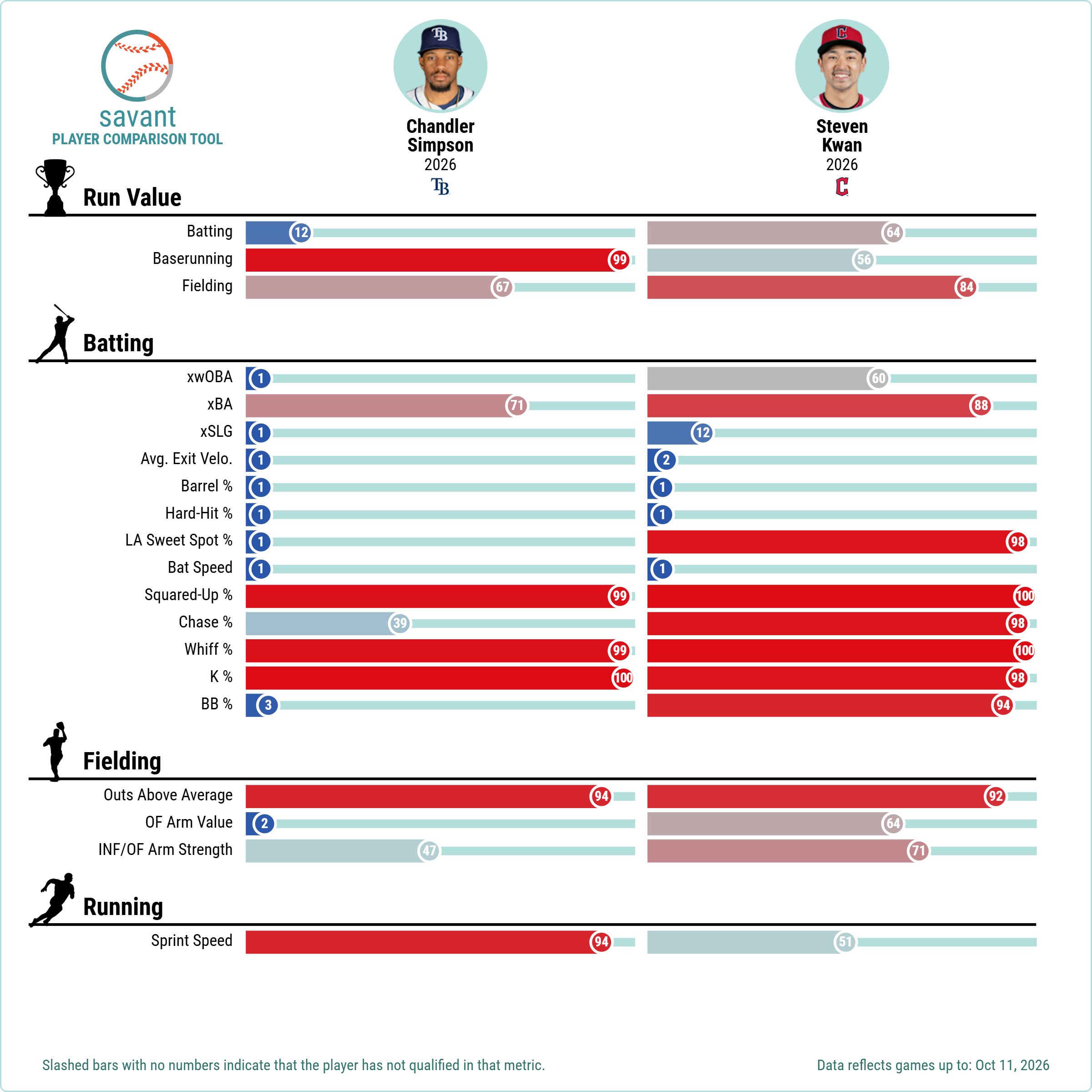
Kwan comes in last among 206 qualified hitters in bat speed; at 62.4 mph, his average bat speed was the slowest by a qualifier in a single season since Statcast first released bat-tracking data after the 2023 All-Star break. Simpson, at 65.1 mph, is not far behind. The Major League average is 72.1 mph.
Swinging the bat hard is all the rage, and for good reason. The harder you swing, the harder you hit the ball, and hard-hit balls are more likely to turn into base hits. Statcast defines fast swings as those with a bat speed of 75+ mph. The league hit .308 with a .613 slugging percentage on fast swings in 2026.
They are not a part of the lexicon for Kwan or Simpson: Kwan had two fast swings all year, and Simpson had three. By comparison, Rays slugger Junior Caminero -- who swings the fastest bat in baseball -- had eight fast swings alone in Game 1 of the ALCS, including on his 111.2 mph RBI single in the first inning.
Bat speed is an obvious way for hitters to succeed, and yet Kwan and Simpson are successful without it. How do they do it?
This starts with making a ton of contact, which you’d probably expect from hitters who swing the bat slowly. Simpson, a poster child for the contact-savvy Rays, had the third lowest swing-and-miss rate (10.8%) among qualifiers. He trailed Kwan (8.2%), whose whiff rate tied a career low in a single season and the contact king, Luis Arraez.
But simply making contact without bat speed would not be enough; these types of hitters have to make good contact -- hitting the ball on the sweet spot of the bat. Kwan and Simpson do this better than anyone.
Squared-up rate shows us how often a hitter makes optimal contact on the fat part of the bat. Doing so helps a hitter get the most out of his bat speed, however limited, and translate that to exit velocity. No one has a higher squared-up rate per swing than Kwan. Simpson ranks third highest, behind Arraez.
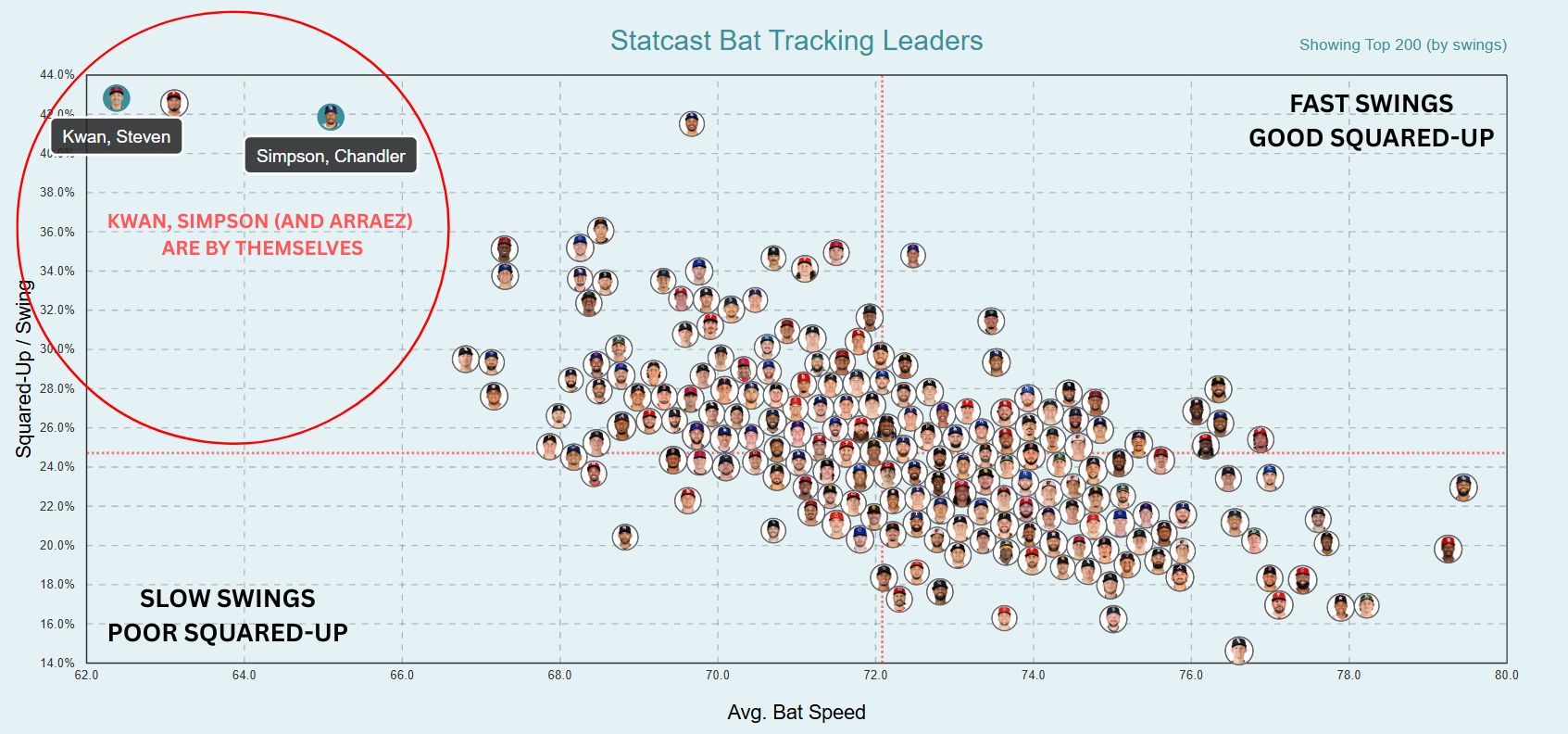
Kwan and Simpson are outliers, alone in the upper left-hand corner of the graphic. To be a productive hitter in that quadrant, you have to have excellent bat control. That’s the separator from the bottom-left corner. You won’t see anyone there, because a hitter who doesn't swing the bat fast and doesn't square the ball up likely isn't a Major League player.
Kwan and Simpson are most similar in their bat-to-ball skills. But they arrive to this point differently. Their swings are tailored toward their respective approaches.
Let’s start with Simpson. Everything that he does at the plate is centered around maximizing his elite speed. He is not trying to hit the ball in the air. Simpson actually hits the ball on the ground at a higher clip than all but one qualified hitter. Nor is he trying to hit the ball far. The average distance of Simpson’s 175 base hits -- 106 feet -- is the shortest of any player in a single season in the Statcast Era (min. 100 hits).
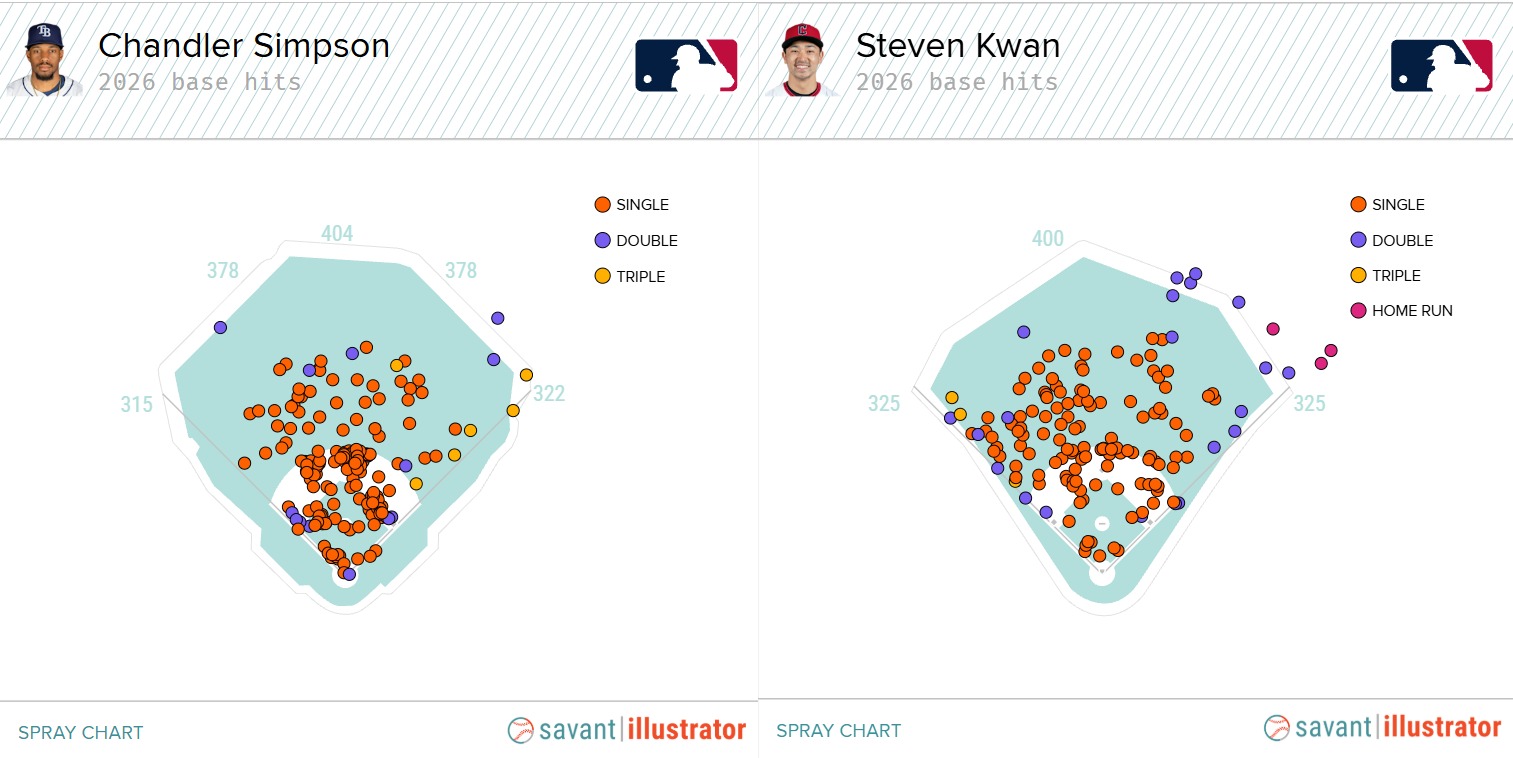
How does his swing help him accomplish this? Simpson’s average attack angle of three degrees -- which measures the upward (or downward) trajectory of the barrel at contact -- is one of the lowest in baseball. A low attack angle is a ground-ball swing or a line-drive swing. Those are the batted balls that Simpson wants to spray. Only four qualified hitters let the ball travel deeper, which Simpson can do, because he is not trying to do damage like a typical hitter.
Simpson has the second-lowest launch-angle sweet-spot percentage in baseball, which means that hardly any of his batted balls are hit with a launch angle between 8-32 degrees. That's the optimal range for a hitter to do damage on a batted ball. Kwan, meanwhile, has the fifth-highest LA sweet spot rate in baseball. He is looking to spray line drives, not slap ground balls.
This is where they are a little bit different. Kwan is not nearly as fast as Simpson; his sprint speed is league average. And so, much like your typical modern hitter, he does not want to hit ground balls.
But this is a little more nuanced, especially this year. In the offseason, Kwan went through a bat speed program that involved swinging heavier bats. Swing faster, hit harder -- that was the idea. It’s something that Kwan had in mind each of the past three seasons, too. He’s spoken openly before about wanting to slug more, and he’s even done so.
That's all fine and good. Except, through June 30, Kwan was hitting .212 with a 78 wRC+, making him one of the eight weakest qualified hitters in baseball. His bat speed remained the lowest in the game and he had 24 hard-hit balls, 12 fewer than the second fewest among qualifiers.
Since then, Kwan has reverted to being Kwan. He’s gone from the eighth-weakest hitter to the eighth-most productive hitter.
Some of this has to do with his batting average on balls in play. At the same time, we can see that Kwan's bat is moving differently, which reflects a change in approach.
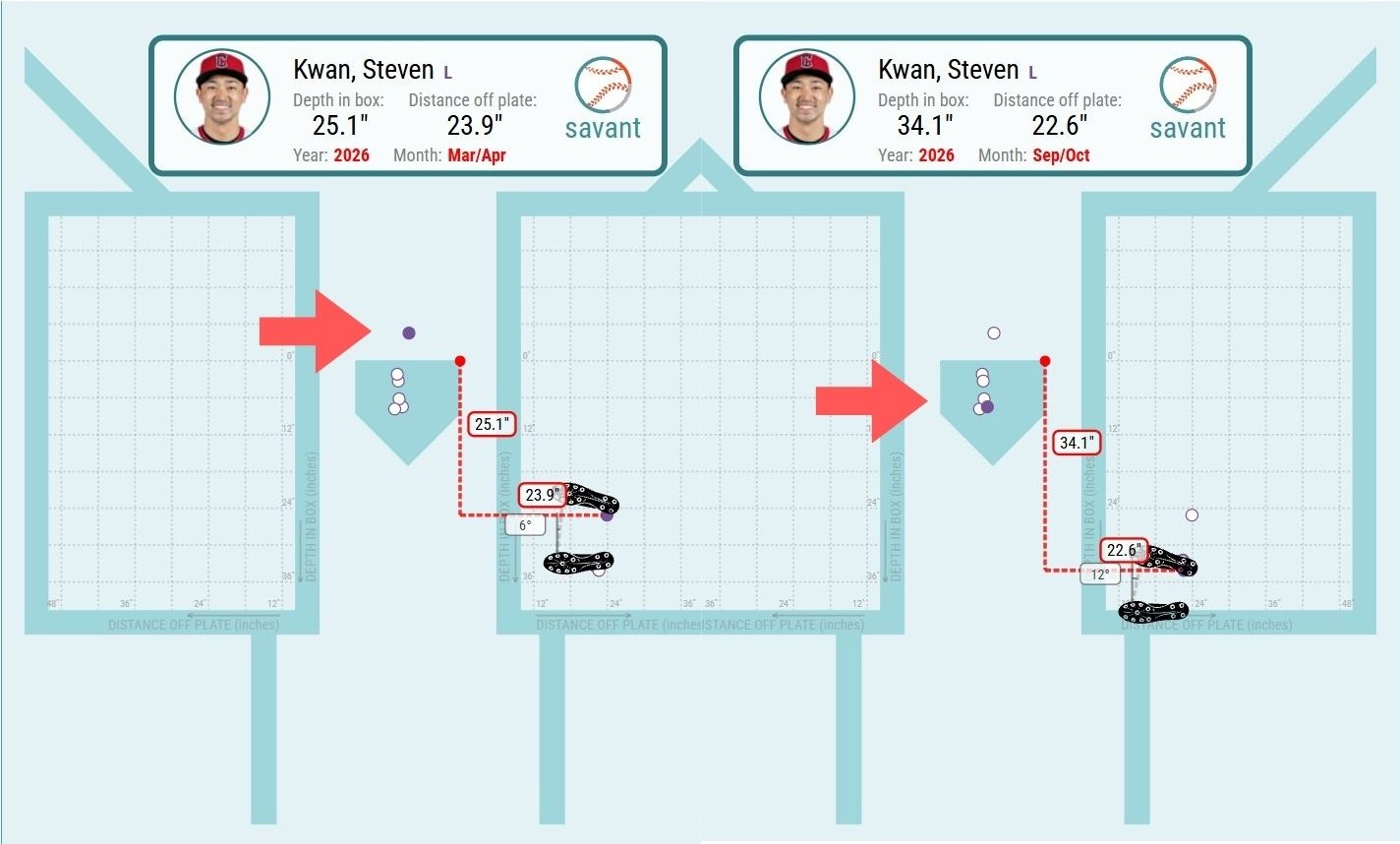
His attack direction -- which measures the way the barrel of the bat is moving horizontally at contact -- is more geared toward the opposite field, starting at three degrees to the pull side in March/April and ending at four degrees the other way in September. Kwan has also moved way back in the batter's box -- standing nine inches farther back in October than he did in April. He's seeing the ball longer, and also letting it travel deeper. That makes sense, because his barrel is traveling to the opposite field at point of contact. He can flick the ball the other way.
It's worth repeating that this approach would not work for most hitters. There are sound, proven reasons why hitters are trying to catch the ball out of front and lift it in the air to the pull side. Kwan and Simpson don't do that. It works for them. And you can see this throwback approach on display, side by side, throughout the ALCS.