
Of all the needs that the Phillies will attempt to address between now and Opening Day, a right-handed bat seems most pressing.
Sure, they need outfielders -- "right now, we don't have an outfield," president of baseball operations Dave Dombrowski mused at the GM Meetings last week. But that is intertwined with what we're about to show you.
Last season, only the Rockies received worse production from right-handed hitters than the Phillies. Philadelphia's right-handed bats combined for an 80 wRC+ -- in simpler terms, they hit 20% worse than the average Major League hitter. (Philly's left-handed hitters, by comparison, managed a 104 wRC+ that ranked in the middle of the pack.)
Lowest wRC+ from RHB, by team, 2026
30. Rockies, 79
29. Phillies, 80
28-T. Reds, 86
28-T. Giants, 86
28-T. Mets, 86
This was the weakest group of Philly right-handed hitters in a decade, and the 2016 Phillies are not exactly a club to remember. That 71-win outfit handed out a combined 461 plate appearances to Tyler Goeddel (47 wRC+) and Aaron Altherr (64 wRC+).
In a three-year span from 2023-25, the Phillies benefited from slightly above-average (101 wRC+) production from their right-handed hitters. The performance wasn't remarkable, but on a team anchored by left-handed sluggers and a stalwart starting rotation, this was enough.
That flipped rather suddenly in 2026, and now a right-handed bat ought to be atop Dombrowski's to-do list. For reasons we'll get to later on, that's easier said than done -- look no further than this year's Trade Deadline, when the Phillies, in need of a right-handed bat, instead acquired the left-handed-hitting Luis Arraez.
So, how did the Phillies get to this point, and how can they avoid a repeat in 2027? Let's dive in.
Where did things go wrong?
Philadelphia's right-handed hitters in 2026 can be neatly divided into three groups.
1) The success stories
The Phillies did what they could do fix this problem midseason. Derek Hill, acquired in a trade with the White Sox in June, posted a 109 wRC+ in 67 games following the deal (again, read that as "9% better than league average"). Bryan De La Cruz, signed to a Minor League contract last November, received a callup in July and managed a 108 wRC+ in 34 games with the big league club.
2) The disappointments
Those ancillary pieces could only do so much. Philadelphia expected Otto Kemp and Adolis García to reverse the club's misfortunes against left-handed pitching via some much-needed pop.
Needless to say, things didn't play out that way. Kemp made the club out of Spring Training, only to strike out 10 times in 27 plate appearances. He was demoted to Triple-A Lehigh Valley in May, and we didn't see him again until the NL Wild Card Series, where he made the final out of the Phillies' season.
García's season ended in June with right lat surgery, and he was one of the least productive hitters to take at least 250 plate appearances in 2026.
3) The big names
And yet, even still, the Phillies could have survived next-to-nothing contributions from Kemp and García had their high-profile guys performed. Alec Bohm (90 wRC+), Trea Turner (83 wRC+) and J.T. Realmuto (68 wRC+) were all well below league average. For Bohm, in all likelihood, this past season will mark the end of an underwhelming tenure with the club that made him the No. 3 overall pick in the 2018 Draft. We'll get to Turner and Realmuto in a little bit.
How might the Phillies fix this?
And now we get to the tricky task laid out in front of the Philadelphia brass. Where to go from here?
Out of the organization, you're probably thinking. Well, the Phillies have expressed interest in both Randy Arozarena and Seiya Suzuki, two of the top hitters on the free-agent market. That makes plenty of sense. Not only are they both right-handed, they are two of the 17 right-handed-hitting outfielders who took at least 400 plate appearances with above-average or better hitting in 2026. That's actually one more player than 2025, which had just 16 such outfielders, the lowest in a full season since 1960.
That's a big part of the problem here: There is a well-documented scarcity of right-handed bats. Lefty mashers are making a resurgence, in no small part because of MLB's 2023 shift restriction rules.
That makes for fewer productive right-handed hitters, too, and also fewer outfielders in this category. As a group, right-handed-hitting outfielders managed a 100 wRC+ in 2026, which is to say they hit like the league-average hitter -- just as they did in 2025. This is a trend now, and it’s also the third-lowest figure in the Live Ball Era, which began in 1920.
The Phillies are smack in the middle of all this. Stop us if you've heard this one before: Only the Rockies received worse production from their right-handed-hitting outfielders in 2026.
The most straightforward path, then, would be if the right-handed bats that the Phillies have under contract for 2027 simply play better. Any sort of bounce-back would go a long way toward fixing one of the club's most glaring issues.
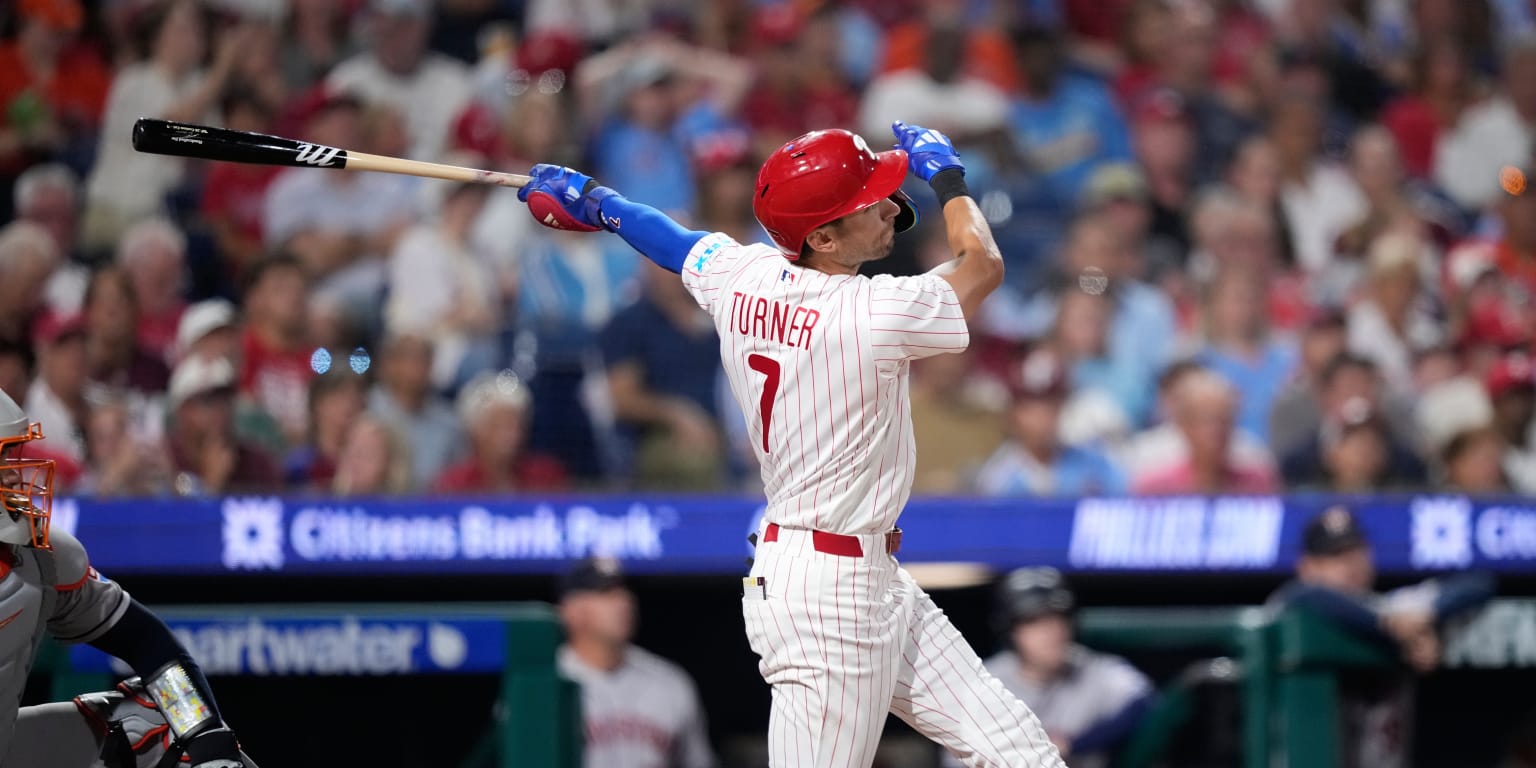
So much of this starts with Turner. He had been a better-than-league-average bat in every MLB season in which he took at least 100 plate appearances until last year, when he managed a career-worst .675 OPS. He has seven years left on his contract, but is it already reasonable to wonder what's left in the tank? Turner will be 34 next summer, and his ability to hit fastballs -- typically a strength -- regressed last season.
Then there's Realmuto, who will enter his age-36 season coming off a career-worst .331 slugging percentage and a .614 OPS in 123 games. He plays a physically taxing position and just posted his lowest hard-hit rate in a single season since 2017. The Phillies would do well to get him off his feet more often, and, if anything, maybe that could help to rejuvenate his bat.
Whether it comes from an improvement within or an external addition, a right-handed bat should be atop the club's wish list this offseason.