

Cam Schlittler throws a whole lot of fastballs, and the Red Sox wanted to be ready for the high-octane heat. They reportedly “wore out” the Trajekt machine last weekend at Tropicana Field, hoping to sync their bats with Schlittler’s elite velocity ahead of their showdown in Game 1 of the American League Wild Card Series on Tuesday night.
The strategy seemed sound. Schlittler is the poster child for throwing three distinct fastball shapes, the latest pitching trend to sweep the Majors. In the regular season, he threw his fastballs -- four-seamer, sinker and cutter -- 89.2% of the time, the highest rate of any starting pitcher (min. 750 pitches). And he throws hard, with 94th-percentile average fastball velocity. The fastball-heavy approach is why Schlittler is almost certainly going to win the American League Cy Young Award next month.
There was just one problem: Schlittler has a curveball now. It’s a good one, and he'll showcase it again on Monday night when the Yankees ace gets the ball in Game 2 of the ALDS against the Rays at Tropicana Field.
In another dazzling postseason start against the Red Sox, Schlittler unleashed a career high 32 curveballs, or 27% of his 117 pitches. For Schlittler, that sort of usage was unprecedented. The 25-year-old had never thrown more than 20 curveballs in a single game in his MLB career. In five prior starts against the Red Sox, he threw a total of 41 curves. But to kick off a postseason encore, he threw more curveballs than sinkers or cutters.
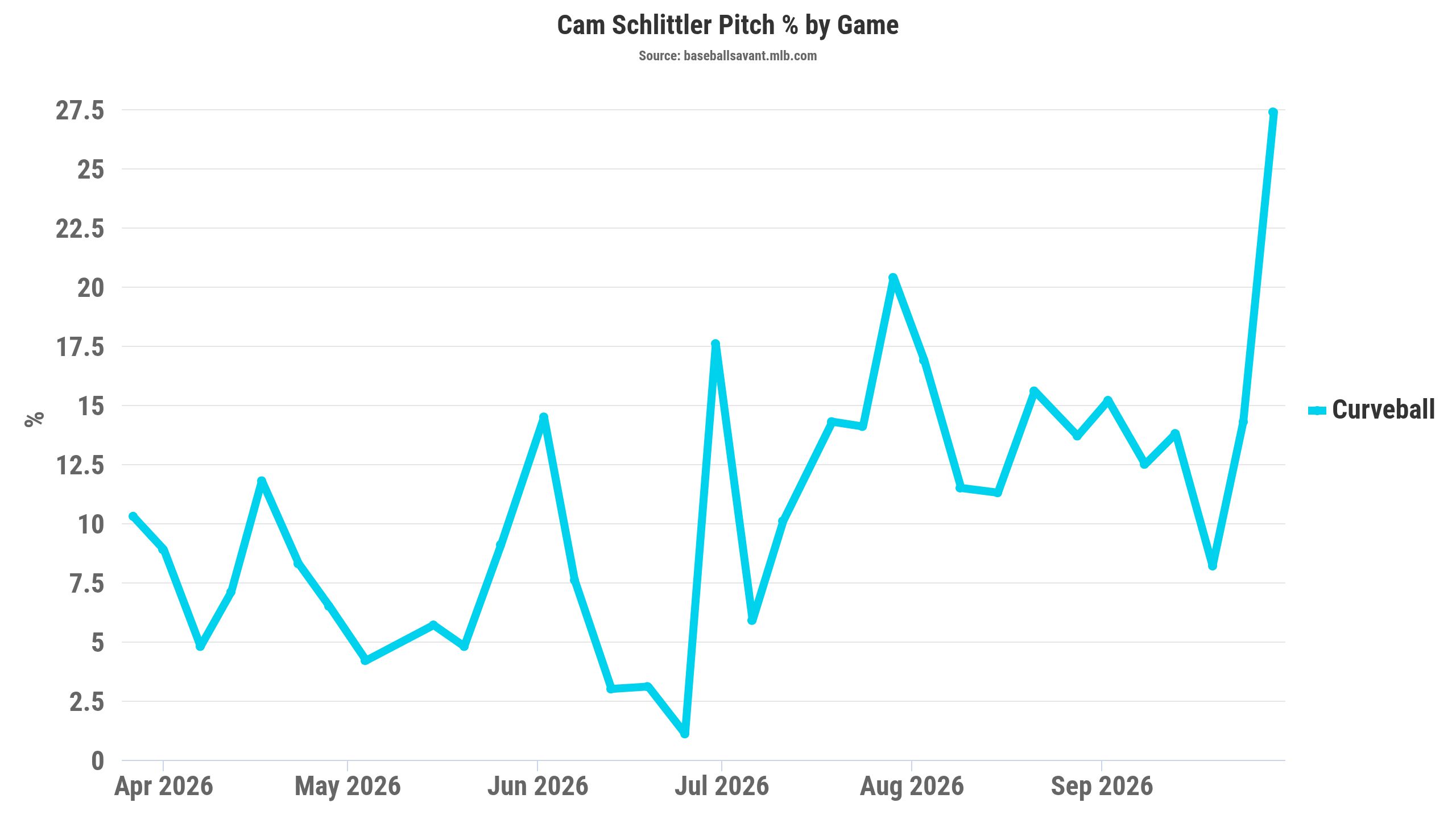
Schlittler generated eight whiffs on 16 swings against his curveball, which accounted for four of his 10 strikeouts. The eight swings and misses that Schlittler got via his curveball were the most in a single game in his career.
If you’ve been following along with Schlittler’s steady dominance over the past few months, this isn’t exactly a new development. MLB.com’s David Adler wrote about Schlittler’s new-look curveball in August, noting that the pitch had become a power curve -- gaining a few ticks in velo while maintaining its sharp vertical movement.
Against the Red Sox, Schlittler's curveball averaged 85.8 mph. That’s not as hard as he threw it in August, when he sat at 87.5 mph. Still, it’s much firmer than it was earlier in the year.
Schlittler's evolving curveball
- March/April: 84.2 mph / 48.8 inches vertical break
- Postseason: 85.8 mph / 48.7 inches vertical break
This is a good pitch on its own. By Stuff+, which uses a model to grade the raw “nastiness” of an individual pitch, Schlittler’s curveball had one of the best shapes in baseball after the All-Star break. The reason it’s lethal, though, is because of how it plays off the four-seam fastball.
That’s really the case for every pitch in Schlittler’s arsenal. It’s why he’s had so much success with three fastball variants: The sinker and cutter look like the four-seamer out of his hand, and they’re thrown at a similar speed. But when they arrive at the plate, they have vastly different movement profiles. That's nearly impossible for hitters to time up.
The curveball, meanwhile, mirrors the spin of the four-seamer.
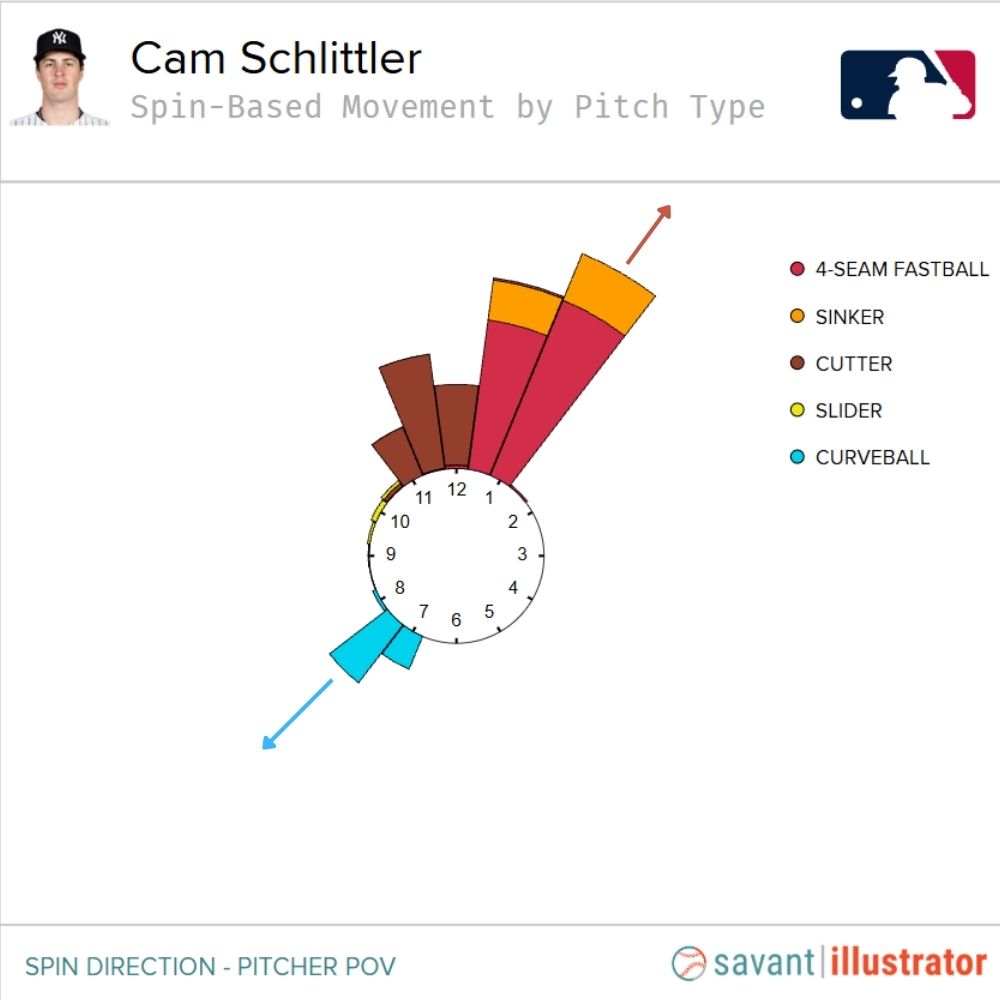
Try picturing the face of a clock. Schlittler’s four-seamer spins in the “12:45” direction, with a bit of backspin and some side-to-side spin toward his arm side. The curveball, meanwhile, rotates in the “7:15” direction, on the opposite side of the clock. It’s not a perfect mirror combination -- that would be exactly 6:00, or 180 degrees, apart. But when Schlittler releases his four-seamer and curveball, they look the same because of spin mirroring. One spins backwards, one spins forwards, and it’s hard for a hitter to tell which pitch is coming.
Here’s what this all looks like.
On Tuesday, Red Sox hitters swung under 65% of Schlittler’s four-seam fastballs, which rises above bats. But Boston swung over 67% of his curveballs, unable to lay off the big break.
This isn’t something that hitters had to worry about before with Schlittler, who succeeded almost exclusively with nasty hard stuff. It is certainly a part of the calculus now. He plays his fastball at the top of the zone and pours the curveball down, which maximizes the relationship between these two pitches. That’s how you get silly-looking swings, over and over again.
But why did he use it so often on Tuesday?
The Red Sox cannot hit Schlittler. They are certainly not alone in that, given that Schlittler is one of baseball’s elite pitchers, but their struggles are magnified. Schlittler’s 0.47 ERA is the lowest by a pitcher in his first six career starts against the Red Sox, including the playoffs, since earned runs became official in 1913.
At the same time, Schlittler made four starts against Boston in the regular season. Red Sox hitters had seen him repeatedly, and spent an entire weekend gearing up for his vicious fastball shapes.
Scenarios like these are why pitchers always fiddle with additional pitches behind the scenes. For example, Brewers right-All-Star Jacob Misiorowski hasn’t thrown his changeup since June. But he plays catch with it and incorporates it into his bullpens, just in case he needs to break it out while facing a lineup multiple times in October. It is a luxury that the best pitchers can afford -- using a legitimate weapon sparingly -- and Schlittler is among that group.
He even teased this possibility a few weeks back.
“I think it’s like, screw it, I’ll start throwing it more if I need to, you know?” Schlittler told MLB.com in August. “You don’t always need to do that. But it’s better to get that pitch under control, and if I do need to bring it out, then I can get in the zone and get swing-and-miss with it.”
It certainly seemed to catch the Red Sox off guard.
“That’s something that was new for today’s game,” outfielder Wilyer Abreu said after the game. “... He pitched to our weakness, and we couldn’t make the adjustment.”
The weakness, as it turns out, is curveballs. Only the Orioles had a lower batting average against curveballs in the regular season than the Red Sox (.195). Boston also had the second worst wOBA (a version of on-base percentage that properly values extra-base hits) against curveballs.
What does this mean for this series?
The Rays, like the Red Sox, don’t hit curveballs well. Tampa Bay’s .262 wOBA against curveballs is fifth lowest in MLB. All-Star third baseman Junior Caminero posted a .481 slugging percentage against curveballs, his second lowest against any pitch type (Caminero only hit for less power against changeups).
There’s a little more to this, though. Schlittler’s curveball shouldn’t be grouped with other curveballs. We can narrow this down a little bit more to power curves -- 85+ mph -- from right-handed pitchers. The Rays have accrued -5 batting run value against this subset of pitches, tied with the Red Sox for second fewest in MLB. Maybe that's something Schlittler can exploit.
In three starts against the Rays, Schlittler threw a total of 22 curveballs -- 10 of which came in his most recent outing against Tampa Bay on Sept. 24.
Schlittler does not need his curveball to dominate. He overwhelmed opposing lineups all year long while using the pitch sparingly. But it is a weapon, and these types of wrinkles are most valuable this time of year. He’ll be looking for any advantage he can get against a one-of-a-kind lineup in the Division Series.