
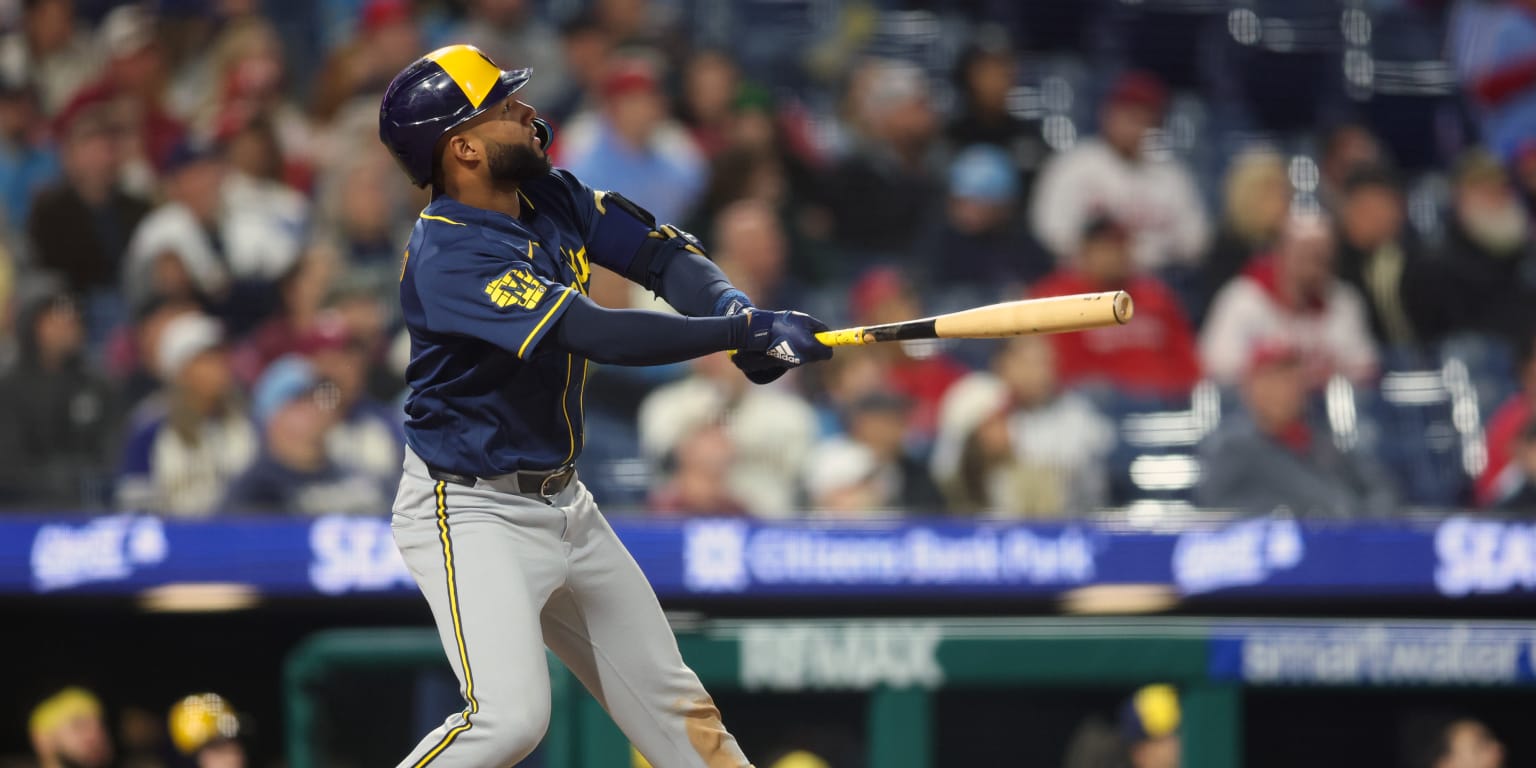
The Brewers increased their regular-season win total for the fourth consecutive year, a remarkable feat for a club that has also claimed four straight NL Central titles. They’ve done so with an offense that, at least on the surface, is strikingly similar to 2025.
Comparing Milwaukee's offense, 2025 vs. 2026
- 2025: .736 OPS / 107 wRC+ / 4.98 runs per game
- 2026: .743 OPS / 107 wRC+ / 5.14 runs per game
By wRC+ -- which quantifies run creation and compares it to the league average -- the 2026 Brewers and 2025 Brewers had equally productive offenses. But Milwaukee does not necessarily want equal, not when its bats disappeared last October amid a four-game sweep in the NLCS. Brewers hitters combined to post a .384 OPS against the Dodgers, scoring a grand total of four runs. They need to be better.
This year's lineup relies on a lot of the typical Brewers-esque traits that you'd expect under the hood. Milwaukee does not play powerball like a typical modern offense. Only the Blue Jays hit fewer home runs in the regular season. No team pulls the ball in the air less often. No team hits more ground balls. And no one swings less frequently, either.
In one way, though, Milwaukee is doing something new. The Brewers -- yes, the Brewers -- swing some of the fastest bats in baseball.
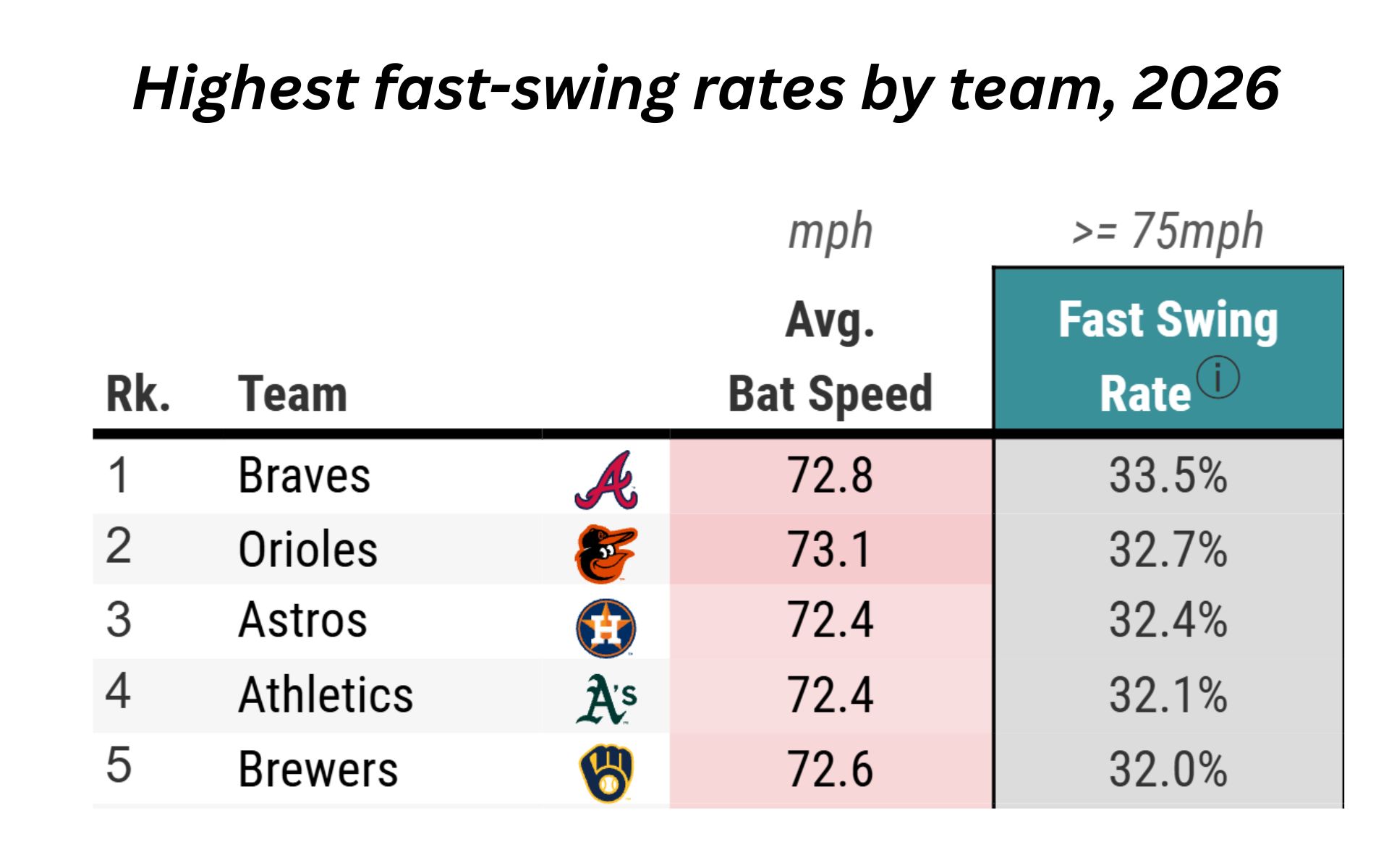
A “fast swing” is any swing with a bat speed of 75+ mph, and that’s not some arbitrary number. The difference between a “fast swing” and anything else is considerable. In 2026, fast swings produced a .308 BA and a .613 SLG.
We have Statcast bat-tracking data since the 2023 All-Star break. As a team, the Brewers have never swung faster than they are now. The last five months have produced the team’s five highest fast-swing rates under tracking. Only the Reds improved their fast-swing rate more from 2025 to 2026 than the Brewers (+8.4%).
This is not to say that the Brewers are suddenly the 2025 Blue Jays, who added a ton of bat speed to a contact-oriented profile that fueled a teamwide power surge. These teams are not really anything alike. Toronto emphasized bat speed as an organizational philosophy. Milwaukee operates differently.
“There’s a big difference between bat speed and hitting,” Brewers president of baseball operations Matt Arnold said in 2024. “You just have to be careful with that with hitters.”
Perhaps this is more important. Not only are the Brewers swinging some of baseball’s fastest bats, but they are also making flush contact. Squared-up rate shows which hitters get the most out of their bat speed by hitting the ball on the sweet spot of the bat. The Dodgers are the only team with a higher squared-up rate than the Brewers (33.7%).
The version of squared-up that requires elite bat speed is called blasts, and sure enough, the Brewers lead baseball in blasts per swing. In the chart below, you want to be in the top right quadrant -- faster swings and higher blast rates.
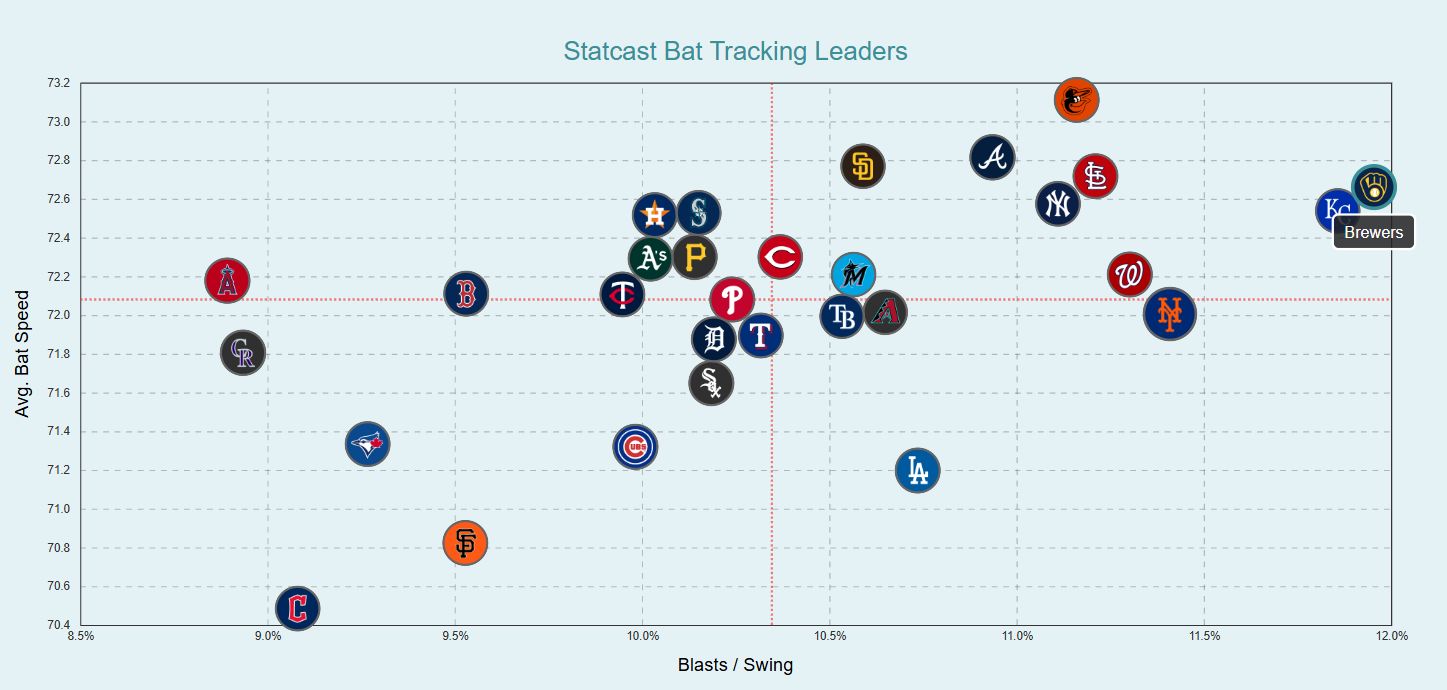
So, Milwaukee's hitters are swinging faster, and that bat speed is translating to higher exit velocities because they're making flush contact on the sweet-spot of the bat.
In 2025, the Brewers had the third-lowest average exit velocity (88.6 mph) and sixth-lowest hard-hit rate (39.3%) in baseball. They're one of just four teams to improve their hard-hit rate from 2025 to '26, with a 40.3% hard-hit rate that ranks seventh best. This isn't a massive improvement, but consider this: The league as a whole made worse contact this year than it did last year, with the hard-hit rate dropping from 41.0% to 38.7%. Yet, the Brewers got better.
That's how this year's offense is different. The Brewers hit the ball harder because they swing the bat faster while making flush contact, all against the backdrop of the game's reduced offensive output. That seems poised to help them in October.
Wait. How did this happen?
Ah, right. We should probably explain how the Brewers got from Point A to Point B.
“I think the bat speed is more of the result of a process than it is a target,” lead hitting coach Eric Theisen told MLB.com last week in the visitor’s dugout at Citizens Bank Park in Philadelphia. “There are so many factors, so many things that play into it.”
It is partially about personnel. Outfielder Garrett Mitchell and first baseman Jake Bauers swing two of the 15 fastest bats in the game, among qualified hitters. They combined to take over 800 more at-bats in 2026 than they did in 2025. In February, the Brewers also traded third baseman Caleb Durbin to the Red Sox, and while Durbin was a finalist for the NL Rookie of the Year Award, he also had sixth-percentile bat speed. But this is about existing players swinging harder more often, too.
Notable Brewers hitters to improve their fast-swing rate, 2025 to 2026
- Joey Ortiz: +9.1% (24.2% --> 33.3%)
- Jackson Chourio: +6.6% (39.9% --> 46.5%)
- William Contreras: +2.2% (34.9% --> 37.1%)
Swinging fast isn’t an organizational philosophy. But making good swing decisions is.
“You’re going to have a higher bat speed when you’re swinging at better pitches,” Theisen said. “I think, as a whole, our offense does a good job of that. Swinging at better pitches is going to be an indicator of getting better swings off and moving the bat faster. I think that’s where it starts.
“... Pitch selection is the foundation for what we do. When you get better pitches to hit, all those other things start falling into place.”
This season, the Brewers saw 3.97 pitches per plate appearance, which was tied with the Orioles for the most in the Majors. That’s largely because Milwaukee does not swing the bat. The Brewers’ 43.9% swing rate was the lowest by a team in a non-shortened season since the 2019 Angels.
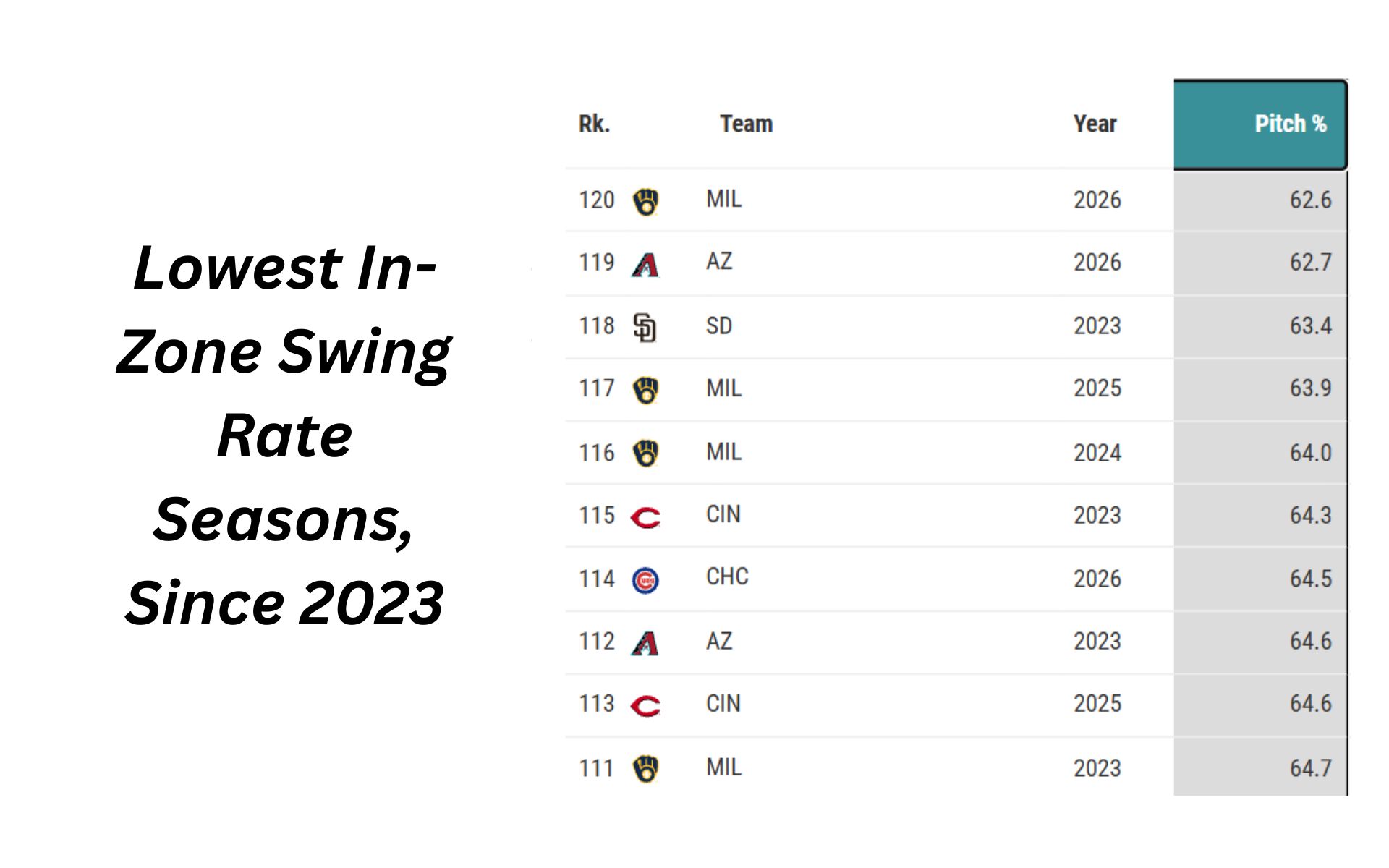
This is about not chasing outside the zone, but it's also about being selective in the zone, too. Milwaukee had the lowest swing rate on pitches in the strike zone for the third straight season. Sometimes, there’s a strike that’s not a great pitch to hit. It’s part of the reason why swing decisions are so complicated and nuanced.
“Takes are a part of training to help you get better at making decisions,” Theisen said. “In order to get better at anything, you have to do more of that thing. And you’ve got to be willing to be uncomfortable when you do that.”
When a batter swings at a pitch that he can do damage with, that’s likely going to be their ‘A’ swing, which is going to be fast. That’s why Theisen thinks the Brewers are swinging harder -- their swing decisions are better. It’s all very granular, but on a player-by-player basis, we can spot a few differences.
Take Joey Ortiz. A centerpiece of the return Milwaukee received from the Orioles for Corbin Burnes, Ortiz was the fourth-worst qualified hitter in a two-year span from 2025-26. This year, his 103 wRC+ renders him better than league average. That’s a huge leap. Ortiz’s swing rates have not changed much, but maybe his decisions have. For instance, he is swinging more frequently at pitches in the middle of the zone and above, which makes sense because Ortiz is a good high-ball hitter.
“You want to be aggressive to the things that you’re good at,” Ortiz said. “I haven’t really focused on [bat speed]. Those are metrics I don’t really think about. I just focus on if I’m hitting the ball hard, taking good swings, and swinging at the right pitches.”
The same goes for Jackson Chourio, the 22-year-old who ran a career-best 130 wRC+ in 2026. Only six qualified hitters cut their swing rate more this year than Chourio, a group that includes the Cubs’ Pete Crow-Armstrong and the Rays’ Junior Caminero. These are some of the best hitters in baseball.
This is about being patient, but not to a fault.
“We want to be aggressive, but we want to be aggressive to our pitch, and pitches that are good pitches to hit,” Theisen said. “As a group, we know that that’s a priority. It’s emphasized. And guys do a really good job of being stubborn and buying in and knowing that when they get good pitches to hit, they’re going to be the best version of themselves.”
It’s easier said than done, and the challenge will also be amplified in October, where that good pitch is often few and far between. But the Brewers are dug in. They are getting their ‘A’ swings off more often, and that just might make a difference over the next few weeks.