
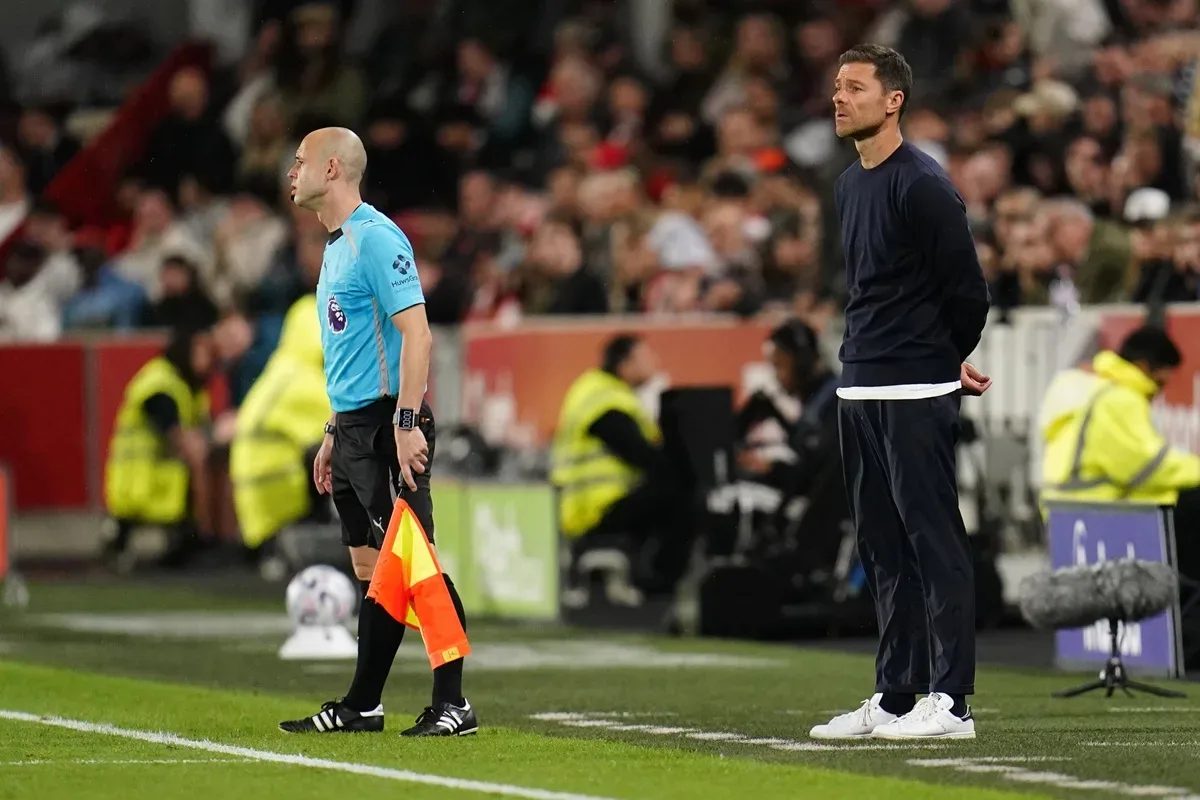
Xabi Alonso’s Bayer Leverkusen invincible campaign in 2023/24 marks the first time a team has gone unbeaten in German Bundesliga history. They set a historic record in European football by going 51 consecutive matches without a defeat. Though their legendary unbeaten run stopped in the Europa League final against Atalanta, their breathtaking journey will forever remain one of modern football’s greatest masterpieces.
Embed from Getty ImagesContinuing his managerial journey at Chelsea, Xabi Alonso had a decent start to his first Premier League campaign. The tactical system that once brought Bayer Leverkusen to tremendous heights is replicated. This lays the foundation for Chelsea’s new tactical identity, and what can be called the ”W-Mproject”. Xabi Alonso’s modern 3-4-2-1 structure transforms into a 3-2-2-3 shape, similar to Herbert Chapman’s legendary 1930s W-M formation.
This tactical analysis focuses on how the W-M system could be revitalised in the modern era. The analysis also highlights how the system could elevate Chelsea’s attacking play. Could Xabi become inspired by the former England manager Fabio Capello?
The rise, fall and comeback of the W-M system
The W-M formation is created when a line is extended between the five back players, similar to the letter W. A line between the five offensive players resembles an M. Arsenal’s Herbert Chapman became the most successful manager to use the W-M formation. While Arsenal were runners-up in the 1931/32 season, Chapman won the FA Cup in 1930, and the First Division in 1930/31 and 1932/33.
Chapman used a 3-2-2-3 tactical shape: three defenders locked down opponents, two wing-backs dominated the flanks, two central midfielders controlled the pitch centrally, and three players up front attacked in the penalty area. In 1925, the offside law changed, and required only two players to defend. Chapman’s tactical revolution included a third central defender, the stopper, who brought defensive stability. He also introduced counter-attacks that surprised opponents when attacking players quickly advanced with vertical passes.
Embed from Getty ImagesEventually, teams added another central defender to create a back four, and teams zonal-marked rather than man-marked. This extra defender and tactical shift provided permanent cover and made the old W-M attacking structure ineffective. For decades, teams lined up in different 4-4-2 shapes. England’s World Cup triumph in 1966 showed that Brazil’s 4-2-4 was easily exploited, and the 4-4-2 became the new standard. The Brazilian 4-2-4 had four attackers and focused on attacking. The English 4-4-2 was pragmatic, more balanced, and England’s manager, Alf Ramsey, inspired the world. The 4-4-2 became British football culture.
Meanwhile, Italian Catenaccio football valued the tradition of a back three. The tactical DNA of Italian football is rooted in Catenaccio, where teams from the 1960s to today use a man-marking system: two defenders, “stoppers,” follow opponents’ forwards, while a free defender, sweeper (libero), clears up behind them. In the early 2000s, Italian managers were widely regarded as some of the finest tactical minds in world football, with Fabio Capello standing out.
Before managing the English national team from 2007, legendary Fabio Capello made his name in Italy, at AS Roma, where he won the Scudetto in the 2000/2001 season. Known for his winning mentality, he also won the league several times with AC Milan (four titles), Juventus, and Real Madrid (two titles at each club). When England hired Fabio Capello, the goal was to win the prestigious World Cup. In 2010, Capello planned to use a 3-5-2 but managed a successful qualification campaign without changing formation.
While managing the English national team, he used a 4-2-3-1 in qualification games and a rigid 4-4-2 in the World Cup group and knockout phase. Critics voiced their concern over playing Steven Gerard on the left flank. Capello did not manage to play both Gerrard and Lampard in central midfield. Another concern was that Joe Cole, who had just won a domestic double with Chelsea and was considered one of England’s most creative players, was almost entirely ignored. If Capello had used a 3-6-1 formation, he could have played Gareth Barry as defensive anchor, Steven Gerrard as a box-to-box player, Frank Lampard, and Joe Cole/Jack Wilshere as double 10s behind Wayne Rooney. A back three of John Terry, Rio Ferdinand, and Ledley King/Jamie Carragher, with Ashley Cole and Glen Johnson/Gary Neville as wing-backs, could have been a winning team.
Embed from Getty ImagesDuring his career, Capello used different formations, and his management style meant adapting to the players’ profile and pragmatically using a structure that could fit their style of play. At Milan, he used a 4-4-2 that he inherited from legendary manager Arrigo Sacchi. Roma gave him room to experiment, and he chose 3-6-1 because they needed defensive stability, and five defenders could help the team increase their long-term resilience. Since pragmatism was a leading principle, Capello probably didn’t want to experiment too much with England’s squad.
“Every time I get new players, I evolve,” […] “You have to look closely at the players you have, analyse them and know how to bring the very best out of every single one. How do you do that? By finding a playing style, a system, that allows the players to produce their best”.
If Capello had elaborated on the 3-6-1 before the 2010 World Cup, he would have done far more than revitalise Herbert Chapman’s legendary W-M system on the international stage. Capello could have used his experience winning Serie A with Roma, where he used a 3-6-1 to balance defensive stability with creative, dual-playmaker magic. England’s ‘Golden Generation’ could have become an unstoppable winning machine capable of dominating international football.
Embed from Getty ImagesFrom England’s national team, Fabio Capello, and Chelsea’s creative Cole back then, to another magical Cole at Chelsea today, what insights from Capello’s Roma could Xabi Alonso use in the Premier League today?
How Xabi could unlock double 10s with Capello’s system
When Xabi Alonso used 3-2-2-3. He revitalised the WM system in a modern Premier League context: He faced the challenge of bridging the gap between Capello’s Italian pragmatism, Chapman’s counter-attacking, and his own possession-oriented style of play. While Chapman used a deep defensive block and vertical long balls in the 1930s, Capello used a rigid Italian shield to unleash individual playmakers such as Francesco Totti and Antonio Cassano in the 2000s. Xabi integrated both into his system and added fluid, short-passing positional play to control the game’s rhythm. Xabi’s W-M system is a modern tactical masterpiece built on balance between attacking creativity and defensive solidity. At the same time, insights from Capello’s Roma era could elevate his current Premier League campaign.
Executing the 3-6-1 system
The first insight is that Xabi Alonso failed campaign at Real Madrid was mostly because he used 4-2-3-1 or 4-3-3, which he didn’t fully believe in. This mirrors Capello’s failed World Cup with England, when he abandoned his 3-5-2 formation and got stuck with several tactical dilemmas, such as playing Gerrard on the left flank. At Chelsea, Xabi was allowed to sign players that could fit his preferred system. Xabi signed Morgan Rogers as an attacking midfielder, and he plays alongside Cole Palmer, an attacking playmaker, and together they are double 10s. Xabi believes in the system, but to unlock the Premier League’s low defensive blocks, attacking play needs to be unpredictable.
The art of tactical unpredictability
The second insight is highlighting unpredictability, changing the attacking shape, and rotating creative players up front. Roma had strong personalities who sometimes disrupted squad harmony. Capello managed the pressure and stood out at Roma as a tactical mastermind. He used a 3-4-1-2 formation that shifted into a 3-6-1 or a 3-5-1-1. Capello played with two offensive midfielders, Francesco Totti and Antonio Cassano, behind a striker, either Gabriel Batistuta or Vincenzo Montella. Totti and Cassano were a creative duo, double 10s, focused on unlocking Italian low blocks. Totti elaborated on his and Cassano’s tactical role under Capello:
“Under Capello, when I played with Cassano, we were often strikers on paper but playing as attacking midfielders — given licence to move in a free role.”
Capello adjusted the formation and sometimes played a 3-5-1-1 formation, rotating Gabriel Batistuta and Vincenzo Montella as the striker in front of Totti or Antonio Cassano. To use this insight, Xabi Alonso could rotate Estevao Willian consistently as an attacking player. He is a high-impact substitute, but also one of the best talents worldwide. Xabi could rotate Rogers or Palmer and frequently start with Estevao. To be more unpredictable, Xabi could use 3-5-1-1, more often playing Estevao as a second striker behind João Pedro to create a magical Brazilian attacking duo.
Strengthen the defensive shield
The third insight highlights defensive solidity to unleash creative players up front. To grant creative players complete freedom in attack, the wing-backs must have strong defensive ability and stamina. Capello used energetic, dynamic players, primarily Cafu and Vincent Candela, who dominated the flanks in Serie A – in the 2000s probably the best league in the world. Damiano Tommasi was a tireless ball-winner and predecessor to Gennaro Gattuso’s aggressive style. He played alongside Emerson, a powerhouse and long-standing defensive midfielder for the Brazilian national team.
Chelsea’s wide players Pedro Neto and Malo Gusto are not traditional wing-backs. Neto is a natural attacking winger converted into a wing-back, while Gusto mostly played in a back-four before Chelsea. Without key player Marc Cucurella, who signed for Real Madrid, and without traditional wing-backs, Chelsea’s weakness is covering the flanks defensively. Another key player, Enzo Fernandez, left for Manchester City, which leaves central midfield vulnerable. The 36-year-old Jordan Henderson is still going strong but is a short-term alternative. Reece James often plays in central midfield and is defensively strong but naturally a right fullback. Caicedo is a key player, and the question is whether this duo is dynamic enough.
Reaching a top position in the Premier League and competing in the Champions League demands a far higher level in central midfield. To truly elevate the W-M project, Xabi needs central midfielders that can lock down transitions defensively. They also need to be press-resistant enough to play through a high-intensity press and help Palmer dictate the game’s rhythm. This could be too much for a converted fullback and a pure ball-winner to handle.
Chelsea’s rebuild this season included world-class goalkeeper Emiliano Martinez and defender Maxence Lacroix, who will bring stability and experience from the Argentinian and French national teams. But Maxence Lacroix, Levi Colwill, and Wesley Fofana often lack coordination positionally, especially in transition. This trio remains a critical weak link when forced to defend quick transitions and 1v1s against top teams in the Premier League and elite European opposition.
Leading the Superstars
The fourth and final insight is that without a strong defensive foundation, the attacking game will fail. If Chelsea constantly concedes goals, players will get frustrated. Alonso’s squad is full of strong personalities that are challenging to handle under pressure. If the defence breaks down, these players will lose faith in the system. Despite locker-room instability, Fabio Capello’s success at Roma were sustained by strong leadership.
Embed from Getty ImagesNo system is universally superior, and football is a game of creative chess where specific tactical combinations maximise players’ strengths, minimise their weaknesses, and create the flow to win games. However, it’s still too early to judge whether Xabi Alonso’s system will bring lasting success to Chelsea.
What do you think about the evolution of the W-M system?
Will Xabi Alonso’s Chelsea campaign be successful?

World In Sport Forum
Continue the discussion
Join other fans in the World In Sport Forum and debate the biggest talking points from this article.