
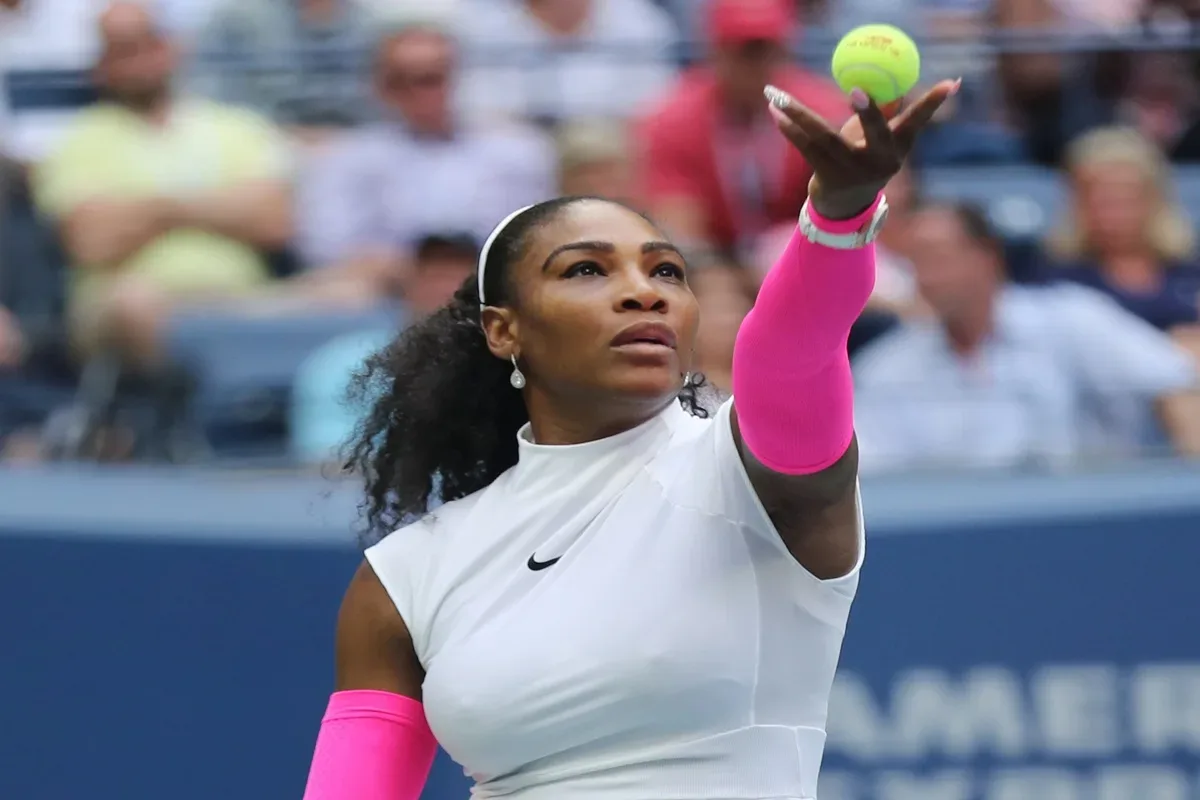
Serena Williamsâ career includes 23 Grand Slam singles titles, 319 weeks as world No. 1, four Olympic gold medals and 73 WTA singles titles. Her powerful serve, aggressive returns and sustained success across surfaces and generations reshaped womenâÂÂs tennis.
The profile follows her rise from public courts in Compton, partnership with Venus Williams, major health setbacks and 2017 Australian Open triumph. It also covers her 2022 departure from tennis and return to professional competition in 2026.
Serena Williams built a tennis career around power, precision and an ability to keep succeeding across different eras of the womenâÂÂs game.
Her 23 Grand Slam singles titles remain the Open Era record for a woman. She spent 319 weeks as world No. 1, won four Olympic gold medals and collected 73 WTA singles titles. Alongside Venus Williams, she also became one of the most successful doubles players of her generation.
Those numbers only explain part of her significance.
Williams helped change the physical demands of elite womenâÂÂs tennis. Her serve became one of the most reliable attacking weapons the sport had seen, while her return game allowed her to take control of points almost immediately. She also sustained that level over more than two decades.
Even the apparent end of her career proved temporary. After stepping away following the 2022 US Open, Williams returned to professional competition in 2026 at the age of 44.
For readers following the modern game, World in SportâÂÂs wider tennis coverage tracks the Grand Slams, WTA Tour and the players now competing in the era Williams helped shape.
From Saginaw to the courts of Compton
Serena Jameka Williams were born on 26 September 1981 in Saginaw, Michigan, to Richard Williams and Oracene Price. The family later moved to Compton, California, where Serena and her older sister Venus learned the sport on public courts.
Richard studied the game and took a leading role in coaching both sisters. Rather than following a conventional junior pathway, the family limited their exposure to the junior circuit and focused heavily on development.
In 1991, the family moved to Florida, where Serena and Venus trained at Rick MacciâÂÂs academy. Their route into elite tennis remained unusual, but the technical foundations were becoming clear. Serena developed the serve, explosive movement and aggressive groundstrokes that would later define her game.
She turned professional in 1995. Her first WTA qualifying appearance came in Quebec City, although age restrictions meant opportunities were initially limited.
By 1997, the wider tennis world had started to take notice. In Chicago, the 15-year-old defeated Mary Pierce and Monica Seles during a run to the semi-finals. She ended that season inside the worldâÂÂs top 100.
The transition from prospect to major champion did not take long.
Embed from Getty ImagesThe first Grand Slam breakthrough
Williams won her first WTA singles title in Paris in 1999.
Later that year, she produced the result that established her among the leading players in the sport.
At 17, Williams won the US Open singles title. She defeated Martina Hingis in the final after also beating several elite opponents during the tournament. It was the first of what would eventually become 23 Grand Slam singles titles.
That victory mattered beyond the trophy itself.
Williams already possessed exceptional power, but her game was more complete than the simple description of a power player suggested. She could defend, change direction quickly and turn neutral rallies into attacking opportunities within one or two shots.
Her return of serve became especially important. Against weaker second serves, she regularly stepped inside the baseline and removed time from her opponent.
The combination made her difficult to contain on every surface.
The first Serena Slam and rise to world No. 1
The 2002 season moved Williams into another category.
She won Roland Garros, Wimbledon and the US Open in succession. Venus stood across the net in each final.
Williams then defeated her sister again in the 2003 Australian Open final. That gave her four consecutive major titles across two seasons â a sequence that became known as the âÂÂSerena SlamâÂÂ.
She first reached world No. 1 in July 2002.
Her run was significant because it demonstrated that her game travelled. Clay demanded patience and movement. Grass rewarded the serve and first strike. Hard courts required a mixture of both.
Williams could succeed under all three sets of conditions.
World in SportâÂÂs guide to tennis court surfaces explains why those differences normally require players to make substantial tactical adjustments.
Williams did not need to play the same way everywhere. On quicker courts, she could shorten rallies with her serve and return. On slower courts, her weight of shot, defence and ability to redirect the ball still provided routes to victory.
Success was not uninterrupted.
Knee surgery in 2003 kept her out for eight months. Further physical problems restricted her schedule during later seasons. Yet she repeatedly returned to the top level rather than allowing one dominant period to define her career.
What made Serena Williamsâ playing style so effective?
The serve formed the foundation.
Williams combined speed with placement and disguise. The ball toss gave opponents little advance information about direction, while her ability to find wide angles or attack down the middle made it difficult for returners to commit early.
Her second serve also mattered. Although double faults could appear during difficult periods, she generally possessed enough pace and spin to stop opponents from attacking freely.
Then came the return.
Williams could stand aggressively against second serves and strike through the ball early. That placed immediate pressure on opponents who knew that a slightly weaker service game might disappear quickly.
From the baseline, she used a two-handed backhand and a powerful forehand. Her movement allowed her to defend when required, but the main objective was usually to change the balance of the rally rather than simply stay in it.
That aggression carried risk. When timing deserted her, errors could accumulate.
At her best, though opponents had very little time to settle.
Championships across three decades
Williamsâ major-title record eventually reached 23.
She won seven Australian Opens, three Roland Garros titles, seven Wimbledon championships and six US Opens. Her victories stretched from the 1999 US Open to the 2017 Australian Open.
| Career achievement | Total | Detail |
|---|---|---|
| Grand Slam singles titles | 23 | Open Era womenâÂÂs record |
| Grand Slam womenâÂÂs doubles titles | 14 | All won with Venus Williams |
| Grand Slam mixed doubles titles | 2 | Wimbledon and US Open in 1998 |
| WTA singles titles | 73 | Won across more than two decades |
| Weeks at world No. 1 | 319 | Includes 186 consecutive weeks |
| Olympic gold medals | 4 | One singles and three doubles |
Career-title figures current to 20 September 2026.
She also held the No. 1 ranking for 186 consecutive weeks between 2013 and 2016, matching Steffi GrafâÂÂs record for the longest uninterrupted spell at the top of the WTA rankings. Her 319 total weeks at No. 1 place her behind only Graf and Martina Navratilova in the womenâÂÂs rankings era.
For newer followers of the sport, World in SportâÂÂs guide to ATP and WTA rankings explains how ranking points and tournament results determine the world order.
Olympic success and doubles with venus
SerenaâÂÂs partnership with Venus added another dimension to both careers.
Together, the sisters won 14 Grand Slam womenâÂÂs doubles titles. They never lost a Grand Slam doubles final, finishing 14-0 in those championship matches.
They also won Olympic doubles gold in Sydney in 2000, Beijing in 2008 and London in 2012.
Serena added the singles gold medal at London 2012, defeating Maria Sharapova 6-0, 6-1 in the final on WimbledonâÂÂs Centre Court. That completed a career Golden Slam in singles: all four majors plus Olympic gold.
She ultimately achieved a career Golden Slam in both singles and doubles, a distinction the WTA records as unique.
Embed from Getty ImagesHealth setbacks and another dominant run
Williamsâ longevity becomes clearer when placed beside the interruptions.
After a serious foot injury in 2010, she suffered a pulmonary embolism and was hospitalised. She returned to Grand Slam tennis at Wimbledon in 2011 after almost a year away.
The comeback developed into another of her strongest periods.
She won Wimbledon, the US Open and Olympic singles gold in 2012. The following year, she produced a 78-4 record and won 11 titles, including Roland Garros and the US Open.
Williams then constructed a second Serena Slam.
Beginning with the 2014 US Open. She won four consecutive majors through Wimbledon in 2015. She entered that yearâÂÂs US Open with the possibility of completing the calendar Grand Slam, but Roberta Vinci beat her in the semi-finals.
The defeat ended the calendar-year attempt, but not her run at the top.
Williams won Wimbledon again in 2016 to reach 22 Grand Slam singles titles, drawing level with GrafâÂÂs Open Era record at the time.
Then came Melbourne in 2017.
A 23rd major at the Australian Open
Williams arrived at the 2017 Australian Open chasing the outright Open Era record.
She did not drop a set.
In the final, she defeated Venus to claim her seventh Australian Open title and 23rd major singles championship. Williams later revealed that she had been pregnant during the tournament.
It remains her most recent Grand Slam singles title.
After giving birth later that year and experiencing serious health complications, Williams returned to professional tennis in 2018.
She reached four more Grand Slam singles finals: Wimbledon and the US Open in 2018, followed by the same two finals in 2019. She did not win any of them, leaving her on 23 rather than drawing level with Margaret CourtâÂÂs overall mark of 24 major singles championships.
That distinction remains important when discussing the records. Williams hold the Open Era womenâÂÂs singles record. CourtâÂÂs 24 includes titles won before the Open Era began in 1968.
Stepping away â And coming back
The 2022 US Open initially appeared to mark the end.
Williams beat Danka Kovinic and world No. 2 Anett Kontaveit before losing to Ajla Tomljanovic in the third round. She had described her decision as âÂÂevolving awayâ from tennis rather than simply retiring.
For almost four years, that looked like the final chapter.
It was not.
Williams returned to professional competition at QueenâÂÂs Club in June 2026, partnering Victoria Mboko. They defeated third seeds Nicole Melichar-Martinez and Erin Routliffe before MbokoâÂÂs knee injury ended their tournament.
A doubles appearance in Berlin followed before Williams accepted a Wimbledon singles wild card.
Her first singles match since 2022 ended in a 6-3, 6-7 (6), 6-3 defeat to Maya Joint on Centre Court. Williams remained competitive over three sets, although a knee problem subsequently forced her to withdraw from the Wimbledon doubles event with Venus.
World in Sport covered that return in its report on Wimbledon day two.
The sisters reunited in Cincinnati in August and then appeared together at the US Open.
Serena also partnered Carlos Alcaraz in the 2026 US Open mixed doubles competition before joining Venus in the womenâÂÂs doubles draw. Hao-Ching Chan and Maya Joint beat the sisters 6-3, 6-7 (6), 7-6 (7) in a first-round match lasting just over three hours.
As of 20 September 2026, that US Open doubles match is SerenaâÂÂs most recent recorded professional appearance.
Embed from Getty ImagesSerena Williamsâ place in tennis history
Williamsâ legacy does not depend on turning her career into an argument over one statistical record.
The broader picture is substantial enough.
She won majors as a teenager and after turning 35. She became world No. 1 for the first time in 2002 and held the ranking for the final time in 2017, when she became the oldest woman to occupy the top position.
She won major titles on grass, clay and hard courts. She recovered from lengthy injuries and serious health problems. She combined one of the best serves in womenâÂÂs tennis with an aggressive return game and baseline power that influenced how elite players approached the sport.
Her impact also extended beyond results.
The visibility of Serena and Venus, two Black sisters who developed initially on public courts in Compton, widened ideas about who could reach the highest level of professional tennis. The USTA has credited the sisters with helping increase the sportâÂÂs reach and diversity.
The 2026 comeback has added an unexpected final section to the story. It does not need to produce another major championship to alter the achievements that came before it.
Twenty-three Grand Slam singles titles, 319 weeks at No. 1, four Olympic gold medals and success across different generations already provide the foundation of Serena Williamsâ career.
What remains open is simply how much more competitive tennis she wants to play.

World In Sport Forum
Continue the discussion
Join other fans in the World In Sport Forum and debate the biggest talking points from this article.