
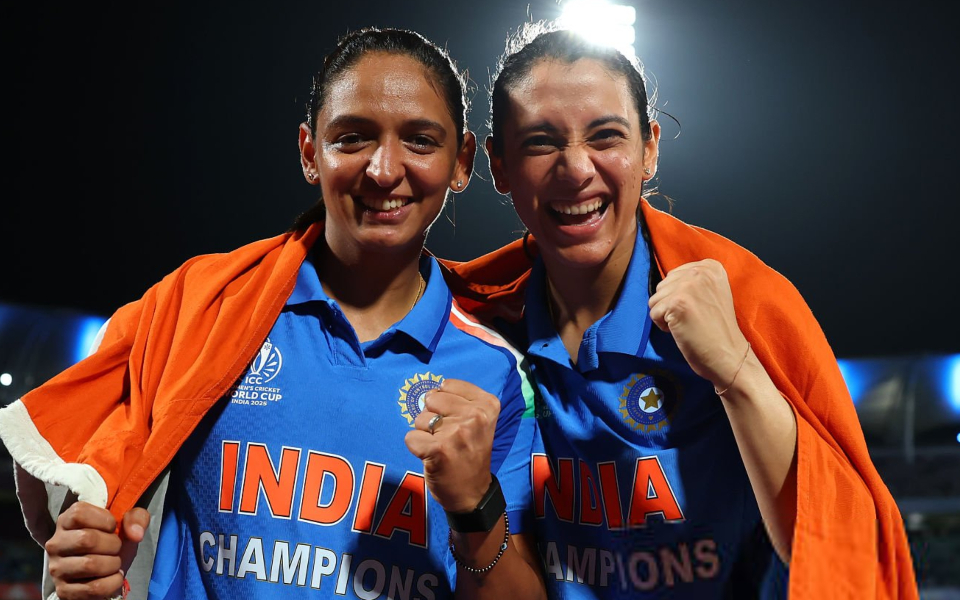
A team source has confirmed that the captaincy dispute created unease in the Indian women's dressing room before Harmanpreet Kaur stepped down.
Smriti Mandhana has been appointed as the new captain of the Indian women's cricket team following Harmanpreet Kaur's resignation from the position across all formats. The transition, however, has not been without friction. A team source has confirmed that the captaincy had become a point of serious tension between the two senior players.
Harmanpreet, 37, who hails from Moga and first led India in 2016, stepped down after a review meeting with the BCCI. She ended her leadership tenure having just captained India to a second consecutive Asian Games gold in Japan. The decision to step down came after it was made clear to her at the review meeting in Guwahati, chaired by BCCI Secretary Devajit Saikia, that a change of guard was inevitable.
"They were not seeing eye to eye for a while now and that led to an obvious unease in the dressing room," the team source was quoted as saying by India Today.
Why was Mandhana seen as the obvious choice to succeed Harmanpreet?
Mandhana, who made her international debut in 2013, has established herself as one of the leading batters in women's cricket. The 30-year-old left-handed opener has accumulated more than 10,000 runs across formats and has been widely regarded as India's best batter by a considerable margin.
It was no secret that Mandhana had grown impatient with the selectors, who maintained the status quo on captaincy even after India ended their ICC trophy drought by winning the ODI World Cup at home. In a recent interview, she had expressed her readiness to lead the side. After India's Asian Games gold, she also stated that the team should be targeting bigger tournaments. In between those highs, India made premature exits from back-to-back T20 World Cups, which raised questions over the leadership, particularly in the shortest format.
Former India captain Mithali Raj had spoken after India crashed out of the T20 World Cup in the United Kingdom earlier this year, questioning Harmanpreet's form and fitness and arguing that the selectors should have elevated Mandhana two or three years earlier.
"I thought she would be given the captaincy of the ODI format two-three years back. She can still be the ODI and Test captain and the T20 captaincy could be given to someone younger like Shafali (Verma)," Mithali had said.
What does Harmanpreet's continued presence as a player mean for team dynamics?
Harmanpreet has indicated that she intends to continue as a player for the next two or three years. This means the two senior players will share the dressing room, with Mandhana now holding the captaincy that was previously a source of friction between them.
This is not the first time the selectors have faced criticism over a leadership transition in the Indian women's team. When Harmanpreet took over the ODI captaincy from Mithali following the 2022 World Cup, relations between the two veterans were reported to be at an all-time low, and that episode caused factionalism within the squad.
While India performed strongly in the recent Asia Cup and the Asian Games, Harmanpreet was not at her best with the bat during those campaigns. As a specialist batter in the side going forward, the expectations on her individual performance are expected to rise. Whether Harmanpreet and Mandhana can set aside their differences for the team's benefit remains an open question.