
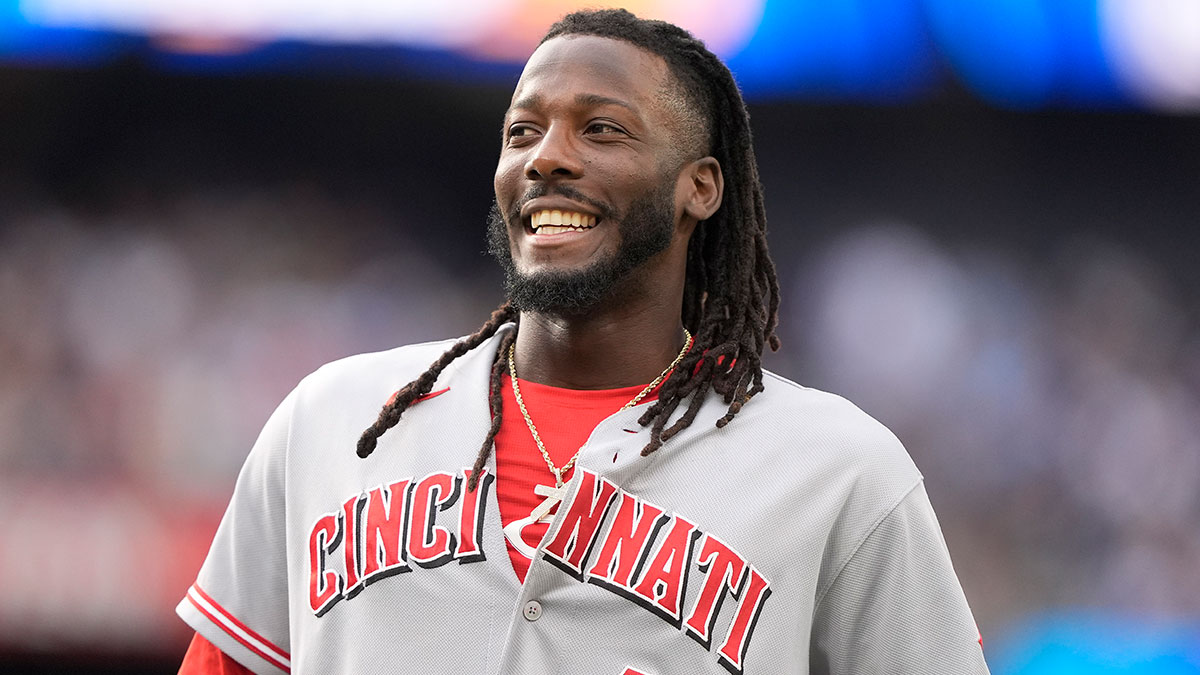
The Boston Red Sox should pursue Elly De La Cruz with an offer substantial enough to give the Cincinnati Reds a difficult decision. Franklin Arias, Payton Tolle, and Justin Gonzales would provide a potential shortstop successor, an established young starter, and another promising bat.
The Athletic's Jim Bowden identified De La Cruz as a potential target in his assessment of Boston's offseason plans.
“The Red Sox will also continue to call the Nationals regarding a possible CJ Abrams trade and the Reds if Cincinnati decides to move Elly De La Cruz. Either way, expect them to be aggressive with the aim of adding at least a bat or two.”
The assessment does not establish the Reds intend to trade their star. The following package is an editorial proposal, not a reported offer or an established asking price.
Hypothetical trade
Red Sox receive Elly De La Cruz
Reds receive Franklin Arias, Payton Tolle and Justin Gonzales
Why Elly De La Cruz fits Boston's future
The Red Sox scored 689 runs in 2026, ranking 23rd in the majors. De La Cruz would address that weakness after hitting .283 with a .365 on-base percentage, .515 slugging percentage, 30 home runs and 30 stolen bases.
At 24, the switch-hitter offers more than an immediate boost. His remaining control through 2029 would give Boston three seasons to build around him before free agency, making a substantial investment more defensible than surrendering premium talent for a rental.
The clearest defensive plan would put De La Cruz at shortstop and explore moving Trevor Story to second base. Story's previous experience there makes that a practical option, although Boston would need to evaluate how the change affects its other infield options.
Story's contract runs through 2027 with a club option for 2028. Acquiring De La Cruz would address Boston's longer-term shortstop outlook while immediately strengthening the lineup.
The Red Sox would be paying for established production during a player's prime. However, Arias could become an excellent major league shortstop himself. Trading him would mean choosing De La Cruz's demonstrated ability over the possibility of developing a less expensive alternative.
Why the Reds should consider this return
The Reds finished the 2026 season 75-87 and last in the National League Central. That record creates reason to reconsider the roster's construction, but it does not make trading De La Cruz necessary.
Arias supplies the potential successor. The 20-year-old ranks second overall on MLB Pipeline's prospect list after batting .323/.400/.557 with 25 home runs between Double-A and Triple-A in 2026.
Those results give the Reds a plausible path to introducing him in 2027. They do not guarantee an immediate replacement for De La Cruz. Cincinnati would need to judge his readiness rather than force a timetable to justify the trade.
Tolle gives the package something more concrete. The 24-year-old left-hander went 9-6 with a 3.03 ERA and 171 strikeouts across 148 2/3 major league innings in 2026.
Hunter Greene's second Tommy John surgery makes another effective starter particularly valuable, with his recovery likely costing him the 2027 season. Tolle could strengthen the rotation immediately while contributing beyond that injury absence.
Gonzales adds another potential everyday hitter. The 19-year-old outfielder, Boston's second-ranked prospect, reached Double-A during a season in which he hit 19 home runs with an .834 OPS across two levels.
His development remains unfinished. Cincinatti would acquire another opportunity to build offensive depth, rather than a guaranteed starting outfielder.
Article Continues BelowTogether, the three players would offer different paths to improving the Reds' future. Tolle already has major league success, Arias is approaching that level, and Gonzales offers a longer development timeline.
Boston must account for losing Payton Tolle
The Red Sox cannot treat Tolle as expendable. His departure would create a substantial rotation opening, and retaining other starters would not automatically replace his production.
Boston should complete this deal only alongside a credible plan to restore those innings. Another acquisition or a justified internal promotion could help, but simply counting available arms would undersell his contribution.
Cincinnati faces an equally important calculation. De La Cruz remains under control for three seasons, so keeping him and improving his supporting cast remains a legitimate alternative.
Neither side should mistake a compelling framework for a guaranteed agreement.
This offer deserves consideration because it gives both clubs a defined direction. Boston would acquire an offensive centerpiece for multiple seasons. The Reds would receive a potential shortstop successor, an effective young starter and another promising bat. The package could improve both outlooks, provided each organization accepts the talent and certainty it would surrender.