
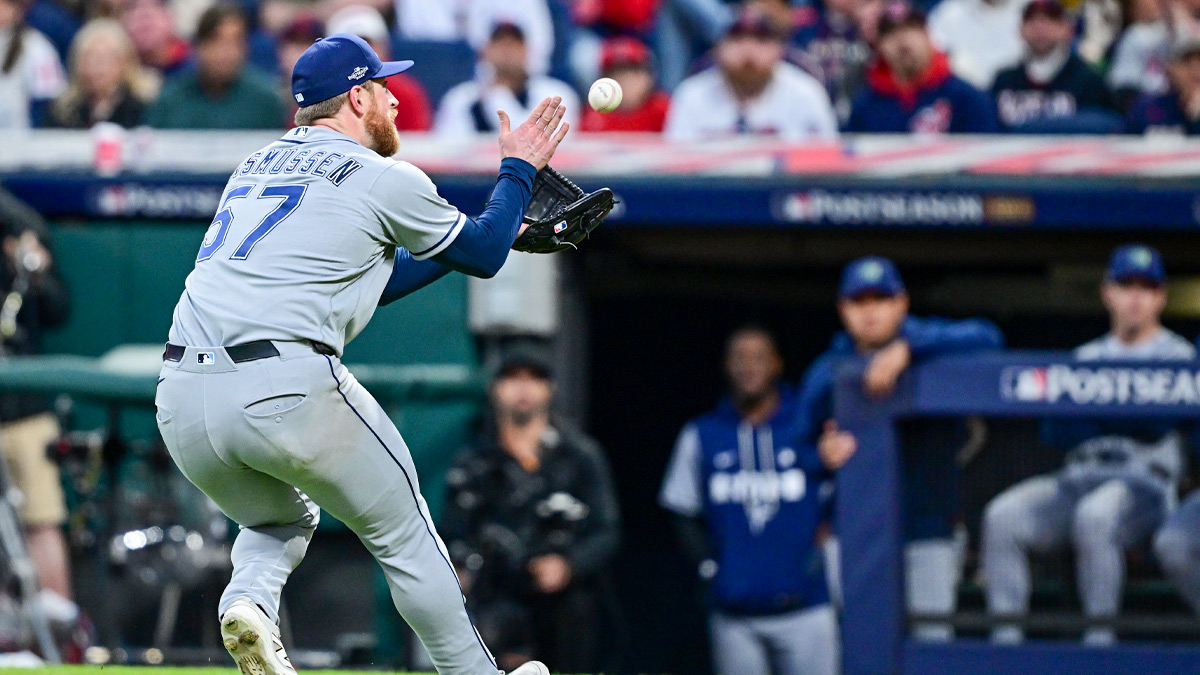
The Tampa Bay Rays must avoid pulling effective starters too early when the 2026 World Series begins Friday against the Milwaukee Brewers. Turning to the bullpen simply because the lineup turns over could undermine one of Tampa Bay’s greatest strengths.
Manager Kevin Cash should have relievers ready, but each pitching change must account for the starter’s command, workload and upcoming matchups.
As the Rays open Game 1 at American Family Field, Cash’s priority should be identifying the pitcher best equipped to get the next out.
Their recent performances offer a compelling starting point.
Drew Rasmussen threw eight scoreless innings against the New York Yankees in the ALDS opener. He followed with seven innings of one-run ball against the Cleveland Guardians in ALCS Game 5.
Freddy Peralta earned ALCS MVP after allowing one run across 12 innings.
Those outings demonstrate that Cash already trusts his starters to deliver length. The danger would be abandoning that approach under World Series pressure.
Tampa Bay should preserve the option to ride an effective starter while preparing alternatives for specific threats. That requires evaluating how he is pitching, rather than treating his earlier success as either irrelevant or a guarantee.
A starter who continues locating his fastball, landing secondary pitches and avoiding dangerous contact deserves consideration for another inning.
That does not establish an automatic right to stay in. It establishes a reason to compare him carefully with the reliever warming behind him.
The Brewers can make that comparison uncomfortable.
Jake Bauers drew a 12-pitch walk in NLCS Game 2 and hit an 11-pitch home run in Game 3. Those battles illustrate the cost of repeatedly failing to finish hitters.
A pitching change cannot guarantee an escape from that problem. A fresh reliever still must throw strikes and put Milwaukee away.
Rays must avoid pulling effective starters too early
The potential mistake becomes clearer in a hypothetical sixth inning. Suppose Rasmussen holds a narrow lead, maintains his command and has a manageable pitch count.
If the next hitter's handedness is the primary argument for removing him, Cash should ask whether the replacement improves Tampa Bay's chances. The answer depends on the individual matchup, the starter's condition and the available alternatives.
It cannot come from handedness alone.
Nor should this argument dismiss the Rays' bullpen. Bryan Baker has allowed one hit across seven scoreless postseason innings. Tampa Bay has legitimate reasons to trust its relief options.
The issue is when to use them.
An unnecessary early change could require another reliever later, reduce tomorrow's availability or expose an arm to the same hitters again as the series progresses.
Article Continues BelowThose possibilities matter most when the starting pitcher remains capable of handling another segment of the lineup.
However, preserving bullpen innings must remain secondary to winning the game in front of Cash. A starter losing velocity, missing repeatedly or allowing increasingly dangerous contact should prompt action.
A scoreless line can hide deterioration. Equally, a clean single does not automatically establish that a pitcher has lost effectiveness.
Cash needs to distinguish those situations while respecting workload restrictions and each pitcher's health.
The recommendation is straightforward. Build the pitching plan around current effectiveness, preparation and the specific opponent. Keep the bullpen active enough to respond before a manageable situation becomes a damaging rally.
The Rays cannot control whether every sound decision produces a favorable result. They can control whether their reasoning accounts for the pitcher actually standing on the mound.
Against the Brewers, surrendering effective outs could prove costly. Tampa Bay cannot afford to let an unnecessary pitching change become the difference between winning a World Series championship and watching Milwaukee celebrate.