
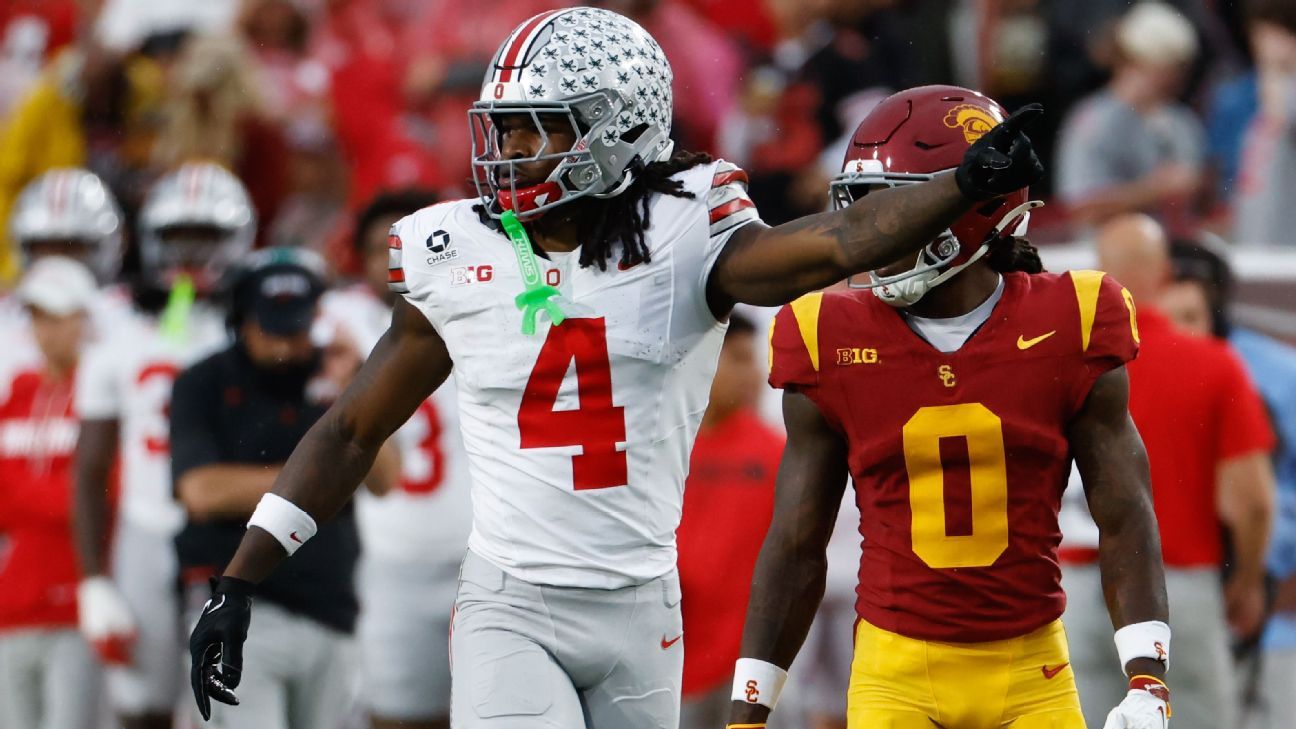
The first two months of the college football season were messy and increasingly chaotic. Week 9 was no exception, though a lot of its surprises were either (A) games that were projected to be close but were blowouts instead or (B) close calls for top teams.
No. 1 Miami (tight win over North Carolina), No. 4 Indiana (overtime win over Minnesota) and No. 8 BYU (tight win over Arizona State) all fit the latter category. Other than USC knocking off a wounded Ohio State, the underdogs couldn't quite get it done against the top teams this time around.
But forget all that -- it's November now. Virtually everything we eventually remember about the 2026 season will happen from this point forward. And with the first College Football Playoff rankings of the season coming out Tuesday, let's spin this forward a bit with help from some playoff tiers.

Playoff tiers
Using a combination of the Allstate Playoff Predictor and odds driven by my SP+ rankings, we can pretty easily bunch teams into groups of playoff likelihood. (I like creating an average of the two sources because it smooths out some of the rough edges in both models.)
Tier 1
Miami (8-0, 98.3% average playoff odds)
It only briefly felt like Miami was in true danger against North Carolina on Saturday night: The Tar Heels took the lead early in the fourth quarter before Miami responded with a nine-play TD drive, recovered a fumble and scored again. The response to adversity was strong, just as it was a couple of weeks ago against Florida State.
The Hurricanes have underachieved defensively for three straight weeks, however, allowing 31 points per game and forcing their amazing offense to be amazing at all times. Defense is why they're projected underdogs at Notre Dame this coming weekend, but while it might be a fatal flaw as far as winning the national title goes, it hasn't prevented them from all but locking up a CFP spot. They would have to lose to Notre Dame and then potentially lose two of their last three after that to miss out. All three of those games are at home, and the Canes are currently projected favorites of at least 17 points in each. They're likely still in with a 10-2 record, and SP+ gives them only a 1% chance of finishing the regular season 9-3 or worse.
Tier 2
Indiana (8-1, 89.2%)
Notre Dame (7-1, 86.4%)
Utah (8-0, 85.6%)
Georgia (7-1, 84.7%)
Based on these odds, about 3.5 of these four teams will make the CFP. They're all in pretty good shape but still have to finish the job.
For Indiana, that means figuring out a sudden QB crisis. Josh Hoover has completed just 16 of 37 passes in his past two games while battling arm issues, and he hasn't completed more than 55% of his passes in a game since Oct. 3. He evidently picked up another knock in the first half of the Hoosiers' overtime win over Minnesota, and backup Grant Wilson had to come in to save the day. He wasn't amazing (9-for-17 for 156 yards and a touchdown), but he was a massive improvement over Hoover.
Curt Cignetti and offensive coordinator Mike Shanahan now have a much-needed bye week to either get Hoover healthy and back on track or officially switch to Wilson. They barely escaped Week 9 with an 8-1 record, and while they're projected double-digit favorites in each of their three remaining games, they were nearly three-touchdown favorites against Minnesota, too.
For Notre Dame, that means better starts. In the Fighting Irish's loss at BYU, they trailed 21-10 at halftime; on Saturday against Navy, they got sliced up by the Midshipmen's offense in the first half and trailed 13-7 after 29 minutes before finally finding the accelerator. A slow start against Miami could be devastating with the way the Hurricanes can pile on points, and it could leave them vulnerable to upsets against SMU and Syracuse. They should still get into the CFP at 10-2 but almost certainly not at 9-3.
For Utah, that means going 1-1 over the next two games. Granted, the Utes might still get in at 10-2, but if they can beat either BYU at home or Arizona in Tucson, they'll have both a quality win and a very good shot at finishing the regular season 11-1. The Utes were unreal in the first half against Cincinnati on Saturday, scoring touchdowns on all four offensive drives and scoring a pair of defensive touchdowns as well (a Rabbit Evans fumble return and an Elijah Davis pick-six). Against the team that had just beaten Texas Tech, they led 42-6 at halftime. (The Utes fell asleep a bit in the second half, but that's forgivable.) Anytime they're that aggressive and effective, they'll win.
For Georgia, that means keeping the turnovers in check. After two more against Florida, the Bulldogs have fumbled eight times in their past three games and 15 times for the season, and while it's basically their only weakness, it contributed to their loss to Auburn and could obviously bite them again in upcoming games at Ole Miss and South Carolina and at home against Missouri. If the Dawgs go 2-1 in that stretch, their playoff spot is nearly set. So stop dropping the damn ball.
Tier 3
UCLA (8-0, 71.2%)
Ohio State (6-2, 68.6%)
Wake Forest (7-1, 65.4%)
On average, about 2.1 of these three teams make it. That means, of course, that about one won't. And as strange as this sounds, the blue blood is probably the most vulnerable. In Ohio State's first game after losing quarterback Julian Sayin to injury, the Buckeyes ran the ball pretty well against USC and got a decent performance from freshman Luke Fahey. But they kept settling for field goals, and their defense allowed 6.8 yards per play and three touchdowns to a Trojans offense that got humbled by Wisconsin last week.
USC was the first of five straight SP+ top-30 opponents the Buckeyes will face to end the regular season, likely all without Sayin, and when the defense needed to step up a bit to help out the offense, it couldn't do it. That's pretty foreboding.
The other two teams in this tier continued to look the part Saturday. UCLA handled Nevada with ease, pitching a 27-0 shutout and moving up to fourth nationally in fewest points allowed per drive. (Yes, the Bruins were playing Nevada, but hey, at 93rd in SP+ the Wolf Pack aren't that far behind three of UCLA's recent Big Ten opponents -- Purdue, Maryland and Michigan State.) They're projected favorites in each of four remaining regular-season games, and while games against Michigan and USC are relative tossups, the Bruins also still have a mulligan. SP+ says their most likely regular-season record is 11-1, which would obviously get them in.
Wake Forest, meanwhile, has simply looked like one of the best teams in the country in recent weeks. The Demon Deacons have beaten SP+ projections for seven straight weeks and have beaten their past four opponents by an average of 47-8. Each of those four opponents are currently among the bottom seven in the ACC, but ... 47-8! Gio Lopez and the Deacs' offense are up to second nationally in points per drive, combining extreme efficiency with only three turnovers.
They still have to face SMU (away) and Duke (home) and therefore have only a 32% chance of ending the regular season 11-1. But they would still have a chance of getting in at 10-2, and they could also get in by winning the ACC no matter their record.
Tier 4
Texas Tech (7-1, 57.1%)
BYU (7-1, 51.4%)
Alabama (6-2, 46.6%)
Texas (6-2, 45.5%)
LSU (6-2, 44.5%)
Ole Miss (6-2, 42.6%)
Kentucky (7-1, 35.5%)
Now things get really interesting. This seven-team tier will likely produce about three bids based on the teams' average odds -- all these teams are virtually guaranteed bids if they win out, but most won't. In fact, per SP+ none have a greater than 31% chance of doing so.
Kentucky likely has an extra mulligan thanks to its 7-1 record and strong schedule strength, but SP+ has not been in love with the Wildcats -- they're 88th in points allowed per drive, they're 3-0 in one-score finishes, and their one loss was by 28 points to Alabama -- and gives them only a 20% chance of getting to even 10-2.
Of all the teams here, I like BYU's chances the best: The Cougars have a major trump card with their win over Notre Dame, and that should give them another mulligan. SP+ gives them a 62% chance of finishing 10-2 or better, and I think their odds are therefore better than what we see above.
Thanks to the presence of four two-loss SEC teams, this tier might be the most interesting when it comes to Tuesday night's rankings, but we'll get into that a bit further below.
Tier 5
Houston (6-2, 23.1%)
Tennessee (6-2, 19.7%)
USC (7-2, 15.1%)
Iowa (6-2, 14.0%)
Arizona (6-2, 13.1%)
Missouri (6-2, 8.2%)
Northwestern (6-2, 6.4%)
Florida (5-3, 6.0%)
SMU (6-2, 5.8%)
Oregon (5-3, 4.3%)
This pool of teams will likely produce a single playoff bid. It's a mix that includes ACC and Big 12 teams that almost certainly need to win out to have a chance (among them, Houston has the best chance of doing that, at 32% per SP+). Also in that mix are either Big Ten or SEC teams that likely would get in by winning out but are unlikely to do so (Tennessee, USC, Iowa, Missouri, Northwestern) or three-loss Big Ten/SEC teams that have a sliver of a chance for a bid at 9-3.
Week 10 is enormous for this tier: Iowa visits Northwestern in a Tier 5 eliminator, and Tennessee (vs. Kentucky), Missouri (vs. Texas), SMU (vs. Virginia Tech), Florida (vs. Oklahoma) and Oregon (at Ohio State) all face stiff tests. This tier will likely be a lot smaller a week from now, either because teams fall out or move up.
Tier (Group of) 6
Boise State (7-1, 52.7%)
New Mexico (7-1, 20.1%)
Liberty (7-1, 13.5%)
UTSA (7-1, 11.2%)
Week 9 almost brought us a massive shakeup in the race for the G6's guaranteed playoff bid. James Madison fell asleep against Troy after going up 14-0 and suffered five turnovers and a shocking overtime loss. That virtually eliminated the Dukes from contention.
Then both New Mexico and Boise State had to put in full, 60-minute shifts. Up 21-9 early in the fourth quarter, New Mexico was driving for the clinching score when San José State's Tuli Tagovailoa-Amosa picked off a pass and took it 89 yards for a score. The shocked Lobos had to make two late defensive stops to prevent a devastating upset.
Then there was Boise State's 46-45 win over Texas State on Saturday night. I'd never seen a game with runs of 28-3, 36-0 and 18-6 before, but this game produced exactly that, and BSU narrowly survived because it was responsible for the first and last of those runs. If you were, like me, in bed for the second half -- hey, I have to get up early on Sundays -- you owe it to yourself to watch the extended highlight package. It was absolutely bonkers.
Because both favorites survived, BSU and New Mexico still lead this list -- New Mexico is ranked in the AP poll for the first time, which is super cool -- and both are projected favorites in each remaining regular-season game (though Boise is currently only an 8.5-point favorite over Week 11 opponent Oregon State). But Saturday was a reminder that upsets happen; both the Broncos and Lobos have only a 55% chance of getting to 11-1, and if they do slip, UTSA could have a chance to swoop in. So might a Liberty team that has been absolutely rampant of late. November could still give us a couple of plot twists.
Thoughts about the CFP rankings
Now that rankings time is officially upon us, I thought I'd share a computer average that I fiddled with quite a bit last season. It's basically 80% résumé metrics (strength of record and résumé SP+) and 20% quality (SP+ and FPI), and I find it a good starting point for CFP discussions.
That's doubly true this season, since caterwauling from the SEC -- specifically, SEC coaches unhappy about the league moving to nine-game conference schedules -- resulted in a supposed commitment to extra scrutiny for strength of schedule. We won't know what that means until we see the first rankings, but while this 80/20 computer average suggested neither Alabama nor Oklahoma should have made last year's CFP, it places some two-loss SEC teams higher than teams from other conferences with better records this time around.
Current 80/20 formula top 25
1. Miami (8-0)
2. Georgia (7-1)
3. Utah (8-0)
4. Indiana (8-1)
5. Notre Dame (7-1)
6. Alabama (6-2)
7. Ohio State (6-2)
8. UCLA (8-0)
9. Texas (6-2)
10. LSU (6-2)
11. Wake Forest (7-1)
12. Ole Miss (6-2)
13. BYU (7-1)
14. Texas Tech (7-1)
15. Kentucky (7-1)
16. Tennessee (6-2)
17. Boise State (7-1)
18. USC (7-2)
19. Houston (6-2)
20. Iowa (6-2)
21. Northwestern (6-2)
22. Missouri (6-2)
23. Arizona (6-2)
24. Florida (5-3)
25. Oregon (5-3)
(For those interested in the G6 race, New Mexico ranks 26th here, while Liberty is 29th and UTSA is 31st.)
This list makes a solid amount of sense to me, but it wouldn't surprise me if the CFP rankings look awfully different. For one thing, Kentucky will almost assuredly rank a lot higher thanks to its superior record and its win over LSU. (Again, neither the FPI nor SP+ love the Wildcats, and it shows here.) And Ole Miss will probably be ahead of the Tigers because of the head-to-head win.
If the strength-of-schedule lobbying was effective, I could see each of the SEC's six 6-2 teams ranking at least one spot higher. If I were personally ranking them, however, I would have them all a couple of spots lower because I think punishing teams with better records for the fact that they weren't invited into the SEC is pretty ridiculous. The SEC isn't entitled to playoff spots simply because its teams elected to make more money by adding a ninth conference game. But these computer averages definitely give us a reminder that their schedule strength is pretty stout.
We'll see what the committee says Tuesday.
Other Week 9 thoughts
What on earth, Cig? I cannot stress how many different things Indiana coach Curt Cignetti did wrong at the end of the Hoosiers' win over Minnesota, and I'm not even counting the fact that he could (or probably should) have yanked Josh Hoover sooner than he did. Down 13-10 with 3:05 left, he did what Ryan Day did in last year's Big Ten championship game, electing to kick a game-tying field goal on fourth-and-1 instead of going for the lead. The move didn't backfire like it did on Day -- Nico Radicic made the 34-yard kick despite issues earlier in the game -- but it was ultra-conservative and lowered the Hoosiers' odds of winning.
Then, when Minnesota was within range of a 60-yard Luke Drzewiecki field goal, Cignetti allowed 40 seconds to run off the clock instead of calling a timeout; so when Drzewiecki made the long-range bomb, the Hoosiers got the ball back with 19 seconds left instead of close to a minute.
And then, after a 33-yard pass to Charlie Becker, Cignetti still didn't call time out, assuring that the Hoosiers could snap the ball just once more before attempting a field goal. When that pass fell incomplete, long-kick specialist Paddy McAteer had to attempt a 60-yarder of his own. That he made it -- and that Indiana somehow prevailed despite everything -- was incredible, but it didn't make either of these baffling decisions correct.
(I saw some folks on social media say this run of decisions -- and the lack of consequences -- was extremely Les Miles-esque. That gave me a reason to relive 2010 LSU-Tennessee, so now you get to as well.)
Seriously, though, two 60-yarders? Both kicks were just about perfect, too. My goodness.
WHAT A SWING OF EMOTIONS!! https://t.co/MQE6MGyphr
— CBS Sports College Football 🏈 (@CBSSportsCFB) October 31, 2026
A devastating trip to central New York. In terms of stakes, the three most devastating losses of the weekend were probably Ohio State falling to USC, James Madison blowing it against Troy and SMU getting upset at Syracuse.
The Orange have been a feistier team of late, nearly upsetting Louisville before taking North Carolina down in Chapel Hill. That they got off to a hot start and led 20-10 at halftime wasn't the biggest surprise in the world. But SMU seized control in the second half, going on a 17-0 run to take the lead.
Even when Syracuse got moving again after falling behind, the Mustangs' defense held the home team to a field goal, and quarterback Kevin Jennings, excellent for most of the second half, threw a gorgeous third-down long ball to tight end Theo Melin Ohrstrom, who looked for a moment like he reeled it in. He couldn't hold on, however, and after SMU punted, Syracuse drove 68 yards and scored the game-winning TD with 17 seconds left.
With the loss, SMU saw both its CFP and ACC title odds take a massive hit. The Mustangs will have to win out in ACC play (which includes a huge game against Wake Forest in Week 11, plus a visit from 6-2 Virginia Tech this coming Friday) to still have a chance in the league race, and they'll have to win at Notre Dame in Week 12 to have any hope of getting in the playoff as an at-large team. All margin for error is gone.
Biggest blocked kick of the weekend. Using my SP+ odds, Texas Tech's win over Arizona increased Tech's CFP odds by about 16 percentage points and decreased Arizona's by 20. It was guaranteed to be one of the most impactful games of the day, and it turned on a blocked PAT.
Kedrick Reescano's 1-yard plunge with 5:34 left in the third quarter was Arizona's third touchdown in three drives; the Wildcats were flying, and they had outscored the Red Raiders 20-10 over the previous 20 minutes. But Ansel Nedore blocked the PAT, and while we often overstate the impact (or existence) of momentum, there's no question momentum turned to Tech. Here were the next nine drives:
• Tech: touchdown
• Arizona: three-and-out
• Tech: field goal
• Arizona: turnover on downs
• Tech: fumble
• Arizona: three-and-out
• Tech: punt
• Arizona: three-and-out
• Tech: touchdown
In this span, 12 dropbacks for Arizona's Noah Fifita netted just 34 yards (including two sacks) with a devastating stretch of four straight incompletions, including a wide-open pass on fourth down. Tech went on a 17-0 run and saw out a season-saving 34-26 win.
Tech quarterback Thomas Castellanos, now eligible again, averaged just 5.3 yards per dropback and completed just 11 of 24 passes while starting over mistake-prone Will Hammond, but he lit a spark in the Tech run game (18 non-sack carries for 124 yards) and with the game on the line he outplayed Fifita.
I kind of expected to hear Mike Norvell was fired by the time I was done with this column. It didn't happen until I was putting the final touches on it, but it did happen. Florida State's 36-24 home loss to Clemson was the death knell. And it was sure an odd way to go out. On a purely statistical basis, FSU was the superior team, generating a higher percentage of plays gaining double-digit yards (25.8% to 14.5%), gaining 64 more yards despite 14 fewer snaps and generating a higher success rate (43.5% to 34.2%). (Success rate indicates how frequently an offense is gaining 50% of necessary yardage on first down, 70% on second and 100% on third and fourth.)
Ashton Daniels threw for 350 yards and a pair of touchdowns, but he also threw three interceptions and lost a fumble, and FSU suffered a minus-four turnover margin. When the Noles cut a 19-point deficit to five in the fourth quarter, they were one stop away from maybe winning the game despite all the issues. Instead, they gave up a 79-yard touchdown run to Tait Reynolds on third-and-12.
Moments of absolute class and explosiveness, done in by terrible mistakes and hapless moments. That describes this loss and, in the end, the Norvell era.
Condolences in advance to USC. Three weeks ago, Oklahoma upset No. 1 Texas; the Sooners then proceeded to misplace their offense yet again in a 21-13 loss to Kentucky. Two weeks ago, Auburn scored a wild upset over Georgia 27-24 between the hedges; it has since lost to LSU and Ole Miss by a combined 83-32. Last week, UCF rode Keyone Jenkins and a particularly bouncy Bounce House to a 39-31 upset of BYU; on Saturday back at home, it got destroyed 41-9 by a Baylor team that had just fired its head coach.
With the win over Ohio State, USC made it four straight weeks with an unranked team upsetting a top-two opponent. It's incredible, and it's extremely 2007-esque -- that's the only other season in which it happened more than twice in a row. (Granted, it happened nine times in a row that year; 2007 remains unmatched. So far.) But while this trend could mean doom for one of this week's top two teams -- Miami and Georgia -- it seems to almost guarantee doom for the Trojans. Maybe they got their faceplant out of the way in advance with last week's awful performance against Wisconsin, and maybe they'll be saved from blushes by being on their bye this week. But this does not make me feel good about their odds of performing well at Indiana in two weeks.
This week in SP+
The SP+ rankings have been updated for the week. Let's take a look at the teams that saw the biggest change in their overall ratings. (Note: We're looking at ratings, not rankings.)
Moving up
Here are the five teams that saw their ratings rise the most this week:
Liberty: up 4.1 adjusted points per game (ranking rose from 45th to 28th)
Sacramento State: up 3.6 points (from 138th to 135th)
Wake Forest: up 3.3 points (from 25th to 16th)
Jacksonville State: up 3.0 points (from 85th to 68th)
Kennesaw State: up 2.9 points (from 120th to 110th)
Liberty began the season with a loss to James Madison and a near loss to Gardner-Webb -- and fell to 102nd in SP+ because of it. But the close call evidently woke the Flames up: Since that game, they have outscored six opponents by an average score of 39-11 and overachieved against SP+ projections by 13.5 points per game. All of their vanquished opponents rank 101st or worse in SP+, and the Flames never win a strength-of-schedule competition. But they're treating bad teams like a top-30 team would, and they've risen 74 spots in SP+ in the past seven weeks.
Moving down
Here are the five teams whose ratings fell the most:
Virginia: down 4.3 adjusted points per game (ranking fell from 53rd to 63rd)
Auburn: down 3.6 points (from 51st to 58th)
Boston College: down 3.4 points (from 78th to 94th)
Oklahoma: down 3.3 points (from 33rd to 46th)
UCF: down 3.3 points (from 56th to 65th)
Remember when Virginia began the season by destroying NC State? Neither do I.
My 20 favorite games of the weekend
1. No. 20 Boise State 46, Texas State 45. Boise State led by so much at halftime that I didn't even provide a backup option when I submitted my playoff picks and went to bed. And then the Broncos gave up 36 points in 16 minutes -- and won anyway. Wild.
2. No. 4 Indiana 23, Minnesota 16 (OT). Curt Cignetti's late decision-making was frustrating, but back-to-back 60-yard field goals at the end of regulation? Wow.
3. Syracuse 30, No. 19 SMU 27. Poor Theo Melin Ohrstrom probably didn't sleep last night after dropping a pass that would have just about locked up the game for SMU.
4. Division II: Shepherd 35, Shippensburg 32. After watching a 14-point lead turn into a four-point deficit, Shepherd got one last chance to save itself, and with 24 seconds left, Michael Hardyway went deep to Carrington Nickens-Yzer for an 80-yard, go-ahead score. Shippensburg quickly moved into field goal range but couldn't hit a 52-yarder at the buzzer.
5. Division III: Azusa Pacific 23, La Verne 20. There's always room on this list for a Hail Mary.
It's a Hail Mary finish behind the paywall for Azusa Pacific! 39-yard TD catch by Robert Taylor in the end zone as time expires, lifting the Cougars to a 23-20 win vs. La Verne! Four lead changes in the final five minutes. Here's how it ended up @flosports. #d3fb https://t.co/tHn8pNw8rx
— D3football.com (@d3football) November 1, 2026
6. Division III: Johns Hopkins 31, Muhlenberg 28. Had you ever seen a game-winning fair catch kick before? Did you know fair catch kicks were a thing in college? (It's a recent rule change.)
7. FCS: Sacred Heart 32, Stony Brook 31. Down 18 with six minutes left, Sacred Heart drove 94 yards for a TD, drove 93 yards for another TD and drove 94 yards again in the final minute, scoring the winning points on a 6-yard pass from Poochie Snyder to Jason Palmieri. Wow.
8. Iowa State 51, No. 24 Oklahoma State 49. A 24-7 run flipped this game in ISU's favor, but OSU charged back from 10 down to take the lead on a Wyatt Young TD with 53 seconds left. No worries: Kyle Konrardy hit a 34-yard field goal at the buzzer. There were some serious track meets this weekend, but this was hard to beat.
9. FCS: No. 4 Youngstown State 31, No. 11 North Dakota 28. What does the win probability chart look like when a team trails by 14 in the second half but rallies and scores the winning touchdown on fourth-and-19? This:
I love it when a game from my smaller-school showcase turns out to be a thriller.
10. Division II: No. 24 East Stroudsburg 32, No. 3 Kutztown 25 (OT). In one of the week's biggest Division II games, East Stroudsburg used an early 16-0 run to lead most of the way, but Kutztown scored twice in the final seven minutes and forced overtime with a late TD. Had the Golden Bears saved their unbeaten record? Nope. East Stroudsburg scored first, forced a turnover on downs and pulled off the upset.
12. NAIA: No. 8 Grand View 36, William Penn 34.
13. FCS: No. 23 Idaho State 34, Utah Tech 27.
14. Division III: Bridgewater 51, Roanoke 48.
15. Division III: Dickinson 54, Carnegie Mellon 51 (OT).
16. FCS: Princeton 21, Cornell 20.
17. North Texas 48, Florida Atlantic 41.
18. FCS: No. 1 Tarleton State 28, Eastern Kentucky 24.
19. No. 1 Miami 38, North Carolina 35.
20. Elizabeth City State 5, Winston-Salem 0.
What was I supposed to do, not include a 5-0 game?