
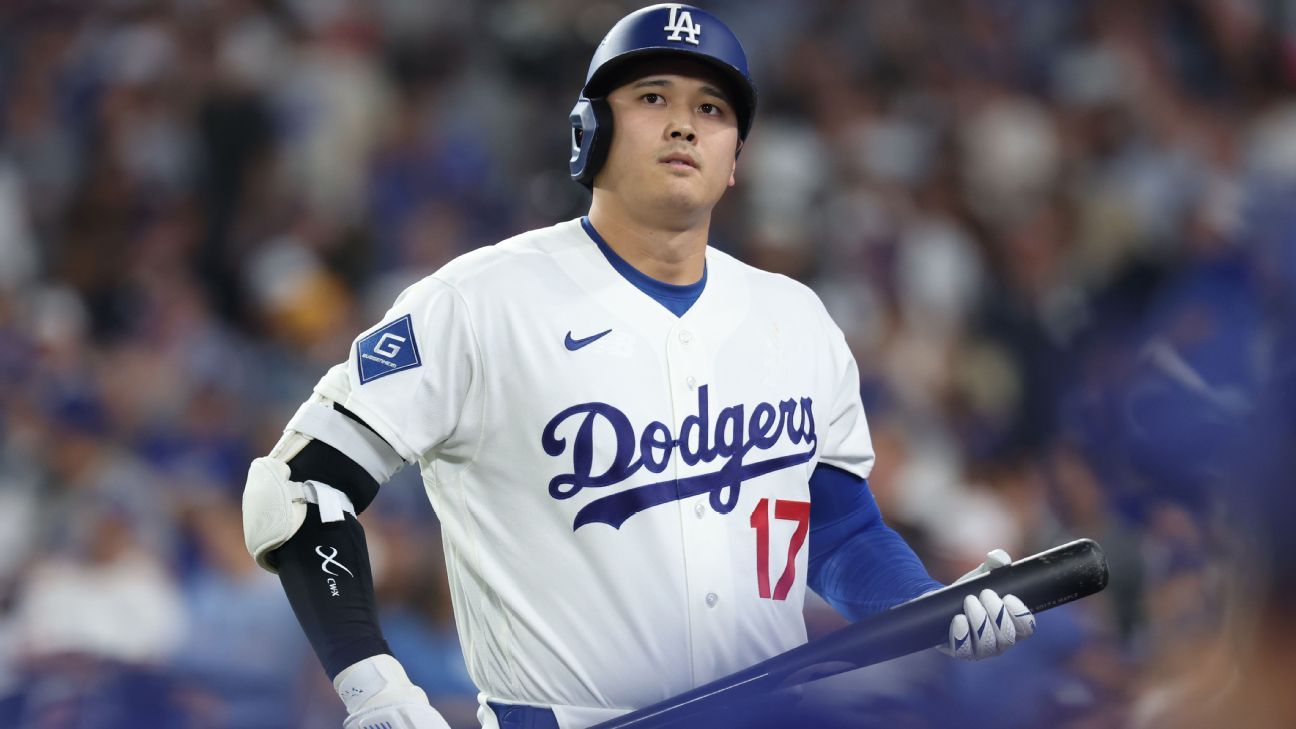
LOS ANGELES -- Shohei Ohtani will not require surgery to treat his left knee or right arm or any other ailment he dealt with throughout the second half of this past season, Dodgers president of baseball operations Andrew Friedman said Wednesday.
Doctors merely prescribed rest. The expectation is that his 2027 season will be unaffected. When Ohtani begins his preparations for it, he will train as a two-way player.
"I fully expect him to pitch next year," Friedman said during an end-of-season news conference from Dodger Stadium.
What that looks like, however, has yet to be determined.
"This is unprecedented, what he's doing," Friedman added. "So obviously for us it's unprecedented. We don't have any experience to draw from. We can't go look at how other situations have played out to try to learn from the good and the bad. We have to all just figure it out together. And I'm not only expecting him to pitch; we're excited about him pitching. So now it's about: How do we do that? How do we manage through a long season and have him at his best going into October? That's a challenge."
Ohtani was a diminished version of himself by the time October rolled around. He ended the regular season with 11 hits and 29 strikeouts over his last 70 at-bats and went 4-for-22 with no extra-base hits in his first seven postseason games. Ohtani finally broke through with a home run in Game 4 of the National League Championship Series, his first since Aug. 18, but it was too late for a Dodgers team that was ultimately swept by the Milwaukee Brewers.
Asked if the Dodgers could have managed Ohtani's two-way status differently to put him in a better spot for October, Friedman said: "I don't know the answer to that. It's one of those things that -- the injuries started in early July. Through mid-August, he was still I think the consensus MVP."
Ohtani went 8-2 with a 1.79 ERA in his first 14 starts, striking out 95 batters and issuing 26 walks in 85⅔ innings. But continual pain in his left knee and right bicep prevented him from pitching beyond July 3. As of Aug. 18, he was slashing .294/.390/.558 with 30 home runs and seven stolen bases. But physical discomforts started to bleed into his at-bats, ultimately throwing his mechanics out of whack. Ohtani was not placed on the injured list until after Labor Day, giving him only five regular-season games to get re-acclimated to major league pitching before the playoffs.
Speaking after the Dodgers' season-ending 6-4 loss on Oct. 15, Ohtani said he was "not quite satisfied with how things shaped up on the pitching side."
"I haven't been able to really come to grips with what I've learned overall this season," Ohtani added through an interpreter. "It's something that I'm going to go back to the drawing board in terms of treatment, training programs and see what I can come up with for next season."
Ohtani was attempting his first full-time two-way season in three years, and doing so at age 32 proved more difficult than at 29. Friedman acknowledged that Ohtani's offensive struggles "certainly had an impact" on the Dodgers' early exit. But the entire offense slumped, combining to post a .590 OPS in the postseason and go 4-for-27 with runners in scoring position in the NLCS.
Friedman announced there will be no changes to Dave Roberts' coaching staff and said it is "business as usual" with owner Mark Walter, who is under federal investigation over alleged multi-billion-dollar self-dealing.
"We talked to Mark after we lost," Friedman said, "and he was obviously really disappointed. But so much of his focus was on, 'OK, what can we do? What are our plans?'"
The Dodgers' brain trust hasn't necessarily figured that out just yet.
At the forefront of their minds will be the pending free agency of Tarik Skubal, the ace pitcher they acquired before the trade deadline, as well as several important relievers, most notably Alex Vesia and Evan Phillips. Along the way, Friedman and his group will try to figure out how to inject some youth into baseball's oldest position player group.
But nothing will be more important than their plan with Ohtani -- specifically how they handle his pitching so that he makes an impact on the mound without it affecting his offense.
The Dodgers could opt to start his season as a pitcher later, or work in more off days in between, or perhaps some combination of both. For this to work, several people within the organization believe, Ohtani will have to be more forthcoming with his ailments. One question the Dodgers haven't seemingly figured out is how much autonomy Ohtani will have over how this plays out.
One thing seems certain: Friedman, and perhaps the Dodgers as a whole, value his pitching enough to give it another try.
"I think we're just going to have to be very deliberate about it on all sides," Friedman said of the back-and-forth communication, "because the value of it is incredible, and therefore it's incumbent upon all of us to figure out the best way to do it."