
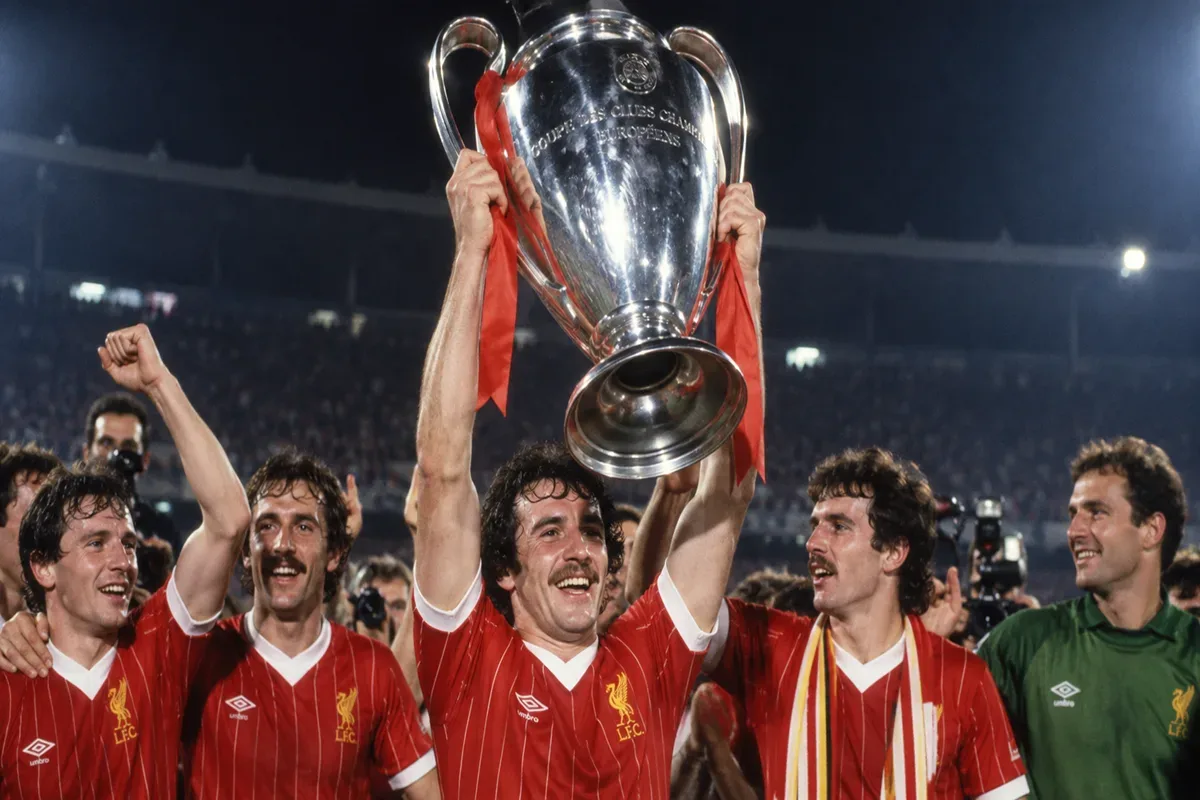
Between 1976 and 1984, Liverpool established themselves as the dominant force in English football and one of Europe’s most successful clubs. Four European Cups, seven First Division championships, four League Cups and a UEFA Cup demonstrated an extraordinary level of sustained success.
Their European Cup victories came in 1977, 1978, 1981 and 1984, with Bob Paisley overseeing the first three and Joe Fagan completing the fourth. Liverpool achieved these triumphs against different opponents, in different circumstances and with a squad that evolved throughout the period.
The achievement was not simply the number of trophies. Liverpool maintained their standards while replacing influential players, responding to domestic challengers and adapting to different European opponents.
At the centre of that success stood a management structure built around continuity, intelligent recruitment and collective responsibility.
By the time Liverpool defeated Roma in the 1984 European Cup final, they had become the first English club to win the competition four times.
How Liverpool built their European Dynasty
Liverpool’s rise began before their first European Cup victory.
Bill Shankly transformed the club after taking charge in 1959. He established a demanding football culture, rebuilt the playing squad and created the foundations for sustained domestic success.
Shankly guided Liverpool to First Division titles in 1964, 1966 and 1973. He also delivered the club’s first UEFA Cup in 1973.
When Shankly retired in July 1974, his successor inherited a successful organisation rather than a rebuilding project.
Bob Paisley had already spent years working within Liverpool’s coaching structure. He understood the players, the demands of the club and the principles behind their success.
His appointment ensured continuity, but Paisley did more than preserve Shankly’s achievements.
He refined the team’s tactical approach, strengthened the squad and developed a side capable of competing against Europe’s leading clubs.
Liverpool’s famous Boot Room played an important role. Coaches and senior staff exchanged ideas, assessed opponents and maintained consistent standards.
Joe Fagan, Ronnie Moran and other experienced figures contributed to an environment where the football operation remained stable despite changes in personnel.
That structure became one of Liverpool’s greatest strengths.
1976: The first major step towards European supremacy
Liverpool’s 1975–76 campaign provided the first clear evidence of Paisley’s ability to deliver major trophies.
The Reds won the First Division championship before adding the UEFA Cup.
Their European opponents in the final were Club Brugge, who pushed Liverpool through a demanding two-legged contest.
The Belgian side established a 2–0 lead at Anfield before Liverpool responded with three goals in five second-half minutes.
Ray Kennedy, Jimmy Case and Kevin Keegan scored to secure a 3–2 first-leg victory.
Brugge again took the lead in the return fixture, but Keegan equalised. The match ended 1–1, giving Liverpool a 4–3 aggregate victory.
The result demonstrated qualities that would become familiar throughout the following eight years.
Liverpool could control possession, absorb pressure and respond when opponents threatened their position.
Their domestic success also secured entry into the following season’s European Cup.
Paisley now had the opportunity to challenge for the most prestigious trophy in European club football.
1977: Liverpool win their first European Cup
Liverpool entered the 1976–77 European Cup as English champions.
Their route to the final included a memorable quarter-final against Saint-Étienne.
After losing 1–0 in France, Liverpool needed a comeback at Anfield.
Kevin Keegan opened the scoring, but Dominique Bathenay’s equaliser left the home side facing elimination.
Ray Kennedy restored Liverpool’s lead on the night before substitute David Fairclough scored in the 84th minute.
The 3–1 victory secured a 3–2 aggregate success.
Liverpool subsequently defeated Zürich in the semi-finals to reach their first European Cup final.
However, their pursuit of three major trophies suffered a setback when Manchester United defeated them 2–1 in the FA Cup final on 21 May.
Four days later, Liverpool faced Borussia Mönchengladbach at Rome’s Stadio Olimpico.
Terry McDermott opened the scoring in the first half. Allan Simonsen equalised after the interval, but Tommy Smith restored Liverpool’s advantage with a header.
Phil Neal then converted a penalty to complete a 3–1 victory.
Captain Emlyn Hughes lifted the European Cup as Liverpool became champions of Europe for the first time.
The victory also marked Kevin Keegan’s final appearance for the club before his transfer to Hamburg.
Liverpool had won the English championship and European Cup in the same season, establishing themselves among the continent’s leading teams.
Embed from Getty Images1978: Kenny Dalglish helps Liverpool retain their crown
Keegan’s departure presented Paisley with an important recruitment challenge.
Liverpool responded by signing Kenny Dalglish from Celtic in August 1977 for a British-record £440,000.
The Scottish international offered a different attacking profile.
Where Keegan combined relentless movement with aggressive forward play, Dalglish contributed outstanding close control, intelligent passing and exceptional awareness of space.
He could lead the attack or move deeper to connect midfield with the forwards.
His arrival strengthened Liverpool’s ability to retain possession and create chances through combination play.
The decision proved decisive during the 1978 European Cup final.
Liverpool faced Club Brugge at Wembley on 10 May, attempting to become the first English club to retain the trophy.
The match remained tight until Dalglish produced the defining moment.
He collected Graeme Souness’s pass and lifted the ball over goalkeeper Birger Jensen.
Liverpool won 1–0 and secured their second successive European Cup.
The result confirmed that the 1977 triumph was not an isolated achievement.
Paisley had replaced a major attacking player without weakening the team’s European competitiveness.
Liverpool also won the 1977 UEFA Super Cup, defeating Keegan’s Hamburg 7–1 on aggregate.
Nevertheless, domestic competition remained fierce.
Nottingham Forest challenge Liverpool’s dominance
Liverpool’s European successes did not make them unbeatable.
Brian Clough’s Nottingham Forest emerged as their strongest domestic challengers during the late 1970s.
Forest won the 1977–78 First Division championship, finishing ahead of Liverpool despite having only recently returned to the top flight.
They also defeated Liverpool in the League Cup final after a replay.
The rivalry extended into Europe.
In September 1978, Forest eliminated the defending European champions in the first round.
They won 2–0 at the City Ground before securing a goalless draw at Anfield.
Forest went on to win the European Cup in 1979 and retained it in 1980.
Their success, explored in World in Sport’s Nottingham Forest history feature, demonstrates the strength of English club football during this period.
Liverpool responded by strengthening their domestic position.
The 1978–79 season produced one of the most impressive league campaigns in English football history.
Paisley’s side won 30 of their 42 matches, drawing eight and losing only four.
They scored 85 goals and conceded just 16.
Their 68 points established a First Division record under the two-points-for-a-win system.
Goalkeeper Ray Clemence recorded 28 league clean sheets as Liverpool finished eight points ahead of Forest.
The defensive record reflected more than the goalkeeper’s performances. Liverpool controlled matches through possession, organisation and disciplined positioning.
They retained the championship in 1979–80, finishing two points ahead of Manchester United.
Although their European Cup campaigns ended early in both seasons, Liverpool remained the benchmark domestically.
1981: Alan Kennedy delivers a third European Cup
Liverpool’s 1980–81 season illustrated the difference between league consistency and knockout success.
The Reds finished fifth in the First Division, their lowest league position under Paisley.
Aston Villa claimed the championship, while Liverpool concentrated on their remaining opportunities.
They won their first League Cup after defeating West Ham United 2–1 in a replay at Villa Park.
Their European Cup campaign proved even more significant.
Liverpool overcame Aberdeen and CSKA Sofia before facing Bayern Munich in the semi-finals.
A goalless first leg at Anfield left the tie finely balanced.
In Munich, Liverpool lost Dalglish to an early injury. Young substitute Howard Gayle unsettled Bayern’s defence with his pace before Paisley eventually replaced him with Jimmy Case.
Ray Kennedy scored late in the second half.
Although Karl-Heinz Rummenigge equalised, Liverpool progressed on the away-goals rule.
Real Madrid awaited them in the final at the Parc des Princes on 27 May 1981.
The Spanish club possessed an exceptional European history, but Liverpool remained composed in a closely contested match.
With nine minutes remaining, left-back Alan Kennedy advanced into the penalty area and struck the decisive goal.
Liverpool defended their advantage to secure a 1–0 victory.
Paisley became the first manager to win three European Cups.
The victory also reinforced the significance of Liverpool’s tactical discipline.
They did not always need to dominate matches through attacking football. Their defensive organisation, patience and ability to recognise decisive moments made them formidable knockout opponents.
Embed from Getty ImagesThe players who defined Liverpool’s greatest era
Liverpool’s success depended on exceptional individuals operating within a carefully organised team.
Ray Clemence provided security in goal during the earlier European triumphs. His positioning, handling and consistency contributed significantly to the club’s defensive strength.
Phil Neal became one of the team’s most dependable players. The right-back combined defensive responsibility with attacking support and appeared in all four European Cup-winning sides.
Alan Hansen developed into a central figure in Liverpool’s defence after arriving from Partick Thistle in 1977.
His composure and passing ability allowed the team to build attacks from deeper positions rather than relying exclusively on long clearances.
Graeme Souness brought authority to midfield.
The Scottish international combined physical strength, technical ability and competitive intensity. He could dictate possession, challenge opponents and deliver forward passes.
Terry McDermott offered attacking movement and goals from midfield, while Ray Kennedy supplied balance and intelligence on the left.
Ronnie Whelan, Sammy Lee and Craig Johnston became increasingly important as Paisley refreshed the squad.
Dalglish remained the outstanding creative influence.
His movement between midfield and attack frequently disrupted defensive organisation. He could receive passes under pressure, hold possession and release teammates into dangerous areas.
The emergence of Ian Rush added another dimension.
Liverpool signed the Welsh striker from Chester in 1980, but his development into a regular goalscorer accelerated during the following seasons.
Rush combined intelligent movement with clinical finishing.
His partnership with Dalglish became central to Liverpool’s attacking effectiveness.
Rather than operating as two conventional centre-forwards, the pair complemented each other. Dalglish created space and supplied passes, while Rush attacked gaps behind defenders.
By 1983–84, Rush had become one of Europe’s most productive forwards.
He scored 47 goals in all competitions that season, including 32 in the First Division.
Liverpool had successfully moved from the Keegan era to a side built around Dalglish and Rush without sacrificing their collective identity.
Why Liverpool’s tactical approach worked
Liverpool’s European dynasty rested on a straightforward principle: the team mattered more than individual reputation.
Their football combined controlled possession with disciplined defending and quick attacking movement.
They did not depend entirely on direct play, despite competing in an English football environment where physical challenges and long passing remained common.
Instead, Liverpool frequently moved the ball through midfield, used supporting runners and waited for opponents to lose their defensive shape.
Souness could control the tempo from central positions. Dalglish regularly moved towards the ball, creating space for teammates.
Full-backs provided support, but the team remained conscious of defensive balance.
The approach also allowed Liverpool to adapt to different opponents.
Against weaker sides, they could establish territorial control and sustain attacking pressure.
Against leading European teams, they were comfortable defending for extended periods before exploiting opportunities.
Their European Cup final victories illustrated that adaptability.
Liverpool scored three against Borussia Mönchengladbach in 1977 but needed only one goal against Club Brugge in 1978 and Real Madrid in 1981.
Their ability to protect narrow leads became particularly important in knockout football.
Paisley’s management also encouraged responsibility throughout the squad.
Players understood their tactical roles and rarely needed dramatic changes to the team’s structure.
The system made it easier to introduce new signings without disrupting established partnerships.
Liverpool’s greatest advantage was not one tactical innovation. It was their ability to combine several effective principles and maintain them over successive seasons.
Liverpool’s domestic control between 1981 and 1983
Liverpool’s return to domestic supremacy followed a difficult opening to the 1981–82 campaign.
They stood 12th in the First Division after the Boxing Day fixtures.
However, a remarkable improvement saw them win 20 of their remaining 25 league matches.
They eventually finished four points ahead of Ipswich Town to reclaim the championship.
Liverpool also retained the League Cup, defeating Tottenham Hotspur 3–1 after extra time.
The following season brought another league and League Cup double.
Liverpool finished champions in 1982–83 and defeated Manchester United 2–1 after extra time in the League Cup final.
That success gave Paisley six First Division championships, three European Cups, three League Cups and a UEFA Cup during his managerial career.
According to Liverpool’s official league honours record, his six championship-winning seasons were 1975–76, 1976–77, 1978–79, 1979–80, 1981–82 and 1982–83.
Paisley retired from management in 1983.
Once again, Liverpool selected a successor from within their established coaching structure.
Joe Fagan inherited a squad that had experienced extraordinary success but still faced the challenge of maintaining it.
1984: Joe Fagan completes a historic treble
Fagan’s first season produced one of the most successful campaigns in Liverpool’s history.
The Reds won the First Division championship for the third consecutive season.
They also reached the League Cup final against Everton, creating the first all-Merseyside final in the competition.
The opening match at Wembley ended goalless after extra time.
Three days later, the teams met again at Maine Road.
Graeme Souness scored in the 21st minute, giving Liverpool a 1–0 victory and their fourth successive League Cup.
Their European campaign continued alongside domestic success.
Liverpool defeated Odense, Athletic Bilbao, Benfica and Dinamo București to reach the European Cup final.
Roma provided the opposition, with the match taking place at their own Stadio Olimpico.
The Italian side possessed considerable quality, including Brazil internationals Falcão and Toninho Cerezo.
They also enjoyed the advantage of playing the final in familiar surroundings.
Liverpool nevertheless approached the match with confidence and experience.
Phil Neal opened the scoring before Roberto Pruzzo equalised shortly before half-time.
Neither side found a winner during the remainder of normal time or extra time.
The European Cup would be decided by a penalty shootout.
Grobbelaar and Kennedy secure Liverpool’s fourth European crown
Bruce Grobbelaar became one of the central figures in the 1984 final.
The Liverpool goalkeeper attempted to distract Roma’s penalty takers with exaggerated movements and his famous ‘spaghetti legs’ routine.
Roma’s Bruno Conti and Francesco Graziani both failed to convert their penalties.
Liverpool also missed their opening effort through Steve Nicol, but Phil Neal, Graeme Souness and Ian Rush scored.
Alan Kennedy then stepped forward.
Three years earlier, Kennedy had scored the winning goal against Real Madrid.
This time, he converted the decisive penalty to secure a 4–2 shootout victory.
Liverpool had won their fourth European Cup.
The achievement completed a treble of the First Division championship, League Cup and European Cup.
Fagan had delivered three major trophies in his first season as manager.
Liverpool’s fourth European Cup victory was particularly significant because it demonstrated that their success could continue beyond Paisley’s departure.
The foundations established by Shankly and developed under Paisley remained effective under new leadership.
Embed from Getty ImagesLiverpool’s four European Cup final victories
Liverpool’s official European Cup history confirms the four victories that defined this period.
| Year | Opponent | Result | Venue |
|---|---|---|---|
| 1977 | Borussia Mönchengladbach | 3–1 | Stadio Olimpico, Rome |
| 1978 | Club Brugge | 1–0 | Wembley, London |
| 1981 | Real Madrid | 1–0 | Parc des Princes, Paris |
| 1984 | Roma | 1–1 (4–2 on penalties) | Stadio Olimpico, Rome |
Three of those victories came under Paisley, while Fagan managed the fourth.
Liverpool also secured seven league titles between 1976 and 1984, reinforcing their position as England’s leading club during the period.
How Liverpool’s European Dynasty changed English football
Liverpool’s success formed part of a remarkable period for English clubs in European competition.
Between 1977 and 1982, English teams won the European Cup six consecutive times.
Liverpool secured three of those titles, Nottingham Forest won twice, and Aston Villa triumphed in 1982.
However, Liverpool distinguished themselves through the duration of their success.
They remained competitive across successive generations of players and continued winning major trophies following management changes.
The contrast with other great European teams helps explain their historical standing.
Ajax dominated the early 1970s with an approach closely associated with Total Football. Real Madrid established the competition’s original benchmark through five successive European Cups between 1956 and 1960.
Later, Arrigo Sacchi’s AC Milan would become influential through their coordinated pressing and defensive organisation, as examined in World in Sport’s AC Milan 1988–1990 analysis.
Liverpool’s defining characteristic was different.
They built a winning structure that survived major departures and evolved without losing its identity.
Keegan left, but Dalglish arrived.
Clemence departed, and Grobbelaar became Liverpool’s first-choice goalkeeper.
The emergence of Rush strengthened an already successful attack.
Paisley retired, yet Fagan maintained the standard.
These transitions demonstrate why Liverpool’s achievements cannot be explained solely through individual brilliance.
The club had developed a culture in which recruitment, coaching and tactical understanding reinforced each other.
Their achievements also came in a demanding competitive environment. English clubs faced powerful domestic rivals, while European Cup qualification and knockout ties offered little margin for error.
Liverpool’s reign was not free from disappointment. They lost important domestic finals, endured early European exits and failed to win the FA Cup throughout Paisley’s managerial tenure.
Those setbacks provide essential context.
Their achievement was not uninterrupted dominance in every competition. It was the ability to recover, adapt and continue competing for the biggest trophies.
By the summer of 1984, Liverpool had firmly established themselves among Europe’s most successful clubs.
Four European Cups in eight seasons represented an extraordinary return, but their wider legacy rested on how they achieved it.
Liverpool combined outstanding players with disciplined coaching, careful recruitment and an institutional commitment to continuity.
Their fourth European Cup, won against Roma in their own stadium, provided the defining conclusion to a period that had transformed the club’s standing in European football.
The images of Alan Kennedy converting the decisive penalty and Liverpool celebrating in Rome captured the final major achievement of this particular era.
Behind that moment stood nearly a decade of consistently successful football, developed under two managers and sustained by one of the most accomplished squads English football has produced.

World In Sport Forum
Continue the discussion
Join other fans in the World In Sport Forum and debate the biggest talking points from this article.